How to Test Facebook Ad Creatives (2026 Guide)
To test Facebook ad creatives, run an ABO campaign with 3 to 5 ad sets that each hold one distinct creative and identical copy, fund each with $50 to $100 per day, and let it run at least 7 days to statistical significance. Use Ad Set Budget Optimization for fair comparison, not Advantage+, which rotates creative algorithmically rather than testing it. The goal is a clean read on which creative wins and why.
Facebook rewards the brands that test creative fastest and cleanest. This guide covers the three ways to test on Meta, the exact ABO setup, how dynamic creative fits, and the decision rules that stop you from scaling a false winner. It applies the general ad creative testing framework to Facebook specifically.
How do you A/B test Facebook Ads?
You A/B test Facebook Ads by showing different creative variations to comparable audiences and measuring which performs better on your primary metric, while holding everything else constant. The core rule is isolation: change one variable, usually the visual or the hook, and keep audience, budget, copy, and placement identical so the result is attributable to the creative.
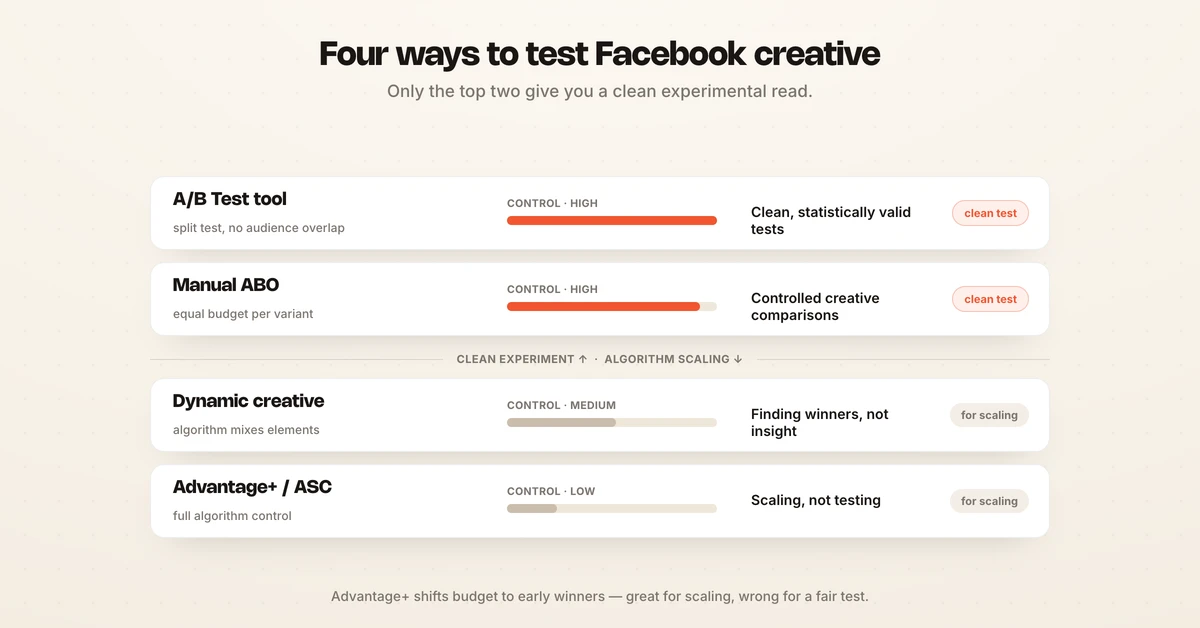
Meta gives you three ways to do this, and they are not equal. The built-in A/B Test tool (split testing) divides your audience into non-overlapping groups for a statistically clean comparison. Manual ABO testing gives you hands-on control over budget per variant. Dynamic creative and Advantage+ let the algorithm mix and rotate, which optimizes but does not produce clean experimental data.
| Method | Control | Best for |
|---|---|---|
| A/B Test tool (split test) | High, no audience overlap | Clean, statistically valid tests |
| Manual ABO | High, equal budget per variant | Controlled creative comparisons |
| Dynamic creative | Medium, algorithm mixes elements | Finding winners, not insights |
| Advantage+ / ASC | Low, full algorithm control | Scaling, not testing |
The ABO creative testing setup
Ad Set Budget Optimization is the cleanest structure for manual creative testing, because it lets you assign equal budget to each variant. Campaign Budget Optimization skews spend toward whichever ad set gets an early lead, which starves the other variants of data before they have a fair chance, so it corrupts a test even when it optimizes a live campaign well.
Build the test like this:
- One ABO campaign with 3 to 5 ad sets, each set an equal daily budget.
- One distinct creative per ad set, with copy and headline held identical so only the visual differs.
- The same audience and placements across all ad sets to keep the comparison fair.
- $50 to $100 per variant per day, enough to gather signal and clear the learning phase.
Always test new creatives against other new creatives, never against a proven winner, because an established ad has data and social proof a fresh one has not built yet, per Motion. Testing new against new tells you which concept is strongest before you promote it. For campaign mechanics, see how to run Facebook Ads.
Prioritize what you test the way you would on any platform: the hook and the concept move performance most, so test those before format, and format before visual details or copy. A striking new visual on a weak angle still loses, so spend your test budget where the impact is highest. Diagnose stalls in a live account with Facebook Ads optimization.
What is Facebook dynamic creative?
Facebook dynamic creative is a format where you upload multiple assets (images, videos, headlines, and copy) and Meta's algorithm automatically mixes them into combinations, then serves the ones it predicts will perform. It is efficient at finding a winning combination without you building every permutation by hand.
The tradeoff is insight. Dynamic creative tells you which combination won but not always why, because the algorithm controls the mixing and distribution, so you get performance without a clean lesson. It also spreads spend unevenly across combinations, which makes it unreliable as a controlled experiment.
Use dynamic creative to find performance quickly when you have a moderate set of assets, then run structured ABO or split tests when you need to understand which specific element drives the result. The two work together: dynamic creative for speed, controlled tests for learning. See the dynamic creative optimization glossary entry for more.
Why Advantage+ is not creative testing
Running creative inside Advantage+ Shopping Campaigns or with Advantage+ Creative enabled is not testing, and treating it as such leads to wrong conclusions. These are algorithm-driven rotation and optimization tools built to find and scale winners dynamically, not to produce controlled experimental data. For tools built for controlled tests, the creative testing tools roundup compares the options by job and price.
The distinction matters because Advantage+ deliberately does not give every creative equal exposure; it shifts budget toward early winners, which is exactly what you want for scaling and exactly what ruins a test. If you need to know which creative is genuinely best and why, use a split test or ABO. If you just want the algorithm to run your best creative hard, use Advantage+. For scaling proven creative, see how to scale Facebook Ads.
Your weekly testing workflow
Creative testing on Facebook works best as a steady weekly rhythm, not an occasional project. A simple operational cadence keeps a constant flow of new creative moving through the funnel and proven winners moving to scale.
- Launch on Monday: start the week's test with 2 to 5 fresh variants in an ABO campaign.
- Let it run: give the test its full 7 to 14 days without touching it, so the learning phase and day-of-week swings even out.
- Decide at threshold: call winners only when the spend and conversion thresholds are met, not on a hunch.
- Maintain a backlog: keep 3 to 5 new creatives ready at all times so you never stall between tests.
The backlog is the part teams skip, and it is what breaks the rhythm. Without a steady supply of fresh creative, testing stalls and winners fatigue with nothing to replace them. Hawky's Creative Agent generates on-brand variations from your winners to keep that backlog full, and Creative Analysis reads each test at the element level so you learn why a creative won, not just that it did.
When to call a Facebook ad test a winner
Declare a winner only when three conditions are all met, or you are scaling noise. Confidence must be 95% or higher, statistical power at setup should be at least 80%, and the test must have run a minimum of seven full days. If any one is missing, treat the result as directional, not final, per AdManage.
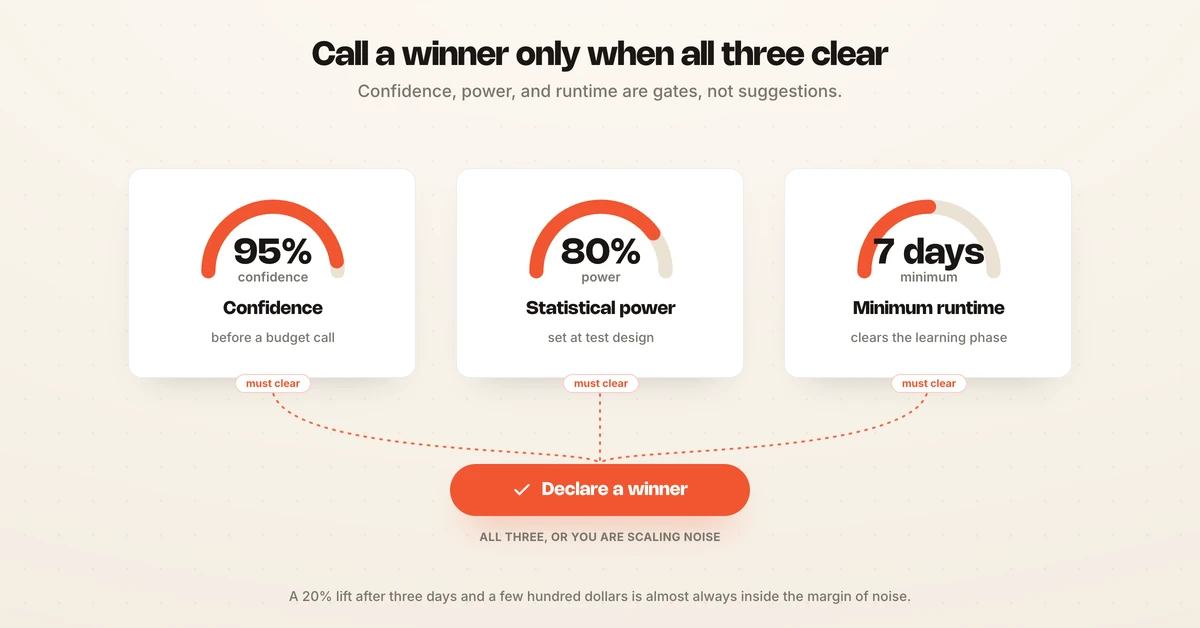
The most expensive mistake is impatience. An ad that looks 20% better after three days and a few hundred dollars is almost always inside the margin of noise, and scaling it wastes budget on a result that regresses. Wait for the thresholds, then act decisively. For the metrics to judge against, see how to measure ad creative performance, and watch winners for ad fatigue once they scale.
Frequently asked questions
How do you A/B test Facebook Ads?
Run an ABO campaign with 3 to 5 ad sets, each holding one distinct creative and identical copy, audience, and placements, so only the visual differs. Fund each ad set equally at $50 to $100 per day and let the test run at least 7 days to statistical significance. Alternatively, use Meta's built-in A/B Test tool, which splits your audience into non-overlapping groups for a statistically clean comparison.
What is Facebook dynamic creative?
Facebook dynamic creative is a format where you upload multiple images, videos, headlines, and copy, and Meta automatically mixes them into combinations and serves the best performers. It is efficient at finding a winning combination without building every version by hand. The tradeoff is that it shows you which combination won but not always why, so it finds performance rather than clean insight.
How long should I run a Facebook ad test?
Run a Facebook ad test at least 7 days, and ideally 7 to 14, to clear the learning phase and average out day-of-week performance swings. Continue until you reach 95% confidence and enough conversions for statistical validity, generally around 100 per variant. Calling a winner after three days almost always measures random noise rather than a real difference.
Should I use ABO or CBO for creative testing?
Use ABO (Ad Set Budget Optimization) for creative testing, because it lets you assign equal budget to each variant for a fair comparison. CBO (Campaign Budget Optimization) skews spend toward whichever ad set gets an early lead, starving other variants of data before they can prove themselves. CBO is good for scaling a proven set of creatives, not for testing new ones.
Is Advantage+ good for creative testing?
No. Advantage+ Shopping and Advantage+ Creative are optimization tools that rotate and scale creative algorithmically, not controlled testing tools. They intentionally give unequal exposure to find and push winners, which corrupts a clean experiment. Use Advantage+ to scale creative you already trust, and use ABO or the A/B Test tool when you need to know which creative is genuinely best.
If keeping a full creative backlog and a clean weekly Facebook testing rhythm is capped by production, Hawky's Creative Agent and Creative Analysis are built for that job.
Ready to hire your first AI performance team? Book Demo