Customer Journey
Last updated
The complete path a person travels from first discovering your brand to becoming a customer and beyond, across every touchpoint and channel. Mapping it is what lets you fund the interactions that create momentum instead of only the last click.
Customer Journey
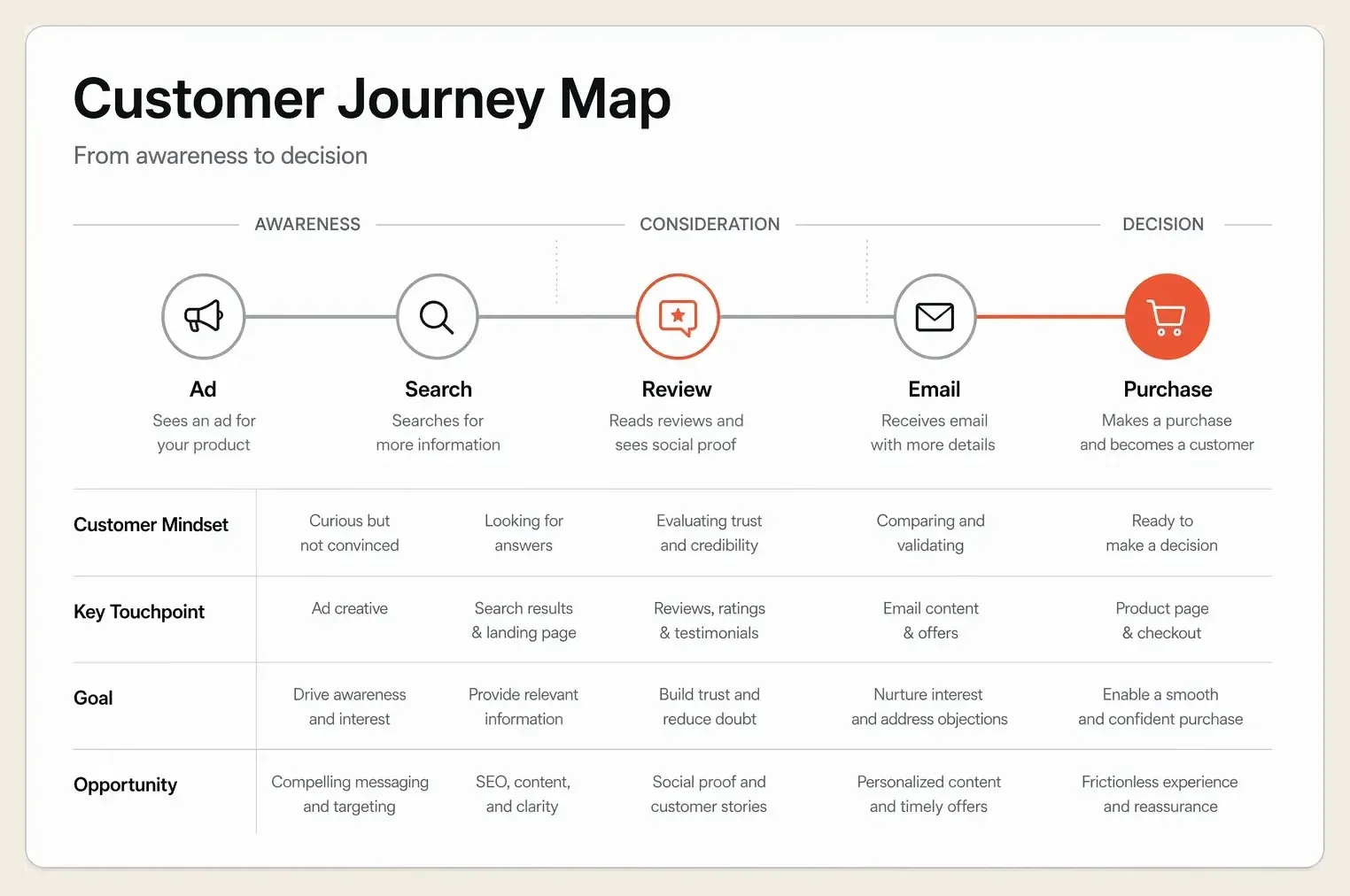
The Customer Journey is the complete path a person travels from first discovering your brand to becoming a customer and beyond, across every touchpoint and channel along the way. It captures the real sequence of interactions, an ad seen on Instagram, a search later that week, a review read, an email opened, a retargeting ad, and finally a purchase, rather than crediting any single click. Understanding the journey matters because customers rarely convert on first contact, and mapping the full path is what lets you spend on the touchpoints that actually move people forward instead of the last one that happened to be there.
Why It Matters
The customer journey matters because almost no one buys on the first touch, and pretending they do distorts every spending decision. Research on buying behavior consistently shows that customers engage with multiple touchpoints, often six to eight or more, before converting, and the brands that map this path see materially stronger retention and revenue than those optimizing a single step. When you can see the whole journey, you fund the interactions that create momentum rather than only the one that closes.
The hidden cost of ignoring the journey is misattributed budget. Last-click measurement hands all the credit to the final retargeting ad and none to the awareness video that started everything, so you cut the very touchpoint that fed the conversion. Pairing journey thinking with the right attribution model stops you from defunding the top of the path just because it does not get the last click.
How It Works
The customer journey is usually understood as a progression through stages of intent, mapped to the touchpoints and channels a prospect uses at each step. It overlaps with the marketing funnel but adds the messy reality of real behavior: people loop back, skip steps, and cross channels.
- Awareness: the prospect first encounters the brand, often through a top-of-funnel ad or social content. This maps to the awareness stage of the funnel stages.
- Consideration: they research, compare, read reviews, and weigh options, moving from cold traffic toward warm traffic.
- Decision: intent peaks and the prospect is ready to act, the moment retargeting and clear offers do their work.
- Retention and advocacy: after purchase, the journey continues into repeat buying, loyalty, and referral.
The point of mapping it is to match the right message to the right moment. Real journeys are nonlinear, so the skill is recognizing where a given prospect actually is and meeting them there, not assuming everyone marches through the stages in order.
A Real Example
A skincare brand assumed its journey was simple: see an ad, click, buy. Mapping real customer paths told a different story. The typical buyer saw a TOFU video, searched the brand a few days later, read reviews, ignored two retargeting ads, opened a discount email, and only then purchased, an average of seven touchpoints over eleven days. Last-click attribution had been crediting the email alone and starving the video that started the path.
Acting on the real journey, the brand kept the awareness video funded, added a mid-journey proof sequence to answer the research step, and timed its retargeting to the decision window. Conversion rate rose 31 percent and blended ROAS climbed from 3.2x to 4.6x within a quarter, because spending finally matched how customers actually moved rather than how the last click made it look.
Common Mistakes
| ❌ Mistakes | ✅ Better Approach |
|---|---|
| Assume customers convert on first contact | Map the real multi-touch path and fund the touchpoints that create momentum |
| Credit only the last click and defund earlier stages | Use a fuller attribution model so awareness and consideration get their due |
| Treat the journey as a straight line everyone follows | Recognize that real journeys loop and cross channels, and meet prospects where they are |
How Hawky Helps
Hawky runs the customer journey as a connected system rather than a set of disconnected campaigns. The Performance Agent allocates budget across the whole path, keeping awareness funded while timing decision-stage spend to where prospects actually convert, so no single touchpoint is starved because it does not get the last click. The journey is managed end to end instead of one step at a time.
FeatherDB is the living memory that makes this possible, holding how customers have moved through touchpoints over time so the account learns the real path and where it breaks. The Creative Agent then builds the right message for each stage, awareness hooks at the start and proof or offer-led creative near the decision, so every step of the journey is served by creative built for that moment.
Frequently Asked Questions
What is the customer journey?
The customer journey is the full path a person takes from first discovering a brand to purchasing and beyond, across every touchpoint and channel. It includes awareness, consideration, decision, and post-purchase retention, capturing the real sequence of ads, searches, reviews, and emails a customer interacts with. Mapping it reveals how people actually buy rather than crediting a single final click.
What are the stages of the customer journey?
The customer journey is commonly mapped into awareness, consideration, decision, and retention or advocacy. Awareness is first contact, consideration is research and comparison, decision is the moment of purchase intent, and retention covers repeat buying and referral. These stages overlap with marketing funnel stages but add the nonlinear reality that real customers loop back and cross channels.
How is the customer journey different from the marketing funnel?
The marketing funnel is a simplified model of stages from awareness to conversion, usually drawn as a straight progression. The customer journey describes the actual, often messy path a real person takes, including loops, channel switches, and post-purchase behavior. The funnel is the planning framework, while the journey is the behavioral reality you map to spend against accurately.
How many touchpoints does a customer journey have?
It varies by product and price, but research commonly finds customers engage with six to eight or more touchpoints before converting, and considered or expensive purchases often take many more. The exact number matters less than the recognition that conversion is rarely first-touch. Mapping the real count for your own customers is what stops last-click measurement from defunding early touchpoints.
Quick Takeaway
The customer journey is the real multi-touch path from first discovery to purchase and loyalty, and because customers almost never convert on first contact, mapping it is what lets you fund the touchpoints that create momentum instead of only the last click.
Orchestrating spend and creative across an entire nonlinear journey is exactly the always-on coordination agents handle better than a stack of siloed campaigns. Ready to hire your first AI performance team? Book Demo