Funnel Stages (TOFU/MOFU/BOFU)
Last updated
The phases a prospect moves through on the way to buying, split into top (awareness), middle (consideration), and bottom (conversion) of funnel. Matching message, creative, and metric to each stage is what keeps a budget compounding instead of leaking.
Funnel Stages (TOFU/MOFU/BOFU)
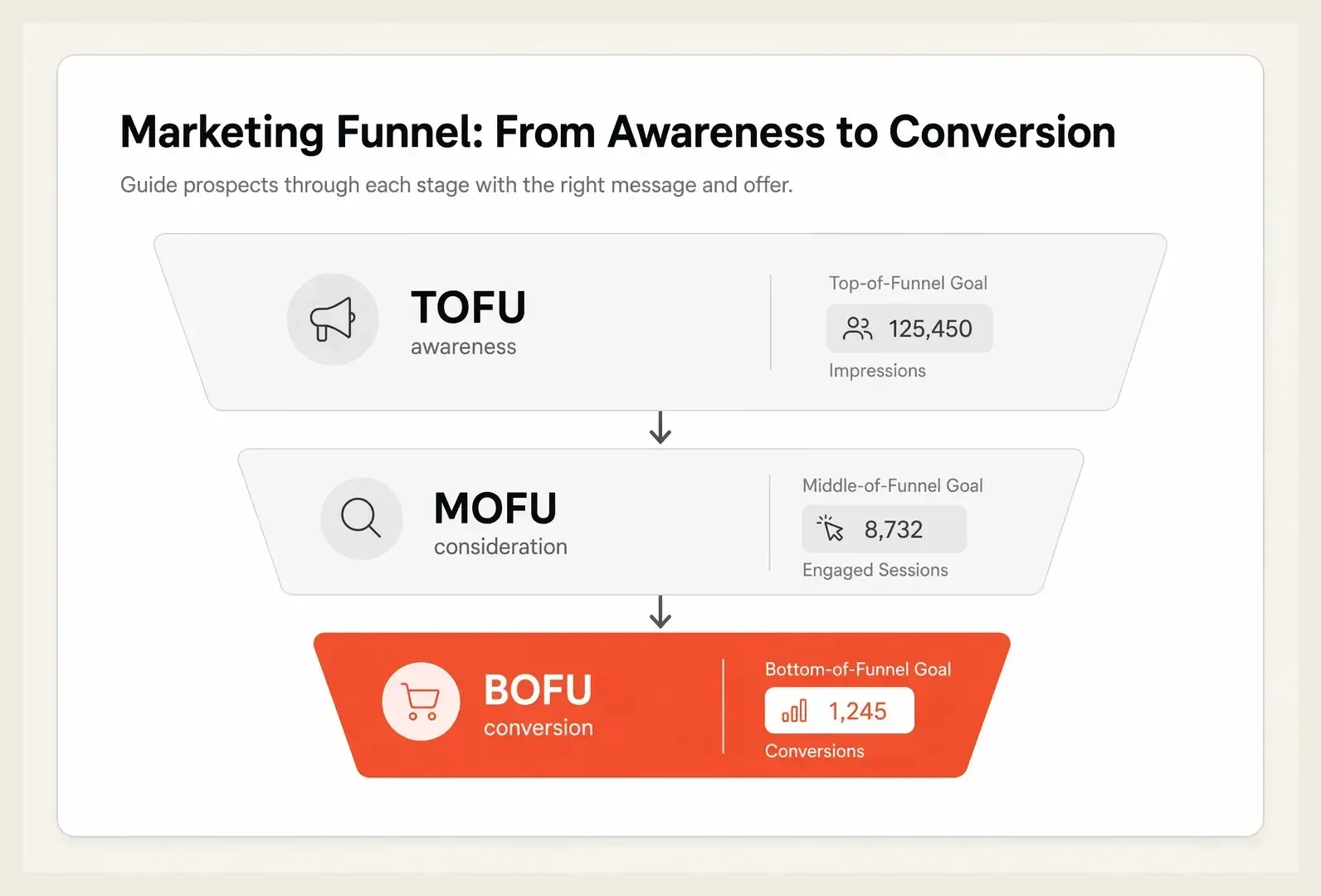
Funnel Stages are the phases a prospect moves through on the way to becoming a customer, commonly split into top of funnel (TOFU), middle of funnel (MOFU), and bottom of funnel (BOFU). TOFU is awareness, where strangers first discover your brand. MOFU is consideration, where interested people weigh their options. BOFU is conversion, where ready buyers decide and purchase. Mapping campaigns to these stages matters because the message, creative, and metric that work at one stage fail at another, and treating all traffic the same wastes budget on people who are not ready to act.
Why It Matters
Funnel stages matter because the wrong message at the wrong stage burns money. Asking a cold stranger to buy now converts poorly, while showing a ready buyer another awareness video wastes an impression that could have closed a sale. Marketers who align campaigns to funnel stages report markedly stronger efficiency, and segmented, stage-aware nurture is associated with roughly 20 percent more sales opportunities than treating every prospect identically.
The cost of ignoring stages is hidden in blended numbers. A campaign can look mediocre on average while its TOFU and BOFU halves perform very differently, and pushing them together means underfunding what works and overfunding what does not. Matching spend and creative to where prospects actually are, from cold traffic at the top to hot traffic at the bottom, is what makes a budget compound instead of leak.
How It Works
Each funnel stage has its own job, message, and success metric, and campaigns work best when they are built for one stage at a time rather than asked to do everything at once.
- TOFU (awareness): reach new cold traffic with broad, attention-first creative. Success is measured in reach, CPM, and engagement, not immediate sales.
- MOFU (consideration): nurture warm traffic who know you, using proof, comparison, and education. Success is measured in clicks, leads, and add-to-carts.
- BOFU (conversion): convert ready buyers with offers, urgency, and retargeting. Success is measured in conversions, CPA, and ROAS.
The stages are not rigid steps so much as states of readiness. A healthy account runs all three at once, feeding the top so the middle and bottom never run dry, and judges each stage by the metric that fits it rather than forcing one KPI across the whole funnel.
A Real Example
A furniture brand judged every campaign on ROAS and kept cutting its top-of-funnel ads because they returned only 0.8x on the click. Within two months its bottom-of-funnel retargeting, once a 6x performer, slid to 3x. The reason was simple: it had stopped filling the top, so the warm and hot audiences the bottom relied on were drying up.
The team rebuilt around funnel stages, funding TOFU on reach and CPM, MOFU on lead and add-to-cart rate, and BOFU on ROAS. They accepted the top would not return immediately and measured it on its real job, feeding the funnel. Within 90 days blended ROAS recovered to 4.5x and total revenue grew 38 percent, because the bottom of the funnel finally had a full top above it.
Common Mistakes
| ❌ Mistakes | ✅ Better Approach |
|---|---|
| Judge every funnel stage by the same KPI like ROAS | Measure each stage by its own metric, reach for TOFU, leads for MOFU, ROAS for BOFU |
| Cut top of funnel because it does not convert directly | Fund TOFU on its real job of feeding the warm and hot audiences below it |
| Show the same creative and offer to cold and ready buyers alike | Match message to readiness, from cold traffic to hot traffic |
How Hawky Helps
Hawky runs the full funnel with agents that allocate to each stage on purpose. The Performance Agent sets and adjusts budget across TOFU, MOFU, and BOFU against the metric that fits each stage, so the top stays funded on reach while the bottom is judged on ROAS, and money flows to where the funnel is actually starving. Instead of one blunt KPI flattening the whole account, each stage is managed on its own terms.
The Creative Agent builds stage-appropriate creative, attention-first hooks for the top and proof or offer-led messages for the bottom, while FeatherDB remembers how prospects have historically moved between stages so the account learns where the funnel leaks and reinforces it.
Frequently Asked Questions
What are the stages of a marketing funnel?
The marketing funnel is commonly split into three stages: top of funnel (TOFU) for awareness, middle of funnel (MOFU) for consideration, and bottom of funnel (BOFU) for conversion. TOFU introduces your brand to strangers, MOFU nurtures interested prospects with proof and comparison, and BOFU converts ready buyers with offers and retargeting. Each stage needs its own message and success metric.
What is the difference between TOFU, MOFU, and BOFU?
TOFU targets cold, unaware audiences with broad awareness creative measured on reach and engagement. MOFU targets warm prospects who know you, using education and proof measured on clicks and leads. BOFU targets hot, ready buyers with offers and urgency measured on conversions, CPA, and ROAS. The distinction is the prospect's readiness to buy and the metric that fits it.
How do you measure each funnel stage?
Measure each stage by the metric that matches its job rather than one blanket KPI. TOFU is measured on reach, CPM, and engagement, MOFU on clicks, leads, and add-to-carts, and BOFU on conversions, CPA, and ROAS. Forcing ROAS onto the top of the funnel makes awareness look like a failure when its real role is feeding the stages below.
Why should you not judge top of funnel by ROAS?
Top-of-funnel campaigns introduce your brand to people who are not ready to buy, so they rarely return strong ROAS on the first click. Their real job is to feed the warm and hot audiences that bottom-of-funnel campaigns convert profitably. Cutting TOFU for low ROAS starves the funnel, and bottom-of-funnel performance declines a few weeks later as those audiences dry up.
Quick Takeaway
Funnel stages, TOFU for awareness, MOFU for consideration, and BOFU for conversion, each need their own message and metric, and the accounts that grow fund the whole funnel instead of judging every stage by the same number.
Balancing budget and creative across all three stages at once is exactly the kind of always-on allocation agents handle better than a manual weekly review. Ready to hire your first AI performance team? Book Demo