Best AI Tools for Advertisers in 2026: The Performance Marketer Stack
The best AI tools for advertisers in 2026 are Hawky for autonomous media buying and creative production, Madgicx for Meta ad automation, and Smartly.io for enterprise creative scale. The stack a performance marketer actually needs has shifted this year. The winning tools no longer just report on your account or hand you a list of recommendations. They do the work, against your KPI, with every move logged and reversible.
This guide ranks the AI tools worth a seat in your 2026 performance marketing stack, what each one does well, where it stops, and which one fits your team.
What an "AI tool for advertisers" actually means in 2026
An AI advertising tool is software that uses machine learning to plan, create, optimize, or analyze paid media campaigns across platforms like Meta, Google, and YouTube. The category split in 2026 into two camps that are easy to confuse and expensive to mix up.
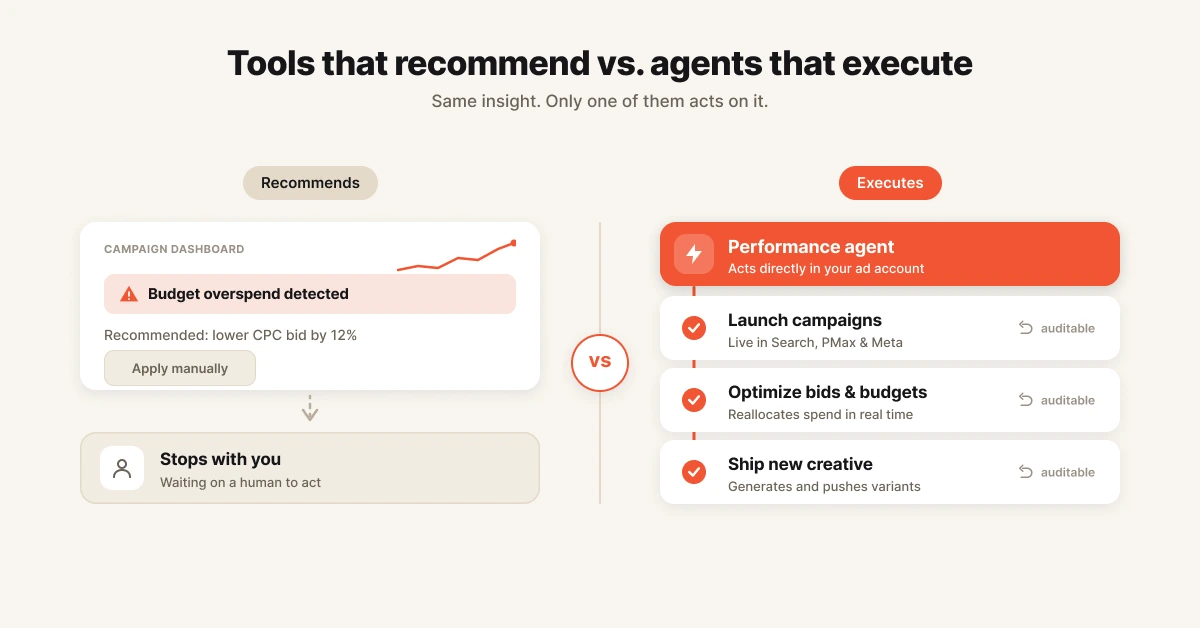
The first camp recommends. These tools surface insights, score creatives, and suggest budget moves, then wait for a human to act. The second camp executes. These are AI agents that run the loop end to end: they launch campaigns, shift spend, generate creatives, and pause fatigued ads on their own, inside guardrails you set.
The difference matters because the bottleneck for most teams is not insight. It is execution time. A good AI tool in 2026 closes the gap between knowing what to do and doing it, and it does so with an audit trail so you can see why every action happened and undo it if needed. That is the bar this list is measured against.
The 8 best AI tools for advertisers in 2026
1. Hawky: Best for autonomous performance marketing across creative and media buying
Hawky is an agentic performance marketing platform built around two always-on AI agents and a Copilot, all powered by FeatherDB, a shared living-context memory layer. Most tools generate recommendations and hand them back to you. Hawky's agents do the job end to end, with every action logged with its trigger data and a confidence score, and one-click reversible.
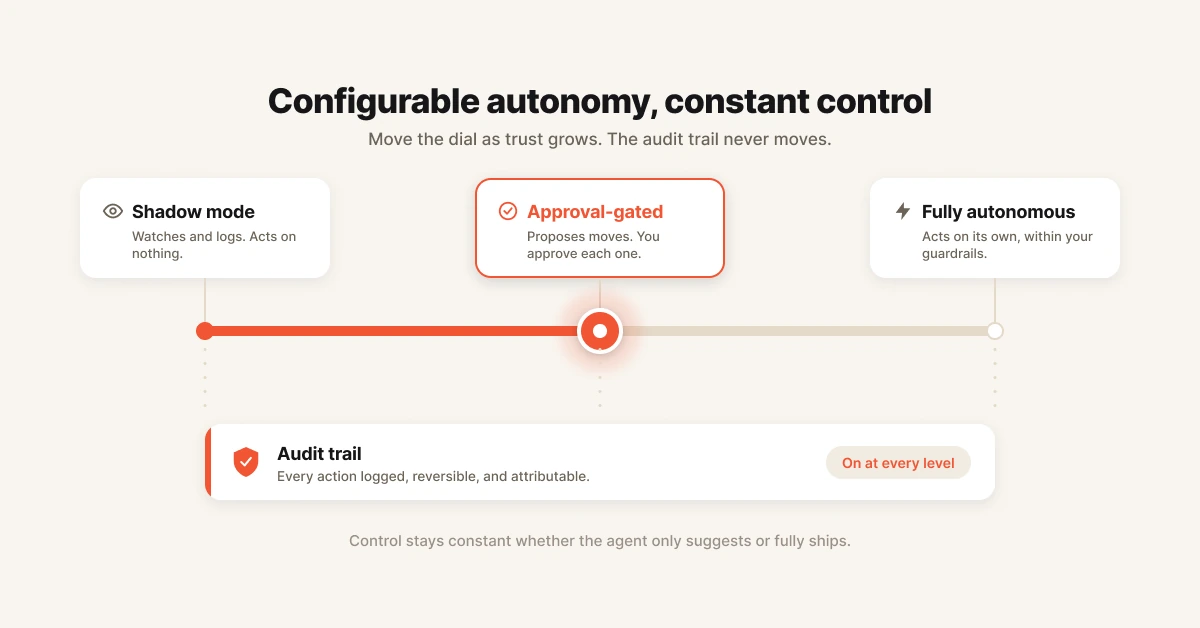
The Performance Agent is an always-on operator for paid media. It plans, launches, and optimizes Meta, Google, and YouTube campaigns against your KPI (ROAS, CAC, LTV, or contribution margin) on a closed loop of Test, Track, Optimize, Scale. The Creative Agent reads your past winners, competitor patterns, and portfolio gaps from Feather, then renders finished on-brand creatives and routes them through seat-level approval. What sets Hawky apart is configurable autonomy: you pick the gate (every batch, every campaign, every brand, or none) and loosen it as trust builds, moving from shadow mode to approval-gated to fully autonomous with the same audit trail throughout.
The results show up in the numbers. Hiveminds cut CPL by 27% and saved 160+ hours per brand monthly running Hawky, and the cohort median across 200+ active customers is +25% ROAS in the first 90 days.
Key capabilities:
- Performance Agent: autonomous media buying that optimizes 24/7 against your KPI with spend caps, guardrails, and shadow mode keeping humans in command.
- Creative Agent: an autonomous creative pipeline that generates on-brand statics from your winners, each batch bound to a specific Meta or Google ad set and each creative citing the evidence behind it.
- Copilot: ask anything about campaigns, creatives, and competitor moves and get sourced answers in seconds, generate creatives, or pause ads from the chat.
- FeatherDB: a living context engine both agents read and write, so memory compounds and every dollar makes the next dollar smarter.
Best for: D2C brands and agencies running $50k to $5M+/month across Meta and Google that want agents to do the labor while the team keeps the judgement. Pricing is outcome-based: a subscription minimum plus KPI-tied upside, with a 30-day free pilot.
Honest limitation: Hawky is focused on Meta, Google, and YouTube. If most of your spend sits on TikTok, Amazon, or native, pair it with a channel-specific tool for now.
2. Madgicx: Best for Meta-first DTC automation
Madgicx is an AI-powered advertising platform built specifically for Meta ads, combining autonomous budget allocation, AI-generated audiences, and creative performance analytics in one workflow. Its autonomous budget management continuously shifts spend between ad sets based on performance, moving money away from underperformers before you waste significant budget.
Strength: Madgicx is the deepest Meta specialist in the category, and its AI surfaces targeting options beyond what standard Meta audience tools show. For a DTC operator running Meta as the primary channel, it is one of the most complete single-platform options.
Limitation: the depth is Meta-centric, so multi-channel teams will still need separate coverage for Google and beyond. Pricing starts around $49 to $99/month and scales with ad spend, with a free trial available. Best for: DTC ecommerce teams running Meta as their main paid channel.
3. Smartly.io: Best for enterprise creative automation at scale
Smartly.io dominates the enterprise market for automated creative production and campaign optimization. It generates thousands of creative variations from templates and tests them systematically across channels, which is why large brands and agencies with high creative throughput rely on it.
Strength: few platforms match Smartly's raw creative-production scale and its established enterprise workflows. Limitation: the power comes at enterprise pricing, reported around $30,000+/year, which prices out most small and mid-market teams. Best for: large brands and agencies with the budget and creative volume to justify an enterprise contract.
4. AdCreative.ai: Best for high-volume static ad generation
AdCreative.ai focuses on performance advertising creative, generating ad banners, social ads, and copy variations optimized for conversions. It is the default pick for marketers who need to pump out a high volume of static variations for testing.
Strength: fast, cheap, conversion-oriented creative generation from product images and copy. Limitation: it generates assets but does not run or optimize your campaigns, so it sits as one piece of a larger stack rather than a complete solution. Pricing starts around $39/month. Best for: media buyers who need creative volume and already have optimization handled elsewhere.
5. Pixis: Best for codeless AI infrastructure
Pixis offers codeless AI infrastructure that lets marketing teams build their own AI models and workflows for targeting, optimization, and creative without writing code. The approach appeals to larger teams that want to assemble custom automation rather than buy a fixed product.
Strength: flexibility and breadth across the funnel for teams that want to configure their own AI stack. Limitation: that flexibility carries a heavier setup and onboarding load, and pricing is quote-based rather than transparent. Best for: mid-market and enterprise teams with the resources to build and maintain custom workflows.
6. Pencil: Best for AI video ad creative
Pencil connects to your ad account and brand assets and uses AI to generate short-form video ads, turning existing assets into fresh content for Reels and TikTok. As video keeps eating share of paid social, a tool focused on AI video generation earns a place in the stack.
Strength: purpose-built for the video creative gap that most static-first tools leave open. Limitation: it is creative generation only, with custom enterprise pricing and no campaign execution. Best for: brands leaning into short-form video who need a steady stream of new cuts.
7. Revealbot: Best for rule-based automation control
Revealbot is an automation platform for Meta and Google Ads built around highly customizable rules. You build conditional logic that triggers specific actions based on combinations of real-time metrics, which gives precise, predictable control over how budgets and bids move.
Strength: granular, transparent rule-based automation that experienced buyers trust. Limitation: rules are only as smart as the person writing them, so this is power-user tooling rather than autonomous decision-making. Best for: hands-on media buyers who want exact control over automation triggers.
8. Google Performance Max: Best native AI baseline
Performance Max is Google's AI-driven campaign type that optimizes across Search, YouTube, Display, Discover, Gmail, and Maps from a single campaign, using Smart Bidding to chase your conversion goal. Every Google advertiser already has access to it, which makes it the baseline AI layer of most stacks.
Strength: unmatched reach across Google's inventory and continuous AI optimization at no extra tool cost. Limitation: it is a black box with limited visibility into placement and search-term data, so it works best paired with a tool that adds transparency and creative control. Best for: any advertiser with meaningful Google spend.
Feature comparison: how these AI tools stack up
| Tool | Primary job | Executes or recommends | Channels | Starting price |
|---|---|---|---|---|
| Hawky | Autonomous media buying + creative | Executes end to end | Meta, Google, YouTube | Outcome-based + pilot |
| Madgicx | Meta automation | Executes (Meta) | Meta | ~$49-99/mo |
| Smartly.io | Creative automation | Executes (enterprise) | Multi-channel | ~$30k+/yr |
| AdCreative.ai | Static creative generation | Recommends/generates | Creative output | ~$39/mo |
| Pixis | Codeless AI workflows | Mixed | Multi-channel | Quote-based |
| Pencil | AI video creative | Generates | Social video | Custom |
| Revealbot | Rule-based automation | Executes (rules) | Meta, Google | Quote-based |
| Performance Max | Native campaign AI | Executes (Google) | Google network | Included |
Tools that recommend vs. agents that execute: the distinction that decides your stack
The single most useful filter when building your 2026 stack is whether a tool recommends or executes. A dashboard that flags a fatigued creative still leaves you to brief, build, approve, and launch the replacement. An agent catches the fatigue, generates the on-brand replacement, and ships it into the right ad set, then logs what it did. (What is creative fatigue?)
Recommendation tools were the right answer when AI could not be trusted to act. That constraint is loosening, but only for tools that pair autonomy with control. The teams adopting agents fastest are the ones that can answer three questions: can I see why it acted, can I gate which actions need approval, and can I undo it. When the answer to all three is yes, autonomy stops being reckless and becomes an edge.
This is also where shared memory matters. A pile of point tools never compounds, because the creative tool never learns what the optimization tool discovered. A platform with living context (Hawky's FeatherDB, for example) means every decision feeds the next one, so the system gets smarter as it runs instead of starting cold each time. When you evaluate a tool, ask what it remembers and who else inside the system can read that memory.
Which AI tool is right for your team?
If you run a lean D2C brand spending $50k+/month and your bottleneck is execution time, an agentic platform like Hawky removes the most labor: it buys media and produces creative against your KPI so the team does judgement, not grunt work. Start in shadow mode, then loosen the gate as the audit trail earns your trust.
If you are a Meta-only DTC operator who wants strong automation without changing how you work, Madgicx is the focused pick. If you are an enterprise brand with serious creative volume and budget to match, Smartly.io is built for that scale.
If your gap is purely creative output, AdCreative.ai (statics) or Pencil (video) slot in cheaply alongside whatever runs your campaigns. If you are a power-user buyer who wants exact, transparent control, Revealbot's rule engine is the tool. And every Google advertiser should treat Performance Max as the native baseline and add a layer on top for transparency.
The honest takeaway: most teams end up paying for three or four point tools that do not talk to each other. The reason to consolidate onto an agentic platform is not just cost. It is that one system with shared memory and configurable autonomy does the work the point tools only describe.
Frequently asked questions
What is the best AI tool for advertising in 2026?
For most performance marketers, the best AI tool in 2026 is an agentic platform that executes rather than just recommends. Hawky leads for autonomous media buying and creative production across Meta, Google, and YouTube, while Madgicx is the strongest Meta-only option and Smartly.io fits enterprise creative scale.
Can AI run ad campaigns by itself?
Yes. AI agents can now plan, launch, optimize, and scale campaigns autonomously against a target KPI. The trustworthy ones keep humans in command through guardrails, spend caps, approval gates, and a full audit trail, so you can run them in shadow mode first and grant more autonomy as trust builds.
What is the difference between an AI ad tool and an AI ad agent?
An AI ad tool surfaces insights and recommendations and waits for a human to act. An AI ad agent does the work end to end, launching campaigns, shifting budget, and generating creatives on its own inside the limits you set, with every action logged and reversible.
How much do AI advertising tools cost?
Pricing ranges widely in 2026. Creative generators like AdCreative.ai start around $39/month, Meta automation tools like Madgicx run roughly $49 to $99/month and up, and enterprise creative platforms like Smartly.io reach $30,000+/year. Agentic platforms like Hawky use outcome-based pricing, a subscription minimum plus KPI-tied upside.
Is AI replacing media buyers?
No. AI agents change the job rather than replace the team. The labor moves to agents while judgement, strategy, and brand decisions stay human, so buyers shift from manual execution to directing and auditing the agents.
Do I need multiple AI tools or one platform?
It depends on your spend and how much your point tools share context. Separate creative, optimization, and analytics tools rarely talk to each other, so teams running meaningful spend increasingly consolidate onto one platform with shared memory so every decision compounds instead of starting cold.
If execution time is your real bottleneck and you want agents that buy media and build creative against your KPI without giving up control, Hawky's Performance Agent and Creative Agent are built for that job.
Ready to hire your first AI performance team? Book Demo