The Best Facebook Ad Reporting Tools for 2026 (Tested & Ranked)
The best Facebook ad reporting tools in 2026 are Hawky for reporting that turns into action, Supermetrics for piping ad data into your own BI stack, and Triple Whale for DTC ecommerce attribution. The right tool depends on whether you need a dashboard, an attribution model, or an agent that acts on what the report finds.
Most reporting tools stop at the chart. They tell you CPA rose and creative fatigued, then leave the work to you. This guide ranks the Facebook ad reporting tools worth paying for in 2026, how each was tested, what it does well, and where it stops.
What a Facebook ad reporting tool actually does in 2026
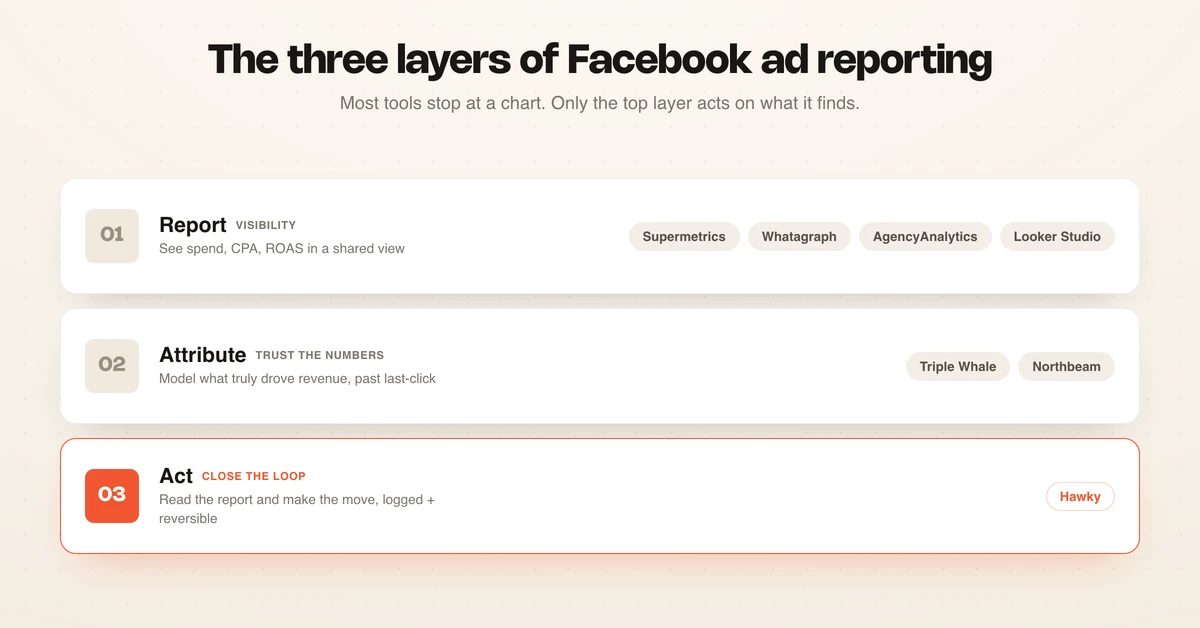
A Facebook ad reporting tool collects, cleans, and visualizes Meta ads data so you can measure performance, attribute conversions, and decide where to spend next. In 2026 the category splits into three layers that solve different problems and are easy to confuse.
The first layer is dashboard reporting: tools that pull Meta data into clean, shareable views (Supermetrics, Whatagraph, AgencyAnalytics, Looker Studio). The second is attribution: tools that model which touchpoints actually drove revenue beyond Meta's own 7-day window (Triple Whale, Northbeam). The third is action: agents that read the report and execute the fix, not just flag it.
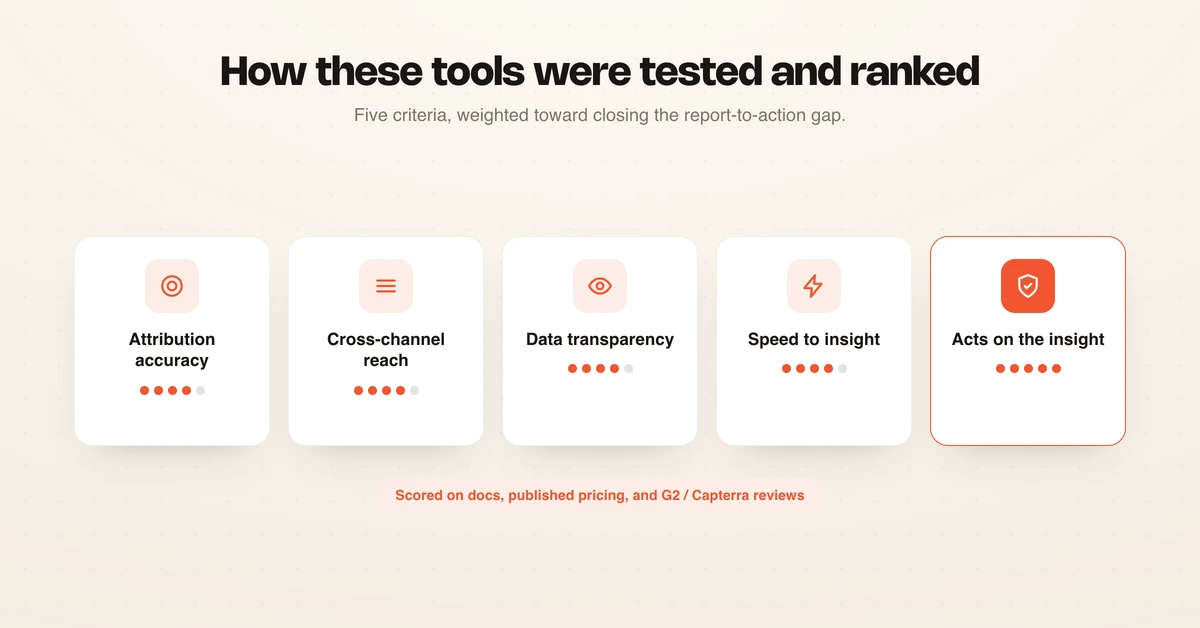
A good reporting tool in 2026 is judged on five things: attribution accuracy, cross-channel coverage, data transparency, speed to insight, and whether it can act on what it finds. That is the bar this ranking uses.
How these tools were tested: each was scored on the five criteria above using documented features, published pricing, and aggregated user reviews from G2 and Capterra, then ranked by how much of the report-to-action gap it closes.
The 8 best Facebook ad reporting tools for 2026
1. Hawky: Best for reporting that turns into action
Hawky is an agentic performance marketing platform built around two always-on AI agents and a Copilot, all powered by FeatherDB, a shared living-context memory layer. Most reporting tools describe the past. Hawky's agents read the same data and act on it, with every action logged with its trigger and a confidence score, and one-click reversible.
The reporting itself is element-level. The Copilot breaks down why an ad works at the hook, visual, and CTA level, cites the exact creative or metric behind every answer, and turns any view into a presentation-ready deck in one click. The Performance Agent then takes the next step a dashboard cannot: it reallocates budget, pauses fatigued creatives, and scales winners against your KPI, 24/7. Configurable autonomy keeps you in command: start in shadow mode where it only reports, move to approval-gated, then to fully autonomous, with the same audit trail throughout.
Key capabilities:
- Element-level creative analysis: scores every hook, visual, and CTA, and tracks how each element trends over time.
- Copilot with citations: ask "why is this working?" and get a sourced answer in seconds, plus one-click executive decks.
- Performance Agent: reads the report and acts on it, reallocating spend and pausing fatigue against your ROAS, CAC, or LTV target.
- FeatherDB: a living context engine so every report compounds and the next decision starts smarter.
Best for: D2C brands and agencies running $50k to $5M+/month on Meta and Google that want the report and the action in one system. Pricing is outcome-based: a subscription minimum plus KPI-tied upside, with a 30-day free pilot. Hiveminds cut CPL by 27% and saved 160+ hours per brand monthly running Hawky.
Honest limitation: Hawky focuses on Meta, Google, and YouTube. If you need a raw data pipe into a custom warehouse, pair it with a connector like Supermetrics.
2. Supermetrics: Best data pipeline into your own BI stack
Supermetrics is a marketing data connector that pulls Meta ads data into destinations like Google Sheets, Looker Studio, Excel, and BigQuery, where you build your own reports. It specializes in moving data from 100+ sources into one place rather than visualizing it for you.
Strength: it is the most reliable way to get clean Facebook ad data into a BI tool or warehouse your team already uses. For analysts who want full control over the model, nothing beats a solid pipe.
Limitation: it moves data, it does not interpret or act on it, so you still need a reporting layer and an analyst on top. Pricing starts around $39/month for a single data source and scales up for agency plans (Supermetrics pricing). Best for: data-led teams that build their own dashboards in Sheets, Looker Studio, or BigQuery.
3. Triple Whale: Best for DTC ecommerce attribution
Triple Whale is an ecommerce analytics and attribution platform that consolidates Meta, Google, and Shopify data into a single source of truth for DTC brands. Its pixel and attribution model aim to credit revenue more accurately than Meta's in-platform reporting.
Strength: it is purpose-built for Shopify DTC, with first-party attribution and a mobile-friendly dashboard operators actually check daily. Limitation: the value is concentrated in ecommerce, so lead-gen and non-Shopify teams get less from it. Pricing is published on its site and scales with revenue and add-ons (Triple Whale pricing). Best for: Shopify DTC brands that want attribution and reporting in one operator dashboard.
4. Northbeam: Best for advanced multi-touch attribution
Northbeam is a machine-learning attribution platform that combines multi-touch attribution with media mix modeling for brands scaling spend across channels. It exists to answer the incrementality question Meta's last-click view cannot.
Strength: its attribution and MMM depth suits brands spending enough that a 5% measurement error is real money. Limitation: the sophistication carries a steeper price and learning curve than dashboard tools, so it is overkill for small accounts. Pricing is quote-based and aimed at higher-spend brands (Northbeam pricing). Best for: scaling DTC brands that need defensible cross-channel attribution.
5. Madgicx: Best Meta-first reporting plus automation
Madgicx is an AI-powered Meta ads platform that pairs reporting with automated bidding, audience tools, and creative insights in one workflow. It blends analytics with execution specifically for Facebook and Instagram.
Strength: it is a deep Meta specialist, and its creative and audience reporting goes beyond what native Ads Manager shows. Limitation: the depth is Meta-centric, so multi-channel teams need separate coverage for Google and beyond. Pricing for its Pro plans starts around $45/month with a free trial (Madgicx pricing). Best for: DTC teams running Meta as their primary channel who want reporting and automation together.
6. Whatagraph: Best for agency client reporting
Whatagraph is a reporting platform built to produce presentation-ready, white-label reports across many marketing channels with minimal effort. Its focus is making client reports look polished and stay on schedule.
Strength: it produces the most visually clean, automated client reports in the category, which saves agencies hours every month. Limitation: it is a reporting and visualization layer, not an attribution engine or an optimizer, so insight depth is shallower than specialist tools. Pricing is published on its site by seat and data volume (Whatagraph pricing). Best for: agencies that report to many clients and value presentation and automation.
7. AgencyAnalytics: Best for agency dashboards at scale
AgencyAnalytics is a client-reporting platform with 80+ marketing integrations, automated dashboards, and white-label delivery aimed at agencies managing many accounts. It centralizes Facebook ads alongside SEO, PPC, and social in one client view.
Strength: breadth of integrations and a low per-client cost make it efficient for agencies with large client rosters. Limitation: it is built for breadth over depth, so single-channel Facebook analysis is lighter than a Meta specialist. Pricing scales per campaign or client and is listed on its site (AgencyAnalytics pricing). Best for: agencies that need many client dashboards across channels.
8. Looker Studio: Best free baseline
Looker Studio is Google's free data visualization tool that builds custom Facebook ad dashboards when paired with a data connector. It is the default starting point for teams that want flexible reporting without a software bill.
Strength: it is free, highly customizable, and integrates cleanly with the wider Google stack. Limitation: it has no native Meta connector, so you need a paid pipe like Supermetrics to get the data in, and you build and maintain everything yourself. Best for: lean or technical teams that want a free, flexible dashboard and have an analyst to build it.
Feature comparison: how these Facebook ad reporting tools stack up
| Tool | Primary job | Reports, attributes, or acts | Channels | Starting price |
|---|---|---|---|---|
| Hawky | Reporting plus autonomous action | Acts end to end | Meta, Google, YouTube | Outcome-based + pilot |
| Supermetrics | Data pipeline to BI | Moves data | 100+ sources | ~$39/mo |
| Triple Whale | DTC attribution | Attributes | Meta, Google, Shopify | Revenue-based |
| Northbeam | MTA + MMM | Attributes | Multi-channel | Quote-based |
| Madgicx | Meta reporting + automation | Reports and acts (Meta) | Meta | ~$45/mo |
| Whatagraph | Client reporting | Reports | Multi-channel | Seat-based |
| AgencyAnalytics | Agency dashboards | Reports | 80+ integrations | Per-client |
| Looker Studio | Custom dashboards | Reports | Via connector | Free |
Reporting, attribution, or action: which layer you actually need
The most useful question when choosing a Facebook ad reporting tool in 2026 is which of the three layers solves your real bottleneck. Buying the wrong layer is how teams end up with four tools that overlap and still cannot answer "what do I do next."
If your problem is visibility, you need the reporting layer: get clean Meta data into a shared dashboard (Supermetrics into Looker Studio, or Whatagraph and AgencyAnalytics for client-ready output). If your problem is trust in the numbers, you need attribution: a model like Triple Whale or Northbeam that credits revenue beyond Meta's last-click, last-7-day view. (What is incrementality?)
If your problem is execution time, none of those layers fixes it, because they all stop at the insight and hand the work back to you. That is the gap an agent closes: it reads the report, makes the budget or creative move, and logs why. A pile of point tools never compounds, because the reporting tool never learns what the optimization tool discovered. When you evaluate a tool, ask what it remembers and whether it can act, not just chart.
Which Facebook ad reporting tool is right for your team?
If you are a Shopify DTC brand and you distrust Meta's in-platform numbers, start with Triple Whale for attribution and a daily operator view. If you are scaling past seven figures a year and need defensible cross-channel measurement, Northbeam's attribution and MMM are built for that spend.
If you are an agency reporting to many clients, Whatagraph or AgencyAnalytics will save the most hours on presentation and delivery. If you have an analyst and want full control, pipe data with Supermetrics into Looker Studio and build exactly what you want.
If your real bottleneck is execution time, not visibility, an agentic platform like Hawky removes the most labor: it reports at the element level and then acts on the report against your KPI, with an audit trail and one-click undo. The honest takeaway is that most teams pay for three or four reporting and attribution tools that still leave the work to a human. Consolidating onto a system that reports and acts is how you stop paying for insight you never have time to use.
Frequently asked questions
What is the best Facebook ad reporting tool in 2026?
The best Facebook ad reporting tool depends on the layer you need. For teams that want reporting plus action in one system, Hawky leads because its agents act on the report, not just chart it. For raw data into your own BI stack, Supermetrics is the strongest pipe, and for DTC ecommerce attribution, Triple Whale is the standard pick.
What is the difference between Facebook ad reporting and attribution?
Facebook ad reporting collects and visualizes platform metrics like spend, CPA, and ROAS so you can see what happened. Attribution goes further and models which touchpoints actually caused a conversion, often beyond Meta's last-click, 7-day window. Reporting tells you the numbers; attribution tells you which numbers to trust when channels overlap.
Do free Facebook ad reporting tools work?
Free tools like Looker Studio work well for visualization, but they have no native Meta connector, so you still need a paid data pipe such as Supermetrics to feed them. Free options are a strong fit for lean or technical teams with an analyst to build and maintain dashboards. Teams that need attribution, automation, or action will outgrow a free dashboard quickly.
How much do Facebook ad reporting tools cost in 2026?
Pricing ranges widely by layer. Data connectors like Supermetrics start around $39/month, Meta-focused platforms like Madgicx start around $45/month, and attribution platforms like Northbeam are quote-based for higher-spend brands. Agentic platforms like Hawky use outcome-based pricing, a subscription minimum plus KPI-tied upside.
Can a reporting tool optimize my Facebook ads automatically?
Most reporting tools cannot; they surface insights and wait for a human to act. A few platforms pair reporting with automation (Madgicx) or full agentic execution (Hawky), where the system reads the report and makes the budget or creative move itself. The trustworthy ones keep humans in command with guardrails, approval gates, and a reversible audit trail.
Which Facebook ad reporting tool is best for agencies?
For agencies, the best pick depends on the job: Whatagraph and AgencyAnalytics lead for polished, white-label client reporting across many accounts, while Hawky fits agencies that want to act on the data, not just present it. Hiveminds, an agency, cut CPL by 27% and saved 160+ hours per brand monthly using Hawky's agents.
If your reporting tells you what happened but the work of fixing it still lands on your team, Hawky's Performance Agent reads the report and acts on it against your KPI, with guardrails and a full audit trail keeping you in command.
Ready to hire your first AI performance team? Book Demo