How to Do Creative Strategy in 2026: A Modern Operator's Playbook
Creative strategy in 2026 is a repeatable operating loop, not a brainstorm: you mine performance data for insight, turn it into a hypothesis-driven brief, concept divergent creative, test it systematically, read the results at the element level, then iterate the winners before they fatigue. Creative is now the biggest lever in paid media, more than targeting, so the team that runs this loop fastest wins.
Most teams still treat creative as an output: a designer gets a vague brief and ships assets that may or may not work. A modern operator treats it as a system, where every brief is a bet, every test produces a learning, and every learning sharpens the next brief. This playbook walks through that system step by step, with the cadence, budget, and roles that make it run.
What creative strategy means in 2026
Creative strategy is the discipline of using performance data to decide what to make, why, and how to test it, so that creative output reliably moves your KPI instead of guessing. It sits between the data and the design: it reads what is working across campaigns, formats, and audiences, then translates that into briefs and direction the production team can execute.
What changed in 2026 is which lever matters most. With broad targeting and AI delivery now the default, the algorithm finds the buyer, so creative is the variable that decides who wins. Your job has shifted from managing campaigns to training the system with better inputs: stronger concepts, cleaner signals, and faster iteration.
A good creative strategy in 2026 is judged on one thing: does it run a learning loop that compounds. Random testing produces noise. A systematic loop produces a library of proven angles that makes every next launch smarter. (Creative strategy for performance marketing)
The modern creative strategy playbook: a 6-step loop
The operator's playbook is a six-step loop you run continuously, not a project you finish. Each step feeds the next, and the whole thing tightens every cycle.
| Step | What you do | Output |
|---|---|---|
| 1. Mine | Analyze winners, losers, and competitors | Insights |
| 2. Brief | Turn each insight into a hypothesis | A testable brief |
| 3. Concept | Make divergent, not duplicate, creative | Variants to test |
| 4. Test | Run a structured, budgeted test | Clean signal |
| 5. Read | Score results at the element level | Learnings |
| 6. Iterate | Scale winners, refresh before fatigue | Compounding library |
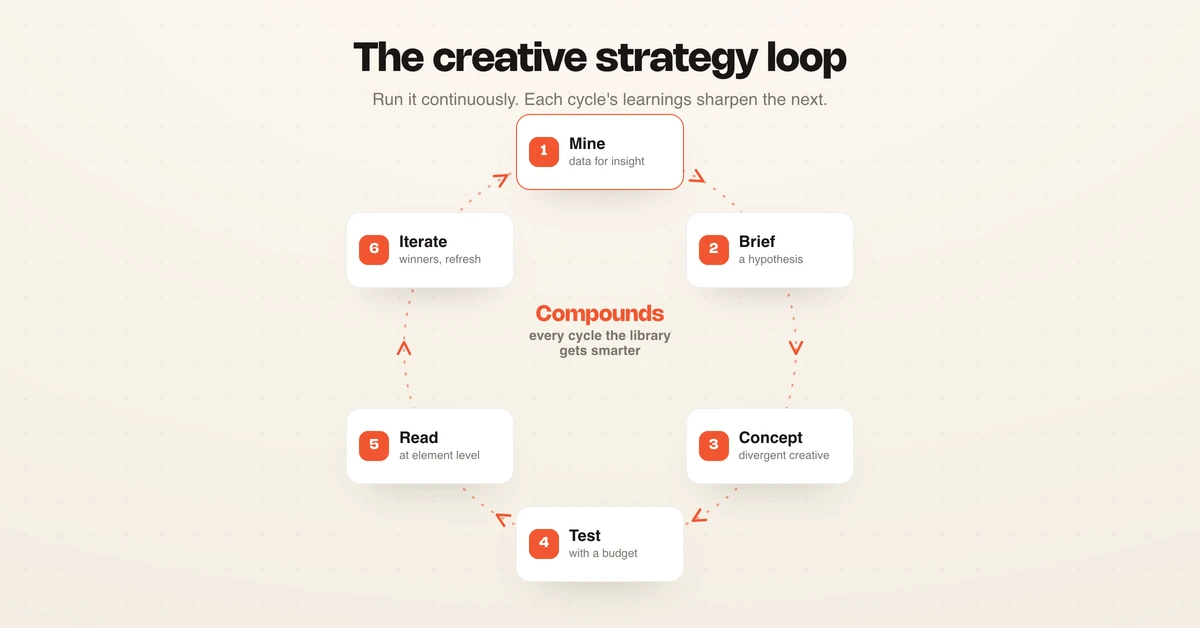
The rest of this guide breaks down each step with the thresholds and cadence that work now.
Step 1: Mine your data for insight
Start every cycle by mining performance data for patterns, because the best brief is downstream of a real insight, not a hunch. Pull your top and bottom performers from the last 30 to 90 days and ask what the winners share: hook style, format, angle, offer, visual cue.
Go past the surface metric. A creative does not win because it is a video; it wins because the first frame names a sharp pain or the hook opens a curiosity loop. Tag your library so you can query it, and add competitor patterns from the Meta Ad Library to see which angles a category is leaning into. (How to analyze creative performance)
What "done" looks like: a short list of specific, repeatable patterns ("UGC unboxing hooks beat studio shots by 30% on cold traffic") rather than vague impressions.
Step 2: Turn each insight into a hypothesis-driven brief
A good brief in 2026 is a hypothesis, not a task. It isolates one variable and links it to a measurable outcome, so the test produces a clean learning whether it wins or loses.
Write each brief in a causal form: "We believe a problem-first hook will lift hook rate for cold audiences, because our top performers all open on the pain." That structure forces a single variable, a target metric, and a reason. Vague briefs ("make some fresh statics") produce results you cannot learn from.
Pro tip: keep the body and offer constant when the hypothesis is about the hook. If you change three things at once, a win tells you nothing about why.
Step 3: Concept divergent creative, not duplicates
The goal of concepting is divergence, not volume: to scale in 2026 you do not need more ads, you need different ads. Ten variations of the same concept fatigue together and teach the algorithm nothing new.
Build a spread across the axes that matter: hook, format, angle, and visual style. Mix UGC, studio statics, motion, and founder-led cuts so you avoid the algorithm blindness that comes from one look. A handful of genuinely divergent concepts beats fifty near-identical variants, because each one probes a different reason someone might buy. (Static ads that convert)
What "done" looks like: a small set of concepts that are different in kind, each tied back to a hypothesis from Step 2.
Step 4: Test systematically, with a budget
Systematic creative testing drives 2 to 3 times better performance than random testing, so the test design matters as much as the creative. Give each concept enough budget and time to reach a defensible sample before you judge it.
Set the rules before you launch: one variable per test, equal budget per variant, and a pre-set spend or conversion threshold for calling a winner. A common structure is to run a small batch of concepts, each with a few variations, in a clean test campaign. The operational standard is to allocate 15 to 20% of ad budget to creative testing so the learning loop never starves. (The ultimate guide to creative testing)
What "done" looks like: every concept gets a fair, equal-budget read against a metric you chose in advance.
Step 5: Read results at the element level
Read tests at the element level, not just the ad level, because that is where the reusable learning lives. An ad-level "this won" tells you what to scale; an element-level read tells you why, so you can apply it to the next ten briefs.
Score the hook, the visual, the copy, and the CTA separately against a creative performance score, and read metrics in funnel order: hook rate for attention, CTR for intent, CPA or ROAS for the decision. The pattern you extract ("first-frame text lifts hook rate across formats") becomes a rule that feeds Step 1 of the next cycle. (Creative performance metrics)
What "done" looks like: a written learning per test, filed where the next brief writer will actually see it.
Step 6: Iterate winners and refresh before fatigue
Close the loop by scaling winners and iterating them before they wear out. A proven concept has a life, and the operator's job is to refresh the hook or angle while it still has room, not after CPA spikes.
Use two levers: iterate a winner fast by swapping the hook, first frame, or format, and develop net-new concepts from the patterns you have banked. Watch for creative fatigue signals (rising frequency, falling hook rate) and keep a bench warming so a replacement is always ready. Then feed the new winners back into Step 1, so the library compounds instead of starting cold each quarter.
What "done" looks like: winners scaled, fatigue caught early, and the next cycle's insights already queued.
How to budget, staff, and pace creative strategy
Creative strategy runs on cadence and clear roles, not heroics. The teams that win make testing easy and iteration fast, so the loop turns every week instead of every campaign.
| Lever | 2026 operating standard |
|---|---|
| Testing budget | 15-20% of ad spend on creative testing |
| Concept cadence | 2-4 new concepts per week |
| Refresh cadence | Weekly variants on high-spend campaigns |
| Core roles | Strategist (insight to brief), designer (production), buyer (test and scale) |
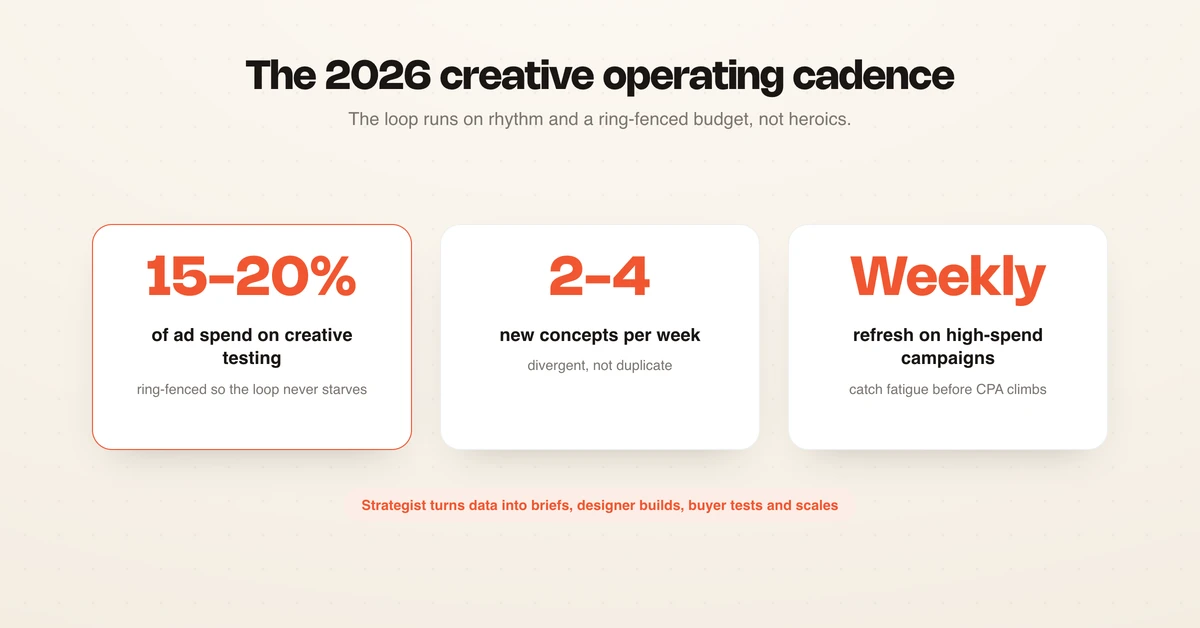
The creative strategist is the connective role: they bridge data and creative, turning what the numbers say into briefs the team can build. On lean teams one person wears all three hats, but the loop is the same. Keep the cadence steady and the briefs hypothesis-led, and the system outperforms a bigger team running on vibes.
Common mistakes to avoid
Most creative strategies break for the same few reasons. Avoid these and the loop keeps compounding.
- Volume over divergence. Fifty near-identical variants fatigue together. Make fewer, genuinely different concepts.
- Briefs without a hypothesis. "Make fresh creative" produces results you cannot learn from. Isolate one variable and a target metric.
- Reading at the ad level only. Without element-level scoring you learn what won, never why. Score the hook, visual, copy, and CTA.
- No testing budget. If testing competes with scaling for spend, it loses, and the pipeline dries up. Ring-fence 15-20%.
- Letting learnings evaporate. A win nobody writes down is a lesson you pay to learn twice. File every learning where the next brief starts.
Tools and AI agents that run the loop
You can run this loop in spreadsheets and a design queue, but the manual version is slow: mining data by hand, writing briefs, chasing production, and filing learnings eats the week. Tooling compresses each step.
Analytics and tagging tools speed up Step 1 and Step 5 by scoring creatives at the element level automatically. Generative tools speed up Step 3 by producing variants fast. An agentic platform like Hawky runs the whole loop: its Creative Agent reads your winners, competitor patterns, and portfolio gaps from FeatherDB, renders finished on-brand concepts tied to a specific ad set, and routes them through approval, while the Performance Agent tests, scales, and refreshes against your KPI. Configurable autonomy keeps you in command: run it approval-gated so every concept gets a human yes, or fully autonomous with a complete audit trail.
The payoff is loop speed. The Man Company doubled creative performance and cut iteration cycles by 50% running this system, because the insight-to-brief-to-test cycle that took a week now turns in a day. Whether you automate it or not, the principle holds: creative strategy is a loop, and the faster it compounds, the more it wins.
Frequently asked questions
What is creative strategy in performance marketing?
Creative strategy in performance marketing is the discipline of using performance data to decide what creative to make, why, and how to test it, so output reliably moves a KPI. It bridges data and design: the strategist analyzes what is working across campaigns and translates it into briefs and direction. In 2026 it is the highest-impact work in paid media, because creative now matters more than targeting.
How do you build a creative strategy in 2026?
Build creative strategy as a repeatable six-step loop: mine performance data for insight, turn each insight into a hypothesis-driven brief, concept divergent creative, test systematically with a ring-fenced budget, read results at the element level, then iterate winners before they fatigue. Run it continuously rather than per campaign, so each cycle's learnings sharpen the next. The teams that win are the ones whose loop turns fastest.
How much budget should go to creative testing?
The 2026 operating standard is to allocate 15 to 20% of total ad spend to creative testing. Ring-fencing that budget keeps the learning loop running so a pipeline of proven concepts is always ready to scale. If testing has to compete with scaling for the same dollars, it loses, and creative output stalls.
How many creatives should you test per week?
Most brands benefit from testing 2 to 4 new creative concepts per week, which keeps a steady pipeline of potential winners without overwhelming the account. The right number scales with spend: higher budgets support more concurrent tests, while leaner accounts test fewer but should still run continuously. Quality and divergence matter more than raw volume.
What does a creative strategist do?
A creative strategist bridges data and creative output. They analyze what is working across campaigns, formats, and audiences, then translate those insights into hypothesis-driven briefs, concepts, and direction the production team executes. On lean teams the strategist, designer, and media buyer may be the same person, but the job of turning data into testable creative bets stays the same.
Is AI replacing creative strategists?
No. AI changes the creative strategist's job rather than replacing it. Agents now handle the labor of generating variants, scoring elements, and refreshing fatigued creative, while the strategist sets the hypotheses, judges the angles, and owns the brand decisions. The work moves from manual production to directing and auditing the system.
If running the mine, brief, concept, test, read, iterate loop by hand is eating your team's week, Hawky's Creative Agent and Performance Agent are built for that job: they read your winners, ship divergent on-brand concepts, and test and refresh against your KPI, with guardrails and a full audit trail keeping you in command.
Ready to hire your first AI performance team? Book Demo