Ad Fatigue: How to Detect, Diagnose, and Beat It
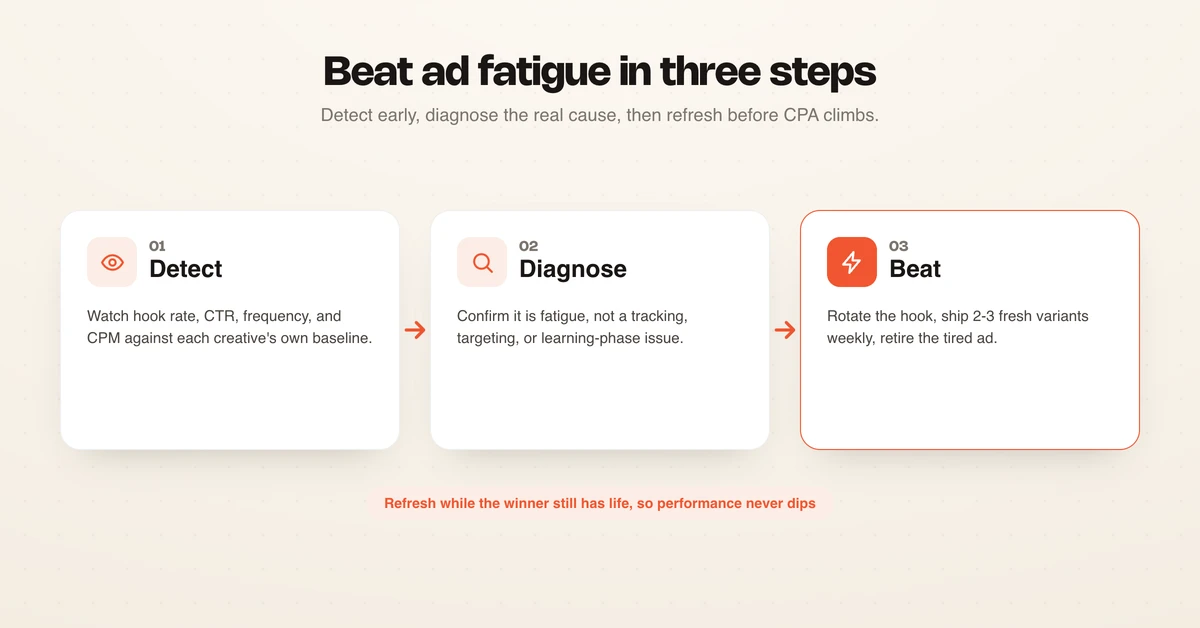
Ad fatigue is when your audience sees a creative so often that it stops responding, and you beat it in three steps: detect it early with hook rate and frequency, diagnose that it is really fatigue and not a tracking or targeting problem, then refresh the creative before CPA climbs. In 2026 this matters more than ever, because Meta's newer delivery models exhaust audiences faster than they used to.
Most teams catch ad fatigue too late, after CPA has already spiked and a week of budget is gone. The fix is to read the early-warning metrics, confirm the cause, and refresh on a schedule instead of in a panic. This guide walks through how to detect, diagnose, and beat ad fatigue, with the exact thresholds and cadence that work now.
What ad fatigue is in 2026
Ad fatigue is the decline in ad performance that happens when your target audience has seen a creative too many times and stops engaging with it. It shows up as falling click-through rates, rising frequency, and climbing costs on a creative that used to win.
The creative side of this problem is creative fatigue: the specific creative wears out even though the offer and targeting are unchanged. Ad fatigue is the broader symptom, driven by both creative repetition and audience saturation. (Why your ads stop working)
What changed in 2026 is speed. Industry analyses report that Meta's machine-learning delivery now exhausts a target audience faster than older systems, so fatigue that once took two to three weeks can appear in five to seven days. The practical result: a refresh cadence built for 2023 is now too slow, and weekly creative rotation is the new baseline for high-spend accounts.
What causes ad fatigue
Ad fatigue has two root causes: creative repetition and audience saturation. Creative repetition is when the same opening frame, hook, or concept runs long enough that regular viewers tune it out, even if the offer is still good. Audience saturation is when your targeted pool is too small for your spend, so the algorithm cycles the same people and frequency climbs fast.
The two compound. A small audience saturates quickly, which makes any single creative fatigue sooner, which is why high spend against a narrow audience is the fastest route to fatigue. Knowing which cause dominates decides your fix: repetition calls for a creative refresh, while saturation calls for wider targeting or a new audience.
How to detect ad fatigue: the 5 early-warning metrics
You detect ad fatigue by watching upper-funnel metrics that move before CPA does. The earlier the metric sits in the funnel, the sooner it catches fatigue, which is why hook rate moves first and CPA moves last.
Read these five signals in order, and treat two or more sliding together as confirmation.
| Metric | Fatigue signal | How early it catches it |
|---|---|---|
| Hook rate / thumb-stop | Falling vs the creative's own baseline | Earliest |
| CTR | Down 10-15% off the 7-day rolling baseline | Early |
| Frequency | Above 2.5-3 (prospecting), 4-6 (retargeting) | Early |
| CPM | Rising while CTR falls | Mid |
| CPA / ROAS | CPA up 15%+, ROAS sliding | Last |
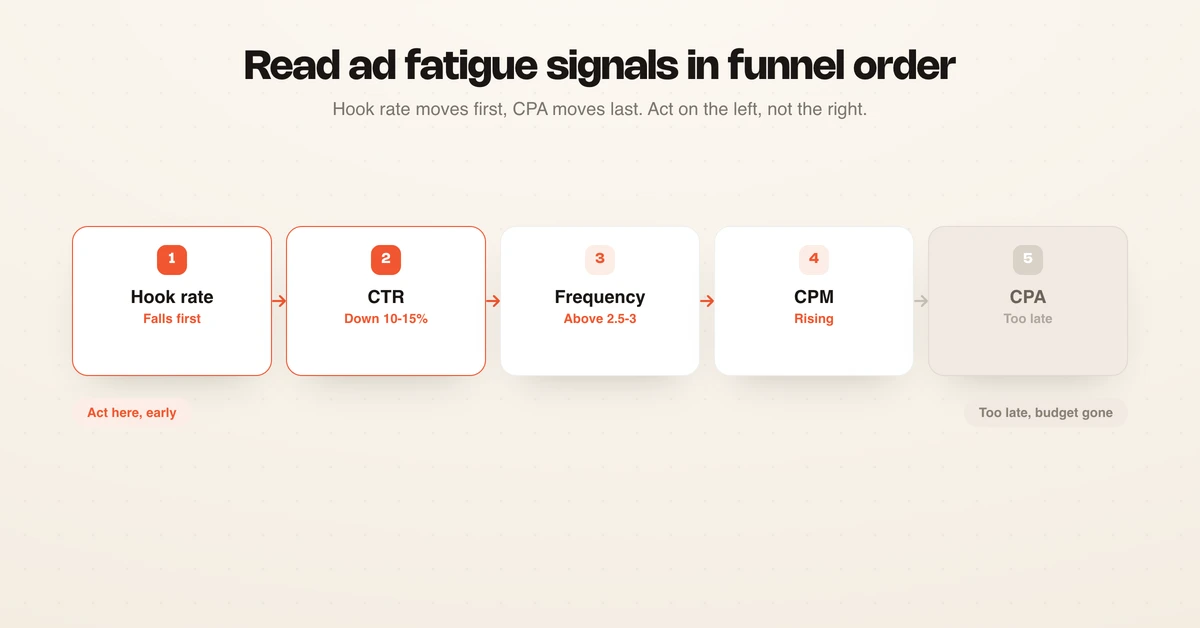
Hook rate is the percentage of impressions that become 3-second views, and a falling hook rate is the clearest early sign that creative repetition has made your opening frame invisible. When CTR then drops for several days while frequency climbs, the pattern is no longer noise, and a sustained CTR decay is the most reliable early signal. Rising CPM with falling CTR confirms it, because the algorithm is bidding harder to reach the few people in your audience who have not already seen the ad.
Pro tip: track each creative against its own baseline, not the account average. A 12% CTR drop on your best performer matters more than a low absolute CTR on a new test.
How to diagnose ad fatigue: is it really fatigue?
Before you refresh, confirm the decline is fatigue and not something that a new creative will not fix. Diagnosing the real cause saves you from rebuilding creative when the actual problem is tracking, targeting, or seasonality.
Run this quick differential before you act:
- Fatigue: frequency is rising and the decline is concentrated on specific aging creatives. A refresh fixes it.
- Audience saturation: even fresh creatives fatigue fast because the audience is too small. Widen targeting or ad saturation will keep recurring.
- Tracking break: conversions fell off a cliff across all ads at once. Check the pixel and Conversions API, not the creative.
- Targeting or auction shift: CPM jumped account-wide, often seasonal or competitive. The creative may be fine.
- Budget or learning reset: you edited the ad set and it re-entered the learning phase. Wait, do not refresh.
The tell that separates fatigue from the rest is the combination: declining CTR plus rising frequency plus rising CPM on specific creatives, while the rest of the account holds. If all your ads dropped at once, it is probably not fatigue.
How to beat ad fatigue: the refresh playbook
You beat ad fatigue by refreshing the creative before CPA confirms the problem, and by keeping a bench of new concepts ready so you never scramble. There are two levers, and strong accounts use both.
Iterative refresh extends a winner's life fast: change the hook, the first frame, the text overlay, the colors, or the format while keeping the core concept. Net-new concepts give longer-term durability: fresh angles, new creators, different formats, and new offers that open a different audience. Iterative buys you days; net-new buys you months.
The workflow that works:
- Rotate the hook first. The opener fatigues before the body, so a new hook on a proven creative often restores hook rate without a full rebuild. Pull from a tested swipe file of hooks.
- Ship 2-3 fresh variants weekly on high-spend campaigns, so a replacement is always warming up before the current winner dies.
- Retire, do not just pause. Move fatigued creatives out and let spend consolidate on the fresh winners.
- Feed winners back in. Build the next batch from what is working, not from scratch, so each round compounds. Disciplined creative testing is how you keep the bench full.
Done right, you are replacing the hook or concept while the old one still has life, so performance never visibly dips. That is the difference between managing fatigue and reacting to it.
How often to refresh ad creative in 2026
Refresh cadence depends on spend and campaign type, but the 2026 baseline is faster than most teams run. The higher your spend and the smaller your audience, the sooner a creative saturates.
| Campaign type | Refresh cadence | Frequency to watch |
|---|---|---|
| High-spend prospecting | Weekly new variants | Above 2.5-3 |
| Standard prospecting | Every 1-2 weeks | Above 3 |
| Retargeting | Every 2-3 weeks | Above 4-6 |
| Evergreen / low spend | Every 3-4 weeks | Above 3 |
These are starting points, not rules. Track each creative against its own fatigue curve and let the metrics, not the calendar, make the final call.
Common mistakes to avoid
Most teams lose money to ad fatigue for the same few reasons. Avoid these and you stay ahead of the curve.
- Waiting for CPA to confirm it. By the time CPA spikes, you have burned days of budget. Act on hook rate and frequency instead.
- Refreshing the whole ad when only the hook is tired. Rotate the opener first; it is faster and often enough.
- No bench. One winner with nothing behind it means a scramble when it dies. Keep 2-3 variants warming up.
- Confusing fatigue with a tracking break. If everything dropped at once, check the pixel before you rebuild creative.
- Refreshing during the learning phase. Editing mid-learning resets it. Let the ad set stabilize first.
How to automate ad fatigue detection and refresh
You can watch these metrics by hand, but fatigue moves faster than a weekly check, and the manual loop of spotting it, briefing a replacement, and shipping it loses days. Automation closes that gap.
Most analytics tools alert you when a creative fatigues, then hand the work back to you. An agentic platform like Hawky closes the loop instead. Its Performance Agent watches each creative against its own baseline and catches fatigue 4 to 7 days earlier than a manual review, then the Creative Agent generates an on-brand replacement from your winners and routes it through approval, all logged and reversible. Configurable autonomy keeps you in command: run it in shadow mode to only flag fatigue, approval-gated to confirm each refresh, or fully autonomous with a full audit trail.
The payoff is time and consistency. The Man Company doubled creative performance and cut iteration cycles by 50% running this loop, because the refresh happens the moment fatigue starts instead of a week later. Whether you automate it or not, the principle holds: detect early, diagnose correctly, and refresh before the numbers force your hand.
Frequently asked questions
What is ad fatigue?
Ad fatigue is the drop in performance that happens when your audience has seen an ad so often that it stops engaging. It shows up as falling click-through and hook rates, rising frequency, and climbing CPM and CPA on a creative that used to perform. The fix is to refresh the creative before costs climb, not after.
How do you know if your ads have ad fatigue?
You know ads are fatiguing when hook rate and CTR fall against the creative's own baseline while frequency and CPM rise, usually on specific aging creatives rather than the whole account. CTR down 10-15% off its 7-day baseline with frequency above 2.5-3 on prospecting is a reliable warning. If every ad drops at once, suspect a tracking or targeting issue instead of fatigue.
What frequency is too high for Facebook ads?
For prospecting campaigns, a frequency above 2.5 to 3 is a flag that fatigue is setting in, because most of your audience has now seen the ad several times. Retargeting tolerates more, around 4 to 6, since those audiences are smaller and warmer. Treat these as thresholds to investigate, not hard caps, and confirm with CTR and CPM trends.
How often should I refresh my ad creative in 2026?
High-spend prospecting campaigns should add fresh variants weekly in 2026, because Meta's delivery exhausts audiences faster than it used to. Standard prospecting can refresh every one to two weeks, and retargeting every two to three weeks. Let each creative's own fatigue curve, not just the calendar, decide the exact timing.
What is the difference between ad fatigue and creative fatigue?
Creative fatigue is when a specific creative wears out and stops performing even though the offer and targeting are unchanged. Ad fatigue is the broader performance decline, driven by both creative repetition and audience saturation. In practice you diagnose them the same way, with hook rate, CTR, frequency, and CPM, and you beat both by refreshing creative before CPA climbs.
Can ad fatigue be prevented?
You cannot stop audiences from saturating, but you can prevent the painful version of fatigue by refreshing on a schedule instead of reacting to a CPA spike. Keep a bench of 2-3 fresh variants warming up, rotate the hook before the whole ad, and watch upper-funnel metrics daily. Teams that automate detection and refresh catch fatigue days earlier and rarely see a visible performance dip.
If spotting fatigue, briefing a replacement, and shipping it before CPA climbs is eating your team's week, Hawky's Performance Agent and Creative Agent are built for that job: they catch fatigue early and ship the on-brand refresh, with guardrails and a full audit trail keeping you in command.
Ready to hire your first AI performance team? Book Demo