Facebook Ad Fatigue: How to Detect and Fix It in 2026

Facebook ad fatigue happens when your audience sees an ad too many times and stops responding, shown by rising frequency and CPM alongside a falling CTR. The clearest signal is a CTR drop of 15% or more against a 7-day baseline while frequency climbs past 2.5 to 3.0. In 2026, fatigue hits faster than ever, with concepts burning out in 2 to 3 weeks instead of 6, so early detection and a steady creative refresh are the only real defense.
Ad fatigue is the quiet tax on every Facebook account, because a tiring creative costs more to serve and returns less every day it runs. This guide shows you exactly what causes fatigue, how to catch it early with hard metrics, and how to fix it before it drains your budget.
What is Facebook ad fatigue?
Facebook ad fatigue is the decline in ad performance that happens when the same people see your creative too many times. The novelty wears off, they stop noticing or clicking, and the algorithm has to work harder and pay more to earn the same result. It is a creative problem wearing the disguise of a delivery problem.
The mechanics are straightforward. As frequency rises, the fresh part of your audience shrinks, so the ad increasingly serves to people who already saw it and did not act. Their indifference shows up as a lower click-through rate, and Meta responds by charging a higher CPM to keep delivering, so your costs climb while results fall. See the creative fatigue glossary entry for the underlying concept.
Fatigue is not the same as a bad ad. A fatigued ad was often a winner; it simply exhausted its audience. That distinction matters because the fix is not always a better concept, it is a fresh one, delivered before the current one burns out.
What causes Facebook ad fatigue?
Facebook ad fatigue is caused by an audience seeing your creative too often relative to its size, and a few factors accelerate it. High frequency is the direct cause, but the conditions that drive frequency up are what you actually control.
- Small audiences: a narrow audience recycles the same people fast, spiking frequency in days.
- Single-concept reliance: running one hero creative with nothing behind it means no relief when it tires.
- High budget on a narrow audience: pushing spend into a small pool forces repeated impressions.
- Long run times: leaving a creative live for weeks guarantees the audience has seen it too much.
Meta's Andromeda ranking system is the 2026 accelerant. It weights creative signals harder than the previous generation, so a concept that used to last six weeks now burns through its audience in two or three, per Adlibrary. The practical effect is that your refresh cadence has to be roughly twice as fast as it was a couple of years ago.
How to detect Facebook ad fatigue: the signals
Detect fatigue by tracking a small set of metrics against a 7-day rolling baseline, not by eyeballing the account. Five signals together confirm fatigue, and they usually appear in a predictable order, with the CTR drop leading by several days.
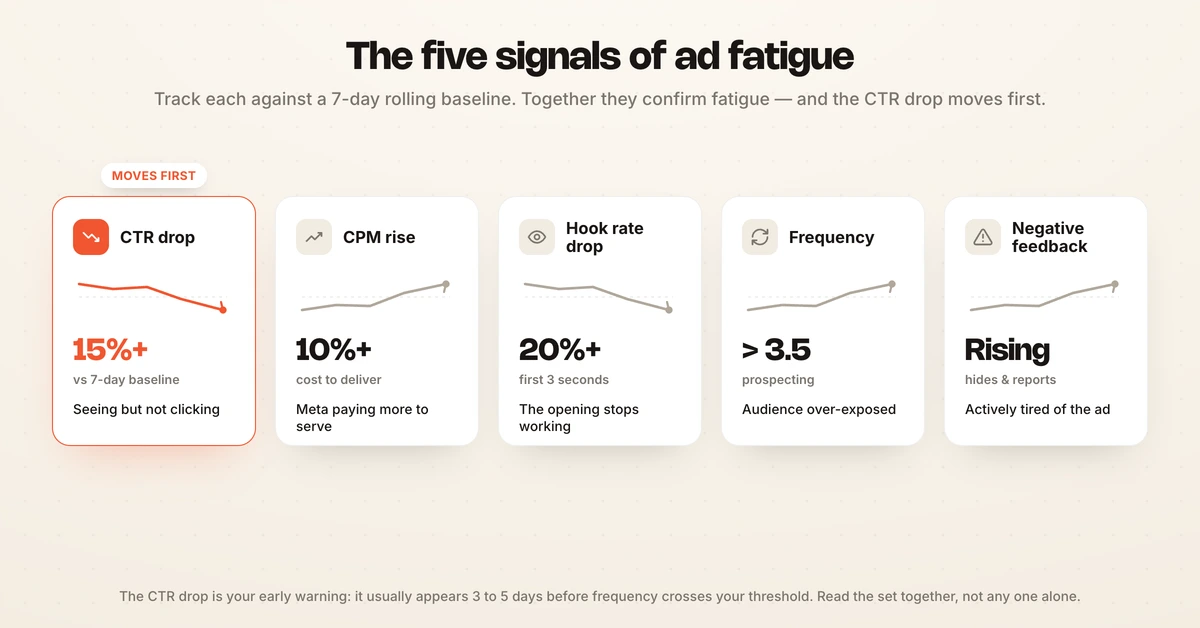
| Signal | Fatigue threshold | What it means |
|---|---|---|
| CTR drop | 15%+ vs 7-day baseline | Audience seeing but not clicking |
| CPM rise | 10%+ | Meta paying more to deliver |
| Hook rate drop | 20%+ | First 3 seconds losing attention |
| Frequency | Above 3.5 (prospecting) | Audience over-exposed |
| Negative feedback | Rising hides/reports | Audience actively tired of the ad |
The CTR drop is your early-warning system, typically appearing 3 to 5 days before frequency crosses your threshold, per AdAmigo. A CTR fall of 20% or more over two weeks confirms fatigue outright, and a rising hide-and-report rate is the audience telling you directly, per Mako Metrics. Watching these together, rather than any one alone, is what separates a real fatigue signal from normal daily noise. For the full metric set, see how to measure ad creative performance and the ad fatigue metrics glossary entry.
What is a good Facebook ad frequency?
A good Facebook ad frequency for prospecting is below 2.5 on a weekly basis, with 2.5 to 3.0 being the danger zone and anything above 4.0 critical. Below 2.5, most audiences absorb the message without tiring; performance starts declining above 2.5 and falls off a cliff past 4.0.
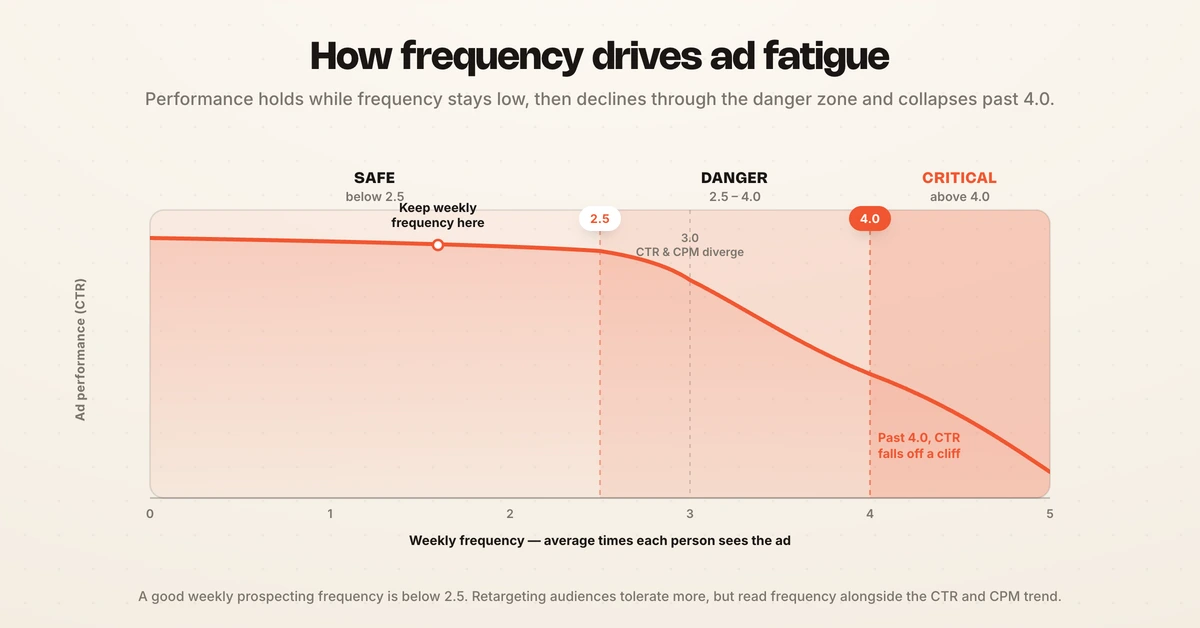
Frequency tolerances differ by funnel stage. Retargeting audiences accept higher frequency than prospecting, because they already know the brand and expect to see it, though even they fatigue if the cap runs unchecked. The safe move is to set frequency caps and watch CTR and CPM diverge, which they do sharply once frequency passes 3.0.
Do not treat frequency as a single number to obey blindly. It is a leading indicator that interacts with audience size and creative volume, so a frequency of 3.0 on a fresh, large audience is healthier than 2.0 on a small, tired one. Read it alongside the CTR and CPM trend, not in isolation.
Fatigue vs audience saturation
Two problems look identical in the dashboard but need different fixes, so it is worth separating them. Creative fatigue means the audience is tired of this specific ad; a fresh creative to the same audience fixes it. Audience saturation means you have run through the useful part of the audience itself; new creative helps less, and you need a larger or different audience.
Tell them apart by testing a genuinely new concept against the same audience. If the new creative revives performance, it was creative fatigue. If even a strong new concept lands flat, the audience is saturated and the constraint is reach, not creative, which usually means expanding targeting or opening a new audience. Misdiagnosing the two wastes weeks, because you keep making new creative for an audience that has stopped growing.
How to fix and prevent Facebook ad fatigue
The permanent fix for ad fatigue is a steady stream of fresh creative entering rotation before the current winner burns out. Most high-spend accounts need new creatives every week, with exact timing depending on budget and audience size. Prevention beats reaction, because by the time fatigue shows in the numbers, you have already paid for it.
When an ad is fatiguing, several fixes work in order of effort:
- Refresh the hook: swapping the first 3 seconds of a video can reset how Meta's algorithm treats the creative.
- Introduce new concepts: rotate genuinely new angles, not just recolored versions of the tired one.
- Expand the audience: a larger pool lowers frequency and buys the creative more life.
- Cap frequency: set a frequency cap to stop over-serving the same people.
The structural fix is throughput. Beating fatigue in 2026 means producing enough new creative to always have the next winner ready, which is exactly where most teams fall behind. Hawky's Creative Agent generates on-brand replacements from your winning patterns, and the Performance Agent catches fatigue 4 to 7 days earlier by watching these signals continuously, then refreshing creative against your KPI with guardrails and a full audit trail. For the testing engine behind the refresh, see how to test Facebook ad creatives.
Frequently asked questions
What causes Facebook ad fatigue?
Facebook ad fatigue is caused by your audience seeing the same creative too many times, which happens fastest with small audiences, single-concept reliance, high budget on a narrow audience, and long run times. As frequency rises, the ad increasingly serves to people who already saw it, so CTR falls and CPM climbs. In 2026, Meta's Andromeda ranking makes creative fatigue set in about twice as fast as before.
What is a good Facebook ad frequency?
A good weekly frequency for prospecting is below 2.5, with 2.5 to 3.0 being the danger zone and above 4.0 critical. Performance declines noticeably past 2.5 and drops sharply beyond 4.0. Retargeting audiences tolerate higher frequency because they already know the brand, but frequency should always be read alongside CTR and CPM trends rather than as a fixed rule.
Why did my Facebook ads stop performing?
The most common reason a Facebook ad suddenly stops performing is creative fatigue: the audience has seen it too often, so CTR drops and CPM rises even though the ad itself has not changed. Check whether frequency has climbed past 2.5 to 3.0 and whether CTR fell 15% or more against its recent baseline. If so, the fix is fresh creative, not a new audience or a bid change.
How often should I refresh Facebook ad creative?
Most high-spend accounts need fresh creative entering rotation every week in 2026, because Meta's Andromeda ranking burns through concepts in two to three weeks instead of six. Exact timing depends on budget and audience size: larger budgets on smaller audiences fatigue faster and need more frequent refreshes. The goal is to have the next winner ready before the current one tires.
How do I know if my ad is fatigued or just bad?
A fatigued ad was usually a strong performer that declined over time as frequency rose, while a bad ad underperforms from launch. Look at the trend: fatigue shows as a falling CTR and rising CPM on an ad that previously worked, often with climbing frequency and negative feedback. A bad ad never got traction in the first place, so it needs a new concept, not just a refresh.
If keeping fresh creative in rotation and catching fatigue before it inflates your Facebook costs is the problem, Hawky's Creative Agent and Performance Agent are built for that job.
Ready to hire your first AI performance team? Book Demo