Ad Fatigue Metrics
Last updated
The signals that reveal when an audience has seen your ad too often, including rising frequency, falling CTR, and climbing cost per result. Reading them early is the difference between refreshing on time and paying to show an ad people ignore.
Ad Fatigue Metrics
Ad Fatigue Metrics are the signals that reveal when an audience has seen your ad too often and has started to tune it out. They track the decline in performance that happens as a creative ages: falling click-through rate, rising frequency, climbing cost per result, and weakening engagement. Together these metrics tell you when a once-winning ad has worn out its welcome and is now quietly draining budget. Reading them early is the difference between refreshing on time and paying to show an ad people have stopped noticing.
Why It Matters
Ad fatigue metrics protect the budget you have already committed to a winning creative. Every ad has a lifespan, and once an audience crosses into overexposure, performance does not plateau, it declines. Studies of paid social consistently find that click-through rates can fall by roughly 50 percent once frequency climbs past the 3 to 5 range within a week, while cost per result rises in step. Without fatigue metrics, you keep spending into that decline blind.
The hidden cost is timing. A brand watching only blended account numbers sees the average drift slowly and assumes the audience is fine, when in reality a few aging creatives are dragging everything down. Catching creative fatigue at the metric level, ad by ad, lets you act while a refresh still resets performance instead of after the damage is locked in.
How It Works
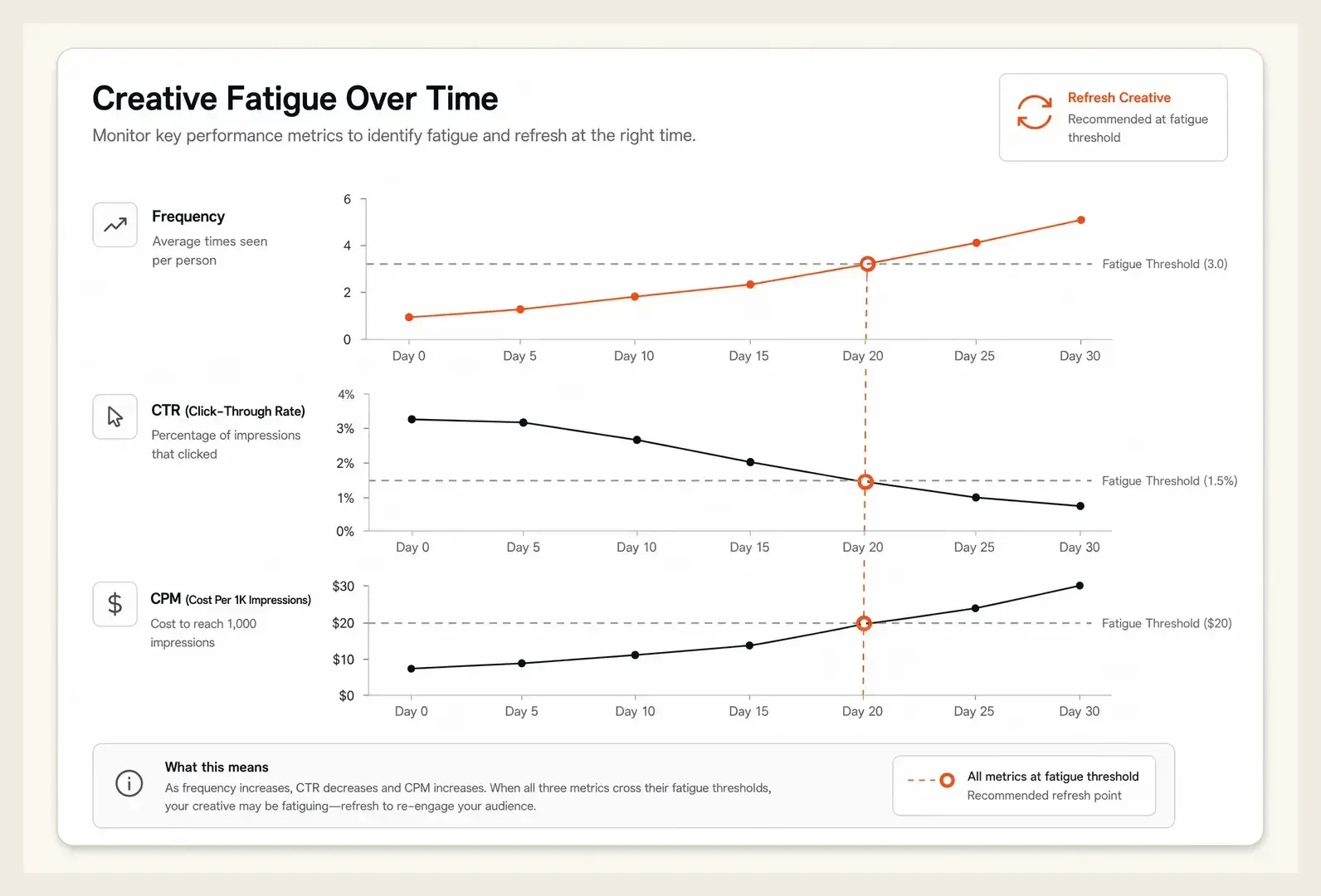
Ad fatigue metrics work by tracking the trajectory of performance for each creative over time rather than its value on any single day. No one number declares fatigue. The pattern across several signals does.
- Frequency: the average times each user has seen the ad. Rising frequency is the leading indicator, and trouble usually starts above 3 to 5 per week.
- Click-through rate trend: a steady decline in CTR on a stable audience signals the creative is losing its pull.
- Cost trend: rising CPM and cost per result on an unchanged setup point to the algorithm charging more for waning attention.
- Engagement decay: falling engagement rate, saves, and shares show the message no longer lands.
The skill is reading these together. Frequency alone can be fine if CTR holds, but frequency climbing while CTR falls and cost rises is the classic fatigue signature that calls for a refresh.
Formula
The single most-watched ad fatigue metric is frequency, calculated per audience over a time window.
Frequency = Total Impressions / Unique Reach
Typical fatigue benchmark ranges for paid social:
- Frequency of 1.0 to 2.5 per week: healthy exposure, creative is fresh.
- Frequency of 3.0 to 5.0 per week: caution zone, watch CTR and cost closely.
- Frequency above 5.0 per week: high fatigue risk, refresh is usually overdue.
A complementary signal is the CTR decay rate, the percentage drop in click-through rate from a creative's peak. A fall of 20 to 30 percent from peak CTR on a stable audience is a common trigger to rotate the ad. Benchmarks vary by platform and audience size, so the trend on your own account matters more than any absolute figure.
A Real Example
A DTC supplement brand had a hero video at a 1.8 percent CTR and a $32 CPA. Over three weeks, ad fatigue metrics told the story the blended report hid: frequency climbed from 2.1 to 6.4, CTR fell to 0.9 percent, and CPA rose to $51. The audience had simply seen it too many times.
Reading the signals, the team refreshed the creative with new hooks built on the same proven angle, using element-level analysis to keep what worked and swap what had worn out. Frequency reset, CTR recovered to 1.6 percent, and CPA fell back to $34 within two weeks. The metrics did not just diagnose the fatigue, they pinpointed the moment to act before more budget was lost to creative burnout.
Common Mistakes
| ❌ Mistakes | ✅ Better Approach |
|---|---|
| Judge fatigue from blended account averages | Track fatigue metrics per creative, since winners and losers hide inside the blend |
| Watch frequency alone and ignore the cost and CTR trend | Read frequency, CTR decay, and cost together as one fatigue signature |
| Wait for performance to crater before refreshing | Set fatigue thresholds and refresh on the signal, not after the budget is gone |
How Hawky Helps
Hawky turns ad fatigue metrics into action with an agent that watches them continuously. The Creative Agent tracks frequency, CTR decay, and cost trends at the creative level and flags fatigue the moment the signature appears, then generates fresh on-brand variations on the hooks and formats that have historically held performance. Instead of a weekly manual audit, the refresh happens on the signal.
FeatherDB remembers each creative's full fatigue history, so the system knows how fast a given angle wears out and pre-empts the decline. Meanwhile the Performance Agent shifts budget away from fatiguing ads toward fresher winners, so the account stops funding attention it has already lost.
Frequently Asked Questions
What are ad fatigue metrics?
Ad fatigue metrics are the performance signals that show when an audience has seen an ad too often and stopped responding. The core metrics are frequency, click-through rate trend, cost per result trend, and engagement decay. Read together, they reveal when a creative has worn out and a refresh is needed before more budget is wasted on declining attention.
What is a good ad frequency before fatigue sets in?
A weekly frequency of 1.0 to 2.5 is generally healthy, 3.0 to 5.0 is a caution zone, and above 5.0 usually signals high fatigue risk. These are guidelines, not hard limits, because tolerance varies by platform, audience size, and creative quality. The reliable trigger is frequency climbing while click-through rate falls and cost rises at the same time.
How do you measure ad fatigue?
Measure ad fatigue by tracking each creative's trajectory rather than a single day's numbers. Watch frequency rising past 3 to 5 per week, CTR falling 20 to 30 percent from its peak, and CPM or cost per result climbing on an unchanged setup. When those signals move together on a stable audience, the creative is fatiguing and should be refreshed.
How do you fix ad fatigue once metrics show it?
Refresh the creative rather than just expanding the audience, since fatigue is a content problem first. Keep the proven angle and swap the worn elements, using element-level analysis to know which hooks and visuals to change. Rotating in fresh variations resets frequency and typically recovers click-through rate and cost within one to two weeks.
Quick Takeaway
Ad fatigue metrics, led by frequency alongside CTR decay and rising cost, tell you exactly when a winning creative has worn out, so you can refresh on the signal instead of paying to show an ad your audience already ignores.
Catching fatigue ad by ad, then refreshing before the decline compounds, is work agents do far better than a weekly manual review. Ready to hire your first AI performance team? Book Demo