How to Analyze Winning Ads: A Breakdown Framework

To analyze a winning ad, confirm it is really a winner with outcome data, break it into its elements (hook, message angle, visual, CTA, format), isolate which element drove the result, and extract the transferable pattern. A winning ad is not luck; it is a repeatable pattern hiding inside a specific execution. The goal of analysis is to find that pattern so you can build the next winner on purpose.
Most teams admire their winning ads instead of dissecting them, then wonder why the next batch flops. This guide is a framework for deconstructing your own top performers, understanding why they won, and turning that understanding into a repeatable playbook.
What makes an ad a winner?
A winning ad is one that beats your target metric and keeps beating it as spend rises, not one that spiked for a day. The only reliable signal of a winner is sustained outcome performance: ROAS or CPA above target, held across enough spend and time to rule out noise. Engagement and likes feel like winning, but they are proxies, not proof.
Two secondary signals confirm a real winner. Longevity is the clearest tell, because a creative that stays live and scaling for weeks is one the algorithm keeps rewarding with cheap delivery, a proxy signal AdLibrary uses to spot winners. Scaling spend without a collapse in ROAS is the other, since a true winner absorbs more budget while staying profitable.
Be strict about this definition before you analyze anything. Analyzing a false winner teaches you the wrong lesson and pollutes your next brief, so verify the outcome data first. For the metrics that confirm it, see how to measure ad creative performance.
The winning-ad breakdown framework
Analyzing a winner means separating what the ad is from why it worked. Break every winning ad into the same set of elements, so you can compare winners to each other and to your losers on equal terms. The elements are the vocabulary of the analysis.
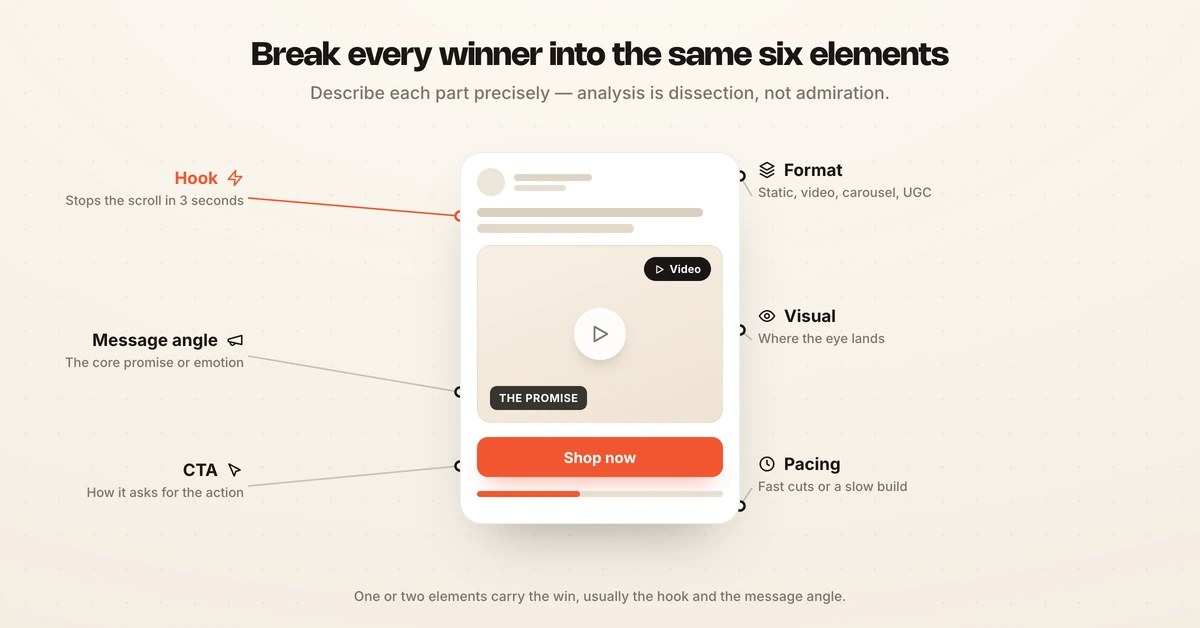
| Element | The question it answers |
|---|---|
| Hook | What stops the scroll in the first 3 seconds? |
| Message angle | What core promise or emotion drives it? |
| Visual | What does the eye land on, and how is it framed? |
| Format | Static, video, carousel, UGC? |
| CTA | How does it ask for the action, softly or strongly? |
| Pacing | Fast cuts or slow build? |
Deconstruct the winner element by element and note what each one is doing. A winner usually has one or two elements carrying most of the load, often the hook and the message angle, because those drive the biggest early performance swings, as Motion's creative benchmarks show. The rest support the star.
The discipline is describing, not admiring. "The hook is a problem stated as a question in the first second, over a fast-cut UGC clip" is analysis. "It's a great ad" is not. Precise description is what makes the pattern transferable. Hawky's Creative Analysis does this breakdown automatically, scoring each element so you see exactly which one carried the win.
Message angles: the frameworks winners use
The message angle is the promise the ad makes, and most winners run one of five proven angles, per creative frameworks catalogued by Madgicx. Naming the angle is often the single most useful output of the analysis, because the angle transfers across products far better than the exact execution does.
- Pain-led: opens on a problem the viewer feels.
- Benefit-led: opens on the outcome or transformation.
- Social proof: leads with reviews, testimonials, or numbers.
- Curiosity: creates an information gap the viewer wants closed.
- Urgency: uses time pressure or scarcity to force action.
Identify which angle your winner uses, then check whether that angle is winning repeatedly across your account. If pain-led hooks consistently outperform benefit-led ones for your audience, that is a durable insight worth building the next brief around. The angle is the pattern; the specific words are just one instance of it.
How to analyze a winning ad, step by step
Turn the framework into a repeatable process. Every time an ad crosses into winner territory, run it through the same five steps.
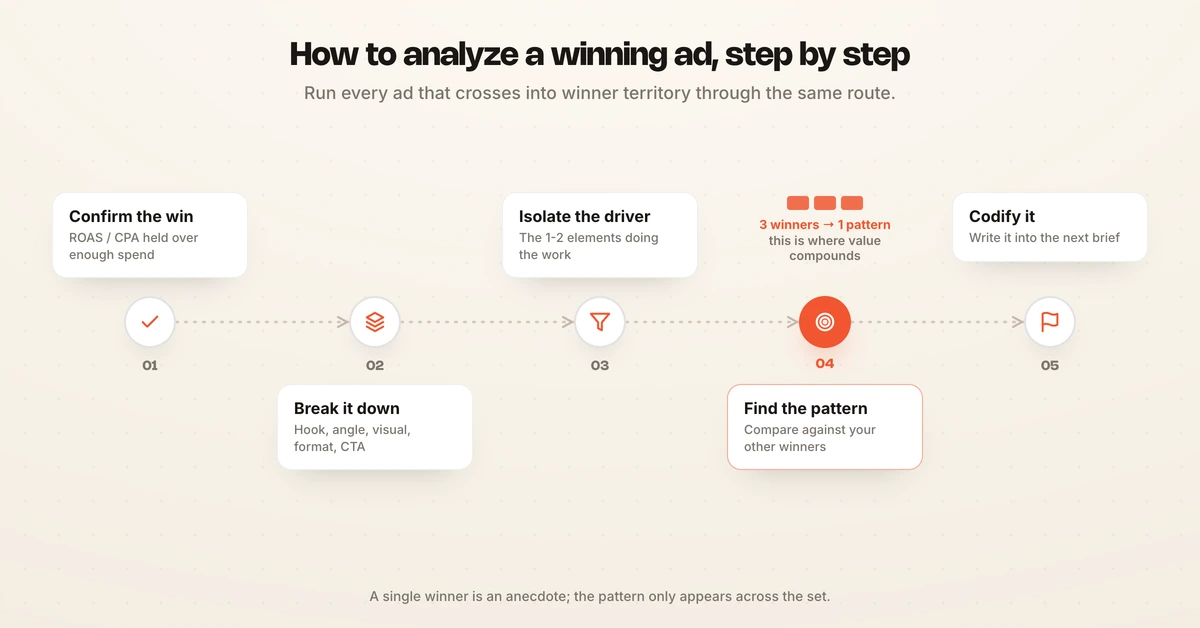
- Confirm the win. Check outcome data (ROAS, CPA) over enough spend and time to rule out noise.
- Break it into elements. Deconstruct hook, angle, visual, format, CTA, and pacing.
- Isolate the driver. Identify the one or two elements doing most of the work.
- Find the pattern. Compare against your other winners to see what they share.
- Codify it. Write the pattern into a brief so the next batch starts from evidence.
The fourth step is where the value compounds. A single winner is an anecdote; three winners sharing a pain-led hook and a UGC format is a pattern you can bet budget on. Analyzing winners in isolation misses the pattern that only appears across them.
Pro tip: keep a running "winners library" of every top performer with its elements tagged, so pattern detection becomes a filter, not a memory exercise.
How to find patterns across your winning ads
Patterns only surface when winners are tagged and compared, not admired one at a time. Tag every winner by its elements (hook type, angle, format, CTA style), then look for the attributes that repeat across the set. The repeating attributes are your account's winning DNA.
This is where analysis becomes strategy. If eight of your last ten winners use social proof in the first three seconds, you have found a rule, not a coincidence, and your next brief should start there. Codify these repeated patterns into Playbooks so the whole team builds from the same evidence instead of re-guessing each cycle.
The compounding payoff is a rising hit rate. Teams that analyze and codify their winners get better at predicting the next one, because every win sharpens the pattern. For the testing system that produces the winners in the first place, see the ad creative testing framework.
Common mistakes when analyzing winning ads
Most winning-ad analysis goes wrong in predictable ways. Avoid these:
- Copying execution, not principle. Cloning the exact ad ages fast; extract the underlying pattern (angle, hook type) and apply it to your own creative.
- Calling winners on early data. A three-day spike is noise. Confirm the win over enough spend before analyzing it.
- Analyzing vanity metrics. Likes and shares are not wins. Anchor the analysis to ROAS and CPA.
- Analyzing winners in isolation. The real insight is the pattern across winners, so always compare against the set.
- Never codifying. An insight that stays in someone's head does not compound. Write it into a brief or playbook.
Frequently asked questions
How do you analyze a winning ad?
Analyze a winning ad by first confirming it is a real winner with outcome data like ROAS and CPA held over enough spend, then breaking it into its elements: hook, message angle, visual, format, CTA, and pacing. Identify which one or two elements drove the result, name the pattern (often the hook style and message angle), and compare it against your other winners to find what they share. Finally, codify that pattern into a brief so the next batch starts from evidence.
What makes an ad a winner?
An ad is a winner when it beats your target metric and keeps beating it as spend rises, not when it spikes for a day. The reliable signal is sustained outcome performance: ROAS or CPA above target across enough spend and time to rule out noise. Longevity (staying live and scaling for weeks) and the ability to absorb more budget without a ROAS collapse confirm it. Engagement metrics like likes are proxies, not proof.
How do you find patterns in top-performing ads?
Find patterns by tagging every winner by its elements (hook type, message angle, format, CTA style) and looking for attributes that repeat across the set. A single winner is an anecdote; three or more winners sharing the same pain-led hook and UGC format is a pattern worth building on. Compare winners against each other rather than analyzing them in isolation, then codify the repeated patterns into a playbook.
What is the difference between analyzing winning ads and getting ad inspiration?
Getting inspiration means collecting ads you like to spark ideas; analyzing winning ads means dissecting proven performers to understand why they worked. Inspiration is about the execution you can see; analysis is about the transferable principle underneath, such as the message angle or hook structure. Inspiration fills a swipe file, analysis fills a playbook, and only the second reliably improves your hit rate.
How many winning ads do you need to spot a pattern?
You need at least three winners sharing an attribute before treating it as a pattern rather than a coincidence. One winner is an anecdote and two could be luck, but three or more top performers using the same message angle, hook type, or format signal a durable rule for your audience. The more winners you tag and compare, the more confident and specific the pattern becomes.
If confirming which ads truly win and extracting the pattern behind them is the problem, Hawky's Creative Analysis is built for that job.
Ready to hire your first AI performance team? Book Demo