Competitive Creative Gap
Last updated
The difference between the volume, variety, and freshness of your ad creative and that of your competitors in the same category. A widening gap quietly turns into lost impressions and rising costs before your own dashboard warns you.
Competitive Creative Gap
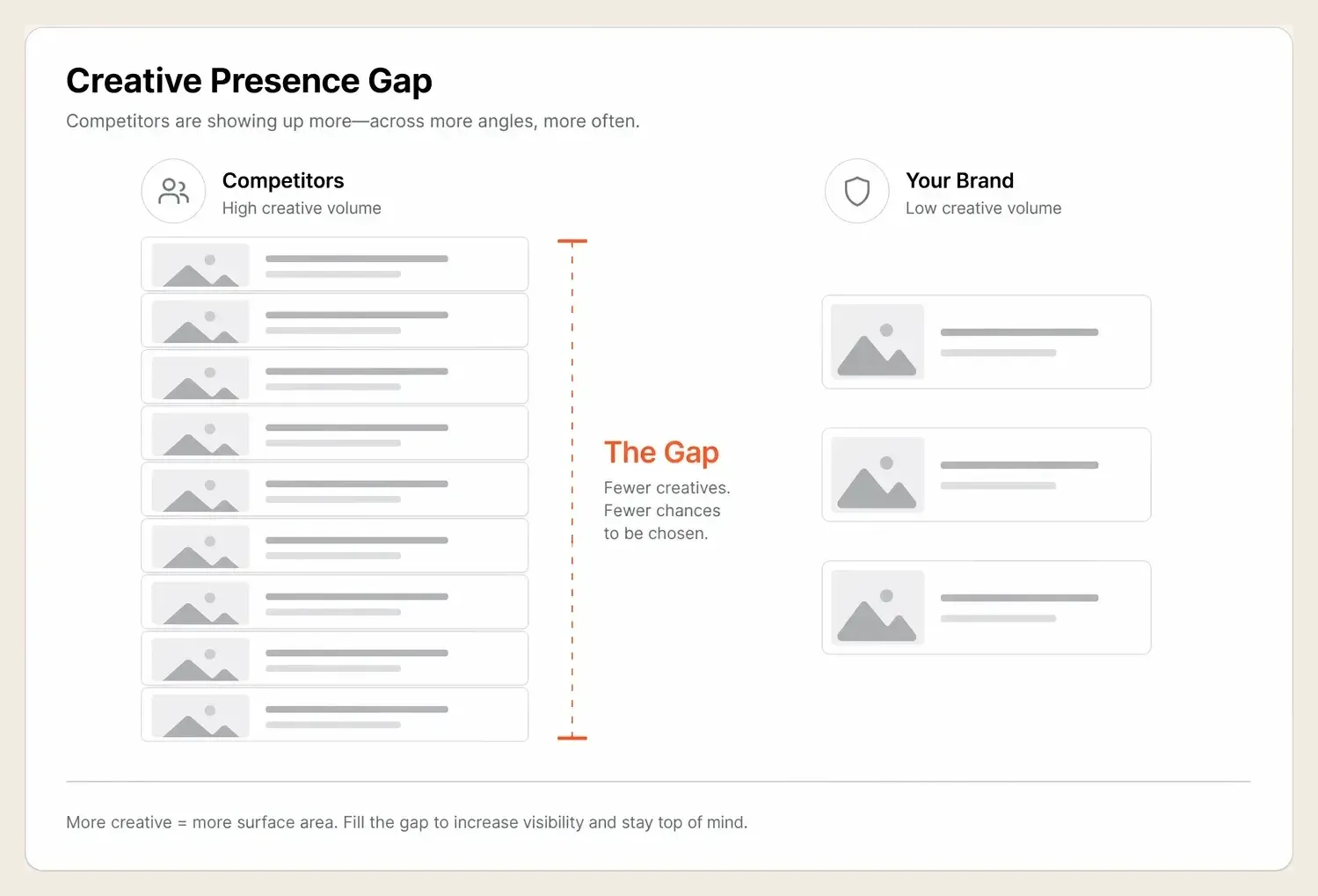
Competitive Creative Gap is the difference between the volume, variety, and freshness of your ad creative and that of your competitors in the same category. It measures how far ahead or behind you are on creative output: how many concepts you test, how fast you refresh, and how many distinct angles you run compared to the brands fighting for the same attention. A widening gap means rivals are feeding the auction more ideas than you are, and the algorithm rewards them for it.
Why It Matters
The competitive creative gap is one of the clearest predictors of who wins paid social over time. Ad platforms reward fresh, varied creative with cheaper distribution, so the advertiser feeding more quality concepts into the system steadily out-delivers the one running a stale handful. Top-performing brands now produce 5 to 10 times more creative variations than they did a few years ago, and creative is responsible for an estimated 56 percent of campaign sales lift, which means a creative gap quickly becomes a performance gap.
The danger is that the gap is invisible on your own dashboard. Your numbers can look fine while a competitor quietly triples their creative velocity, builds a freshness advantage, and starts winning impressions you used to own. By the time your CTR sags and your creative fatigue shows up, the gap has already been compounding for months.
How It Works
Measuring the competitive creative gap means comparing your creative engine to the category, not just auditing your own ads. The signal lives in three dimensions: how much you produce, how varied it is, and how often you refresh.
- Volume: count how many distinct active creatives you run versus what leading competitors keep in rotation across platforms.
- Variety: compare the range of angles, hooks, and formats, since a competitor testing 12 concepts learns faster than one testing 3.
- Freshness: track creative refresh rate against rivals, because the brand that resets fatigued ads sooner holds cheaper distribution.
- Element coverage: use element-level analysis to see which hooks, visuals, and offers competitors cover that you do not.
The gap is rarely about budget. It is about throughput. A smaller advertiser that ships more concepts and refreshes faster can close the gap on a larger one whose creative pipeline cannot keep pace.
A Real Example
A skincare brand was losing share to a competitor despite a comparable budget. A competitive creative gap analysis revealed the cause: the rival kept 40 distinct creatives active and refreshed weekly, while the brand ran 8 and refreshed monthly. The competitor was simply giving the algorithm five times more to optimize.
The brand restructured its pipeline to ship 30 new concepts a month and refresh every 10 days, prioritizing the hook and format types the gap analysis showed it was missing. Within 60 days its creative burnout incidents dropped, average CPM fell 18 percent as the platform rewarded the freshness, and it recovered the impression share it had been bleeding. Closing the throughput gap, not raising spend, reversed the decline.
Common Mistakes
| ❌ Mistakes | ✅ Better Approach |
|---|---|
| Assume more budget closes a creative gap | Increase creative volume, variety, and refresh speed, since the gap is about throughput not spend |
| Compare only your own metrics over time and miss the competitor benchmark | Measure volume and freshness against the category to see the real gap |
| Refresh on a fixed calendar while competitors refresh on fatigue signals | Tie refresh to creative fatigue and competitive pace, not the date |
How Hawky Helps
Hawky closes the competitive creative gap with an agent built to out-produce the category. The Creative Agent generates fresh, on-brand variations at a pace a manual pipeline cannot match, covering the hooks, formats, and angles competitors are running so your rotation stops falling behind. Instead of shipping a handful of concepts a month, the account keeps a deep, varied bench the algorithm can reward.
Copilot reads the competitive intelligence picture to show where rivals are out-producing you, and FeatherDB remembers which angles have already won so new creative builds on proven ground. The Performance Agent then routes budget to the freshest winners, turning higher creative throughput into cheaper distribution.
Frequently Asked Questions
What is a competitive creative gap?
A competitive creative gap is the difference between how much creative you produce, vary, and refresh and what your competitors do in the same category. It captures volume, variety, and freshness rather than a single metric. A negative gap means rivals are feeding the ad auction more quality concepts than you are, which usually turns into a distribution and performance disadvantage over time.
How do you measure a creative gap against competitors?
Measure it across three dimensions: how many distinct creatives you keep active versus competitors, how varied your angles and formats are, and how often you refresh compared to the category. Tools that monitor ad libraries help you count competitor volume and run time. The gap is the distance between your throughput and the leading advertisers in your space, not just changes in your own numbers.
Why does creative volume matter so much for ad performance?
Ad platforms reward fresh, varied creative with cheaper and wider distribution, so the advertiser feeding more quality concepts into the system steadily out-delivers one running a stale few. More variations also mean faster learning about which hooks and formats convert. Since creative drives the majority of campaign performance, throughput often beats budget as the deciding factor.
Can a smaller brand close the creative gap on a bigger competitor?
Yes, because the competitive creative gap is about throughput, not spend. A smaller brand that ships more concepts, tests more angles, and refreshes on fatigue signals can out-learn and out-deliver a larger rival whose creative pipeline is slow. Closing the gap is a question of creative velocity, which is exactly where agentic production changes the math.
Quick Takeaway
The competitive creative gap measures how far your creative volume, variety, and freshness sit ahead of or behind your competitors, and a widening gap reliably turns into lost impressions and rising costs before your own dashboard warns you.
Winning the category comes down to out-producing it on fresh, varied creative, which is a throughput problem agents are built to solve. Ready to hire your first AI performance team? Book Demo