Predictive Analytics
Last updated
The use of historical data and machine learning to forecast future outcomes like which ad will fatigue or which audience will convert. It shifts ad management from reacting after the metrics drop to acting before they do.
Predictive Analytics
Predictive analytics is the use of historical data, statistical models, and machine learning to forecast future outcomes, such as which ad will perform, which customer will convert, or which campaign will hit its target. In advertising, it shifts decisions from reacting to yesterday's results toward anticipating tomorrow's, so budget, creative, and bids can be set before the data fully arrives. Done well, it lets marketers act on likely outcomes instead of waiting for certainty that comes too late to matter.
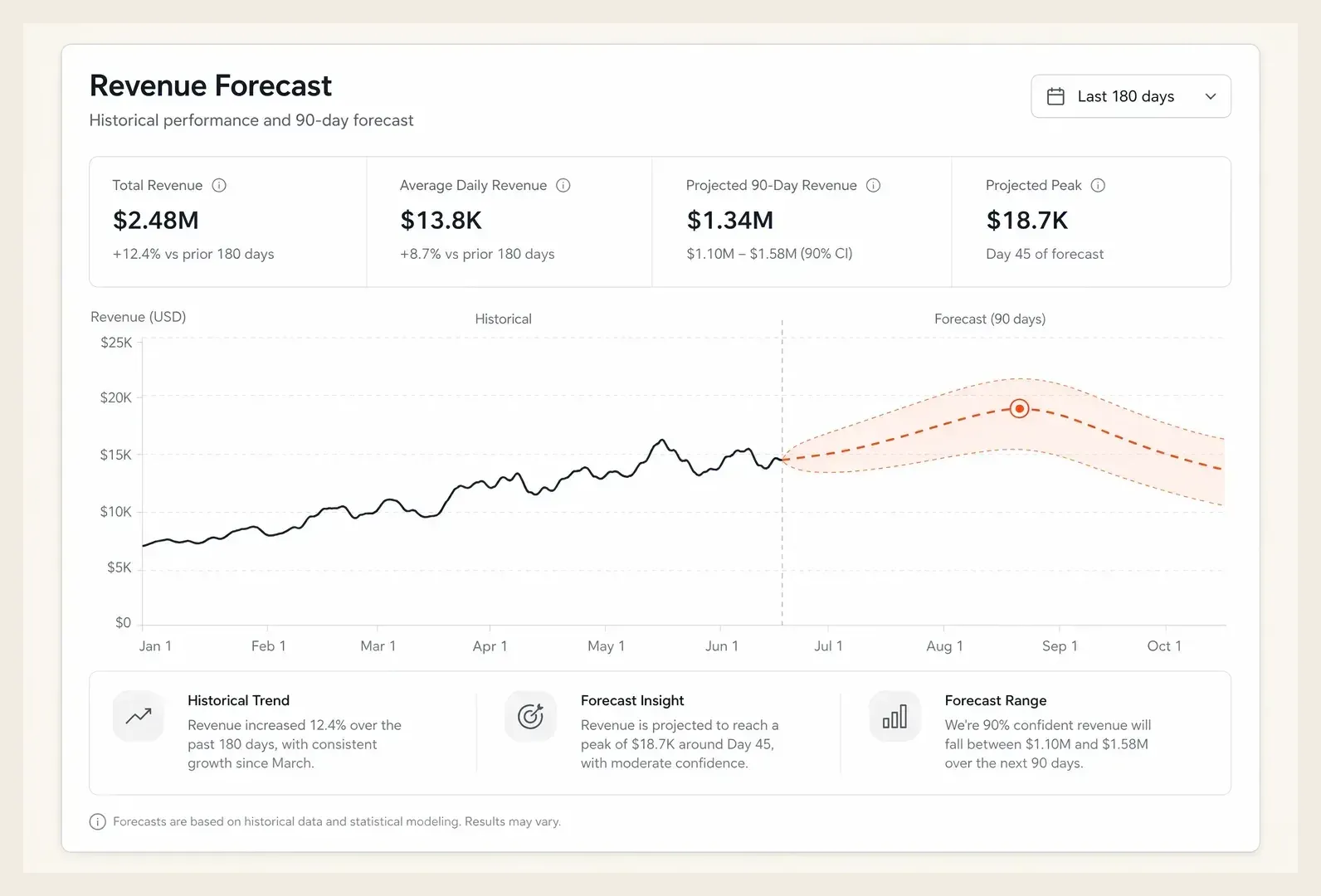
Traditional reporting tells you what already happened. Predictive analytics takes that same history and uses patterns within it to estimate what is likely next, with a measure of confidence attached. It does not promise certainty, it assigns probability, which is exactly what a marketer needs to make a budget call before a campaign has fully matured.
Why It Matters
Most ad spend is committed before the outcome is known, which makes forecasting the difference between proactive and reactive management. When you can estimate that a creative is likely to fatigue within ten days, or that an audience will saturate at a given frequency, you can act before performance drops rather than after the money is spent. That timing advantage compounds across every decision in the account.
The market reflects how valuable this has become. The predictive analytics field has been valued in the billions of dollars and is widely projected to keep growing at strong double digit annual rates, driven heavily by marketing and advertising use cases. The reason is leverage. Reacting to a CPA spike after a week of overspend is expensive, while anticipating it and reallocating early protects margin. Pairing prediction with machine learning in advertising is what turns a historical dashboard into a forward-looking decision engine.
How It Works
Predictive analytics works by learning patterns from historical data, then applying those patterns to new situations to estimate a future result with a confidence level.
- Collect clean historical data. Past campaign performance, creative attributes, audience behavior, and conversion outcomes form the training base.
- Build or apply a model. Statistical methods and machine learning find the relationships between inputs and outcomes, such as which creative traits predict early fatigue.
- Generate a forecast with confidence. The model outputs a probability, like a likely conversion rate range or a fatigue window, not a single guaranteed number.
- Act and feed back. Decisions made on the forecast produce new outcomes, which retrain the model and sharpen the next prediction.
The detail that separates useful prediction from false confidence is data quality and feedback. A model trained on thin or messy data forecasts poorly, and a model that never sees the results of its own predictions cannot improve. The accounts that benefit most treat prediction as a loop, where every outcome makes the next forecast a little more accurate.
A Real Example
A subscription brand spends $40,000 a month and historically reacts to creative fatigue only after CTR has already fallen, which usually costs them a week of inflated CPA before they refresh. They start using predictive signals built on their own performance history to estimate when each creative is likely to fatigue based on frequency, engagement decay, and past patterns.
The model flags that their top performer is likely to fatigue within eight days, well before the metrics visibly drop. The team briefs a refresh in advance, so the new creative is ready to launch the day performance starts to dip rather than a week later.
Over the next quarter, anticipating fatigue instead of reacting to it cuts their wasted spend on declining creative by roughly 30 percent, and blended CPA holds steadier because the account never sits in the expensive gap between fatigue and refresh. The forecast did not need to be perfect. It only needed to be early enough to act on, which is the entire point of prediction.
Common Mistakes
| ❌ Mistakes | ✅ Better Approach |
|---|---|
| Treat a forecast as a guaranteed number | Read predictions as probabilities with confidence and plan for a range of outcomes |
| Train models on thin or messy historical data | Feed clean, structured performance history so the forecast has real patterns to learn from |
| Make a prediction and never check the result | Close the loop so every outcome retrains the model and sharpens the next forecast |
How Hawky Helps
Prediction only matters if something acts on it in time, and Hawky's Performance Agent does exactly that, anticipating shifts in performance and reallocating budget or flagging refreshes before a decline shows up in the dashboard. Instead of forecasts living in a report nobody acts on, the agent treats them as triggers and moves the account proactively.
The forecasting depends on memory, and FeatherDB is the living context the agents read and write, holding the account's full performance history so predictions are grounded in what actually happened in this account rather than generic benchmarks. The Creative Agent uses those forward-looking signals to prepare fresh creative ahead of fatigue, so the account is acting on tomorrow's likely outcome today.
Frequently Asked Questions
What is predictive analytics in advertising?
Predictive analytics in advertising uses historical campaign data and machine learning to forecast future outcomes, such as which creative will fatigue, which audience will convert, or where a campaign is heading. It lets marketers act on likely results before the full data arrives, shifting management from reactive to proactive.
How is predictive analytics different from regular reporting?
Regular reporting describes what already happened, while predictive analytics estimates what is likely to happen next, with a confidence level attached. Reporting is a rear-view mirror, and prediction is a forward-looking signal you can act on before an outcome is locked in.
What data do you need for predictive analytics?
You need clean, structured historical data, including past campaign performance, creative attributes, audience behavior, and conversion outcomes. The quality of that history directly determines forecast accuracy, since a model can only learn patterns that exist in the data it is trained on.
Is predictive analytics accurate enough to act on?
Predictive analytics produces probabilities, not certainties, so it is accurate enough to act on when treated as a confidence-weighted signal rather than a guarantee. A forecast that is directionally right and early is far more valuable than a precise number that arrives too late to change the decision.
Quick Takeaway
Predictive analytics turns historical data into forward-looking forecasts of likely outcomes, letting marketers act before performance shifts instead of after, which is why the field keeps growing fastest in advertising use cases.
When your account only reacts after the metrics drop, an agent should be acting on the forecast before they do. Ready to hire your first AI performance team? Book Demo