Competitor ad analysis is the systematic process of studying rivals' ads to reverse-engineer their strategy, identify what is working, and find the gaps you can exploit. The framework is five steps: gather their ads, categorize them, analyze the elements, benchmark against your own, and act. Run consistently, it lifts ad performance 20 to 40% for a few hours of work per week.
Most teams glance at a competitor's ads once and move on. That is not analysis, it is browsing. This guide gives you a repeatable framework for turning competitor ads into a real strategic edge, from where to find the ads to what to look for and how to benchmark.
What is competitor ad analysis?
Competitor ad analysis is the practice of monitoring, documenting, and reverse-engineering the advertising strategies of your competitors across platforms like Meta, Google, and TikTok. The goal is not to copy, but to understand what your rivals are betting on, what is working for them, and where they are leaving room you can take.
The value comes from consistency, not one-off deep dives. Teams that build competitor research into their creative process see 20 to 40% improvements in ad performance, for a modest investment of two to four hours a week. The returns compound as your understanding of the competitive landscape deepens.
Done right, competitor analysis answers three questions: what are rivals running, what is working for them, and where is the gap. The first is easy to see, the second takes inference, and the third is where the strategic advantage lives.
Where to find competitor ads
You cannot analyze what you cannot see, and the good news is that most competitor ads are now public and free. A free stack of ad libraries covers roughly 80% of what most teams need.
- Meta Ad Library: every active Facebook and Instagram ad, searchable by advertiser.
- Google Ads Transparency Center: verified advertisers' live Search, YouTube, and Display ads.
- TikTok Creative Center: category top ads and trends, plus the TikTok Ads Library for specific brands.
For deeper archives, estimated spend, and historical data, add a paid layer with ad spy tools. The free libraries tell you what is running now; paid tools add history and scale. Start free, and only pay for the depth you will actually use.
The competitor ad analysis framework
A useful analysis follows the same five steps every time, so you build a consistent picture rather than a scattered one. The steps turn scattered browsing into intelligence.
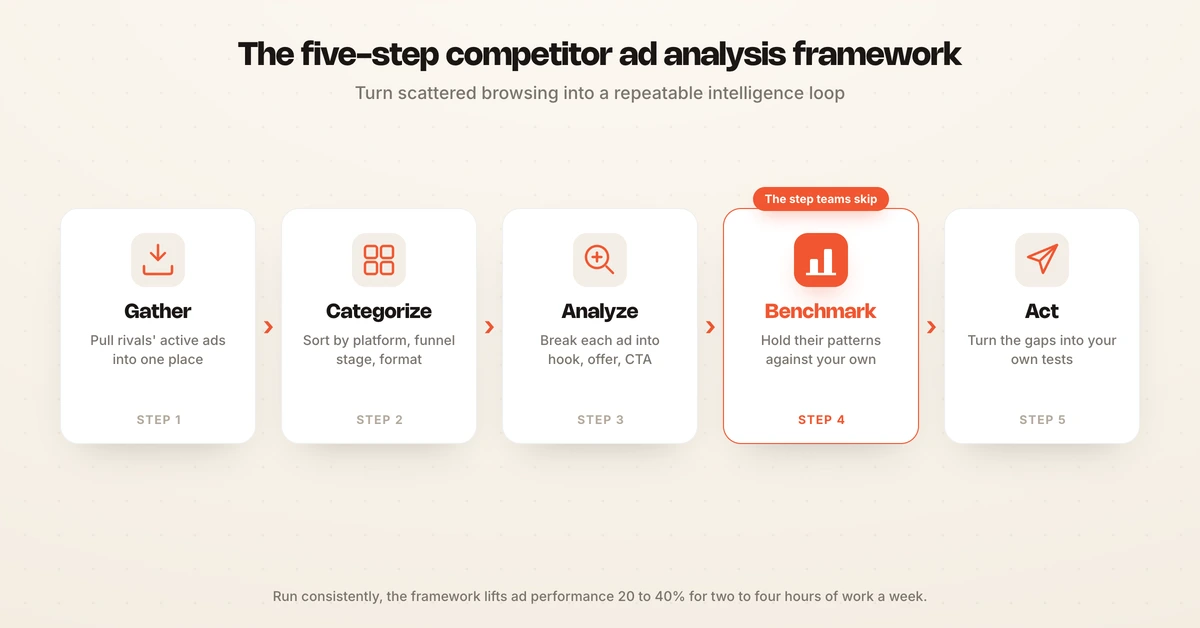
- Gather: pull each competitor's active ads from the libraries above into one place.
- Categorize: sort by platform, funnel stage, and format so you can compare like with like.
- Analyze: break each ad into elements (hook, offer, CTA, format) and note what it is doing.
- Benchmark: compare their patterns against your own account to find gaps and overlaps.
- Act: turn the gaps into hypotheses and test them in your own creative.
The step teams skip is benchmarking. Seeing a competitor's ad is only useful when you hold it against your own, because the insight is in the difference: they run three times your creative volume, or lead with a guarantee you do not offer, or own a channel you ignore.
What to look for in competitor ads
The most actionable signals in competitor ads are longevity, messaging patterns, and testing intensity. Focus on these rather than trying to note everything.
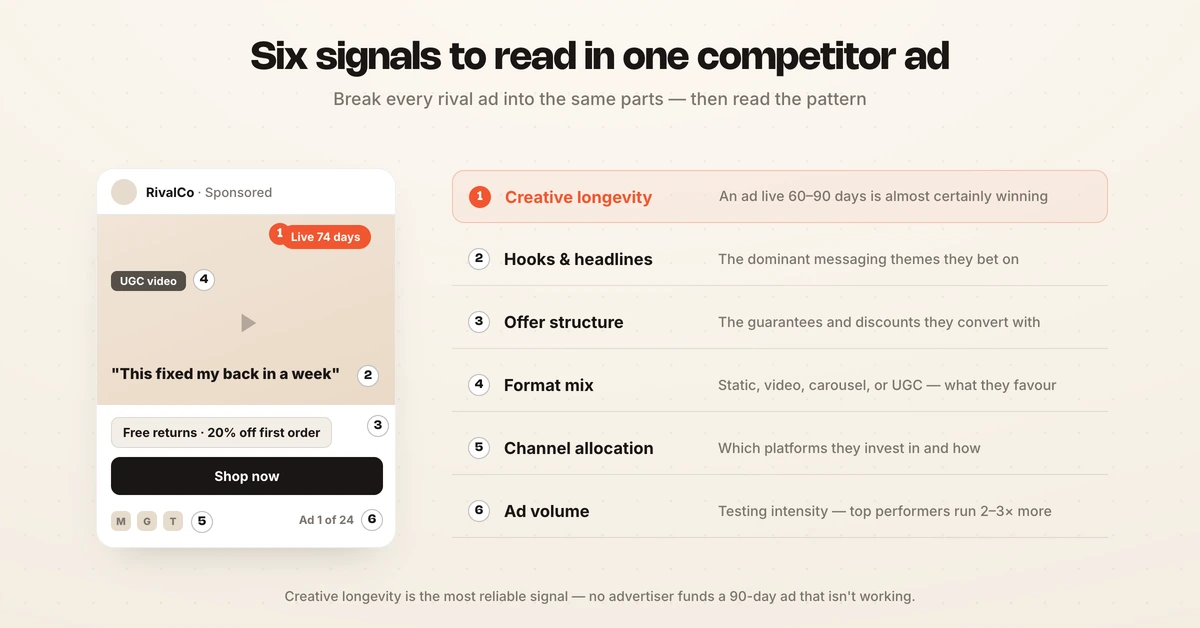
| Signal | What it tells you |
|---|---|
| Creative longevity | An ad live 60 to 90 days is almost certainly winning |
| Hooks and headlines | The dominant messaging themes they bet on |
| Offer structure | The incentives they use to convert (guarantees, discounts) |
| Format mix | Whether they favor static, video, carousel, or UGC |
| Channel allocation | Which platforms they invest in and how they adapt |
| Ad volume | Testing intensity: top performers run 2 to 3x more variations |
Creative longevity is the single most reliable signal, because no advertiser keeps an ad running for 60 or 90 days unless it is generating returns, per AdMapix. Ad volume is the second: if a rival runs three times your creative variations, they are testing three times faster, which is a structural advantage worth matching, and Motion's competitor research points to the same volume gap between top and average advertisers. Watch for change most of all, since a new offer or a ramped format signals where they are placing new bets.
How to benchmark against competitors
Benchmarking turns observation into a scorecard. Line up your account against each competitor on the signals above and look for the gaps. The gaps are your roadmap.
Compare creative longevity to spot whether you are abandoning winners too early or failing to iterate on proven concepts. Compare ad volume to see if your testing cadence is keeping pace. Compare offers and messaging to find angles they own that you do not, and angles nobody has claimed. Each gap is a hypothesis you can test rather than a guess.
Set a cadence and keep it. The most valuable competitive intelligence comes from consistent observation over time, so schedule a weekly or bi-weekly review where you note new ads, longest-running ads, and changes in direction, per AdLibrary. A one-time audit ages instantly; a running record compounds.
Common competitor analysis mistakes
Most competitor analysis goes wrong in predictable ways. Avoid these:
- Copying instead of learning. Cloning a competitor's ad ages fast and cedes them the lead. Extract the principle and apply it to your own angle.
- One-time audits. A single deep dive is stale in weeks. Value comes from consistent weekly observation.
- Ignoring longevity. Judging ads by how they look misses the real signal. A long-running ad is the one to study.
- Analyzing without benchmarking. Competitor data is only useful held against your own account. Always compare.
- Tracking everything. Trying to note every detail buries the signal. Focus on longevity, messaging, and volume.
Tools that make competitor analysis easier
Competitor analysis scales from free to automated depending on how many rivals you track.
- Free ad libraries (Meta Ad Library, Google Ads Transparency Center, TikTok Creative Center) cover most needs for a handful of competitors.
- Ad spy tools (PipiAds, BigSpy, Minea) add historical archives and estimated spend for deeper research.
- Hawky automates the ongoing work: Competitor Analysis maintains a searchable repository across Meta, Google, and TikTok, flags weekly what changed in rivals' hooks and offers, and feeds those gaps into your own creative through the Creative Agent. Hiveminds cut CPL by 27% and saved 160+ hours per brand monthly running this way.
For learning specifically from rivals' creative, see competitor creative analysis.
Frequently asked questions
How do you analyze competitor ads?
Analyze competitor ads with a five-step framework: gather their active ads from free libraries like the Meta Ad Library and Google Ads Transparency Center, categorize by platform and format, analyze each ad's elements (hook, offer, CTA), benchmark the patterns against your own account, and act by testing the gaps you find. Run it on a weekly or bi-weekly cadence, since consistent observation reveals strategy shifts that one-off audits miss.
What should you look for in competitor ads?
Focus on creative longevity, messaging patterns, and testing intensity. An ad running 60 to 90 days is almost certainly winning, so it is the one to study. Note the dominant hooks and headlines, the offer structure they use to convert, their format and channel mix, and their ad volume, since top performers run two to three times more creative variations. Above all, watch for change, because a new offer or ramped format signals a new bet.
How do you benchmark against competitor ads?
Benchmark by lining up your account against each competitor on the same signals: creative longevity, ad volume, offers, and channel mix. Compare longevity to see if you abandon winners too early, compare volume to check your testing pace, and compare offers to find angles they own or nobody has claimed. Each gap becomes a testable hypothesis. Keep a running record over time so the benchmark reflects current strategy, not a stale snapshot.
How often should you analyze competitor ads?
Analyze competitor ads on a weekly or bi-weekly schedule rather than as a one-off project. The most valuable intelligence comes from consistent observation that reveals when a competitor changes their offer, ramps a format, or enters a new channel. A structured review takes only two to four hours a week, and teams that maintain it see 20 to 40% improvements in ad performance as the insights compound.
Is competitor ad analysis legal?
Yes. Competitor ad analysis uses publicly available ads that platforms deliberately make visible through the Meta Ad Library, Google Ads Transparency Center, and TikTok Creative Center. You are studying ads that are already public, not accessing private data. The line to respect is learning from patterns versus copying creative directly, since cloning ads can raise trademark and copyright issues and rarely works as well as an original execution.
If tracking competitor ads across Meta, Google, and TikTok and turning their gaps into your own creative without manual checking is the problem, Hawky's Competitor Analysis is built for that job.
Ready to hire your first AI performance team? Book Demo