Ad Spend Allocation
Last updated
Ad spend allocation is the process of dividing a fixed budget across campaigns, ad sets, audiences, and platforms to maximize total return. Most wasted spend is good money left in the wrong place too long, so allocation decides where a budget is won or lost.
Ad Spend Allocation
Ad spend allocation is the process of dividing a fixed advertising budget across campaigns, ad sets, audiences, and platforms to maximize total return. It answers the constant question of where the next dollar should go, given that every channel and audience has a different and shifting efficiency. Strong allocation moves budget toward what is working and away from what is not, fast enough to matter while the result is still earnable.
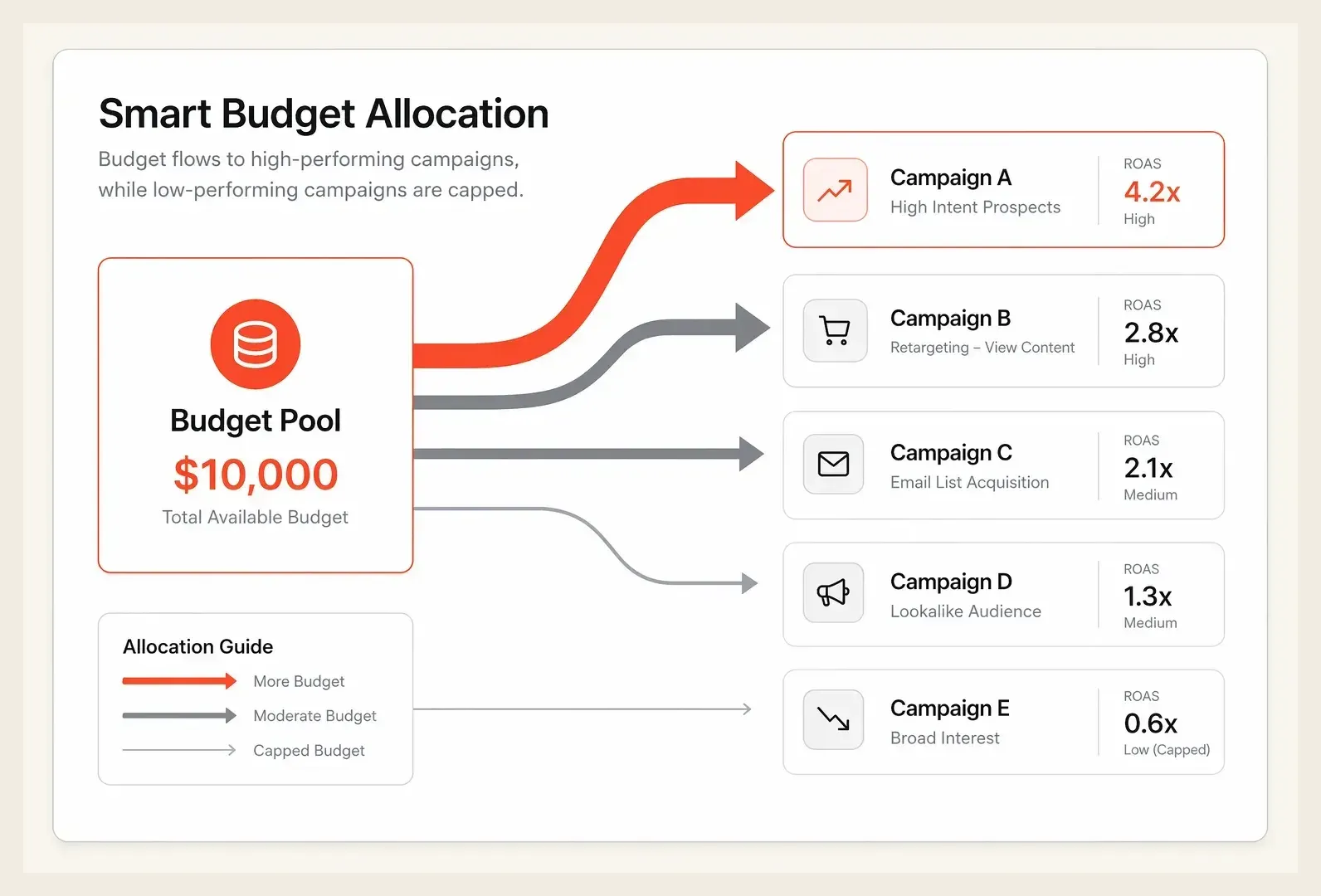
Why It Matters
Allocation is where a budget is won or lost, because the same spend can return wildly different results depending on how it is split. Two accounts with identical budgets and creative will diverge entirely based on whether budget chases efficiency or sits frozen in underperforming ad sets. Most wasted spend is not bad creative, it is good money left in the wrong place too long.
The cost of slow allocation compounds daily. Industry analyses of paid accounts routinely find that 20 to 30 percent of budget sits in underperforming campaigns at any given time, dragging blended ROAS down while better-performing ad sets stay capped. Tightening allocation recovers that spend without raising the budget. It is the closest thing to free performance an account has.
Allocation is also a speed problem. By the time a weekly report flags a winning ad set, the window to scale it has often already narrowed.
How It Works
Allocation works by ranking every campaign, ad set, and audience on a true efficiency metric, then routing budget toward the strongest performers while respecting the limits of what each can absorb. The discipline is matching dollars to where they earn the most incremental result right now.
- Rank on the real KPI: judge spend on ROAS or CPA tied to actual revenue, not last-click vanity or surface clicks.
- Respect saturation: a winning audience has a ceiling, so piling budget past its reach limit only inflates frequency and cost.
- Account for the learning phase: shifting budget too aggressively can reset delivery, so changes are paced, not whiplashed.
- Watch overlap and pacing: budget split across overlapping audiences buys frequency, and uneven budget pacing can blow the day's spend before peak hours.
A Real Example
A fashion retailer runs five campaigns on a $50,000 monthly budget, split evenly at $10,000 each. Two campaigns return a 4.2 ROAS, two return 2.1, and one returns 1.3. The even split feels fair but leaves money in the weakest campaigns while the winners stay capped.
The team reallocates: the two 4.2 ROAS campaigns rise to $16,000 each, the middle pair holds, and the 1.3 ROAS campaign drops to $2,000 while its creative is reworked. Blended ROAS climbs from 2.8 to 3.6 on the same $50,000, lifting monthly revenue by tens of thousands of dollars. Nothing new was launched. Budget simply moved toward proven efficiency and away from waste.
Common Mistakes
| ❌ The Wrong Way | ✅ The Better Way |
|---|---|
| Splitting budget evenly across campaigns to feel fair | Rank on true ROAS or CPA and fund the proven winners |
| Leaving spend in a losing ad set hoping it turns around | Cut or cap underperformers fast and redeploy the budget |
| Dumping budget onto a winner past its audience ceiling | Scale within the reach limit to avoid frequency burn |
| Reallocating only at the monthly review | Adjust continuously so winners scale while the window is open |
How Hawky Helps
Hawky operates the account with agents that allocate spend continuously instead of reporting on it weekly. The Performance Agent ranks every campaign and ad set on the KPI that maps to revenue, then shifts budget toward the performers still returning incremental results and pulls it off the ones that have stalled or saturated. It paces moves to protect the learning phase, so reallocation sharpens delivery rather than resetting it.
When an underperforming campaign is held back by tired creative rather than a bad audience, the Creative Agent ships fresh assets so that spend becomes worth keeping. Both agents read and write to FeatherDB, the account's living memory, which retains each audience's saturation ceiling and historical efficiency so allocation decisions are grounded in what actually worked before.
Frequently Asked Questions
What is ad spend allocation?
Ad spend allocation is how a fixed advertising budget is divided across campaigns, ad sets, audiences, and platforms to maximize total return. It is the ongoing decision of where the next dollar should go, given that each channel and audience has a different and shifting efficiency. Good allocation moves money toward proven performers and away from waste fast enough to capture the result.
How should I allocate my ad budget across campaigns?
Allocate budget by ranking every campaign on a revenue-tied metric like ROAS or CPA, then funding the strongest performers up to the point where their audience saturates. Cap or cut campaigns that consistently underperform and redeploy that spend to winners or to reworked creative. Avoid splitting evenly for fairness, since that strands budget in weak campaigns while the best ones stay capped.
What percentage of budget should go to testing?
A common practice is to reserve roughly 10 to 20 percent of the budget for testing new audiences, creative, and channels, with the remainder on proven performers. The exact share depends on how mature the account is, since newer accounts test more aggressively to find winners. The key is keeping a deliberate testing reserve so the account never stops feeding fresh winners into the allocation pool.
How is ad spend allocation different from budget pacing?
Ad spend allocation decides how budget is divided across campaigns and audiences, while budget pacing controls how evenly that allocated budget is spent over time within a day, week, or flight. Allocation is the where, pacing is the when. Both matter, because perfect allocation can still be undermined if pacing burns the budget before peak conversion hours.
Quick Takeaway
Ad spend allocation is the continuous decision of where budget earns the most, and most wasted spend is good money left in the wrong place too long. Rank on real efficiency, fund the winners within their limits, and move fast enough to catch the result.
Watching budget sit in underperforming campaigns while your winners stay capped? Ready to hire your first AI performance team? Book Demo