Campaign Structure
Last updated
Campaign structure is how an ad account is organized into campaigns, ad sets, and ads, governing how the algorithm learns, how budget flows, and how clearly results read. Over-fragmentation is the most common silent drag on performance, so consolidate enough to feed the learning phase.
Campaign Structure
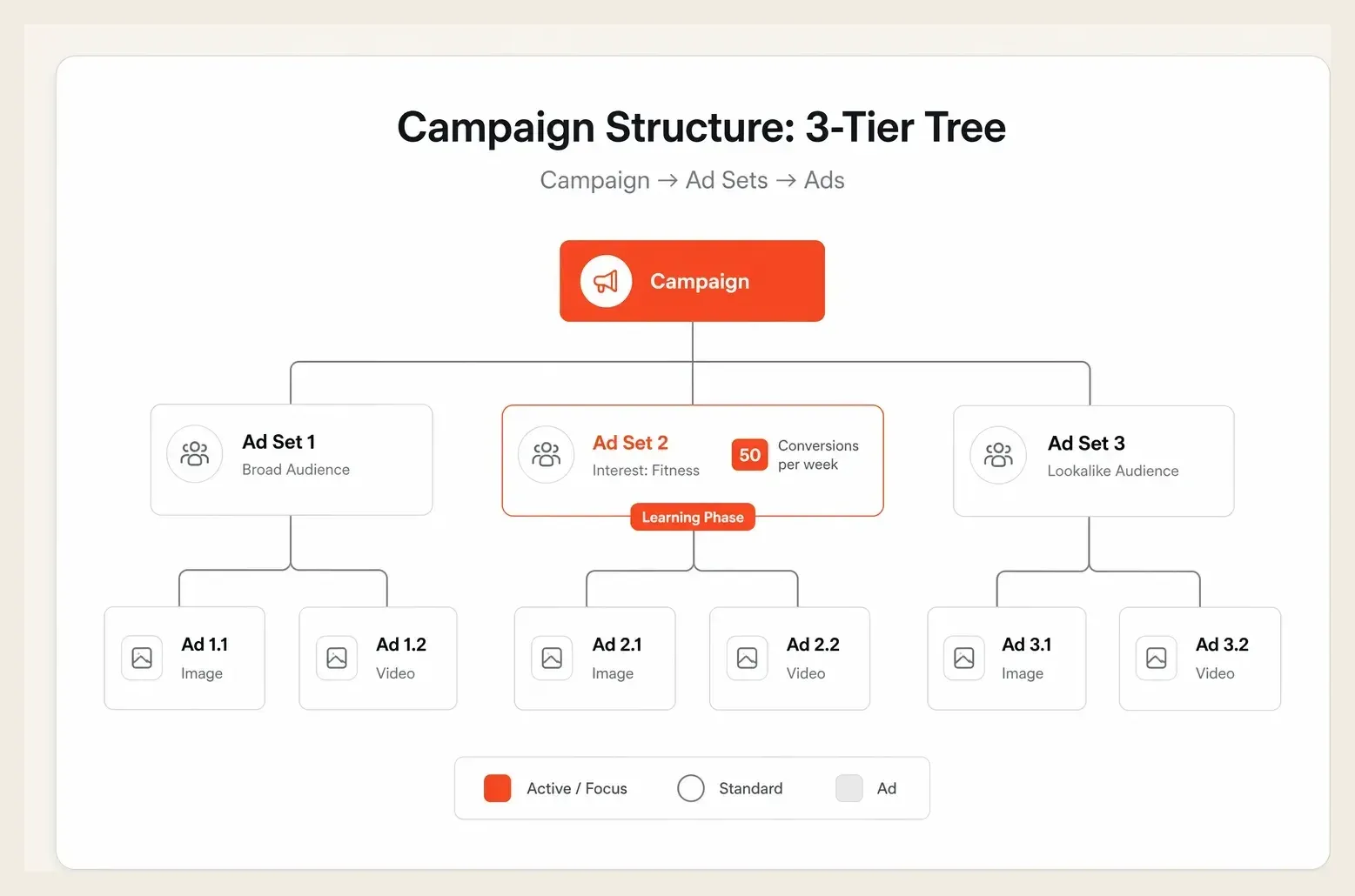
Campaign structure is the way an ad account is organized into campaigns, ad sets, and ads, defining how objectives, budgets, audiences, and creative are grouped and controlled. On Meta this is the three-tier hierarchy of campaign (objective), ad set (audience and budget), and ad (creative), and most platforms follow a similar shape. A clean structure determines how efficiently the platform's algorithm can learn, how budget flows, and how clearly results can be read.
Why It Matters
Structure is the foundation every other optimization sits on, because it governs how the platform's machine learning gathers signal. Split a budget across too many tiny ad sets and each one starves for the conversions it needs to exit the learning phase, so delivery stays unstable and costs stay high. Consolidate thoughtfully and the algorithm learns faster, stabilizes sooner, and spends more efficiently.
The benchmark is concrete. Meta's delivery system needs roughly 50 conversions per ad set per week to exit the learning phase and optimize reliably, and ad sets that never reach it tend to run at higher, noisier CPA. Over-fragmented accounts routinely leave most ad sets stuck below that threshold, which is why structural cleanup alone often lifts performance before a single creative or bid changes.
Structure also decides clarity. A logical hierarchy makes it obvious which audience, creative, and placement drove a result, while a tangled one hides the signal you need to act on.
How It Works
Campaign structure works by organizing the account into a hierarchy where each tier controls a distinct lever, so the platform can allocate budget and learn cleanly. The aim is enough consolidation to feed the algorithm signal, with enough separation to keep results readable.
- Campaign level: sets the objective (conversions, traffic, awareness) and increasingly the budget through campaign budget optimization.
- Ad set level: defines the audience, placements, and often the budget, and is where the learning phase and reach ceiling live.
- Ad level: holds the creative, where ad creative variation is tested against the same audience.
- Consolidation versus granularity: fewer, larger ad sets help exit learning faster, while granular splits aid diagnosis but risk starving signal and adding custom audience overlap.
A Real Example
A supplement brand runs 12 ad sets, each with its own narrow interest audience and a $20 daily budget. None reaches 50 weekly conversions, so every ad set sits permanently in the learning phase, delivery is erratic, and blended CPA is $52.
The team restructures into three broad ad sets at $80 a day each, letting the algorithm find buyers across a larger pool, with creative variation tested at the ad level. Within two weeks all three ad sets clear the learning phase, delivery stabilizes, and CPA drops to $34 on the same total budget. The audiences and creative barely changed. Consolidating the structure simply gave the algorithm the signal density it needed to optimize.
Common Mistakes
| ❌ The Wrong Way | ✅ The Better Way |
|---|---|
| Splitting budget across many tiny, narrow ad sets | Consolidate into fewer, broader ad sets that clear the learning phase |
| Stacking overlapping audiences that compete in the same auction | Separate audiences cleanly to avoid self-competition and overlap |
| Testing creative by duplicating whole campaigns | Test ad creative variation at the ad level within one ad set |
| Mixing objectives and audiences with no naming logic | Keep a clear hierarchy so each result traces to its driver |
How Hawky Helps
Hawky operates the account with agents that act on structure rather than just charting its results. The Performance Agent watches whether ad sets are clearing the learning phase, flags fragmentation that starves the algorithm, and consolidates or separates audiences so budget flows where signal is densest. It manages ad spend allocation and budget pacing across the hierarchy, so the structure stays efficient as performance shifts instead of calcifying.
At the ad level, where structure meets creative, the Creative Agent supplies fresh variations to test within a stable ad set rather than spawning new campaigns that re-fragment the account. Both agents read and write to FeatherDB, the account's living memory, which retains which structural configurations historically cleared learning and held efficient, so each restructure builds on what already worked.
Frequently Asked Questions
What is campaign structure in advertising?
Campaign structure is how an ad account is organized into campaigns, ad sets, and ads, with each tier controlling objectives, audiences and budget, or creative. On Meta it is the campaign, ad set, and ad hierarchy, and most platforms use a similar three-level shape. The structure governs how the algorithm learns, how budget flows, and how clearly results can be attributed.
How many ad sets should a campaign have?
There is no fixed number, but the guiding rule is that each ad set should be able to reach roughly 50 conversions per week so it can exit the learning phase and optimize reliably. That usually means fewer, broader ad sets rather than many narrow ones, especially on smaller budgets. Over-fragmenting an account starves each ad set of the signal the algorithm needs.
What is the difference between a campaign, an ad set, and an ad?
A campaign sets the objective and increasingly the budget, an ad set defines the audience, placements, and often the budget, and an ad holds the creative shown to users. Each tier controls a distinct lever, which is why audiences are tested at the ad set level and creative is tested at the ad level. Keeping these responsibilities separate is what makes results readable and optimization clean.
Should I use one campaign or multiple campaigns?
Favor consolidation, since fewer campaigns and ad sets concentrate conversions and help the algorithm exit the learning phase faster, which lowers CPA. Multiple campaigns make sense when objectives genuinely differ, such as separating prospecting from retargeting, or when budgets must be protected from each other. The default should be the simplest structure that still gives each objective enough signal to optimize.
Quick Takeaway
Campaign structure is the hierarchy of campaigns, ad sets, and ads that decides how the algorithm learns and how budget flows, and over-fragmentation is the most common silent drag on performance. Consolidate enough to feed the learning phase, separate enough to read results, and efficiency follows.
Watching ad sets stall in the learning phase and CPA stay stubbornly high? Ready to hire your first AI performance team? Book Demo