In-Stream Video Ads
Last updated
In-Stream Video Ads are video ads that play before, during, or after other video content on platforms like YouTube and Facebook, capturing committed sound-on attention where the first five seconds decide whether the view is earned or skipped.
In-Stream Video Ads
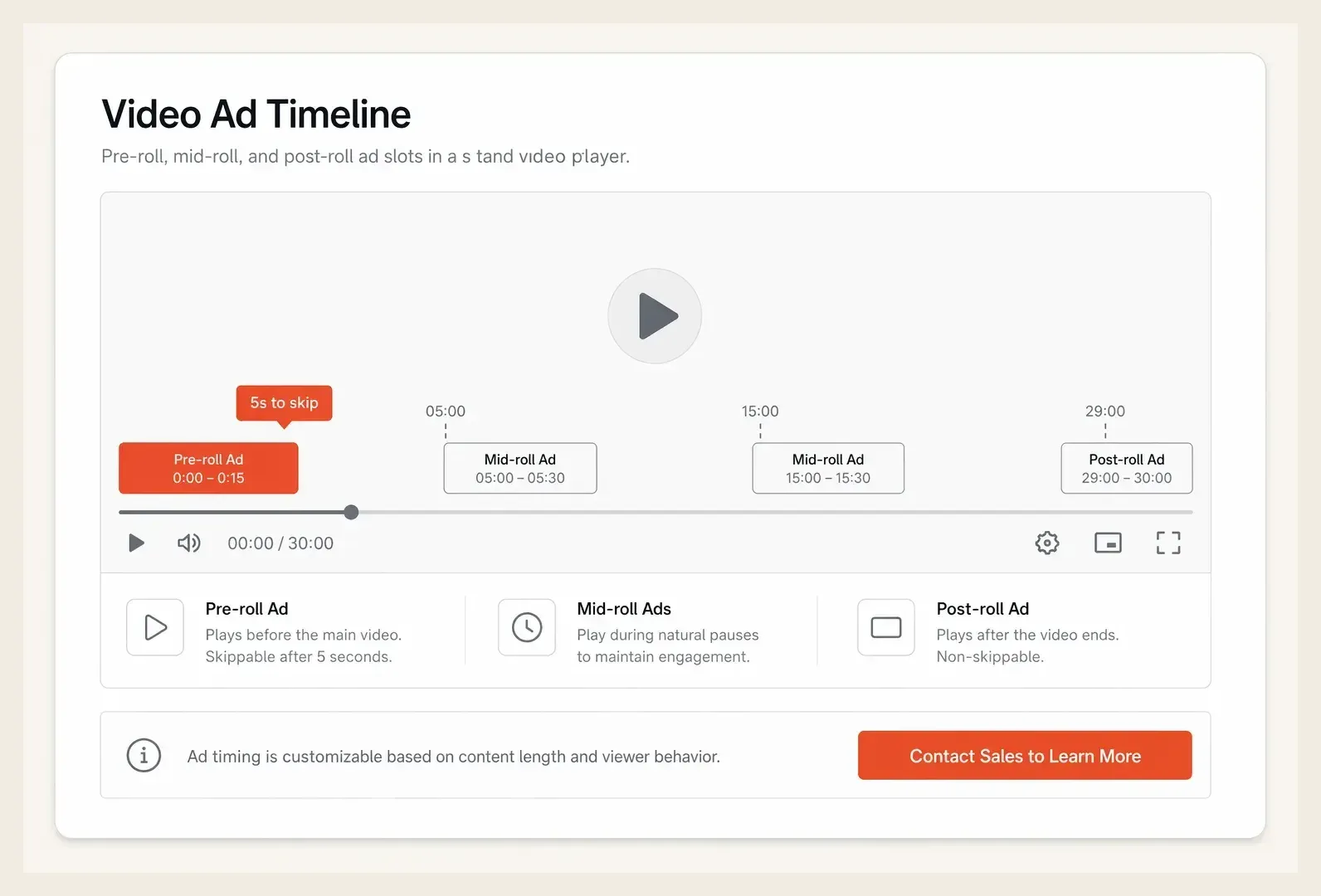
In-Stream Video Ads are video ads that play inside another video, appearing before (pre-roll), during (mid-roll), or after (post-roll) the content a viewer chose to watch on platforms like YouTube, Facebook, and connected TV. Because they run inside content the user already opted into, they capture committed attention on a larger screen with sound on, which makes them a workhorse format for both brand awareness and direct response. The tradeoff is that the viewer did not come for the ad, so the opening seconds have to earn the right to keep playing.
Why It Matters
In-Stream Video Ads matter because they reach audiences in a focused, lean-back state that feed scrolling rarely delivers, and they do it at massive scale. Video is projected to account for roughly 80% of all internet traffic, and connected TV ad spend alone is forecast to pass $40 billion, which means in-stream inventory is both vast and central to where attention is moving. For advertisers, that reach combined with sound-on, full-attention viewing makes in-stream one of the most effective places to build memory and drive consideration.
The format also exposes creative quality fast. On skippable placements, a viewer can drop the ad after five seconds, so a weak open wastes the impression while a strong hook earns the full view. That dynamic shows up directly in cost, since platforms reward ads people choose to keep watching with cheaper delivery, which is why retention metrics like video completion rate sit at the center of in-stream performance.
How It Works
In-Stream Video Ads work by inserting a video unit into the playback timeline of host content, then either forcing a short non-skippable view or giving the viewer a skip option after a few seconds. The placement runs on a CPV or completed-view basis on some platforms and a CPM basis on others, so the bidding model shapes how the creative should be built.
- Front-load the brand and the hook in the first five seconds, before any skip button appears.
- Match the asset to the placement, since skippable, non-skippable, and bumper formats each demand a different length and pace.
- Design for sound-on, because in-stream viewers expect audio, but still caption for accessibility and muted environments.
- Pair a clear call-to-action with the view, so attention earned in-stream converts into a click or a tracked outcome.
Because the viewer is committed to the surrounding content, retention is the lever that lowers cost. The longer people watch before skipping, the cheaper and more widely the platform serves the ad.
A Real Example
A meal-kit subscription brand runs a 6-second non-skippable bumper and a 30-second skippable in-stream ad on YouTube against a $25,000 monthly budget. The first cut of the 30-second ad opens on a slow lifestyle montage and posts a 24% video completion rate with a $0.14 CPV.
The team recuts the ad to open on a person burning dinner and asking "tired of this every night," landing the brand and problem in the first three seconds. The new version posts a 41% completion rate and a $0.06 CPV, less than half the cost per view, and the cheaper attention feeds a larger retargeting pool. Cost per trial signup from the in-stream campaign falls from $58 to $33, and the brand shifts the full video budget behind the recut. The entire improvement comes from front-loading the hook before the skip button appears.
Common Mistakes
| ❌ Mistake | ✅ Better Approach |
|---|---|
| Saving the brand reveal for the end of the video | Show the brand and the hook in the first five seconds before the skip option |
| Running the same cut across skippable, bumper, and non-skippable slots | Tailor length and pacing to each in-stream format |
| Judging the ad on impressions alone | Track video completion rate and view-through rate to see real attention |
| Using in-stream reach with no conversion path | Pair the view with a clear call-to-action and a retargeting follow-up |
How Hawky Helps
In-stream success starts with video that lands the hook before the skip button, and producing enough of those cuts is a creative bottleneck. Hawky's Creative Agent studies which openings, pacing, and structures are holding watch time in your category, then generates on-brand in-stream variants sized for pre-roll, bumper, and skippable placements rather than one master edit stretched across all of them. It isolates the first-five-seconds patterns that historically survive the skip and briefs fresh cuts in that proven shape, so the account always has new video ready before the current winner fatigues.
On delivery, Hawky's Performance Agent reads completion rate and downstream conversions, then shifts budget toward the in-stream creative earning the lowest cost per view and the most valuable retargeting audience. Both agents draw on FeatherDB, the account's living memory, so every new video is informed by which hooks and lengths already converted instead of guessing. The result is a steady supply of placement-specific in-stream creative, optimized against your KPI rather than raw impressions.
Frequently Asked Questions
What is the difference between in-stream and out-stream video ads?
In-stream video ads play inside other video content as pre-roll, mid-roll, or post-roll, so they reach a viewer who is already committed to watching. Out-stream video ads appear inside non-video environments, such as autoplaying inside an article or a feed, and usually start muted, which means they capture less committed attention and rely more on a strong silent open.
How long should an in-stream video ad be?
Length depends on the placement: bumper ads are capped at 6 seconds, while skippable in-stream ads commonly run 15 to 30 seconds and sometimes longer for storytelling goals. Regardless of total length, the brand and the hook should land in the first five seconds, since that is where the viewer decides whether to keep watching or skip.
Are in-stream video ads skippable?
Some are and some are not. Skippable in-stream ads let the viewer skip after about five seconds and typically charge on a CPV or completed-view basis, while non-skippable in-stream ads run a fixed short length, often up to 15 to 30 seconds, and usually charge on a CPM basis. The format you choose changes how the creative should be paced.
How do I measure in-stream video ad performance?
The core in-stream metrics are video completion rate, which shows how many viewers watched to the end, and view-through rate, which captures conversions that follow a view. Pairing those attention signals with cost per result and a retargeting follow-up gives a fuller picture than impressions alone.
Do in-stream video ads work for direct response?
Yes, when the creative earns attention and then routes it to an action. In-stream is strong for awareness, but pairing a clear call-to-action with the view and following up through retargeting turns the attention into measurable conversions, which is how many performance marketers run in-stream as a mid-funnel driver rather than pure branding.
Quick Takeaway
In-Stream Video Ads buy committed, sound-on attention inside content people chose to watch, but the first five seconds decide whether that attention is earned or skipped. Win the open and the platform serves the ad cheaper and wider.
When your video skips early and producing placement-ready cuts is the bottleneck, the fix is agents that generate in-stream creative and place it against your KPI. Ready to hire your first AI performance team? Book Demo