View-Through Rate
Last updated
The percentage of viewers who watch a video ad to completion without clicking and convert later, capturing the passive influence that last-click reporting misses. Read it right and you stop cutting the upper-funnel video that feeds your whole funnel.
View-Through Rate
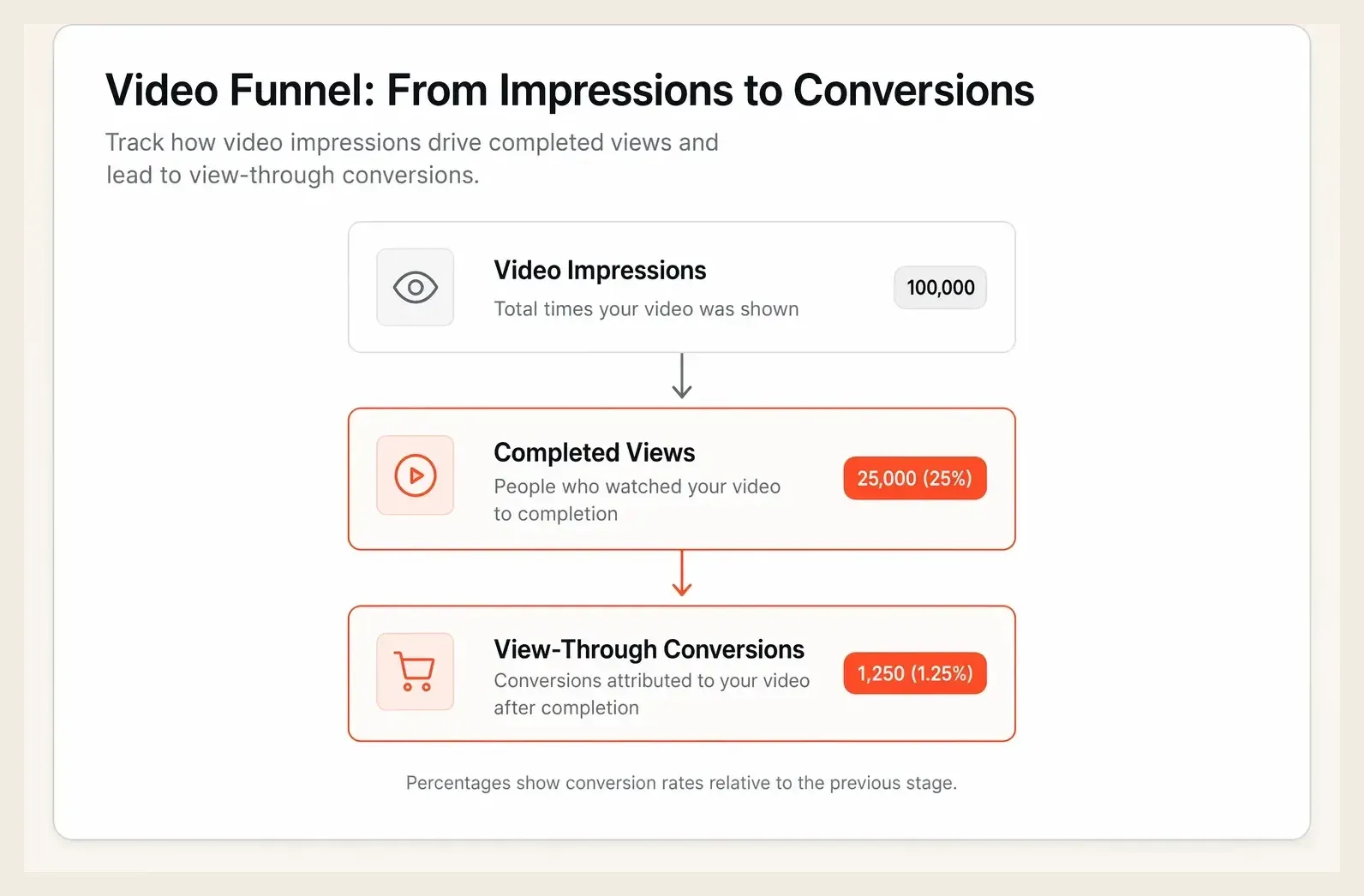
View-Through Rate (VTR) is the percentage of people who see a video ad and watch it to completion without clicking, then later convert or take a tracked action. It measures the passive viewing audience that an impression-based or video campaign influences beyond the click, and it is one of the few metrics that captures the quiet conversions that last-click reporting ignores.
Why It Matters
Most performance reporting only counts the people who click, which means a large share of the audience an ad actually influences never shows up in the numbers. View-Through Rate fixes that blind spot by crediting the viewers who watched, remembered, and converted on their own terms. For brand-heavy and upper-funnel video, VTR is often the difference between a campaign that looks like a loss and one that is quietly driving demand.
The financial stakes are real. Industry studies routinely find that 20 to 50 percent of conversions on awareness-led video campaigns are view-through rather than click-through, so judging those campaigns on clicks alone understates their value by a wide margin. When VTR is ignored, teams cut the exact upper-funnel video that feeds their retargeting pools, then watch lower-funnel CPA climb because the warm audience dried up. Reading VTR keeps that connection visible.
Formula
VTR is a ratio expressed as a percentage. The exact numerator depends on whether a platform measures completed views or view-through conversions, so confirm the definition before comparing channels:
View-Through Rate = (View-Through Conversions / Impressions) x 100
A related and more common video definition divides completed views by total impressions:
VTR = (Completed Views / Impressions) x 100
If a video ad serves 100,000 impressions and 18,000 viewers watch it to the end, the completion-based VTR is 18 percent. Benchmarks shift sharply by platform, format, and view-window length:
| Platform / Format | Typical VTR Range | Notes |
|---|---|---|
| YouTube TrueView | 15% to 30% | Skippable; counted at 30s or full view |
| Connected TV (CTV) | 85% to 95% | Non-skippable, so completion is very high |
| Meta video (feed) | 15% to 25% | Strongly tied to a hook landing in 3 seconds |
| Programmatic display video | 10% to 20% | Varies widely by placement quality |
View-through conversions are usually counted within a 1-day or 7-day window after the view, and a shorter window produces a lower, more conservative number. Always read VTR alongside video completion rate and an attribution model you trust, because a generous view window can inflate the figure.
How It Works
VTR works by attaching a tracking pixel or platform tag to the impression, then crediting conversions that happen after a qualifying view rather than a click. The view window is the key setting, since it defines how long after watching a conversion still counts.
- View Window: The lookback period (commonly 1 or 7 days) that determines whether a later conversion is attributed to the view.
- Completion Threshold: Whether the platform counts a 30-second view, a full view, or a quartile as a qualifying impression.
- Incrementality Check: Whether those view-through conversions would have happened anyway, which a holdout group reveals.
- Funnel Position: VTR matters most for upper-funnel video that seeds demand, less for bottom-funnel search.
In practice, teams use VTR to value awareness campaigns that clicks underrate, then validate it with incrementality testing so they are not paying for conversions that would have landed regardless. The combination keeps upper-funnel budget honest.
A Real Example
A skincare brand ran a YouTube and CTV campaign and nearly shut it off because click-attributed ROAS sat at 0.8, well below the 2.0 target.
Before cutting, the team enabled a 7-day view-through window and found the campaign had a 22 percent completion-based VTR and was driving 4,100 view-through conversions a month that last-click had been crediting to branded search and direct traffic. Blended ROAS including view-through came in at 2.6. To confirm the conversions were incremental, they ran a geo holdout for three weeks. Sales in the exposed regions ran 14 percent higher than the holdout, validating roughly two-thirds of the view-through volume as genuinely incremental. The brand kept the campaign and reallocated budget toward the placements with the strongest validated VTR.
Common Mistakes
| The Mistake | ❌ Wrong Approach | ✅ Better Approach |
|---|---|---|
| Ignoring view-through entirely | Judging video on click ROAS alone | Reading VTR alongside click metrics for the full picture |
| Trusting a long window blindly | Counting 30-day view-through as gospel | Using a 1 to 7 day window and validating with a holdout |
| Skipping incrementality | Assuming every view-through conversion is earned | Running incrementality testing to find the real lift |
| Comparing across formats | Holding CTV and skippable YouTube to one VTR bar | Benchmarking each format and window separately |
How Hawky Helps
When upper-funnel video gets cut because click reporting buries its value, the account loses the demand engine that feeds every lower-funnel campaign. Hawky's Performance Agent reads view-through alongside click and incrementality signals, so it values video on the conversions it actually influences rather than the ones that happen to end in a click. It allocates budget toward the placements and view windows that produce validated lift, not vanity completions.
The Creative Agent keeps the video itself strong, generating hooks and pacing that lift completion so more of the audience reaches a qualifying view. Every learning about which formats and windows drive real view-through conversions is written to FeatherDB as living context, so the next campaign starts from what already worked. The result is an account that protects and scales high-VTR video instead of a dashboard that flags it after the budget is already gone.
Frequently Asked Questions
What is a good view-through rate?
A good VTR depends entirely on format and view window. Skippable YouTube video commonly lands between 15 and 30 percent completion-based VTR, while non-skippable CTV runs 85 to 95 percent because viewers cannot skip. The more useful benchmark is a stable or rising VTR within your own format and a conversion window you trust, validated by an incrementality test.
What is the difference between view-through and click-through conversions?
A click-through conversion happens when someone clicks the ad and then converts, while a view-through conversion happens when someone sees or watches the ad, does not click, and converts later within the view window. View-through captures the passive influence of an impression. It matters most for video and awareness campaigns that seed demand rather than capture an immediate click.
How long is a view-through window?
View-through windows are commonly set to 1 day or 7 days, meaning a conversion is credited to the view only if it happens within that period after watching. Some platforms allow windows up to 30 days, but longer windows inflate the metric by crediting conversions that may have happened anyway. A shorter window produces a more conservative and trustworthy number.
Is view-through rate the same as video completion rate?
They are related but not identical. Video completion rate measures the share of video starts that play to the end, while view-through rate ties a completed view to a downstream conversion within a window. A video can have a high completion rate but a low view-through rate if those viewers rarely convert afterward.
Quick Takeaway
View-Through Rate credits the audience that watches your video, remembers it, and converts without ever clicking, which is exactly the value that last-click reporting throws away. Read it with a short window and validate it with an incrementality test so the upper-funnel video that feeds your whole funnel does not get cut by mistake.
Watching click reporting bury the real value of your video campaigns? Ready to hire your first AI performance team? Book Demo