Channel Attribution: Models, Omnichannel and How to Measure It
Channel attribution is the practice of assigning credit for a conversion to the marketing channels that contributed to it. It answers which channels earned the revenue, using a model that decides how credit is split when a customer touched several before buying.
The reason it stays contentious is that attribution is a choice, not a measurement. Change the model and the same customer journey produces a different winner, with no change in the underlying business.
This guide covers how channel attribution works, the models and what each one distorts, how omnichannel attribution differs, how marketing measurement and attribution fit together, and what to do when the numbers disagree.
What is channel attribution?
Channel attribution assigns credit for a conversion across the marketing channels a customer touched on the way to it. When someone sees a Facebook ad, searches your brand on Google, clicks an email and then buys, attribution decides how much of that sale belongs to each of the four.
Google defines an attribution model as "a rule, a set of rules, or a data-driven algorithm that determines how credit is assigned to touchpoints". The word doing the work is rule. There is no physically correct answer sitting in the data waiting to be found.
Three facts follow from that, and they explain most attribution arguments:
- The model is an assumption, chosen by you, not discovered.
- Every channel platform grades its own homework. Meta counts the sale, Google counts the same sale, and neither deducts what the other claimed.
- Reported totals routinely exceed actual revenue, which is the clearest evidence the first two are true.
How channel attribution works
Attribution runs in three steps: collect the touchpoints, decide which ones fall inside the window, then apply a model to split the credit.
- Collection. Every interaction that can be identified gets recorded: ad clicks, ad views, site visits, email opens, organic sessions. What cannot be identified, such as a conversation or a podcast mention, never enters the system.
- The lookback window. Touchpoints older than the window are discarded. A 7-day window and a 28-day window produce genuinely different answers from identical behaviour, and Meta documents its own default windows separately from Google's.
- The model. Credit is divided across the surviving touchpoints by rule.
Step one is where most of the error enters. Attribution can only ever apportion credit among the touchpoints it can see, so a channel that is hard to track looks weak whether or not it is.
Attribution models compared
Attribution models split credit by rule, and each of the six in common production use systematically favours a different part of the funnel.
| Model | How credit is split | Favours | Use when |
|---|---|---|---|
| Last click | 100% to the final click | Bottom of funnel, brand search | You need a simple, stable default |
| First click | 100% to the first touch | Top of funnel, prospecting | You are judging discovery |
| Linear | Split evenly across all touches | Nothing in particular | You want a neutral baseline |
| Time decay | More credit to recent touches | Mid and lower funnel | Short consideration cycles |
| Position based | 40/20/40 across first, middle, last | Discovery and closing | You value both ends |
| Data driven | Algorithmic, from observed paths | Whatever the data supports | You have enough conversion volume |
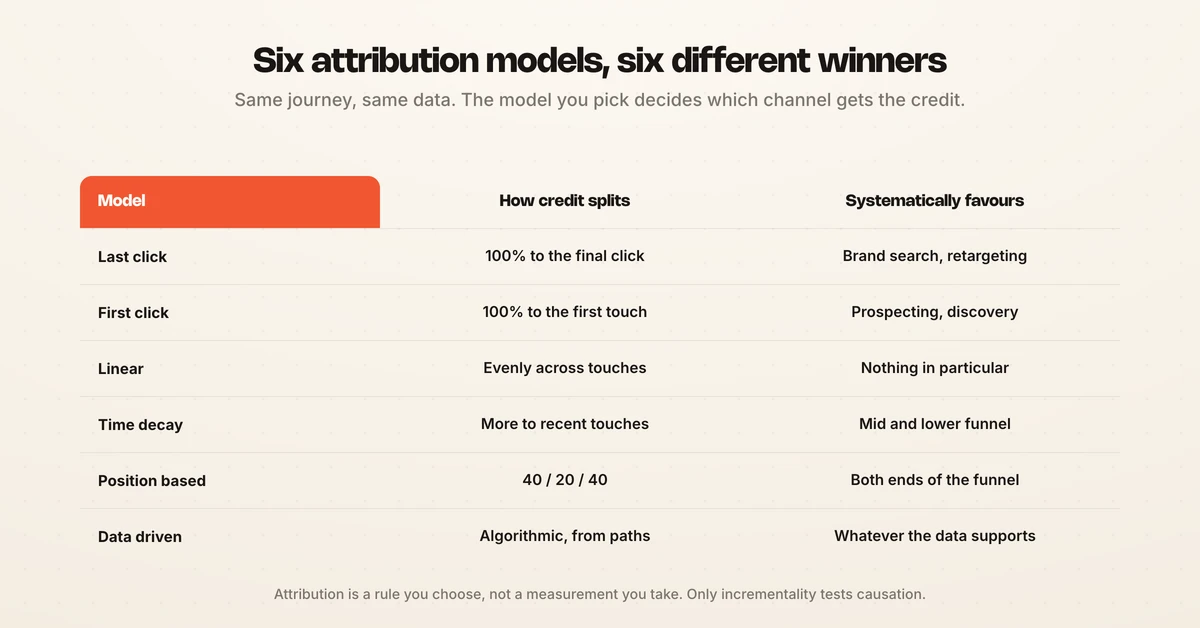
Last click remains the most used and the most misleading. It hands the sale to brand search and retargeting, the two channels most likely to be capturing demand that already existed, and starves the prospecting that created the demand in the first place.
Data driven is the best default where volume allows it, with one caveat worth stating plainly: it is only as good as the paths it can observe, so it inherits every tracking gap in step one.
Omnichannel attribution
Omnichannel attribution extends channel attribution across every place a customer can interact with a brand, including the ones that are not digital advertising: retail stores, call centres, marketplaces, apps and customer service.
The distinction matters because the hard part changes. Multi-channel digital attribution is a modelling problem, and the touchpoints mostly arrive with an identifier attached. Omnichannel attribution is an identity problem first: the same person is a cookie online, a loyalty number in store, a phone number on a call and an email address in the CRM, and none of those join automatically.
| Channel attribution | Omnichannel attribution | |
|---|---|---|
| Scope | Digital marketing channels | Every customer touchpoint, online and offline |
| Main difficulty | Choosing and applying a model | Resolving one person across identities |
| Typical inputs | Ad platforms, analytics, CRM | The above plus POS, call logs, loyalty, app |
| Common failure | Model choice flatters one channel | Offline conversions never join the digital path |
| Who needs it | Anyone spending on more than two channels | Retail, multi-location, high-consideration purchases |
The practical consequence for a brand with physical retail is that digital-only attribution will systematically undervalue upper-funnel spend, because the conversion it drove happened somewhere the pixel could not follow.
Marketing measurement and attribution: how they differ
Marketing measurement and attribution are frequently used interchangeably and are not the same thing. Attribution is one technique inside measurement, and it is the narrowest of the three that matter.
| Approach | Question it answers | Strength | Weakness |
|---|---|---|---|
| Attribution | Which touchpoints get credit for this conversion? | Granular, fast, per-campaign | Only sees tracked touchpoints; not causal |
| Incrementality testing | Would this have happened without the ad? | Genuinely causal | Slow, needs a holdout, disruptive |
| Marketing mix modelling | How does total spend relate to total outcome? | Covers untracked and offline | Coarse, needs history, not per-campaign |
A serious measurement practice runs all three at different cadences: attribution daily for steering, incrementality quarterly to check attribution is not lying, and mix modelling annually for budget planning.
The failure mode is running attribution alone and treating it as truth. Attribution tells you where credit landed under your chosen rule. It does not tell you what the spend caused, which is what incrementality testing exists to answer, and the guide to incrementality in marketing covers how to run one.
Why your platforms disagree
Platform numbers rarely reconcile, and the gap is structural rather than a bug in anyone's implementation.
- Different windows. Meta's default click and view windows are not Google's, and neither matches GA4's.
- View-through counting. Meta credits impressions that were never clicked. Search platforms largely do not.
- Different identity graphs. Each platform resolves people using data the others cannot see.
- Self-serving defaults. Meta's attribution system is built to show Meta's contribution, and it has no visibility into what Google already counted.
The fix is not to make them agree. It is to pick one source as the scoreboard, usually your own analytics or warehouse, use platform numbers only for in-platform optimisation decisions, and check the whole picture against incrementality periodically. Reconciling reported revenue against actual revenue monthly is the cheapest sanity check available. The ROAS vs ROI comparison covers what happens when an inflated attributed number flows into profit reporting.
Choosing an attribution setup
Match the sophistication to the size of the decision, because attribution infrastructure can absorb more budget than the spend it is meant to optimise.
| Monthly spend | Sensible setup |
|---|---|
| Under $10k | Last click in GA4, one source of truth, do not over-engineer |
| $10k to $100k | Data driven in GA4, separate prospecting from retargeting reporting, post-purchase survey |
| $100k to $1M | Data driven plus quarterly incrementality tests, warehouse as scoreboard |
| Over $1M | The above plus marketing mix modelling and a permanent holdout |
The cheapest high-value addition at any spend level is a post-purchase survey asking how the customer heard about you. It catches exactly the channels attribution cannot see, and it disagrees with the dashboard in informative ways.
From attribution to action
Attribution earns its cost only when it changes what the account does, and the gap between knowing and acting is where most of the value leaks.
A reallocation decision made on Monday from last week's attribution report is a decision made against conditions that have already changed. Hawky's Performance Agent operates against the KPI you set, reallocating and pausing across channels while the week is still running, with guardrails, an audit trail and a rollback on every move, and 40+ connected DSPs feeding the same account view so programmatic spend is not reconciled by hand.
Frequently asked questions
What is channel attribution?
Channel attribution assigns credit for a conversion to the marketing channels that contributed to it, using a model that decides how credit is split when a customer touched several before buying. It is a rule you choose rather than a measurement you take, which is why two attribution models applied to identical data will name different winners.
What is the difference between channel attribution and omnichannel attribution?
Channel attribution covers digital marketing channels, where touchpoints usually arrive with an identifier attached, so the main difficulty is choosing a model. Omnichannel attribution extends across every touchpoint including retail, call centres and apps, where the main difficulty is identity resolution: joining the same person across a cookie, a loyalty number, a phone number and an email address.
What is the best attribution model?
Data driven is the best default where you have enough conversion volume for it to work, because it derives credit from observed paths rather than an arbitrary rule. Below that volume, last click is acceptable as a stable baseline provided you know it over-credits brand search and retargeting. No model is correct; each one systematically favours a different part of the funnel.
What is the difference between marketing measurement and attribution?
Attribution is one technique inside marketing measurement, alongside incrementality testing and marketing mix modelling. Attribution assigns credit among tracked touchpoints and answers who gets the sale, while incrementality testing answers whether the spend caused the sale at all. Mix modelling relates total spend to total outcome including untracked and offline channels. Running attribution alone and treating it as truth is the common failure.
Why do Meta and Google report more conversions than I actually had?
Because each platform counts conversions it believes it influenced, using its own attribution windows and its own identity graph, with no visibility into what the other already counted. Meta also credits view-through conversions that were never clicked. The sum therefore exceeds real revenue. Pick one scoreboard outside the ad platforms and use platform figures only for in-platform optimisation.
How long should my attribution window be?
Match it to your actual purchase cycle rather than the platform default. A low-cost impulse product may be fully captured in 7 days, while a considered purchase can take 30 to 90, and a window shorter than the real cycle makes upper-funnel channels look worthless. Check the distribution of your own time-to-purchase before setting it.
Attribution tells you where credit landed under a rule you chose. It does not tell you what to do on Tuesday when one channel is quietly drifting past its target. If the distance between your attribution report and a budget change is measured in days, Hawky's Performance Agent is built for that job.
Ready to hire your first AI performance team? Book Demo