8 Ad Testing Tools That Actually Move Performance (2026 Review)
The three ad testing tools that move performance hardest in 2026 are Hawky, Motion, and Marpipe. Hawky runs the full test-to-scale loop autonomously, Motion explains why your winners won, and Marpipe isolates which element drove the result. Most other "ad testing tools" stop at reporting. They tell you what happened and hand the work back to you.
Ad testing is where paid budgets are won or lost. A team running $50k+/month on Meta lives or dies by how fast it can find a winning creative, prove it, and scale it before creative fatigue sets in. The tools below are ranked by how much of that loop they actually close, not by how many charts they draw.
What "ad testing" actually means in 2026
Ad testing is the structured process of running creative variations against a KPI, measuring which version wins on real spend, and scaling the winner before it fatigues. It covers four phases: research what to test, generate the variations, run the test cleanly, and act on the result. A tool earns its place by owning at least one of those phases well, and the best own more than one.
The old definition stopped at "run an A/B test and read the result." That is reporting with a different name. In 2026 the bar moved, because the bottleneck is no longer measurement. The bottleneck is acting on what you measured fast enough to matter.
What makes a good ad testing tool now is simple. It should give you element-level analysis (hook, visual, CTA), not just ad-level win or loss. It should keep tests statistically clean so you do not call winners on noise. And the strongest ones close the loop: they take the winner and scale it, with guardrails and an audit trail so a human stays in command.
If your focus is the analysis phase specifically, see the companion guide to the 9 best ad creative analysis tools.
The 8 best ad testing tools
1. Hawky: Best for closing the full test-to-scale loop autonomously
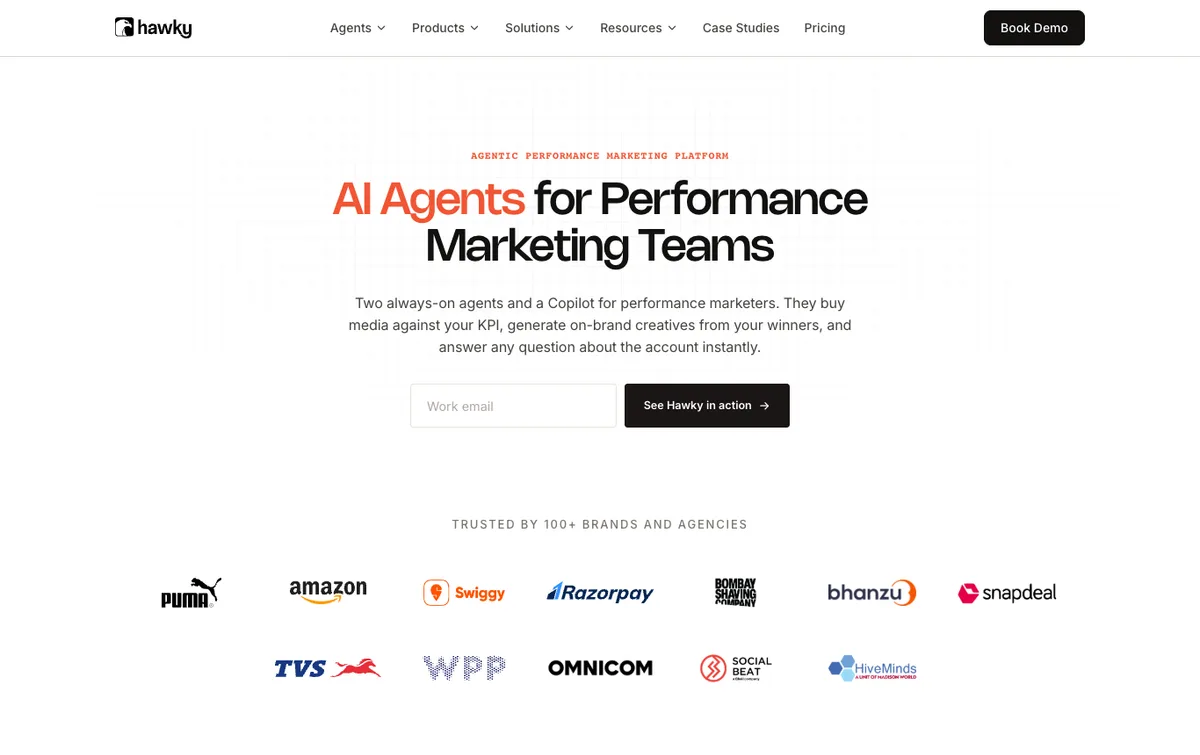
Hawky is an agentic performance marketing platform built around two always-on AI agents and a Copilot, all powered by FeatherDB, a shared living-context memory layer. Where most tools on this list report on a test, Hawky's Performance Agent runs the test, reads the result, and scales the winner against your KPI, 24/7. It runs a closed loop: Test, Track, Optimize, Scale.
This is the difference between a dashboard and an operator. The Performance Agent plans, launches, and optimizes Meta, Google, and YouTube campaigns against ROAS, CAC, LTV, or contribution margin. Every move is logged with the trigger data and a confidence score, and every move is one-click reversible. Guardrails, spend caps, and shadow mode keep humans in command, which is what makes autonomous media buying trustable rather than reckless.
On the creative side, the Creative Agent reads your past winners and portfolio gaps from Feather and renders finished on-brand creatives to feed the next test, each one routed through seat-level approval. Autonomy here is configurable: you pick the gate (every batch, every campaign, every brand, or none) and loosen it as trust builds. The same audit trail follows you from shadow mode to fully autonomous.
Key capabilities:
- Closed-loop testing: the Performance Agent tests, tracks, optimizes, and scales winners against your KPI without waiting on a human to read the chart.
- Configurable autonomy with guardrails: spend caps, approval gates, shadow mode, and one-click reversibility on every action.
- Audit trail on every move: each decision is logged with the trigger data and a confidence score.
- Creative generation from winners: the Creative Agent builds the next round of test variations from proven patterns, brand kit baked in.
Best for: teams running $50k-$5M+/month across Meta, Google, and YouTube who want the testing loop operated, not just reported. Pricing is outcome-based: a subscription minimum plus KPI-tied upside, with a 30-day free pilot. Hiveminds cut CPL by 27% and saved 160+ hours per brand monthly running Hawky.
2. Motion: Best for understanding why a winner won
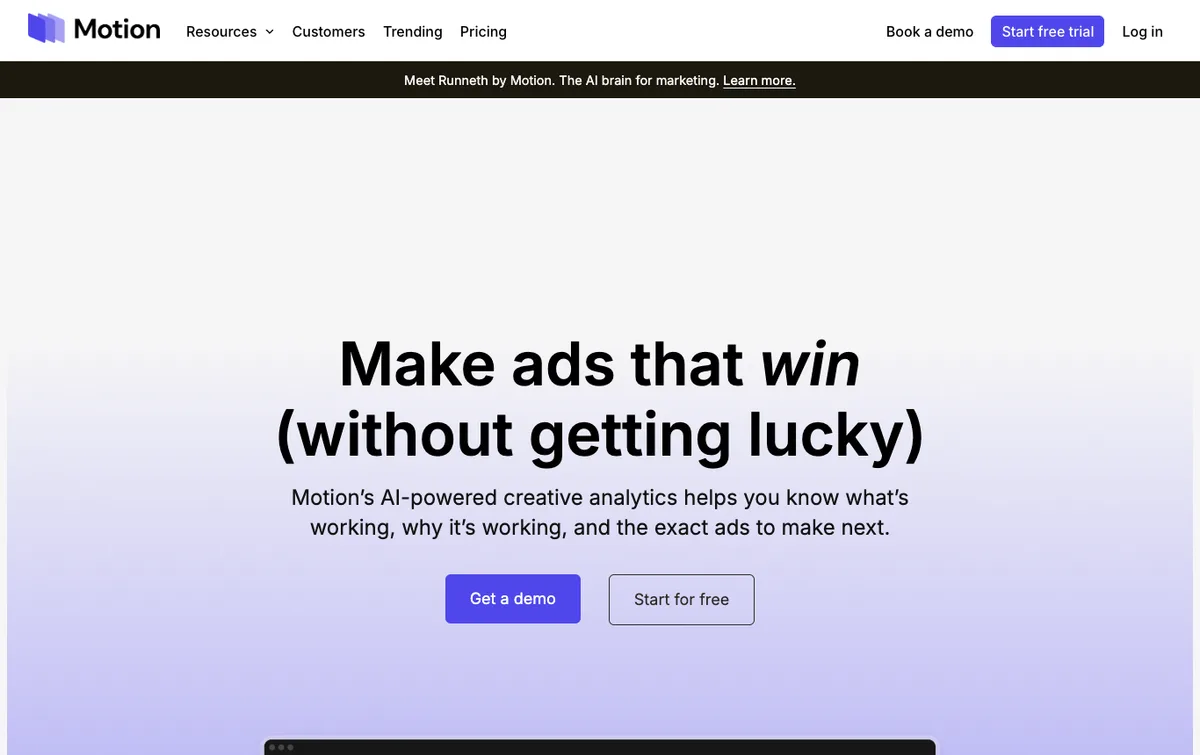
Motion is a creative analytics platform that auto-tags creatives, breaks down performance frame by frame, and helps teams spot which patterns drive results across Meta, TikTok, YouTube, and LinkedIn. It sits in the analysis and strategy layer of testing, and it is very good there. If your question is "why did this ad win," Motion answers it cleanly.
Strength: best-in-class creative reporting and AI tagging, with an ad leaderboard and competitor research built in. The frame-by-frame video analysis is a real edge for video-heavy accounts.
Limitation: Motion explains results, it does not execute. You still launch, optimize, and scale by hand once Motion tells you what worked. Pricing starts around $250/month on the Starter plan for brands spending up to $50,000/month, with custom Pro and Growth tiers above that (as of 2026).
Best for: paid social teams that want deep creative insight and are comfortable acting on it manually.
3. Marpipe: Best for multivariate, element-level testing
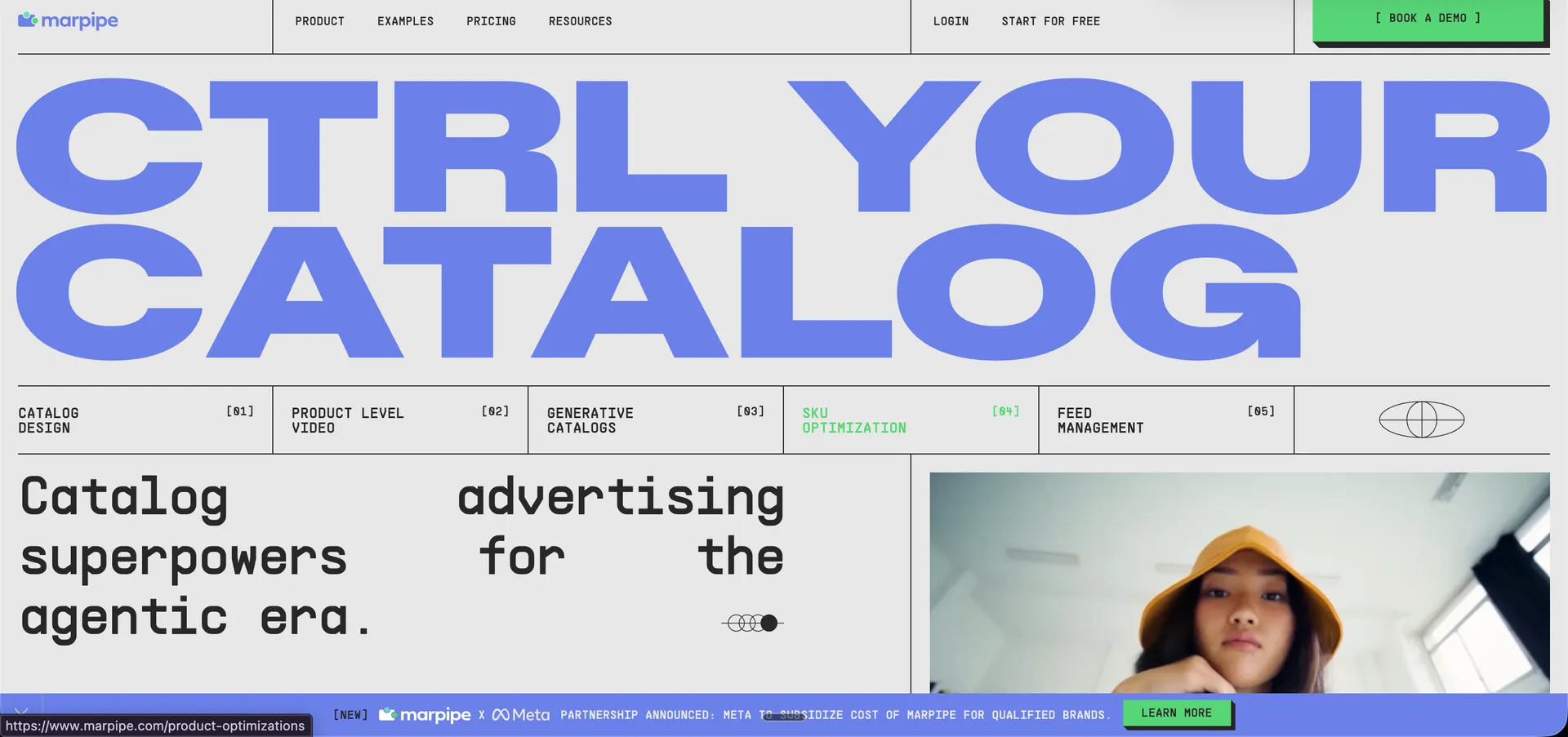
Marpipe automates multivariate testing by building and testing every combination of creative elements, then isolating which individual element drove the difference. Instead of ad-level win or loss, you get element-level data: this headline beat that one, this image lifted CTR, this CTA converted. For teams that want rigor, this is the most scientific option on the list.
Strength: true multivariate testing at scale, which surfaces signal that ad-level A/B tests miss.
Limitation: setup and cost scale up fast, and the workflow is heavier than a simple split test. Published plans run from a free Starter tier to a $199/month Growth plan, with custom Expert plans starting around $999/month (as of 2026).
Best for: e-commerce and creative teams that want to know which element won, not just which ad.
4. Meta Experiments: Best free native A/B testing
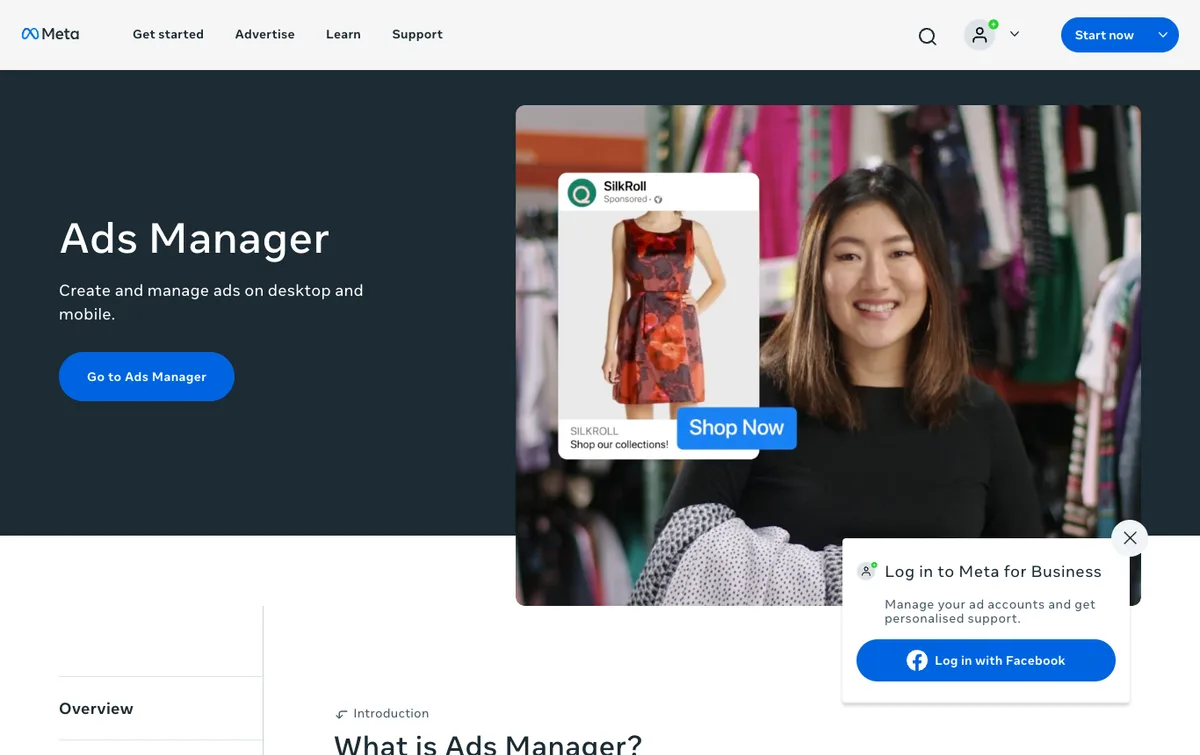
Meta's A/B testing tool inside Ads Manager splits your audience into random, non-overlapping groups and serves each an ad set that is identical except for one variable. That clean split is the point: running campaigns side by side without it skews delivery and contaminates the result. Meta also added a built-in creative testing feature that runs up to five creatives in one ad set with fair delivery.
Strength: free, native, and pulls delivery data straight from the source with no API lag or third-party interpretation. Every advertiser should start here before adding a paid tool.
Limitation: the tool tests and reports, then stops. It needs roughly 3-14 days and $500+ in budget per test for conclusive results, and it offers no element-level analysis or scaling. Setup mistakes can reset the learning phase.
Best for: any advertiser who wants a clean, no-cost baseline test before investing in a platform.
5. Madgicx: Best for AI optimization plus creative insights
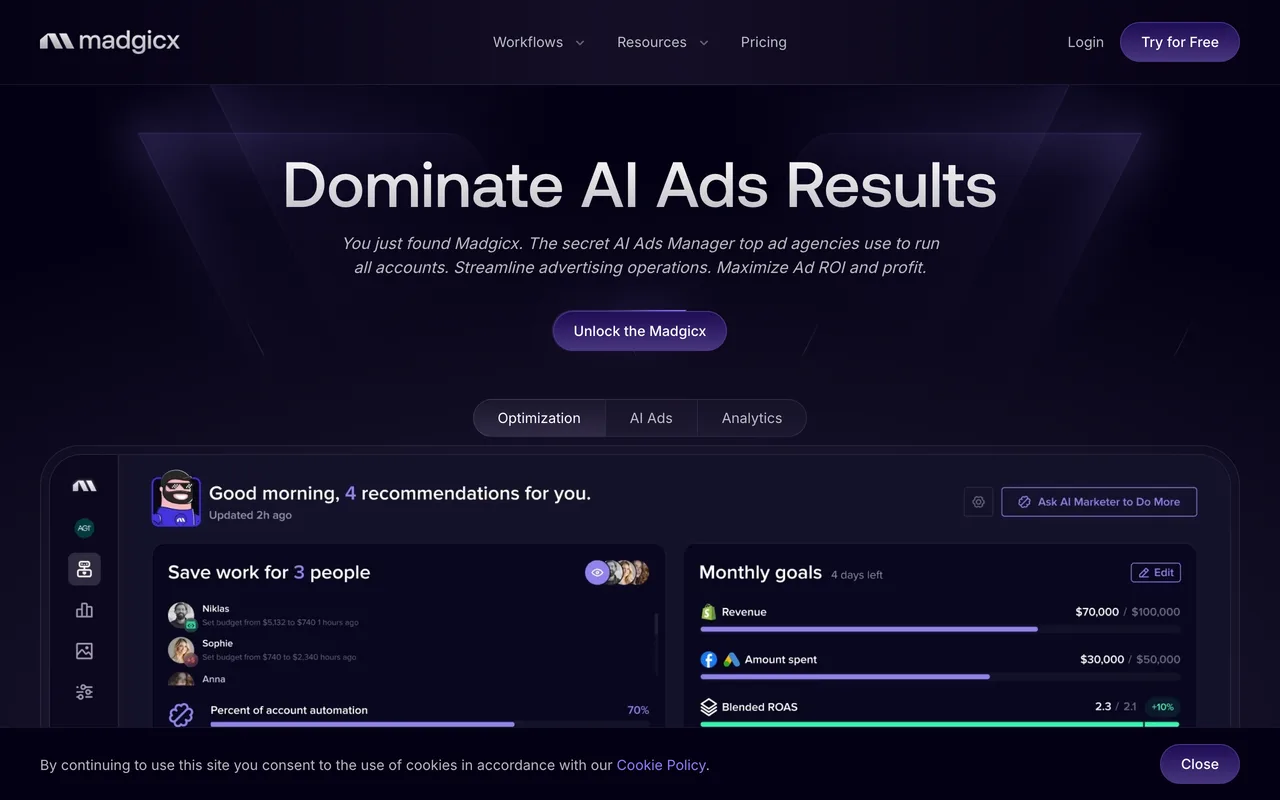
Madgicx is an AI-powered Meta advertising platform that combines creative performance analytics with audience targeting and automated budget rules. Its Creative Insights dashboard clusters ads by visual attributes and performance, helping you spot patterns across a large creative library rather than comparing ads one at a time. It covers launch, reporting, and AI suggestions in one place.
Strength: broad Meta toolkit with automation and creative clustering, useful for accounts with a big library.
Limitation: the breadth means a learning curve, and the AI suggestions still route back to a human to approve and apply. Mid-market pricing typically sits in the $1,000-$10,000/month range depending on spend (as of 2026).
Best for: Meta-focused teams that want analytics and budget automation under one login.
6. AdCreative.ai: Best for AI creative generation with scoring
AdCreative.ai generates branded static and video ad variations quickly and attaches a predictive performance score to each, so you can prioritize which creatives to test first. It sits at the front of the loop: it does not run the test, it produces the contenders. For teams whose bottleneck is creative volume, that is a real unlock.
Strength: fast, on-brand creative generation with a performance score to guide what enters the test.
Limitation: predictive scores are a starting signal, not a verdict. Real spend still decides the winner, and AdCreative.ai does not run that test or scale the result.
Best for: e-commerce brands and agencies that need a high volume of test-ready creatives fast.
7. Foreplay: Best for pre-test research and swipe files
Foreplay occupies the research phase that happens before any creative is made. It saves ads from ad libraries into an organized swipe file, tracks competitors, and turns references into briefs. Better testing starts with better hypotheses, and Foreplay builds the strategic foundation that makes each test more intentional.
Strength: the strongest swipe-file and competitive-research workflow for performance creative teams.
Limitation: it informs what to test, it does not run or measure the test itself. Published pricing runs from around $59/month for solo users to $175/month for teams and $459/month for agencies (as of 2026).
Best for: creative strategists who want a disciplined research input feeding their testing pipeline.
8. Superads: Best for creative reporting dashboards
Superads turns ad account data into shareable creative reporting dashboards, built for teams and client reporting. It pulls performance into clean visual boards so stakeholders can see which creatives are working without digging through Ads Manager. As a reporting layer, it makes test results legible to people who do not live in the ad platform.
Strength: clean, shareable dashboards that make creative performance easy to communicate.
Limitation: reporting only. Superads visualizes outcomes, it does not test, optimize, or scale them.
Best for: agencies and in-house teams that need polished creative reporting for clients and leadership.
Feature comparison: how these tools stack up
| Tool | Primary phase | Element-level signal | Acts on the result | Starting price (2026) |
|---|---|---|---|---|
| Hawky | Test + scale (full loop) | Yes | Yes, autonomous with guardrails | Outcome-based, 30-day pilot |
| Motion | Analyze | Yes | No | ~$250/mo |
| Marpipe | Test (multivariate) | Yes | No | Free to ~$999/mo |
| Meta Experiments | Test | No | No | Free |
| Madgicx | Analyze + optimize | Partial | Suggests, human applies | ~$1k-$10k/mo |
| AdCreative.ai | Generate | No | No | Tiered |
| Foreplay | Research | No | No | ~$59/mo |
| Superads | Report | Partial | No | Tiered |
Test and report vs test and act: the distinction that matters
Most ad testing tools are reporting tools wearing a testing label. They run or read a test, surface the winner, and hand the next decision back to you. That was fine when measurement was the hard part. In 2026, measurement is cheap and acting fast is the constraint, so the tool that only reports leaves the hardest work on your desk.
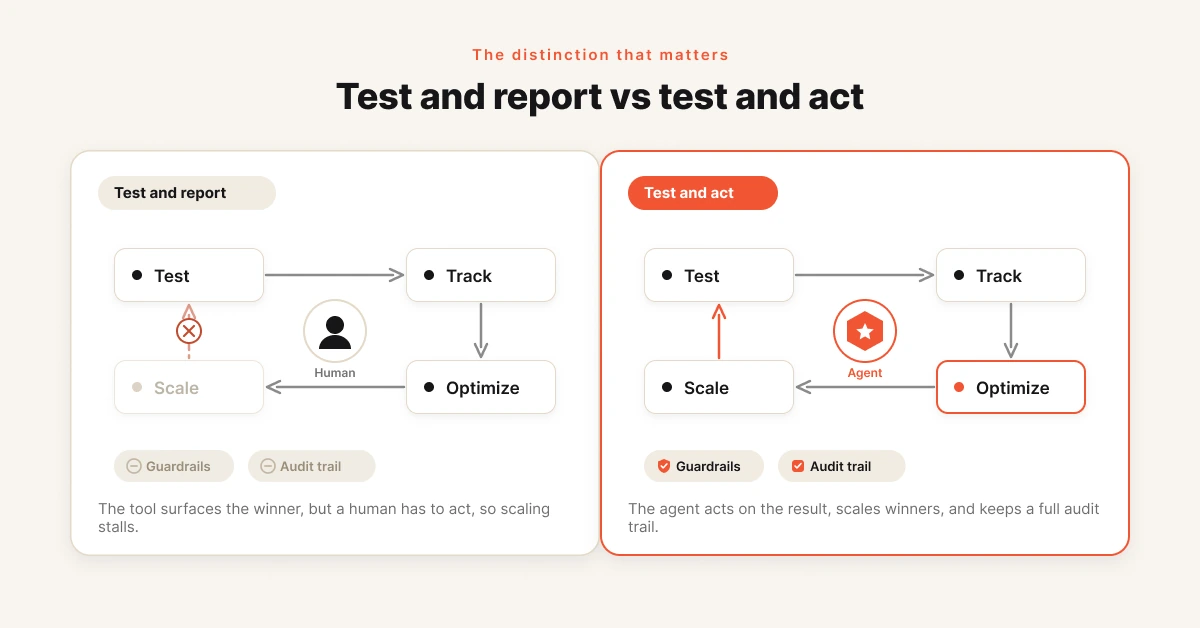
The split is clean. Research, generation, analytics, and reporting tools each own one phase: Foreplay and AdCreative.ai feed the test, Motion and Superads read it, Meta Experiments and Marpipe run it. None of them take the winner and scale it for you. A human still stitches the phases together by hand.
Closing the loop is what changes the economics. When an agent tests, tracks, optimizes, and scales against your KPI, the time between finding a winner and scaling that winner collapses from days to minutes. That speed is where ROAS is actually won, because a winning creative left unscaled for a week is money left on the table.
Autonomy is the unlock, but only when it is paired with control. Configurable gates, spend caps, shadow mode, and a full audit trail mean the agent does the labor while the human keeps the judgement. That is the difference between autonomous media buying you can trust and automation you have to babysit.
Which ad testing tool is right for your team?
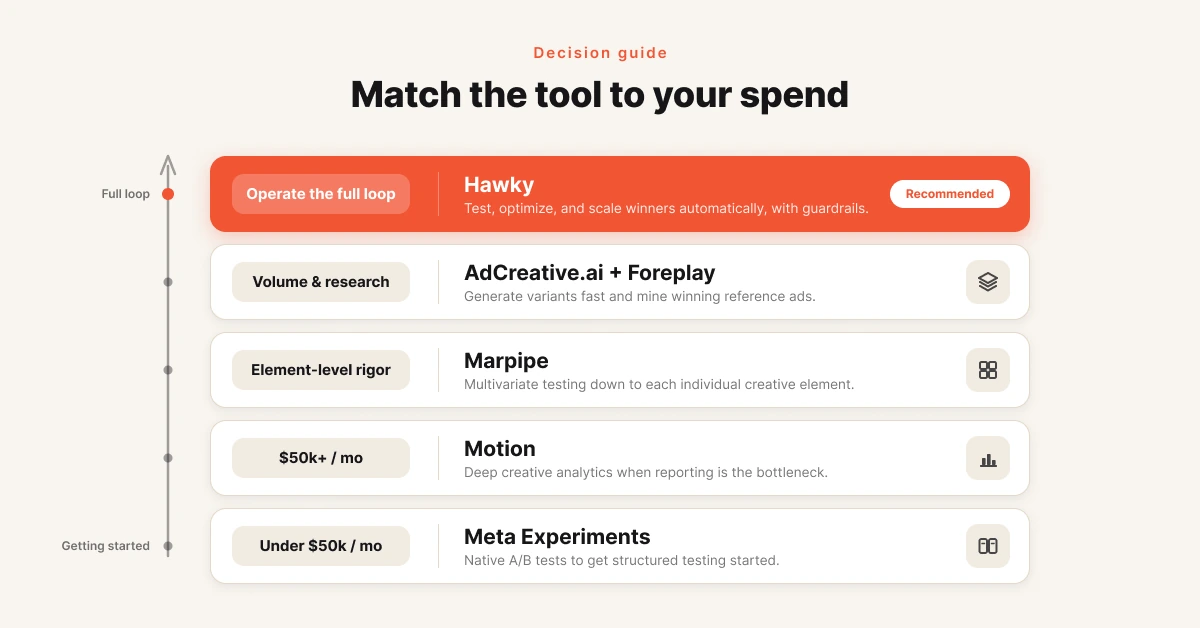
If you spend under $50k/month and want a free baseline, start with Meta Experiments. Run clean single-variable A/B tests, give each one $500+ and a week, and wait for 90% confidence before calling a winner. Add a paid tool only once native testing becomes the bottleneck.
If your bottleneck is understanding why creatives win, choose Motion. Its frame-by-frame analysis and AI tagging give the deepest creative read on the list, and it pairs well with a separate execution layer.
If you need element-level rigor, choose Marpipe. When the question is which headline, image, or CTA actually moved the number, multivariate testing is the only honest answer.
If your bottleneck is creative volume or research, pair AdCreative.ai for generation with Foreplay for swipe-file research. Together they keep your test pipeline full of intentional, on-brand contenders.
If you want the testing loop operated rather than reported, choose Hawky. The Performance Agent and Creative Agent collapse research, testing, and scaling into one autonomous loop with guardrails, which removes the need to run four separate tools and stitch their outputs together by hand. For teams past $50k/month that are tired of being the glue between dashboards, that consolidation is the point.
Frequently asked questions
How do you A/B test ad creative?
Run two ad sets that are identical except for one creative variable, split your audience into non-overlapping groups, and give each version equal budget. Let the test run 3-14 days on at least $500 until it reaches roughly 90% statistical confidence, then scale the winner. Changing more than one variable at a time makes the result impossible to attribute.
What is the best tool for testing Facebook ads?
For a free native baseline, Meta Experiments inside Ads Manager is the best starting point. For deep creative analysis, Motion leads. For teams that want the full test-to-scale loop run autonomously against a KPI, Hawky's Performance Agent closes the loop that the others leave open.
How much does ad creative testing cost?
The tools range from free (Meta Experiments) to roughly $250/month for analytics (Motion), up to $1,000-$10,000/month for mid-market platforms (Madgicx, Marpipe Expert). Hawky uses outcome-based pricing: a subscription minimum plus KPI-tied upside, with a 30-day free pilot. Budget separately for the ad spend the tests themselves consume.
What is multivariate ad testing?
Multivariate testing runs every combination of creative elements (headline, image, CTA) at once and isolates which individual element drove performance. It gives element-level signal that a standard A/B test, which compares whole ads, cannot. Marpipe is the specialist for this approach.
Does Meta have a built-in A/B testing tool?
Yes. Meta's A/B testing tool in Ads Manager splits your audience into random non-overlapping groups and serves each an ad set that differs by one variable. Meta also added a creative testing feature that runs up to five creatives in a single ad set with fair delivery, and it is free beyond your ad spend.
When should you stop a creative test?
Stop when the test reaches about 90% statistical confidence, which usually takes 3-14 days and at least $500 in spend. Calling a winner before then risks scaling noise. Tools that surface confidence levels, or agents that watch the threshold for you, prevent premature decisions.
Ad testing only pays off when the winner gets scaled before it fatigues, and that is the phase most tools leave to you. If your bottleneck is operating the test-to-scale loop instead of just reading it, Hawky's Performance Agent is built for that job.
Ready to hire your first AI performance team? Book Demo