Best Creative Analytics Platforms for Enterprise Teams (2026)
The top creative analytics platforms available in 2026 are Hawky, Motion, and CreativeX. Hawky pairs element-level creative analysis with a Performance Agent that acts on the data. Motion is the strongest pure-play analytics dashboard. CreativeX leads on global brand governance.
Enterprise advertisers do not have a tool shortage. They have a depth shortage. Most platforms marketed as creative analytics produce dashboards and stop there.
Few connect creative elements to performance, predict fatigue before CPMs spike, or close the loop with iteration. This guide ranks the enterprise creative analytics platforms that operate at real scale, with honest notes on where each one falls short.
Creative analytics is the practice of measuring the performance of individual ad creatives at the element level (hook, visual, CTA, body copy, format) rather than at the campaign or ad set level. A creative analytics platform ingests ad performance data from Meta, Google, and other channels, decomposes each creative into its constituent elements, and connects element patterns to outcomes like ROAS, CTR, and CPL.
This page ranks platforms on the dimensions that matter at enterprise scale: data depth, attribution, integration breadth, and whether the system scales to seven-figure monthly spend. For the adjacent category of AI-first tools that also generate creative, see the best creative intelligence platforms. For a wider survey of point tools, see the best ad creative analysis tools.
What to look for in an enterprise creative analytics platform
A creative analytics platform built for an enterprise advertiser should do four things:
- Tag creatives automatically at the element level across every connected channel
- Attribute performance back to specific creative elements, not just ad names
- Predict creative fatigue before performance decay shows up in spend
- Scale to large creative libraries without accuracy loss or slow load times
If a platform stops at CTR by ad name, it is reporting, not analytics. Enterprise teams running seven-figure monthly spend on Meta and Google have moved past that line. The rankings below weigh depth, attribution, and integration breadth over dashboard polish.
The 9 best enterprise creative analytics platforms in 2026
1. Hawky: Best for enterprise teams that want creative analytics plus an agent that acts on the data
Hawky is an agentic performance marketing platform built for teams running serious spend on Meta and Google. It analyzes ad creative at the element level (hook, visual, CTA, body copy), predicts creative fatigue 7 to 10 days before manual monitoring would catch it, and connects element patterns to ROAS, CTR, and CPL. The analytics layer feeds two agents that turn insight into action.
The Performance Agent runs as an always-on operator against a KPI you set, buying across Meta, Google, YouTube, and TikTok, with every action logged, reversible, and bounded by guardrails. The Creative Agent generates on-brand creatives from proven winners, approval-gated before anything ships. FeatherDB holds living-context memory so both agents learn from every account they touch.
Enterprise proof points exist. Hiveminds cut CPL by 27% and saved more than 160 hours per brand each month, and Univest lifted CTR by 20% within seven days by acting on element-level creative scores. Both are documented in the case studies.
Key capabilities:
- Element-level creative analysis on every Meta and Google ad, scoring hook, visual, CTA, and copy independently
- Predictive fatigue detection that flags decay before CPMs rise
- Competitor tracking with a searchable ad repository, weekly alerts, and hook analysis
- Creative Agent generation of regional variations and bulk catalogue creatives from winning patterns, approval-gated
- Performance Agent execution against a KPI across Meta, Google, YouTube, and TikTok, logged and reversible
- FeatherDB living-context memory that compounds learning across accounts
Best for: Enterprise advertisers and performance agencies running $50k or more per month on Meta and Google who want depth of analysis and an operator that acts on it. Works for in-house teams at large D2C brands and agencies managing multiple accounts.
2. Motion: Best for teams that want a polished creative analytics dashboard
Motion is the most established dedicated creative analytics platform on the market. It pulls performance data from Meta, Google, and TikTok, automatically tags creatives by hook, format, persona, and product, and produces visual reports that are genuinely well designed.
Motion is the right call when the primary need is reporting and the team already has separate solutions for creative production, competitor research, and execution. It is the wrong call when the team wants a single platform that connects insight to action.
- Strength: Best-in-class visual reporting, mature creative tagging, strong agency support.
- Limitation: Published pricing starts at $250 per month and scales with ad spend, which prices out smaller teams. G2 reviewers report data accuracy issues on large creative libraries and slow load times. No execution layer.
- Best for: Mid-market and enterprise teams with budget for a dedicated reporting tool and existing solutions for the rest of the workflow.
3. CreativeX: Best for global brands focused on creative quality and brand governance
CreativeX is the enterprise compliance specialist. Its proprietary Creative Quality Score evaluates 21 creative elements against brand guidelines using computer vision, with clients including Mars, Nestle, Bayer, and PepsiCo. The DataLink infrastructure unifies creative data across production and media workflows.
This is the platform Fortune 500 marketing organizations buy when their pain is brand consistency across 30 markets, not ROAS on a single campaign. The trade-off is depth: creative quality scoring is excellent, but actionable iteration and competitor tracking are not the focus.
- Strength: Industry-leading creative quality scoring, deep brand governance features, proven at FMCG global scale.
- Limitation: Light on actionable creative iteration. Built for compliance, not performance optimization. Pricing is enterprise-only and undisclosed.
- Best for: Global enterprises with multi-market brand governance challenges and centralized creative review.
4. VidMob: Best for enterprise video creative analytics
VidMob analyzes more than 1 million creative assets annually for 300 or more brands. The platform combines AI analysis with human creative expertise to score video creatives against platform-specific best practices and produce iteration recommendations. Strong governance features make it a natural fit for teams running video at scale with complex multi-account setups.
The video focus is real. Teams running mostly static or carousel ads will find the platform less differentiated than its video-heavy positioning suggests. Pricing is opaque and the human-in-the-loop component slows time-to-value compared to fully automated platforms.
- Strength: Deepest video creative analytics on the market, strong enterprise governance, AI scoring against platform best practices.
- Limitation: Video-first positioning underserves static-only teams. Slower deployment due to human review layer. Pricing is undisclosed and reportedly costly.
- Best for: Enterprise advertisers with heavy video investment and multi-account governance needs.
5. Smartly.io: Best for enterprise creative automation at scale
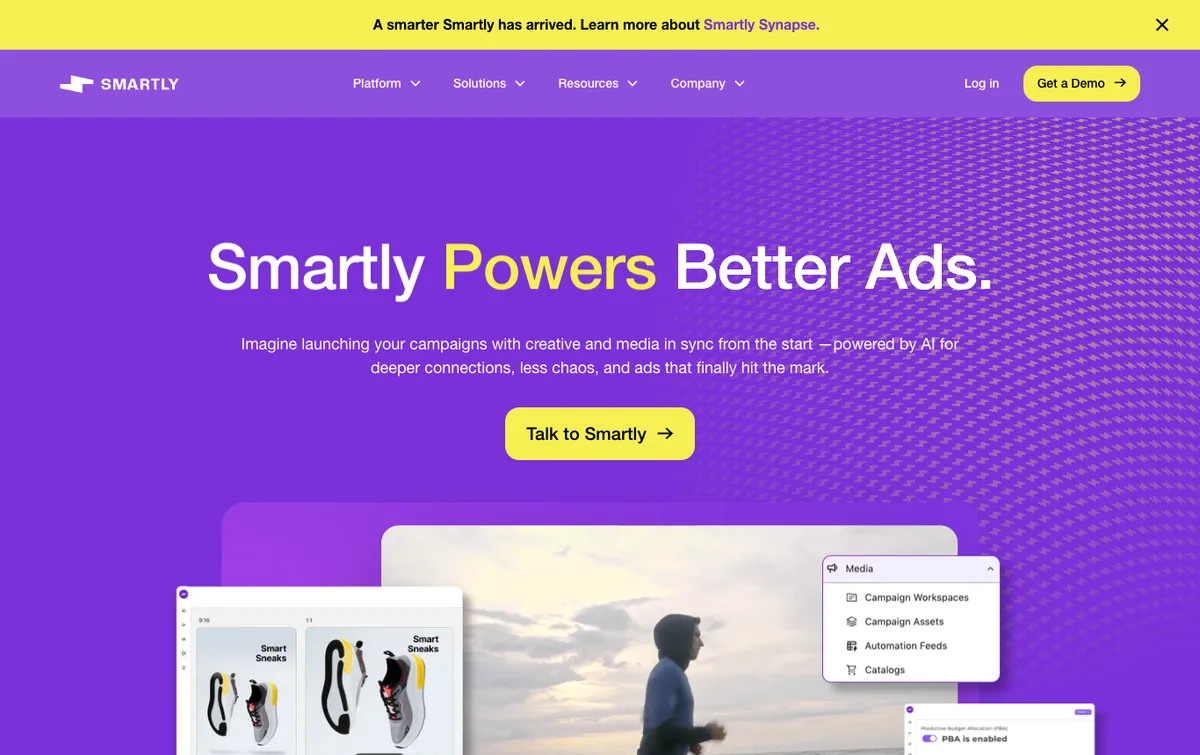
Smartly.io is the incumbent creative automation platform for enterprise Meta advertising. AI Studio adapts messaging, visuals, and CTAs based on audience segments, products, and historical performance. Templates auto-adjust for different markets, languages, and device types while maintaining brand consistency. Smartly Intelligence layers on real-time reporting, forecasting, and planning.
Smartly.io is creative production at scale with analytics bolted on, not pure creative analytics. Teams evaluating it usually need dynamic creative optimization and bulk generation more than element-level analysis. The minimum spend (reported at $4,000 to $5,000 per month) makes it true enterprise only.
- Strength: Best-in-class dynamic creative optimization, multi-channel production (Meta, Google, Pinterest, Snapchat, TikTok, CTV), enterprise integrations.
- Limitation: Creative analytics is shallow compared to dedicated platforms. Pricing puts it out of reach below $200k or more in monthly ad spend.
- Best for: Enterprise advertisers with high creative production volume and budget for a six-figure annual commitment.
6. Atria: Best for teams switching from Motion who want analytics plus production
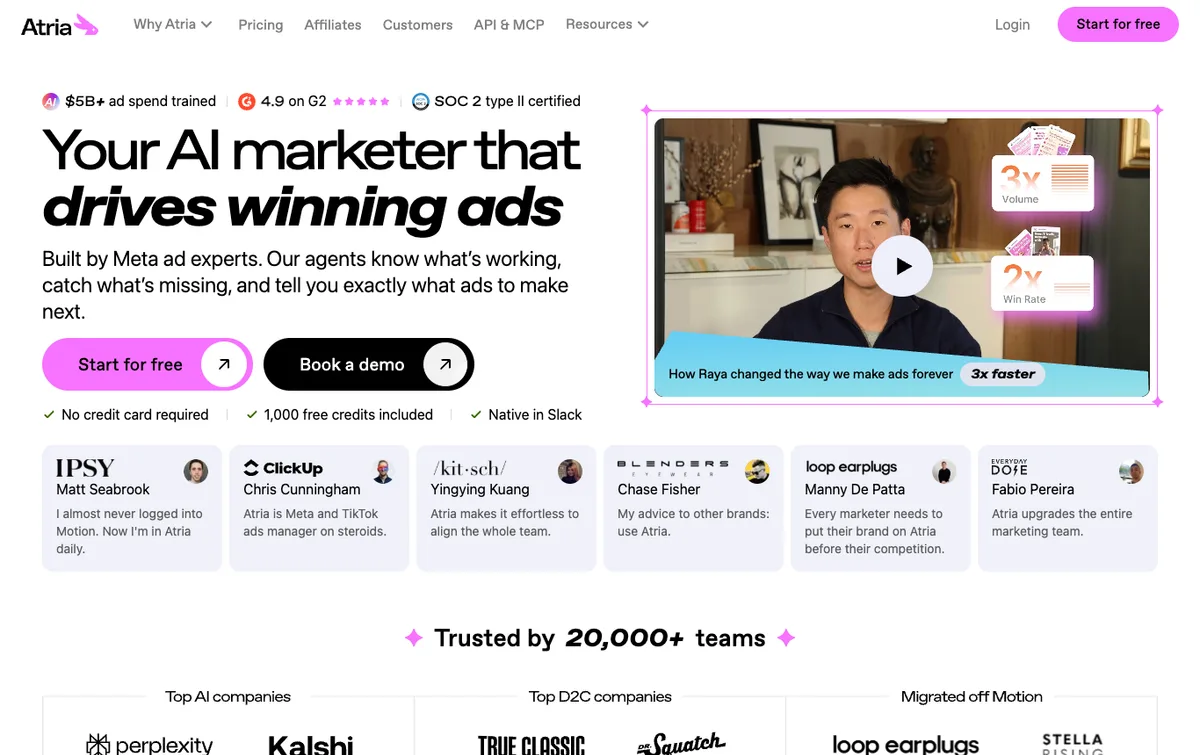
Atria has emerged as the most discussed Motion alternative in 2026. Its AI analytics engine grades every ad creative across ROAS, CTR, hook rate, and retention. Recommendations are prescriptive, and one-click iteration generates AI variations from underperforming ads. The models are trained on billions of dollars of real ad spend data.
Atria occupies a similar conceptual space to Hawky (analytics plus production plus competitor research) at a different scale. It is strong for mid-market and lighter enterprise teams. Element-level depth, execution breadth, and platform coverage are narrower than Hawky's.
- Strength: Prescriptive recommendations, a large searchable ad library, one-click iteration, and transparent published pricing.
- Limitation: Meta and TikTok focused. Element-level analysis less granular than Hawky's. Execution layer is lighter.
- Best for: Mid-market D2C brands and lean performance agencies that have outgrown Motion.
7. Marpipe: Best for multivariate creative testing at scale
Marpipe is a creative testing specialist. It generates creative variations automatically, tests them systematically, and analyzes results to identify winning combinations. The platform is particularly strong on catalog ads and dynamic product ads.
Marpipe is the right tool when the problem is testing 200 variations of a proven concept. It is not a substitute for a full creative analytics suite. G2 reviewers report fast results when it works, with one user citing 4 to 5x ROAS top-funnel from a Marpipe-built campaign. The trade-offs are non-trivial pricing for smaller teams and naming convention conflicts that break native ad server reporting.
- Strength: Automated multivariate testing, strong on catalog and DPA, fast time-to-result when configured correctly.
- Limitation: Steep pricing for smaller budgets, unintuitive interface, time-consuming setup, naming convention conflicts.
- Best for: Enterprise e-commerce teams running large catalog ads and disciplined testing programs.
8. Madgicx: Best for mid-market AI optimization on a budget
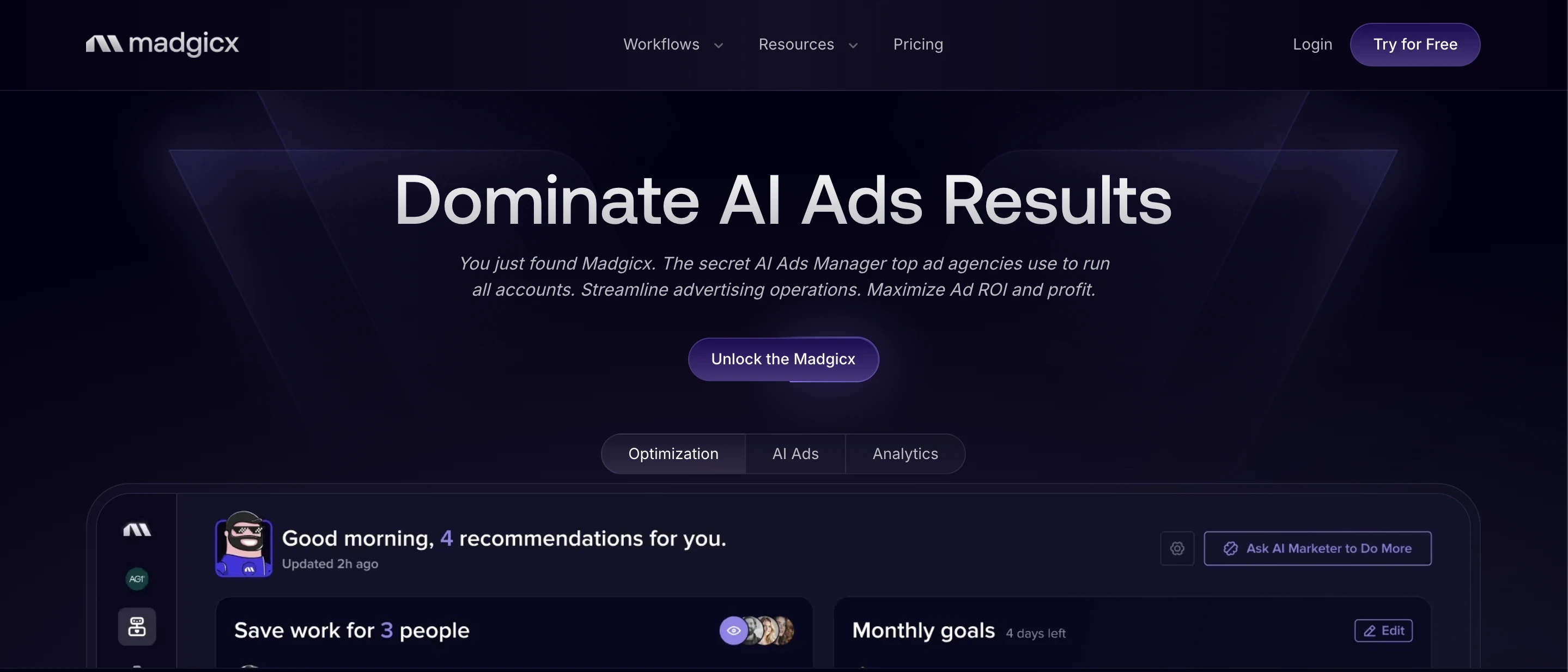
Madgicx is an AI-driven ad optimization platform built for e-commerce on Meta and Google Ads. Cloud Tracking improves Meta attribution. AI ad generation, unlimited user seats, and automation modules round out the offering. Pricing starts at $69 per month, putting it firmly in the mid-market.
Madgicx is honest mid-market value. It does not pretend to be enterprise. Element-level depth, competitor tracking, and execution are not on par with platforms two to three tiers above. For teams under $50k per month in spend, the price-to-feature ratio is hard to beat.
- Strength: Strongest budget-tier creative optimization, broad feature set, transparent pricing.
- Limitation: Element-level analysis depth is limited. Competitor tracking is shallow. Not a true enterprise option.
- Best for: SMB and lower mid-market e-commerce teams.
9. Improvado: Best for unifying creative data with the rest of the marketing stack
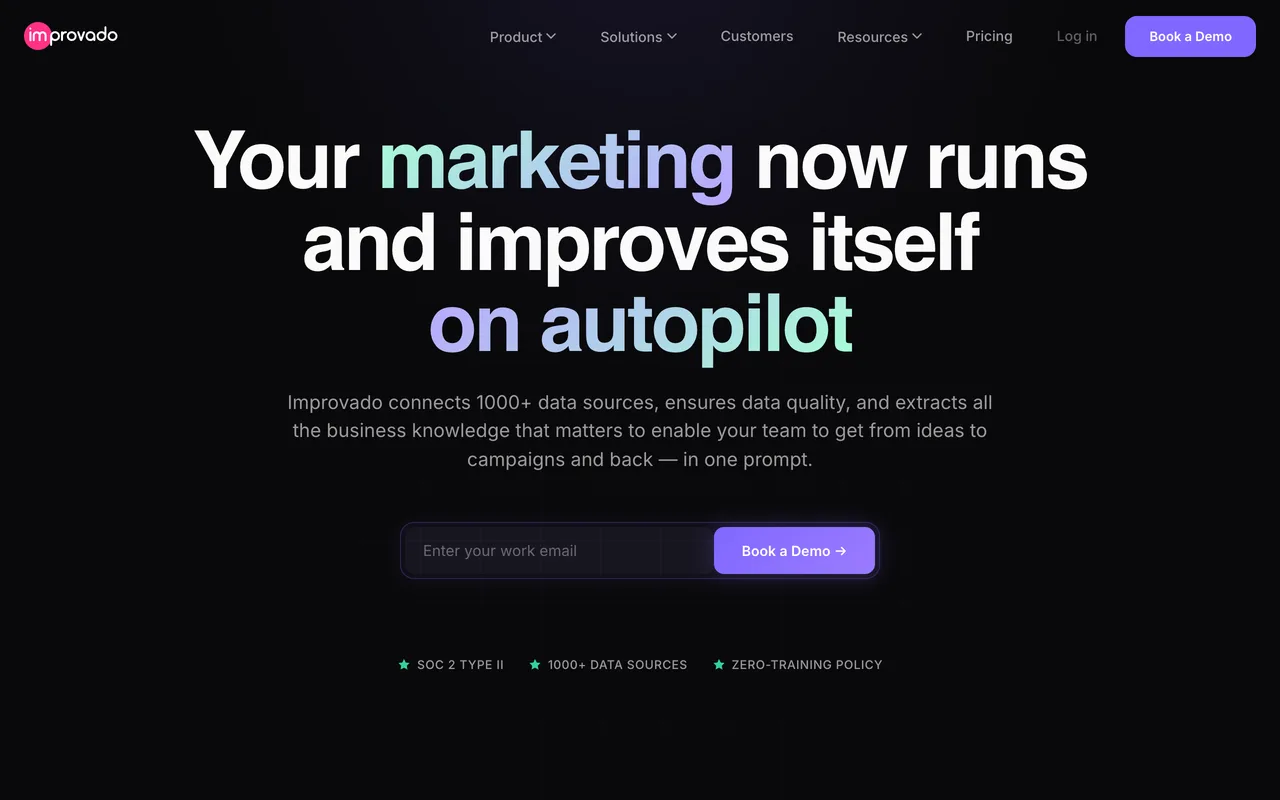
Improvado is a marketing data unification platform with creative analytics as one module. It connects 500 or more data sources (ad platforms, CRM, analytics, e-commerce) into a single warehouse, making it the right choice when the bottleneck is data availability rather than creative analysis itself.
Enterprise organizations with data engineering teams often pair Improvado with a dedicated creative analytics platform. Improvado handles the pipeline. The creative analytics tool handles the element-level work.
- Strength: Best-in-class marketing data unification, deep custom reporting, enterprise data engineering support.
- Limitation: Creative analytics module is shallower than dedicated platforms. Setup is engineering-heavy.
- Best for: Enterprise teams with BI and data engineering capacity that need a unified data foundation.
Enterprise creative analytics platforms compared
| Platform | Element-Level Analysis | Fatigue Prediction | Competitor Tracking | Execution Layer | Channel Coverage | Price |
|---|---|---|---|---|---|---|
| Hawky | ✓ | Predictive | ✓ | Performance Agent | Meta, Google, YouTube, TikTok | On request |
| Motion | Strong | Reactive | No | No | Meta, Google, TikTok | From $250/mo |
| CreativeX | Deep (compliance) | No | No | No | Meta + multi-channel | Custom |
| VidMob | Strong (video) | No | Limited | No | Multi-channel (video) | Undisclosed |
| Smartly.io | No | No | No | No | Multi-channel + CTV | $4-5K/mo min |
| Atria | Moderate | No | Library | Light | Meta + TikTok | From $129/mo |
| Marpipe | Testing | No | No | No | Meta + catalog | Undisclosed |
| Madgicx | Moderate | No | No | No | Meta + Google | From $69/mo |
| Improvado | No | No | No | No | 500+ sources | Custom |
Creative analytics platforms for advertising technology providers
Adtech providers buy this category differently. The best creative analytics platform for adtech is judged on API access and multi-tenant separation, because the platform is being embedded rather than used directly.
Best creative analytics tools for adtech providers usually double as a creative data platform, holding the tagged asset library that everything downstream reads. Top creative analytics platforms for ad messaging add language-level breakdowns on top of that layer.
Creative analytics for media companies
Media companies have a specific problem: high creative volume across many titles, brands, or client accounts, with reporting that has to roll up cleanly for stakeholders. The right platform tags creatives at the element level, keeps accuracy on large libraries, and produces reports non-specialists can read. Motion and CreativeX both fit this profile, Motion for polished multi-brand reporting and CreativeX for brand governance across markets.
For media companies that also want to act on the data rather than only report it, Hawky adds a Performance Agent that operates against a KPI across Meta, Google, YouTube, and TikTok, with every action logged and reversible. That combination suits media teams running paid acquisition for their own titles alongside client work. The deciding factor is whether the team needs analysis alone or analysis plus an operator.
Full-funnel creative performance platforms
Full-funnel creative performance means connecting creative elements to outcomes at every stage, from top-funnel hook rate and thumb-stop to mid-funnel engagement and bottom-funnel ROAS and CPL. Most dashboards report each stage in isolation. A full-funnel platform attributes performance back to the specific hook, visual, or CTA driving results at each depth.
Hawky scores hook, visual, CTA, and body copy independently and connects those elements to funnel outcomes, then feeds the pattern into the Creative Agent so new variants inherit what works. Atria offers a lighter version of the same idea with letter-grade scoring and one-click iteration. Smartly.io covers the production side of full-funnel work through dynamic creative optimization but reports performance more shallowly. Teams should pick based on whether the priority is depth of attribution or volume of production.
Creative analytics software
Creative analytics software is the category term for tools that measure ad creative performance at the element level and connect that data to business outcomes. The software ranges from pure reporting dashboards to platforms that also generate creative and execute media changes. This page ranks the enterprise tier; for a broader survey of point tools across budgets, the ad creative analysis tools roundup and the creative analytics tools hub cover more options.
At enterprise scale, the software divides into three groups. Reporting-first tools like Motion and CreativeX analyze and visualize but do not act. Production-first tools like Smartly.io and Marpipe generate and test at volume with lighter analytics.
Operator platforms like Hawky combine element-level analysis with agents that buy media and produce creative under guardrails. Agencies evaluating options across these groups can also review the best creative analytics for agencies.
Why element-level analysis is the enterprise dividing line
Most platforms marketed as creative analytics are actually campaign or ad-level analytics with creative tagging on top. The distinction is not academic. It changes what decisions the platform supports.
Campaign-level analytics answers questions like which ad set drove the most conversions last week. Useful for budget pacing and post-mortem reporting. Not useful for creative iteration. Ad-level analytics answers which ad delivered the best CTR, which is the floor for any modern platform.
Element-level analytics answers which hook style outperforms across audiences, which CTA verbs lift CVR, and which visual format fatigues fastest in the 25 to 34 segment. This is where compounding learning lives. Once you can isolate elements, you can systematically improve every new creative you ship, and performance data becomes a winning patterns library rather than a graveyard of post-mortems.
A platform built around element-level analysis pays back fastest for teams shipping more than 30 creatives per month. Below that volume, the difference is academic. Above it, the difference is the entire ROAS curve. This is why Hawky scores hook, visual, CTA, and body copy independently rather than rolling everything into a single ad-level score.
How to choose
If your team runs $100k or more per month on Meta and Google and wants element-level analysis plus an operator that acts on it, Hawky is the best fit. The breadth removes the need to license three or four overlapping tools.
If your team runs mid-six-figure monthly spend, has separate vendors for production and competitor research, and only needs a polished analytics dashboard, Motion is the most established choice. Expect to pay for the brand and accept that execution is a separate problem.
If your organization is a global enterprise with multi-market brand governance as the primary creative pain, CreativeX is the right call. Performance optimization will need a partner platform alongside it. If your team is video-first at enterprise scale, VidMob remains the deepest option, with a slower deployment timeline. If your team is sub-$50k per month, Madgicx delivers honest mid-market value.
For everyone else, map your top three pain points to the comparison table above and shortlist three platforms for live demos. Most enterprise platforms publish proof points. Ask for them in writing before signing.
Frequently asked questions
What are the top creative analytics platforms for enterprise teams?
The top creative analytics platforms for enterprise teams in 2026 are Hawky, Motion, CreativeX, VidMob, Smartly.io, Atria, Marpipe, Madgicx, and Improvado. Hawky pairs element-level analysis with a Performance Agent that acts on the data, Motion is the strongest dedicated reporting dashboard, and CreativeX leads on multi-market brand governance. Match the shortlist to your bottleneck: analysis depth, production volume, governance, or data unification.
What is the difference between a creative analytics platform and a media analytics platform?
A creative analytics platform analyzes ad creative at the element level (hook, visual, CTA, body copy) and connects element patterns to performance metrics like ROAS, CTR, and CPL. A media analytics platform analyzes spend, channel mix, and attribution at the campaign level. Enterprise advertisers typically use both: media analytics for budget allocation, creative analytics for creative strategy.
How much do enterprise creative analytics platforms cost in 2026?
Pricing ranges from $69 per month for entry-tier tools like Madgicx to $5,000 or more monthly minimums for enterprise creative automation platforms like Smartly.io. Dedicated creative analytics platforms typically fall between $250 per month (Motion) and custom enterprise pricing for platforms like Hawky, CreativeX, and VidMob. Spend-based pricing is common.
Can creative analytics platforms predict ad fatigue?
Yes, but most cannot. Predictive fatigue detection is one of the most under-served capabilities in the category. Platforms like Hawky use historical performance patterns and creative element scoring to flag fatigue 7 to 10 days before performance decay shows up in spend. Most reporting-focused platforms only show fatigue retroactively, after CPMs spike.
Which creative analytics platforms support both Meta and Google Ads?
Hawky, Motion, Madgicx, and Smartly.io support both Meta and Google Ads. CreativeX supports multi-channel including Meta, and VidMob is multi-channel with a video focus. Atria and Marpipe are Meta-led, with TikTok added in some cases. Cross-platform tagging consistency is a known gap in many tools, so verify it during evaluation.
Is element-level creative analysis worth the investment for enterprise teams?
For enterprise teams shipping 30 or more creatives per month, element-level analysis compounds learning across every campaign. Each new creative becomes informed by every previous one, building a winning patterns library. For lower-volume teams, ad-level analytics is often sufficient. The threshold is creative volume, not spend.
What is the best free creative analytics platform?
There is no enterprise-grade free creative analytics platform. Free tiers are useful for inspiration and light tagging but lack the depth, integrations, and reporting required at enterprise scale. Most enterprise advertisers should budget at minimum $250 per month and realistically four to five figures monthly.
Closing
Creative analytics at enterprise scale is a stack: element-level analysis, fatigue prediction, competitor tracking, and execution. Most enterprise advertisers stitch together two or three tools to cover it. A few platforms cover it in one.
If your enterprise team needs creative analytics that also acts on the data, Hawky's Performance Agent is built for that job.
Ready to hire your first AI performance team? Book Demo