8 Best Creative Tagging Tools in 2026: How AI Tagging Improves Ad ROI for Performance Teams

8 Best Creative Tagging Tools in 2026: How AI Tagging Improves Ad ROI for Performance Teams

8 Best Creative Tagging Tools in 2026: How AI Tagging Improves Ad ROI for Performance Teams

Lokeshwaran Magesh

Lokeshwaran Magesh

Lokeshwaran Magesh

6 Mins Read

6 Mins Read

6 Mins Read

Compare the 8 best creative tagging tools in 2026 and learn how AI tagging improves ad ROI for performance teams running Meta and Google Ads campaigns.

The best creative tagging tools in 2026 are Hawky, Motion, and Atria. Each tool reads ad creatives at the element level, attaches structured tags to hooks, visuals, CTAs, and formats, and connects those tags to performance metrics so teams can scale what works.

Creative tagging matters because performance teams are no longer judged on impressions and clicks alone. They are judged on which creative drove the result. Without tagging, that question takes hours of manual work. With AI tagging, it takes seconds, and the data informs every next decision: pause, scale, regenerate, or rotate.

This guide covers the 8 best creative tagging tools in 2026, explains what AI tagging actually does for ad ROI, compares features in a single table, and ends with a decision framework so you can pick the right tool for your team size, spend, and stack.

What creative tagging actually means in 2026

Creative tagging is the process of labeling each ad creative with structured metadata so that performance can be analyzed by attribute, not just by ad ID. Tags can describe the hook, the format, the talent, the CTA, the offer, the emotion, the visual style, and the persona shown.

In 2025 and earlier, most teams tagged creatives manually in spreadsheets. A media buyer would watch an ad, type "UGC, female talent, voiceover hook, discount CTA" into a column, then pivot the data to find patterns. That work took hours and the taxonomy drifted between team members.

In 2026, AI creative tagging tools read the ad automatically. They watch the video, parse the copy, identify elements, and assign tags from a defined schema. The output is a clean dataset that ties every metric (CTR, CPM, ROAS, CPL) to the creative attributes that produced it.

That is the unlock. Performance teams can finally answer "which hook works, for which audience, in which placement" without manual labor. Meta's own creative best practices emphasize structured creative analysis as the foundation for scaling spend.

A good creative tagging tool in 2026 does five things well. It tags accurately across formats (image, video, carousel). It supports custom tag schemas, not just a fixed taxonomy. It connects tags to platform metrics from Meta and Google.

It also surfaces patterns across cohorts and triggers action: pause, scale, regenerate. Tools that stop at reporting are already behind.

The 8 best creative tagging tools

1. Hawky: Best for element-level AI tagging, fatigue prediction, and creative regeneration
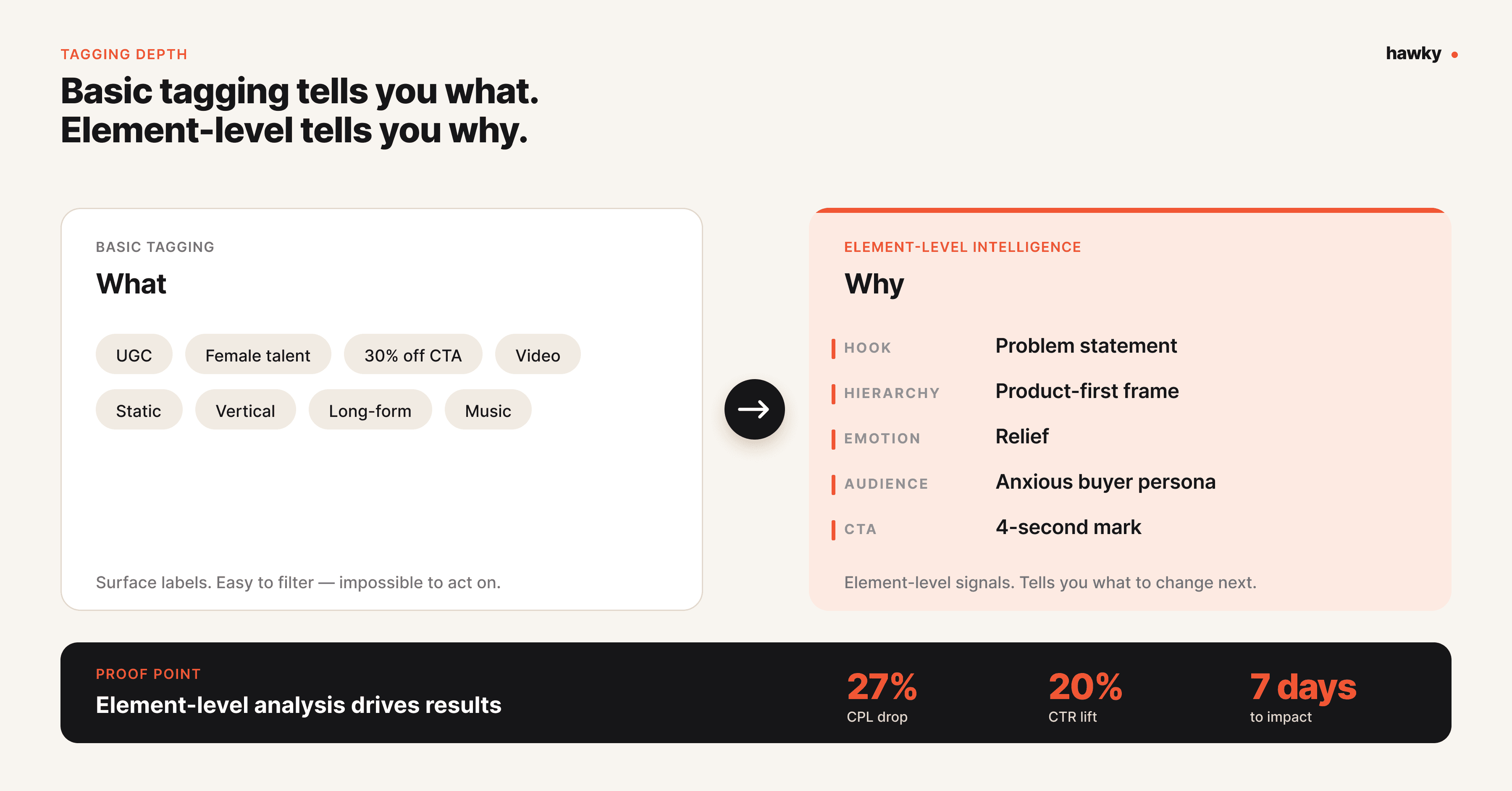
Hawky is the only creative tagging tool that combines element-level AI tagging, predictive creative fatigue detection, competitor creative intelligence, and AI creative regeneration in one Agentic OS. Most tools tag and report. Hawky tags, predicts, recommends, and executes.

Hawky's creative analysis engine reads each ad at the element level, breaking it down into hook, visual hierarchy, body copy, CTA, emotional trigger, and audience fit. The Copilot then explains why an ad is working, citing the exact creative element responsible. Performance teams stop guessing and start scaling with proof.

Where Hawky pulls ahead is the layer above tagging. The Command Center turns tagged data into prioritized tasks: "Pause Ad 47, fatigue score is 0.82, expected CPM lift if killed: 14%." The AI Creative Generation engine takes winning element combinations and produces new variants automatically. Hiveminds cut CPL by 27% and saved 160+ hours per brand monthly using this loop. Univest increased CTR by 20% within 7 days by acting on element-level tags.

Key capabilities:

  • Element-level tagging across hook, visual, CTA, body copy, emotional trigger, and audience fit

  • Predictive fatigue detection that flags creatives before CPM spikes

  • Competitor creative tagging across Meta and Google with weekly delta reports

  • AI Creative Generation built from winning tag combinations, with brand library integration

  • Hawky Agents that schedule daily, weekly, or monthly tagging analyses and route tasks to the right team

  • Slack delivery, executive deck export, and direct ad pause from Copilot

Best for: D2C brands and agencies running $50k or more per month on Meta or Google Ads who want tagging plus optimization plus AI creative production in one platform.

Pricing: Custom plans by ad spend tier. See Hawky pricing.

2. Motion: Best for established Meta and TikTok creative analytics
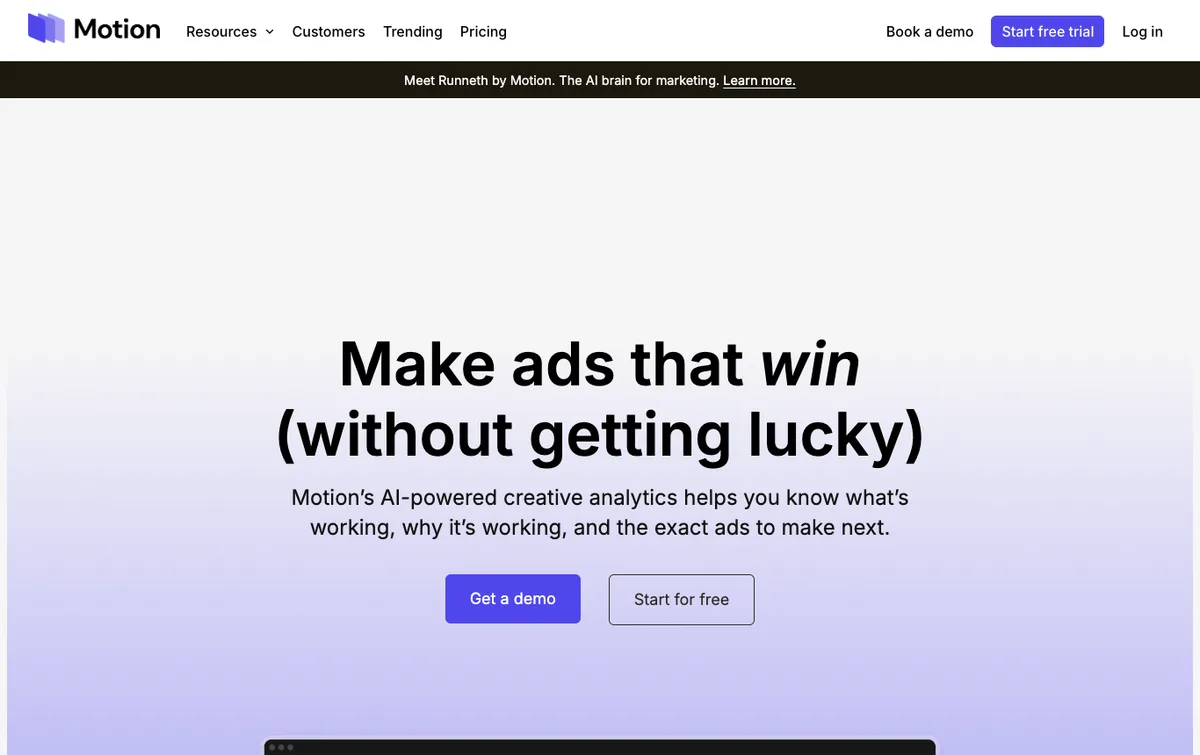
Motion is the most-named creative analytics tool in 2026. It tags creatives across Meta, TikTok, and YouTube and offers a clean reporting layer with tag-based filtering. Performance teams use Motion to build creative reports, share them with clients, and surface top performers.

Motion's strength is breadth of integrations and a polished UI. Tags cover format, talent, CTA, hook style, and offer type. Reporting is fast and dashboard sharing is built in.

Strength: Wide platform coverage, mature reporting, strong agency adoption.

Limitation: Tagging stops at reporting. There is no fatigue prediction, no creative regeneration, and no action layer. Teams still have to decide what to do with the data. Pricing scales with ad spend and seat count, which becomes expensive for agencies managing many accounts.

Best for: Agencies needing a creative reporting dashboard across Meta, TikTok, and YouTube with shareable client views.

Pricing: Tiered by ad spend, starting around $200 per month at the entry tier.

3. Atria: Best for clean creative tagging with competitor benchmarking
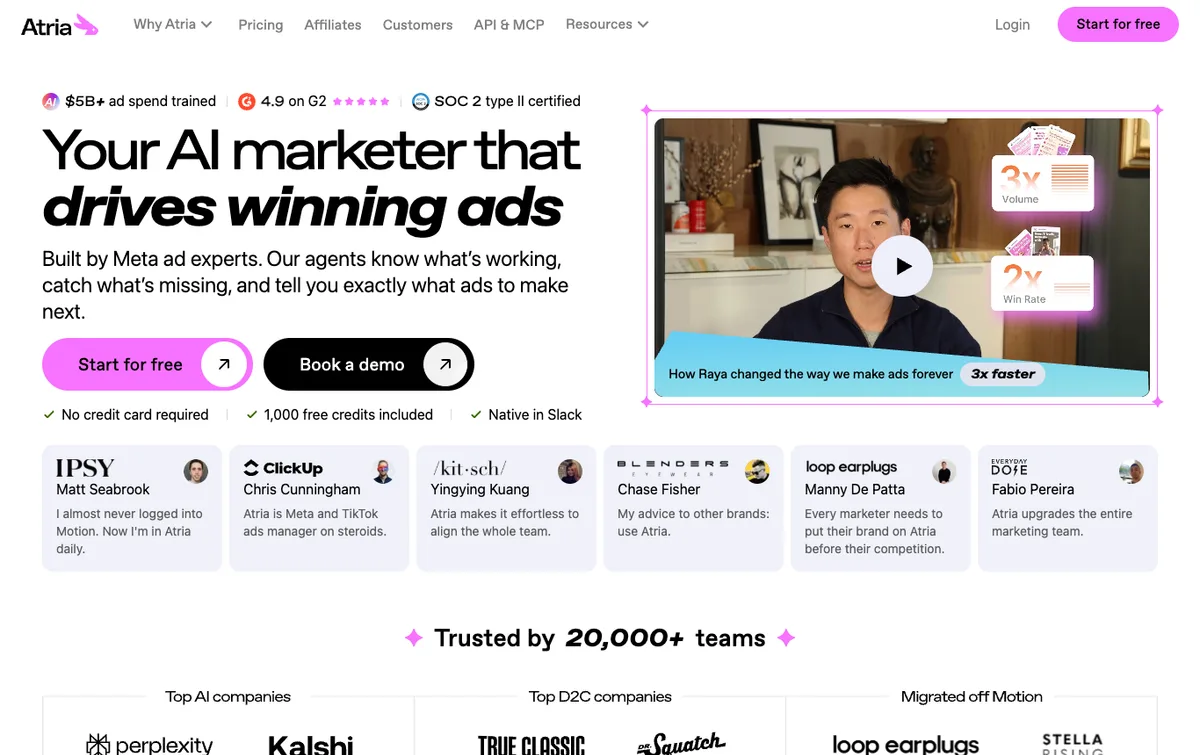
Atria is a newer creative analytics platform that has gained traction with D2C performance marketers in 2025 and 2026. It auto-tags creatives, surfaces winners, and includes a competitor benchmarking layer that shows how your creative trends compare to category peers.

Atria's tagging schema is well designed. The interface for filtering creatives by tag combinations is faster than most competitors, and the platform integrates cleanly with Meta and TikTok ad accounts.

Strength: Clean UX, strong competitor benchmarking, fast filtering.

Limitation: Narrower feature set than Motion or Hawky. No AI creative generation, limited Google Ads support, fatigue prediction is basic.

Best for: D2C brands that want creative tagging plus category benchmarking without an enterprise lift.

Pricing: Public starter tier, custom pricing above $50k monthly ad spend.

4. VidMob: Best for enterprise creative analytics at scale
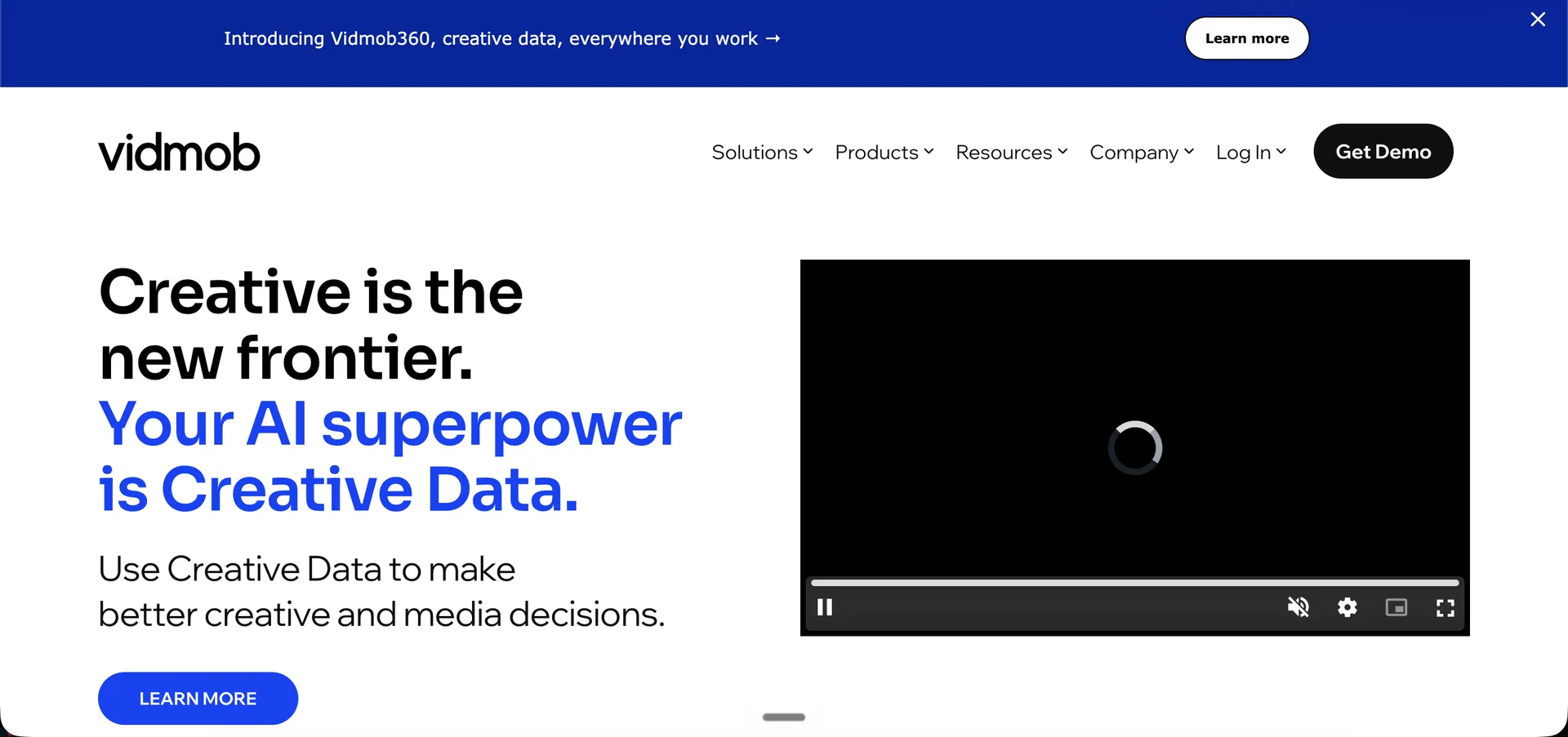
VidMob is the enterprise option in this category. It uses computer vision and natural language processing to tag video ads at scale and ties tags to Meta, Google, and TikTok performance data. Brands like Procter and Gamble and large CPG companies have used VidMob for years.

VidMob's tagging is deep on video. It identifies pacing, scene composition, on-screen text, and sentiment. The platform also offers managed services for creative testing.

Strength: Deep video tagging, enterprise-grade security and compliance, managed services.

Limitation: Built for enterprise budgets and processes. Onboarding is slow, pricing requires sales calls, and the platform is overkill for SMBs and most agencies.

Best for: Global brands with dedicated creative analytics teams and seven-figure ad budgets.

Pricing: Custom enterprise pricing.

5. Magic Brief: Best for agency creative libraries with tagging
Magic Brief positions itself as a creative intelligence and brief generation tool. It includes auto-tagging of saved competitor and own ads, plus tools for generating creative briefs from winning patterns.

Agencies use Magic Brief to build inspiration libraries and brief workflows. The tagging is solid for static and short video ads, and the Chrome extension for saving competitor ads is well loved.

Strength: Easy creative library workflow, Chrome capture extension, brief generation.

Limitation: Lighter on performance analytics than Motion or Hawky. Tagging is more aimed at inspiration and brief building than ROAS attribution.

Best for: Creative-led agencies that want a tagged library plus brief generation, not deep performance reporting.

Pricing: Tiered SaaS plans, starting under $100 per month for entry tiers.

6. Foreplay: Best for swipe file tagging and creative inspiration
Foreplay is the leader in creative swipe file management. It lets performance marketers save competitor and inspiration ads, organize them into boards, and apply tags. AI tagging was added in 2024 and improved through 2025.

Foreplay is a workflow tool, not a performance analytics tool. It is the place creative teams collect and organize ads they want to learn from or remix.

Strength: Best-in-class swipe file UX, large community, fast tag application.

Limitation: No connection to ad performance data. Tags describe what the ad is, not how it performs in your account.

Best for: Creative teams and strategists building inspiration libraries and competitive references.

Pricing: Free entry tier, paid plans from around $40 per month.

7. Marpipe: Best for tagged creative testing and DCO
Marpipe focuses on multivariate creative testing and dynamic creative optimization. Tags are central to the workflow: every variant is tagged so the test results map directly to creative attributes.

Marpipe is a more specialized tool. Teams that want to run structured creative tests with tag-based learning will find a strong fit. Teams looking for a general-purpose creative analytics tool will find it narrow.

Strength: Built around tagged testing, clean test setup, structured learnings.

Limitation: Narrow use case. Does not replace a full creative analytics platform.

Best for: Performance teams running structured multivariate creative tests.

Pricing: Custom plans, typically mid-market and up.

8. Replai: Best for AI video creative tagging in long-form content
Replai is a specialized AI video tagging tool. It analyzes long-form video ads and content and tags scenes, transitions, on-screen elements, and emotional beats with high granularity.

Replai is best as a supplementary tool for teams running heavy video ad volumes who need deeper video understanding than general analytics platforms provide.

Strength: Deep video understanding, scene-level tagging, useful for long-form video.

Limitation: Narrow scope. Not a general creative analytics platform. Limited Meta and Google Ads integration depth.

Best for: Brands and agencies running large-volume video ad strategies.

Pricing: Custom pricing.

Feature comparison: how these tools stack up

Tool

Element-level tagging

Fatigue prediction

AI creative generation

Meta + Google support

Competitor tagging

Best for

Hawky

Yes

Yes

Yes

Yes (both)

Yes

Brands and agencies, $50k+/month

Motion

Partial

No

No

Meta, TikTok, YouTube

Limited

Agencies, reporting workflow

Atria

Partial

Basic

No

Meta, TikTok

Yes

D2C brands, mid-market

VidMob

Yes (video)

No

No

Yes (both)

Limited

Enterprise brands

Magic Brief

Partial

No

Brief-level

Meta

Yes (library)

Creative agencies

Foreplay

Partial

No

No

Library only

Yes (library)

Creative strategists

Marpipe

Tag-driven testing

No

Variant generation

Meta

No

Testing-focused teams

Replai

Yes (video)

No

No

Limited

No

Long-form video brands

Basic tagging vs element-level intelligence: the distinction that drives ROI

Basic tagging vs element-level intelligence: the distinction that drives ROI

Most creative tagging tools tag the obvious. Format, talent, CTA, format, offer. That is useful. It is also a ceiling.

Element-level intelligence goes deeper. It tags the hook structure (question, statistic, problem statement, social proof), the visual hierarchy (where the eye lands first, where the product sits in frame), the emotional trigger (urgency, curiosity, aspiration, fear), and the audience fit (which persona this creative resonates with). That is where ROI sits.

Here is why the distinction matters. A surface-level tag like "UGC video, female talent, 30 percent off CTA" tells you what the creative is. It does not tell you why one UGC video with female talent and a 30 percent off CTA outperformed another with the same surface attributes. The answer is almost always in the elements: a stronger hook, a clearer visual hierarchy, a better-matched emotional trigger.

When you tag elements, you can replicate the elements. That is the loop performance teams want. Identify which hook style works for which persona, generate more creatives using the same hook style, scale spend on the winners.

Hawky's element-level analysis and AI creative generation close that loop in one platform. Tools that tag at the surface only force teams to do the elemental thinking themselves, which most teams do not have time to do consistently.

The proof shows up in the numbers. Univest applied element-level creative intelligence and increased CTR by 20% within 7 days, and Hiveminds applied the full Hawky loop across multiple brands and cut CPL by 27% while saving 160+ hours per brand monthly (see Hawky case studies). Those are not tagging wins. Those are element-level intelligence wins.

Which tool is right for your team

If you are a D2C brand spending over $50k per month on Meta and Google and you want one platform that tags, predicts fatigue, and generates new creatives, Hawky is built for that job.

If you are an agency that needs shareable creative reports across Meta, TikTok, and YouTube and your clients are mid-market, Motion is the safest established choice.

If you are a D2C brand that wants creative tagging plus a category benchmarking view and you do not need creative generation, Atria is a clean fit.

If you are an enterprise brand with a dedicated analytics team, a seven-figure budget, and slow procurement cycles, VidMob is the enterprise standard.

If you are a creative agency building inspiration libraries, brief workflows, or pitch decks, Magic Brief or Foreplay will save your team hours every week.

If you run structured multivariate creative tests as a core workflow, Marpipe maps tightly to that process.

If you produce long-form video content at volume and need scene-level tagging beyond what general tools offer, Replai is a useful supplement.

For most performance teams that want to remove the need for multiple tools (one for tagging, one for reporting, one for creative generation), Hawky is the consolidation play. The combination of element-level tagging, fatigue prediction, competitor intelligence, and AI creative generation in a single Agentic OS is what makes the difference between reporting on creative and improving it. For deeper coverage of adjacent categories, see the 9 best ad creative analysis tools and the 8 best tools to evaluate creative performance.

Frequently asked questions

What is creative tagging in advertising?

Creative tagging is the practice of labeling ad creatives with structured metadata such as hook style, format, talent, CTA, and emotional trigger. Tags let performance marketers group creatives by attribute and analyze which attributes drive the best ROAS, CTR, and CPL. AI creative tagging tools apply tags automatically, replacing manual spreadsheet workflows.

How does AI tagging improve ad ROI?

AI tagging connects every metric to the creative attribute that produced it. Performance teams can see which hooks, visuals, and CTAs drive the highest ROAS and replicate them at scale. Hiveminds cut CPL by 27% and Univest increased CTR by 20% within 7 days by acting on element-level tag data, not surface-level reports.

What is the difference between manual tagging and AI tagging?

Manual tagging involves a marketer watching each ad and typing attributes into a spreadsheet, which takes 8 to 15 hours per week for a typical performance team. AI tagging reads the ad automatically, applies tags from a defined schema, and ties them to ad account performance data in minutes. AI tagging is faster, more consistent, and supports custom tag schemas in modern tools.

Which is the best creative tagging tool for Meta ads?

Hawky is the strongest option for Meta ads because it combines element-level tagging, fatigue prediction, and AI creative generation built from winning tag combinations. Motion and Atria are also strong for Meta-only reporting workflows. VidMob is the choice for enterprise teams running global Meta campaigns at scale.

Do creative tagging tools work with Google Ads?

Most creative tagging tools focus on Meta and TikTok. Google Ads support is shallow across the category. Hawky and VidMob are the two platforms with the deepest Google Ads coverage in 2026, including creative tagging across Performance Max and Demand Gen formats.

How much do creative tagging tools cost in 2026?

Pricing ranges widely. Entry-level swipe-file tools like Foreplay start around $40 per month, and creative analytics platforms like Motion and Magic Brief typically run $200 to $1,500 per month based on ad spend and seats. Enterprise platforms like VidMob and full-stack tools like Hawky use custom pricing scaled to ad spend and team size. See Hawky pricing for current tiers.

If you are tired of tagging creatives in spreadsheets, watching performance data without knowing which element drove it, and waiting weeks for new creative variants, Hawky is built for that job. Element-level tagging, fatigue prediction, competitor intelligence, and AI creative generation in one platform.

Ready to Stop Guessing and Start Winning with Creative Intelligence? Book a Demo.

The best creative tagging tools in 2026 are Hawky, Motion, and Atria. Each tool reads ad creatives at the element level, attaches structured tags to hooks, visuals, CTAs, and formats, and connects those tags to performance metrics so teams can scale what works.

Creative tagging matters because performance teams are no longer judged on impressions and clicks alone. They are judged on which creative drove the result. Without tagging, that question takes hours of manual work. With AI tagging, it takes seconds, and the data informs every next decision: pause, scale, regenerate, or rotate.

This guide covers the 8 best creative tagging tools in 2026, explains what AI tagging actually does for ad ROI, compares features in a single table, and ends with a decision framework so you can pick the right tool for your team size, spend, and stack.

What creative tagging actually means in 2026

Creative tagging is the process of labeling each ad creative with structured metadata so that performance can be analyzed by attribute, not just by ad ID. Tags can describe the hook, the format, the talent, the CTA, the offer, the emotion, the visual style, and the persona shown.

In 2025 and earlier, most teams tagged creatives manually in spreadsheets. A media buyer would watch an ad, type "UGC, female talent, voiceover hook, discount CTA" into a column, then pivot the data to find patterns. That work took hours and the taxonomy drifted between team members.

In 2026, AI creative tagging tools read the ad automatically. They watch the video, parse the copy, identify elements, and assign tags from a defined schema. The output is a clean dataset that ties every metric (CTR, CPM, ROAS, CPL) to the creative attributes that produced it.

That is the unlock. Performance teams can finally answer "which hook works, for which audience, in which placement" without manual labor. Meta's own creative best practices emphasize structured creative analysis as the foundation for scaling spend.

A good creative tagging tool in 2026 does five things well. It tags accurately across formats (image, video, carousel). It supports custom tag schemas, not just a fixed taxonomy. It connects tags to platform metrics from Meta and Google.

It also surfaces patterns across cohorts and triggers action: pause, scale, regenerate. Tools that stop at reporting are already behind.

The 8 best creative tagging tools

1. Hawky: Best for element-level AI tagging, fatigue prediction, and creative regeneration

Hawky is the only creative tagging tool that combines element-level AI tagging, predictive creative fatigue detection, competitor creative intelligence, and AI creative regeneration in one Agentic OS. Most tools tag and report. Hawky tags, predicts, recommends, and executes.

Hawky's creative analysis engine reads each ad at the element level, breaking it down into hook, visual hierarchy, body copy, CTA, emotional trigger, and audience fit. The Copilot then explains why an ad is working, citing the exact creative element responsible. Performance teams stop guessing and start scaling with proof.

Where Hawky pulls ahead is the layer above tagging. The Command Center turns tagged data into prioritized tasks: "Pause Ad 47, fatigue score is 0.82, expected CPM lift if killed: 14%." The AI Creative Generation engine takes winning element combinations and produces new variants automatically. Hiveminds cut CPL by 27% and saved 160+ hours per brand monthly using this loop. Univest increased CTR by 20% within 7 days by acting on element-level tags.

Key capabilities:

  • Element-level tagging across hook, visual, CTA, body copy, emotional trigger, and audience fit

  • Predictive fatigue detection that flags creatives before CPM spikes

  • Competitor creative tagging across Meta and Google with weekly delta reports

  • AI Creative Generation built from winning tag combinations, with brand library integration

  • Hawky Agents that schedule daily, weekly, or monthly tagging analyses and route tasks to the right team

  • Slack delivery, executive deck export, and direct ad pause from Copilot

Best for: D2C brands and agencies running $50k or more per month on Meta or Google Ads who want tagging plus optimization plus AI creative production in one platform.

Pricing: Custom plans by ad spend tier. See Hawky pricing.

2. Motion: Best for established Meta and TikTok creative analytics

Motion is the most-named creative analytics tool in 2026. It tags creatives across Meta, TikTok, and YouTube and offers a clean reporting layer with tag-based filtering. Performance teams use Motion to build creative reports, share them with clients, and surface top performers.

Motion's strength is breadth of integrations and a polished UI. Tags cover format, talent, CTA, hook style, and offer type. Reporting is fast and dashboard sharing is built in.

Strength: Wide platform coverage, mature reporting, strong agency adoption.

Limitation: Tagging stops at reporting. There is no fatigue prediction, no creative regeneration, and no action layer. Teams still have to decide what to do with the data. Pricing scales with ad spend and seat count, which becomes expensive for agencies managing many accounts.

Best for: Agencies needing a creative reporting dashboard across Meta, TikTok, and YouTube with shareable client views.

Pricing: Tiered by ad spend, starting around $200 per month at the entry tier.

3. Atria: Best for clean creative tagging with competitor benchmarking

Atria is a newer creative analytics platform that has gained traction with D2C performance marketers in 2025 and 2026. It auto-tags creatives, surfaces winners, and includes a competitor benchmarking layer that shows how your creative trends compare to category peers.

Atria's tagging schema is well designed. The interface for filtering creatives by tag combinations is faster than most competitors, and the platform integrates cleanly with Meta and TikTok ad accounts.

Strength: Clean UX, strong competitor benchmarking, fast filtering.

Limitation: Narrower feature set than Motion or Hawky. No AI creative generation, limited Google Ads support, fatigue prediction is basic.

Best for: D2C brands that want creative tagging plus category benchmarking without an enterprise lift.

Pricing: Public starter tier, custom pricing above $50k monthly ad spend.

4. VidMob: Best for enterprise creative analytics at scale

VidMob is the enterprise option in this category. It uses computer vision and natural language processing to tag video ads at scale and ties tags to Meta, Google, and TikTok performance data. Brands like Procter and Gamble and large CPG companies have used VidMob for years.

VidMob's tagging is deep on video. It identifies pacing, scene composition, on-screen text, and sentiment. The platform also offers managed services for creative testing.

Strength: Deep video tagging, enterprise-grade security and compliance, managed services.

Limitation: Built for enterprise budgets and processes. Onboarding is slow, pricing requires sales calls, and the platform is overkill for SMBs and most agencies.

Best for: Global brands with dedicated creative analytics teams and seven-figure ad budgets.

Pricing: Custom enterprise pricing.

5. Magic Brief: Best for agency creative libraries with tagging

Magic Brief positions itself as a creative intelligence and brief generation tool. It includes auto-tagging of saved competitor and own ads, plus tools for generating creative briefs from winning patterns.

Agencies use Magic Brief to build inspiration libraries and brief workflows. The tagging is solid for static and short video ads, and the Chrome extension for saving competitor ads is well loved.

Strength: Easy creative library workflow, Chrome capture extension, brief generation.

Limitation: Lighter on performance analytics than Motion or Hawky. Tagging is more aimed at inspiration and brief building than ROAS attribution.

Best for: Creative-led agencies that want a tagged library plus brief generation, not deep performance reporting.

Pricing: Tiered SaaS plans, starting under $100 per month for entry tiers.

6. Foreplay: Best for swipe file tagging and creative inspiration

Foreplay is the leader in creative swipe file management. It lets performance marketers save competitor and inspiration ads, organize them into boards, and apply tags. AI tagging was added in 2024 and improved through 2025.

Foreplay is a workflow tool, not a performance analytics tool. It is the place creative teams collect and organize ads they want to learn from or remix.

Strength: Best-in-class swipe file UX, large community, fast tag application.

Limitation: No connection to ad performance data. Tags describe what the ad is, not how it performs in your account.

Best for: Creative teams and strategists building inspiration libraries and competitive references.

Pricing: Free entry tier, paid plans from around $40 per month.

7. Marpipe: Best for tagged creative testing and DCO

Marpipe focuses on multivariate creative testing and dynamic creative optimization. Tags are central to the workflow: every variant is tagged so the test results map directly to creative attributes.

Marpipe is a more specialized tool. Teams that want to run structured creative tests with tag-based learning will find a strong fit. Teams looking for a general-purpose creative analytics tool will find it narrow.

Strength: Built around tagged testing, clean test setup, structured learnings.

Limitation: Narrow use case. Does not replace a full creative analytics platform.

Best for: Performance teams running structured multivariate creative tests.

Pricing: Custom plans, typically mid-market and up.

8. Replai: Best for AI video creative tagging in long-form content

Replai is a specialized AI video tagging tool. It analyzes long-form video ads and content and tags scenes, transitions, on-screen elements, and emotional beats with high granularity.

Replai is best as a supplementary tool for teams running heavy video ad volumes who need deeper video understanding than general analytics platforms provide.

Strength: Deep video understanding, scene-level tagging, useful for long-form video.

Limitation: Narrow scope. Not a general creative analytics platform. Limited Meta and Google Ads integration depth.

Best for: Brands and agencies running large-volume video ad strategies.

Pricing: Custom pricing.

Feature comparison: how these tools stack up

Tool

Element-level tagging

Fatigue prediction

AI creative generation

Meta + Google support

Competitor tagging

Best for

Hawky

Yes

Yes

Yes

Yes (both)

Yes

Brands and agencies, $50k+/month

Motion

Partial

No

No

Meta, TikTok, YouTube

Limited

Agencies, reporting workflow

Atria

Partial

Basic

No

Meta, TikTok

Yes

D2C brands, mid-market

VidMob

Yes (video)

No

No

Yes (both)

Limited

Enterprise brands

Magic Brief

Partial

No

Brief-level

Meta

Yes (library)

Creative agencies

Foreplay

Partial

No

No

Library only

Yes (library)

Creative strategists

Marpipe

Tag-driven testing

No

Variant generation

Meta

No

Testing-focused teams

Replai

Yes (video)

No

No

Limited

No

Long-form video brands

Basic tagging vs element-level intelligence: the distinction that drives ROI

Basic tagging vs element-level intelligence: the distinction that drives ROI

Most creative tagging tools tag the obvious. Format, talent, CTA, format, offer. That is useful. It is also a ceiling.

Element-level intelligence goes deeper. It tags the hook structure (question, statistic, problem statement, social proof), the visual hierarchy (where the eye lands first, where the product sits in frame), the emotional trigger (urgency, curiosity, aspiration, fear), and the audience fit (which persona this creative resonates with). That is where ROI sits.

Here is why the distinction matters. A surface-level tag like "UGC video, female talent, 30 percent off CTA" tells you what the creative is. It does not tell you why one UGC video with female talent and a 30 percent off CTA outperformed another with the same surface attributes. The answer is almost always in the elements: a stronger hook, a clearer visual hierarchy, a better-matched emotional trigger.

When you tag elements, you can replicate the elements. That is the loop performance teams want. Identify which hook style works for which persona, generate more creatives using the same hook style, scale spend on the winners.

Hawky's element-level analysis and AI creative generation close that loop in one platform. Tools that tag at the surface only force teams to do the elemental thinking themselves, which most teams do not have time to do consistently.

The proof shows up in the numbers. Univest applied element-level creative intelligence and increased CTR by 20% within 7 days, and Hiveminds applied the full Hawky loop across multiple brands and cut CPL by 27% while saving 160+ hours per brand monthly (see Hawky case studies). Those are not tagging wins. Those are element-level intelligence wins.

Which tool is right for your team

If you are a D2C brand spending over $50k per month on Meta and Google and you want one platform that tags, predicts fatigue, and generates new creatives, Hawky is built for that job.

If you are an agency that needs shareable creative reports across Meta, TikTok, and YouTube and your clients are mid-market, Motion is the safest established choice.

If you are a D2C brand that wants creative tagging plus a category benchmarking view and you do not need creative generation, Atria is a clean fit.

If you are an enterprise brand with a dedicated analytics team, a seven-figure budget, and slow procurement cycles, VidMob is the enterprise standard.

If you are a creative agency building inspiration libraries, brief workflows, or pitch decks, Magic Brief or Foreplay will save your team hours every week.

If you run structured multivariate creative tests as a core workflow, Marpipe maps tightly to that process.

If you produce long-form video content at volume and need scene-level tagging beyond what general tools offer, Replai is a useful supplement.

For most performance teams that want to remove the need for multiple tools (one for tagging, one for reporting, one for creative generation), Hawky is the consolidation play. The combination of element-level tagging, fatigue prediction, competitor intelligence, and AI creative generation in a single Agentic OS is what makes the difference between reporting on creative and improving it. For deeper coverage of adjacent categories, see the 9 best ad creative analysis tools and the 8 best tools to evaluate creative performance.

Frequently asked questions

What is creative tagging in advertising?

Creative tagging is the practice of labeling ad creatives with structured metadata such as hook style, format, talent, CTA, and emotional trigger. Tags let performance marketers group creatives by attribute and analyze which attributes drive the best ROAS, CTR, and CPL. AI creative tagging tools apply tags automatically, replacing manual spreadsheet workflows.

How does AI tagging improve ad ROI?

AI tagging connects every metric to the creative attribute that produced it. Performance teams can see which hooks, visuals, and CTAs drive the highest ROAS and replicate them at scale. Hiveminds cut CPL by 27% and Univest increased CTR by 20% within 7 days by acting on element-level tag data, not surface-level reports.

What is the difference between manual tagging and AI tagging?

Manual tagging involves a marketer watching each ad and typing attributes into a spreadsheet, which takes 8 to 15 hours per week for a typical performance team. AI tagging reads the ad automatically, applies tags from a defined schema, and ties them to ad account performance data in minutes. AI tagging is faster, more consistent, and supports custom tag schemas in modern tools.

Which is the best creative tagging tool for Meta ads?

Hawky is the strongest option for Meta ads because it combines element-level tagging, fatigue prediction, and AI creative generation built from winning tag combinations. Motion and Atria are also strong for Meta-only reporting workflows. VidMob is the choice for enterprise teams running global Meta campaigns at scale.

Do creative tagging tools work with Google Ads?

Most creative tagging tools focus on Meta and TikTok. Google Ads support is shallow across the category. Hawky and VidMob are the two platforms with the deepest Google Ads coverage in 2026, including creative tagging across Performance Max and Demand Gen formats.

How much do creative tagging tools cost in 2026?

Pricing ranges widely. Entry-level swipe-file tools like Foreplay start around $40 per month, and creative analytics platforms like Motion and Magic Brief typically run $200 to $1,500 per month based on ad spend and seats. Enterprise platforms like VidMob and full-stack tools like Hawky use custom pricing scaled to ad spend and team size. See Hawky pricing for current tiers.

If you are tired of tagging creatives in spreadsheets, watching performance data without knowing which element drove it, and waiting weeks for new creative variants, Hawky is built for that job. Element-level tagging, fatigue prediction, competitor intelligence, and AI creative generation in one platform.

Ready to Stop Guessing and Start Winning with Creative Intelligence? Book a Demo.

The best creative tagging tools in 2026 are Hawky, Motion, and Atria. Each tool reads ad creatives at the element level, attaches structured tags to hooks, visuals, CTAs, and formats, and connects those tags to performance metrics so teams can scale what works.

Creative tagging matters because performance teams are no longer judged on impressions and clicks alone. They are judged on which creative drove the result. Without tagging, that question takes hours of manual work. With AI tagging, it takes seconds, and the data informs every next decision: pause, scale, regenerate, or rotate.

This guide covers the 8 best creative tagging tools in 2026, explains what AI tagging actually does for ad ROI, compares features in a single table, and ends with a decision framework so you can pick the right tool for your team size, spend, and stack.

What creative tagging actually means in 2026

Creative tagging is the process of labeling each ad creative with structured metadata so that performance can be analyzed by attribute, not just by ad ID. Tags can describe the hook, the format, the talent, the CTA, the offer, the emotion, the visual style, and the persona shown.

In 2025 and earlier, most teams tagged creatives manually in spreadsheets. A media buyer would watch an ad, type "UGC, female talent, voiceover hook, discount CTA" into a column, then pivot the data to find patterns. That work took hours and the taxonomy drifted between team members.

In 2026, AI creative tagging tools read the ad automatically. They watch the video, parse the copy, identify elements, and assign tags from a defined schema. The output is a clean dataset that ties every metric (CTR, CPM, ROAS, CPL) to the creative attributes that produced it.

That is the unlock. Performance teams can finally answer "which hook works, for which audience, in which placement" without manual labor. Meta's own creative best practices emphasize structured creative analysis as the foundation for scaling spend.

A good creative tagging tool in 2026 does five things well. It tags accurately across formats (image, video, carousel). It supports custom tag schemas, not just a fixed taxonomy. It connects tags to platform metrics from Meta and Google.

It also surfaces patterns across cohorts and triggers action: pause, scale, regenerate. Tools that stop at reporting are already behind.

The 8 best creative tagging tools

1. Hawky: Best for element-level AI tagging, fatigue prediction, and creative regeneration

Hawky is the only creative tagging tool that combines element-level AI tagging, predictive creative fatigue detection, competitor creative intelligence, and AI creative regeneration in one Agentic OS. Most tools tag and report. Hawky tags, predicts, recommends, and executes.

Hawky's creative analysis engine reads each ad at the element level, breaking it down into hook, visual hierarchy, body copy, CTA, emotional trigger, and audience fit. The Copilot then explains why an ad is working, citing the exact creative element responsible. Performance teams stop guessing and start scaling with proof.

Where Hawky pulls ahead is the layer above tagging. The Command Center turns tagged data into prioritized tasks: "Pause Ad 47, fatigue score is 0.82, expected CPM lift if killed: 14%." The AI Creative Generation engine takes winning element combinations and produces new variants automatically. Hiveminds cut CPL by 27% and saved 160+ hours per brand monthly using this loop. Univest increased CTR by 20% within 7 days by acting on element-level tags.

Key capabilities:

  • Element-level tagging across hook, visual, CTA, body copy, emotional trigger, and audience fit

  • Predictive fatigue detection that flags creatives before CPM spikes

  • Competitor creative tagging across Meta and Google with weekly delta reports

  • AI Creative Generation built from winning tag combinations, with brand library integration

  • Hawky Agents that schedule daily, weekly, or monthly tagging analyses and route tasks to the right team

  • Slack delivery, executive deck export, and direct ad pause from Copilot

Best for: D2C brands and agencies running $50k or more per month on Meta or Google Ads who want tagging plus optimization plus AI creative production in one platform.

Pricing: Custom plans by ad spend tier. See Hawky pricing.

2. Motion: Best for established Meta and TikTok creative analytics

Motion is the most-named creative analytics tool in 2026. It tags creatives across Meta, TikTok, and YouTube and offers a clean reporting layer with tag-based filtering. Performance teams use Motion to build creative reports, share them with clients, and surface top performers.

Motion's strength is breadth of integrations and a polished UI. Tags cover format, talent, CTA, hook style, and offer type. Reporting is fast and dashboard sharing is built in.

Strength: Wide platform coverage, mature reporting, strong agency adoption.

Limitation: Tagging stops at reporting. There is no fatigue prediction, no creative regeneration, and no action layer. Teams still have to decide what to do with the data. Pricing scales with ad spend and seat count, which becomes expensive for agencies managing many accounts.

Best for: Agencies needing a creative reporting dashboard across Meta, TikTok, and YouTube with shareable client views.

Pricing: Tiered by ad spend, starting around $200 per month at the entry tier.

3. Atria: Best for clean creative tagging with competitor benchmarking

Atria is a newer creative analytics platform that has gained traction with D2C performance marketers in 2025 and 2026. It auto-tags creatives, surfaces winners, and includes a competitor benchmarking layer that shows how your creative trends compare to category peers.

Atria's tagging schema is well designed. The interface for filtering creatives by tag combinations is faster than most competitors, and the platform integrates cleanly with Meta and TikTok ad accounts.

Strength: Clean UX, strong competitor benchmarking, fast filtering.

Limitation: Narrower feature set than Motion or Hawky. No AI creative generation, limited Google Ads support, fatigue prediction is basic.

Best for: D2C brands that want creative tagging plus category benchmarking without an enterprise lift.

Pricing: Public starter tier, custom pricing above $50k monthly ad spend.

4. VidMob: Best for enterprise creative analytics at scale

VidMob is the enterprise option in this category. It uses computer vision and natural language processing to tag video ads at scale and ties tags to Meta, Google, and TikTok performance data. Brands like Procter and Gamble and large CPG companies have used VidMob for years.

VidMob's tagging is deep on video. It identifies pacing, scene composition, on-screen text, and sentiment. The platform also offers managed services for creative testing.

Strength: Deep video tagging, enterprise-grade security and compliance, managed services.

Limitation: Built for enterprise budgets and processes. Onboarding is slow, pricing requires sales calls, and the platform is overkill for SMBs and most agencies.

Best for: Global brands with dedicated creative analytics teams and seven-figure ad budgets.

Pricing: Custom enterprise pricing.

5. Magic Brief: Best for agency creative libraries with tagging

Magic Brief positions itself as a creative intelligence and brief generation tool. It includes auto-tagging of saved competitor and own ads, plus tools for generating creative briefs from winning patterns.

Agencies use Magic Brief to build inspiration libraries and brief workflows. The tagging is solid for static and short video ads, and the Chrome extension for saving competitor ads is well loved.

Strength: Easy creative library workflow, Chrome capture extension, brief generation.

Limitation: Lighter on performance analytics than Motion or Hawky. Tagging is more aimed at inspiration and brief building than ROAS attribution.

Best for: Creative-led agencies that want a tagged library plus brief generation, not deep performance reporting.

Pricing: Tiered SaaS plans, starting under $100 per month for entry tiers.

6. Foreplay: Best for swipe file tagging and creative inspiration

Foreplay is the leader in creative swipe file management. It lets performance marketers save competitor and inspiration ads, organize them into boards, and apply tags. AI tagging was added in 2024 and improved through 2025.

Foreplay is a workflow tool, not a performance analytics tool. It is the place creative teams collect and organize ads they want to learn from or remix.

Strength: Best-in-class swipe file UX, large community, fast tag application.

Limitation: No connection to ad performance data. Tags describe what the ad is, not how it performs in your account.

Best for: Creative teams and strategists building inspiration libraries and competitive references.

Pricing: Free entry tier, paid plans from around $40 per month.

7. Marpipe: Best for tagged creative testing and DCO

Marpipe focuses on multivariate creative testing and dynamic creative optimization. Tags are central to the workflow: every variant is tagged so the test results map directly to creative attributes.

Marpipe is a more specialized tool. Teams that want to run structured creative tests with tag-based learning will find a strong fit. Teams looking for a general-purpose creative analytics tool will find it narrow.

Strength: Built around tagged testing, clean test setup, structured learnings.

Limitation: Narrow use case. Does not replace a full creative analytics platform.

Best for: Performance teams running structured multivariate creative tests.

Pricing: Custom plans, typically mid-market and up.

8. Replai: Best for AI video creative tagging in long-form content

Replai is a specialized AI video tagging tool. It analyzes long-form video ads and content and tags scenes, transitions, on-screen elements, and emotional beats with high granularity.

Replai is best as a supplementary tool for teams running heavy video ad volumes who need deeper video understanding than general analytics platforms provide.

Strength: Deep video understanding, scene-level tagging, useful for long-form video.

Limitation: Narrow scope. Not a general creative analytics platform. Limited Meta and Google Ads integration depth.

Best for: Brands and agencies running large-volume video ad strategies.

Pricing: Custom pricing.

Feature comparison: how these tools stack up

Tool

Element-level tagging

Fatigue prediction

AI creative generation

Meta + Google support

Competitor tagging

Best for

Hawky

Yes

Yes

Yes

Yes (both)

Yes

Brands and agencies, $50k+/month

Motion

Partial

No

No

Meta, TikTok, YouTube

Limited

Agencies, reporting workflow

Atria

Partial

Basic

No

Meta, TikTok

Yes

D2C brands, mid-market

VidMob

Yes (video)

No

No

Yes (both)

Limited

Enterprise brands

Magic Brief

Partial

No

Brief-level

Meta

Yes (library)

Creative agencies

Foreplay

Partial

No

No

Library only

Yes (library)

Creative strategists

Marpipe

Tag-driven testing

No

Variant generation

Meta

No

Testing-focused teams

Replai

Yes (video)

No

No

Limited

No

Long-form video brands

Basic tagging vs element-level intelligence: the distinction that drives ROI

Basic tagging vs element-level intelligence: the distinction that drives ROI

Most creative tagging tools tag the obvious. Format, talent, CTA, format, offer. That is useful. It is also a ceiling.

Element-level intelligence goes deeper. It tags the hook structure (question, statistic, problem statement, social proof), the visual hierarchy (where the eye lands first, where the product sits in frame), the emotional trigger (urgency, curiosity, aspiration, fear), and the audience fit (which persona this creative resonates with). That is where ROI sits.

Here is why the distinction matters. A surface-level tag like "UGC video, female talent, 30 percent off CTA" tells you what the creative is. It does not tell you why one UGC video with female talent and a 30 percent off CTA outperformed another with the same surface attributes. The answer is almost always in the elements: a stronger hook, a clearer visual hierarchy, a better-matched emotional trigger.

When you tag elements, you can replicate the elements. That is the loop performance teams want. Identify which hook style works for which persona, generate more creatives using the same hook style, scale spend on the winners.

Hawky's element-level analysis and AI creative generation close that loop in one platform. Tools that tag at the surface only force teams to do the elemental thinking themselves, which most teams do not have time to do consistently.

The proof shows up in the numbers. Univest applied element-level creative intelligence and increased CTR by 20% within 7 days, and Hiveminds applied the full Hawky loop across multiple brands and cut CPL by 27% while saving 160+ hours per brand monthly (see Hawky case studies). Those are not tagging wins. Those are element-level intelligence wins.

Which tool is right for your team

If you are a D2C brand spending over $50k per month on Meta and Google and you want one platform that tags, predicts fatigue, and generates new creatives, Hawky is built for that job.

If you are an agency that needs shareable creative reports across Meta, TikTok, and YouTube and your clients are mid-market, Motion is the safest established choice.

If you are a D2C brand that wants creative tagging plus a category benchmarking view and you do not need creative generation, Atria is a clean fit.

If you are an enterprise brand with a dedicated analytics team, a seven-figure budget, and slow procurement cycles, VidMob is the enterprise standard.

If you are a creative agency building inspiration libraries, brief workflows, or pitch decks, Magic Brief or Foreplay will save your team hours every week.

If you run structured multivariate creative tests as a core workflow, Marpipe maps tightly to that process.

If you produce long-form video content at volume and need scene-level tagging beyond what general tools offer, Replai is a useful supplement.

For most performance teams that want to remove the need for multiple tools (one for tagging, one for reporting, one for creative generation), Hawky is the consolidation play. The combination of element-level tagging, fatigue prediction, competitor intelligence, and AI creative generation in a single Agentic OS is what makes the difference between reporting on creative and improving it. For deeper coverage of adjacent categories, see the 9 best ad creative analysis tools and the 8 best tools to evaluate creative performance.

Frequently asked questions

What is creative tagging in advertising?

Creative tagging is the practice of labeling ad creatives with structured metadata such as hook style, format, talent, CTA, and emotional trigger. Tags let performance marketers group creatives by attribute and analyze which attributes drive the best ROAS, CTR, and CPL. AI creative tagging tools apply tags automatically, replacing manual spreadsheet workflows.

How does AI tagging improve ad ROI?

AI tagging connects every metric to the creative attribute that produced it. Performance teams can see which hooks, visuals, and CTAs drive the highest ROAS and replicate them at scale. Hiveminds cut CPL by 27% and Univest increased CTR by 20% within 7 days by acting on element-level tag data, not surface-level reports.

What is the difference between manual tagging and AI tagging?

Manual tagging involves a marketer watching each ad and typing attributes into a spreadsheet, which takes 8 to 15 hours per week for a typical performance team. AI tagging reads the ad automatically, applies tags from a defined schema, and ties them to ad account performance data in minutes. AI tagging is faster, more consistent, and supports custom tag schemas in modern tools.

Which is the best creative tagging tool for Meta ads?

Hawky is the strongest option for Meta ads because it combines element-level tagging, fatigue prediction, and AI creative generation built from winning tag combinations. Motion and Atria are also strong for Meta-only reporting workflows. VidMob is the choice for enterprise teams running global Meta campaigns at scale.

Do creative tagging tools work with Google Ads?

Most creative tagging tools focus on Meta and TikTok. Google Ads support is shallow across the category. Hawky and VidMob are the two platforms with the deepest Google Ads coverage in 2026, including creative tagging across Performance Max and Demand Gen formats.

How much do creative tagging tools cost in 2026?

Pricing ranges widely. Entry-level swipe-file tools like Foreplay start around $40 per month, and creative analytics platforms like Motion and Magic Brief typically run $200 to $1,500 per month based on ad spend and seats. Enterprise platforms like VidMob and full-stack tools like Hawky use custom pricing scaled to ad spend and team size. See Hawky pricing for current tiers.

If you are tired of tagging creatives in spreadsheets, watching performance data without knowing which element drove it, and waiting weeks for new creative variants, Hawky is built for that job. Element-level tagging, fatigue prediction, competitor intelligence, and AI creative generation in one platform.

Ready to Stop Guessing and Start Winning with Creative Intelligence? Book a Demo.