What Is DV360? Google Display & Video 360 Explained
DV360 is Google Display & Video 360, the demand-side platform inside Google Marketing Platform. It is where enterprise advertisers and agencies buy display, video, audio, connected TV and YouTube inventory programmatically, across Google's own inventory and dozens of third-party exchanges, from one account. Yes, it is a DSP, and yes, Google owns it.
The confusing part is not what DV360 is. It is why a company already running Google Ads would need a second Google product to buy ads.
This guide answers that, along with how the platform is structured, what the five modules do, what it costs, and who should not buy it.
What is DV360?
Display & Video 360 is Google's demand-side platform. A DSP is the software an advertiser uses to bid on individual ad impressions in real time, across many publishers at once, rather than negotiating inventory with each publisher directly.
Google positions it as "end-to-end campaign management for enterprises in one tool, from media planning and creative development to measurement and optimization". That framing matters, because DV360 is not only a bidder. It bundles the media buying, the creative management, the audience data and the reporting that a large advertiser would otherwise buy from four vendors.
It was formerly called DoubleClick Bid Manager, and it became DV360 in 2018 when Google folded DoubleClick and the Google Analytics 360 Suite into Google Marketing Platform. Older documentation and older media buyers still say DBM.
Is DV360 a DSP, and is it owned by Google?
DV360 is a full demand-side platform, and it is owned by Google. Both answers come with one qualification worth understanding.
DV360 is a full demand-side platform in the conventional sense: you set budgets, targeting and bids, and it bids into open exchanges and private deals on your behalf. It competes directly with The Trade Desk, StackAdapt and Amazon DSP.
The qualification is that Google sits on both sides of the market. It owns the DSP you buy with, Google Ad Manager on the publisher side, and a large share of the inventory itself. That vertical position is why DV360 reaches YouTube when rival DSPs largely cannot, and it is also why the arrangement has drawn sustained regulatory attention. Neither fact changes how you use the tool, but both should inform how much of your budget runs through one vendor.
How DV360 is structured
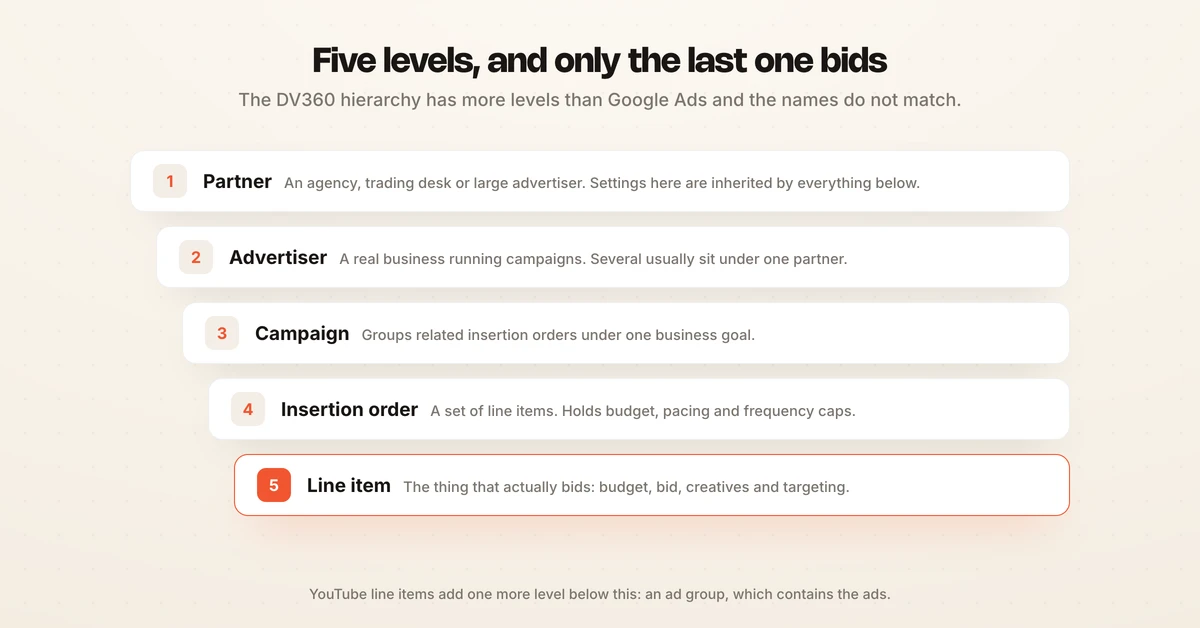
The hierarchy trips up most newcomers, because it has more levels than Google Ads and the names do not match.
| Level | What it represents |
|---|---|
| Partner | An agency, trading desk or large advertiser. Settings here are inherited by everything below. |
| Advertiser | A real business running campaigns. Several usually sit under one partner. |
| Campaign | Groups related insertion orders under one business goal. |
| Insertion order | A set of line items for the same campaign. Holds budget, pacing and frequency caps. |
| Line item | The thing that actually bids. Carries a budget, a bid, creatives and targeting. |
| Ad group | YouTube only. Sits inside a YouTube line item and contains the ads. |
Two practical notes. Partner-level settings are inherited by every advertiser beneath them, including default targeting copied into new campaigns, so a careless partner default propagates silently across clients. And frequency caps can be set at campaign, insertion order and line item level at once, where serving stops as soon as the first cap is reached, which is a common source of unexplained underdelivery.
The line item is where the actual work happens. Everything above it is budgeting and organisation.
The five modules
DV360 is organised into five sections, and Google's own overview treats them as the product's spine.
- Campaigns. Create, optimise and monitor campaigns, insertion orders and line items. Where a buyer spends most of the day.
- Audiences. Build and combine audience segments from first-party, third-party and Google data, including audience profile analysis and audiences built from campaign activity.
- Creatives. Manage creative assets and tie them to the media plan, including the Ad Canvas for building ads.
- Inventory. Discover and manage inventory from exchanges, publishers and broadcasters, and set up deals.
- Insights. Reporting across campaigns, with instant reports for common questions.
The integration between Audiences and Campaigns is the real argument for DV360 over a standalone DSP. Audience segments built from Google Analytics 360 data are usable directly as targeting, without an export.
DV360 vs Google Ads
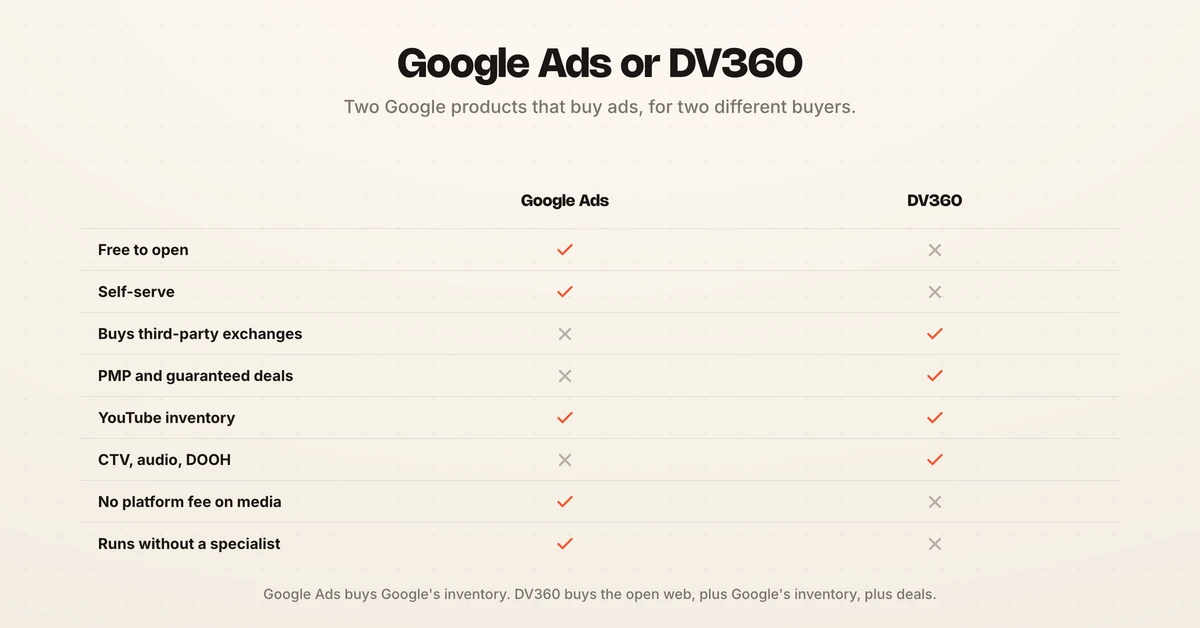
Google Ads and DV360 buy different inventory for different buyers: Google Ads is self-serve and buys Google's own network, while DV360 is contracted and buys the open web as well. That is the question everyone actually arrives with.
| Google Ads | DV360 | |
|---|---|---|
| Buys | Search, Shopping, Google Display Network, YouTube, Demand Gen | Open exchanges, private deals, YouTube, CTV, audio, DOOH |
| Inventory reach | Google's own network | Google's inventory plus dozens of third-party exchanges |
| Deal types | Auction only | Open auction, PMP, preferred, programmatic guaranteed |
| Access | Self-serve, free to open | Contracted through Google or a reseller |
| Cost | Media spend only | Media spend plus a platform fee |
| Built for | Any advertiser, any budget | Enterprises and agencies with programmatic teams |
| Controls | Simplified, automated | Granular targeting, custom bidding, deal negotiation |
The short version: Google Ads is a self-serve product that buys Google's own inventory. DV360 is a contracted enterprise DSP that buys the open web, plus Google's inventory, plus deal-based inventory Google Ads cannot touch.
If you run search and some display and it works, you do not need DV360. Advertisers move to it when they need inventory Google Ads cannot reach, deal types Google Ads does not support, or the audience and frequency control that comes with buying impression by impression.
DV360 vs The Trade Desk and other DSPs
DV360's decisive advantage over independent DSPs is YouTube access, which none of them can match at the same depth. Among independent DSPs the comparison narrows to a few real differences.
YouTube access is the decisive one. DV360 can buy YouTube inventory, including reserved and TrueView formats, through YouTube and partners line items. Independent DSPs cannot buy YouTube at the same depth. For advertisers where video is the channel, this alone settles the question.
The Trade Desk is the independent alternative and its pitch is precisely that it does not own inventory, so it has no incentive to steer your budget. Buyers who care about that conflict choose it knowingly.
Google's data integrations are a genuine advantage if you already run Google Analytics 360 and Google Ad Manager, and close to irrelevant if you do not.
The best media buying tools compares DV360, The Trade Desk, StackAdapt and the rest on channel coverage, automation and pricing model.
Audience targeting in DV360
Targeting is where DV360 earns its fee, and it draws on three data sources at once.
Your own data. Customer lists, site and app visitors via Floodlight tags, and audiences built from prior DV360 campaign activity. First-party data is the most durable of the three and the one worth investing in.
Google's data. Affinity and in-market segments, demographics, and life-event segments built from Google's own signals. This is what an independent DSP cannot replicate.
Third-party data. Segments bought from data providers inside the platform, billed as a data fee on top of media.
Beyond audiences, DV360 targets contextually by content category, keyword and site list, and by device, geography, language, time and viewability threshold. Combined audiences let you union or exclude segments across all three sources, which is the feature buyers most often underuse.
One warning worth stating plainly: every added targeting layer shrinks the pool of impressions you can bid on. Over-targeted line items underdeliver, pay higher CPMs for the impressions they do win, and give the bidding model too little data to optimise against. Start broad and narrow on evidence.
What DV360 costs, and is it free?
DV360 is not free, and it is not self-serve.
You pay two things: the media itself, and a platform fee charged as a percentage of media spend. Google does not publish that percentage. It is negotiated, it varies with committed volume, and it is one of the things a reseller marks up. On top of both sit data fees for third-party segments, and any verification or measurement vendors you add.
Access comes one of two ways. You contract directly with Google, which generally requires meaningful committed spend, or you buy a seat through an agency or reseller that already has a partner account. Most mid-market advertisers arrive through the second route.
Two things to establish before signing. First, the all-in fee: platform fee, reseller margin, data fees and ad serving, expressed as a percentage of your total budget, in writing. Second, who owns the seat and the data if you leave, because a reseller seat is not automatically portable.
Bidding and optimisation in DV360
Bidding is set on the line item, and the choice between manual and automated is the single biggest lever a new buyer has.
Fixed bid. You name a CPM and DV360 does not exceed it. Useful for deals with a negotiated price, and for holding a hard cost ceiling while you learn what inventory is worth.
Automated bidding. Automated strategies optimise toward a goal instead of a price: maximise clicks or conversions while prioritising a target KPI such as CPA, or maximise a KPI while prioritising spending the full budget. The second variant will raise your bid until the budget clears or the average CPM cap stops it, so set that cap deliberately rather than leaving it blank.
Custom bidding. This is the part that separates DV360 from simpler platforms. Custom bidding lets you define what a valuable impression is, rather than accepting the platform's definition. It comes two ways: rule-based, where you weight conversions, clicks or your own custom metrics without writing code, and script-based, where a script assigns weights to impression-time signals and post-impression outcomes. Scripts support more signals and arbitrary logic, and they need someone who can maintain them.
The practical sequence is to start on fixed bidding until you have enough delivery to see which inventory converts, move to an automated strategy with a firm CPM cap, and reach for custom bidding only once you have a conversion signal worth weighting. Custom bidding on thin data optimises confidently toward noise.
The DV360 API
DV360 has a full REST API covering campaign management and reporting, and it matters more here than on a self-serve platform for two reasons.
The first is scale. An agency running hundreds of line items across many advertisers cannot make bulk changes by hand, and the API is how structured campaign builds, bulk edits and automated pacing checks get done.
The second is reporting. DV360's native reporting answers DV360 questions, so teams that need programmatic spend sitting in a warehouse next to Meta, Google Ads and CRM data pull it through the API rather than exporting by hand. That is usually the first integration anyone builds, and it is worth scoping before you sign, because it decides whether your programmatic numbers are ever comparable to the rest of your media.
Who should use DV360, and who should not
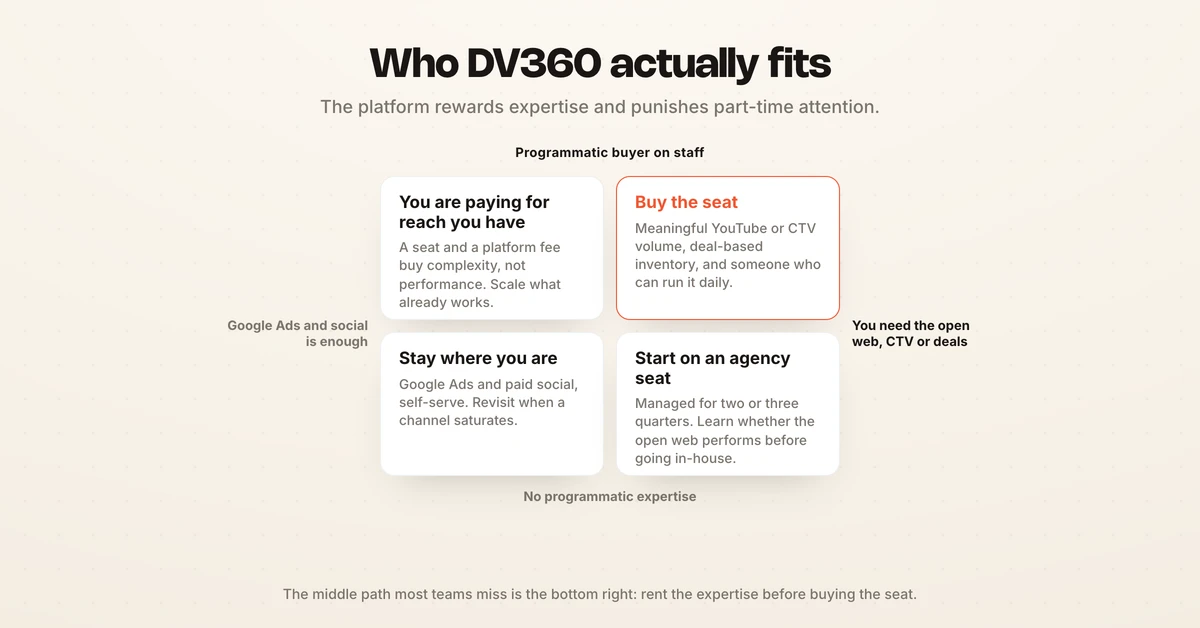
Use DV360 if you buy meaningful YouTube or CTV volume, you need private marketplace and programmatic guaranteed deals, you already run Google Analytics 360, or you have a programmatic buyer on staff or on retainer. The platform rewards expertise and punishes part-time attention.
Do not use DV360 if Google Ads and paid social are still scaling profitably, nobody on the team has run a DSP before, or your total media budget is small enough that a platform fee plus a reseller margin represents a real share of it. At that size the fees buy you complexity rather than reach.
The middle path most teams miss: run a managed engagement through an agency seat for two or three quarters, learn whether the open web actually performs for you, then decide whether an in-house seat is worth it.
Where DV360 sits in a wider stack
DV360 reports on DV360. That is not a criticism, it is what every ad platform does, and it becomes a problem only when your programmatic spend has to be judged against the channels it competes with for budget.
A typical enterprise setup has DV360 for the open web and YouTube, Google Ads for search, and Meta and TikTok in their own managers. Each grades its own homework, each claims the conversions it can see, and reconciling the four is somebody's Monday morning. The interval between a number changing and a budget moving is where the money goes.
Hawky is connected to 40+ DSPs, DV360 among them, so programmatic spend reports into the same account view as Meta, Google, YouTube, TikTok and LinkedIn. To be precise about the boundary: Hawky's Performance Agent operates those five native channels, and the DSP connections are integration coverage, which means DV360 spend is visible alongside everything else rather than bought by the agent. For a performance lead the value is one reconciled picture, and a Command Center where the reallocation decision actually gets made.
For the measurement side of the same problem, incrementality testing is the honest way to judge a channel that produces few clicks, and CTV produces almost none.
Frequently asked questions
What is DV360?
DV360 is Google Display & Video 360, the demand-side platform inside Google Marketing Platform. Advertisers and agencies use it to buy display, video, audio, connected TV and YouTube inventory programmatically, across Google's own inventory and dozens of third-party exchanges, from a single account. It also bundles creative management, audience building and reporting, and it was called DoubleClick Bid Manager before 2018.
Is DV360 a DSP?
Yes. DV360 is a full demand-side platform: you set budgets, targeting and bids, and it bids on individual impressions in real time across open exchanges and private deals. It competes with The Trade Desk, StackAdapt and Amazon DSP. The difference from those is that Google also owns inventory and the publisher-side ad server, which is why DV360 reaches YouTube at a depth independent DSPs cannot.
Is DV360 owned by Google?
Yes. Display & Video 360 is a Google product and one of the pillars of Google Marketing Platform, alongside Campaign Manager 360, Search Ads 360 and Analytics 360. It was formed in 2018 when Google combined the DoubleClick advertiser products with the Google Analytics 360 Suite, which is why the platform was previously known as DoubleClick Bid Manager.
What are the key differences between Google Ads and DV360?
Google Ads is self-serve, free to open, and buys Google's own inventory: search, Shopping, the Google Display Network, YouTube and Demand Gen. DV360 is contracted through Google or a reseller, charges a platform fee on top of media, and buys the open web through dozens of exchanges plus private marketplace and programmatic guaranteed deals that Google Ads cannot access. Google Ads suits any advertiser at any budget; DV360 suits enterprises and agencies with programmatic expertise.
Is DV360 free?
No. You pay for media plus a platform fee charged as a percentage of media spend, and Google does not publish that percentage. Third-party audience data carries additional fees, and a reseller seat adds a margin on top. Access is contracted either directly with Google, which usually requires committed spend, or through an agency or reseller with an existing partner account.
How is a DV360 account structured?
The hierarchy runs partner, advertiser, campaign, insertion order, line item, and for YouTube an ad group inside the line item. A partner is an agency or large advertiser whose settings are inherited by everything beneath it. The line item is what actually bids, carrying budget, bid, creatives and targeting. Frequency caps can be set at campaign, insertion order and line item level, and serving stops at whichever cap is reached first.
DV360 gives you almost every screen a person looks at, and a fee structure that rewards knowing exactly what you are doing with it. What it will not tell you is whether that spend beat the channels you already buy, or move the budget the day the answer changes. If your DV360 spend and your native channels are being reconciled by hand on Monday mornings, Hawky's Performance Agent is built for that job.
Ready to hire your first AI performance team? Book Demo