What Is Programmatic Advertising? How the Auction, the Ecosystem and Programmatic Buying Actually Work
Programmatic advertising is the automated buying and selling of digital ad inventory through real-time auctions, where software decides which impression to bid on, how much to pay, and which ad to serve, in the time it takes a page to load. It replaced the insertion order and the phone call with an auction that clears in under 100 milliseconds.
The word covers a lot of ground, which is why it confuses people. It is a buying method, not a channel. You can buy display, video, connected TV, audio and billboards programmatically, and you can buy all of them badly.
This guide explains how the auction actually works, what each acronym in the supply chain does, the four ways to buy, and the honest drawbacks the vendors skip.
What is programmatic advertising?
Programmatic advertising is the use of software to buy ad impressions automatically, one at a time, based on rules and data rather than a negotiated contract for a block of inventory.
The pre-programmatic model worked like buying a billboard. A media buyer called a publisher, agreed a price for a million impressions on a particular site, signed an insertion order, and the ads ran. Nobody knew which specific people saw them.
Programmatic inverts that. Instead of buying space on a site, you buy an audience, one impression at a time, and you decide the value of each impression as it becomes available. A person loads a page, that page has an ad slot, and an auction runs for the right to show that specific person an ad. Your software decides whether this impression is worth bidding on, and how much.
The shift matters because the unit of purchase changed. You are no longer buying inventory and hoping the right people see it. You are buying attention from identified audiences, priced individually. That is also the source of most of the category's problems, because an audience defined by data is only as good as the data.
How programmatic advertising works, step by step
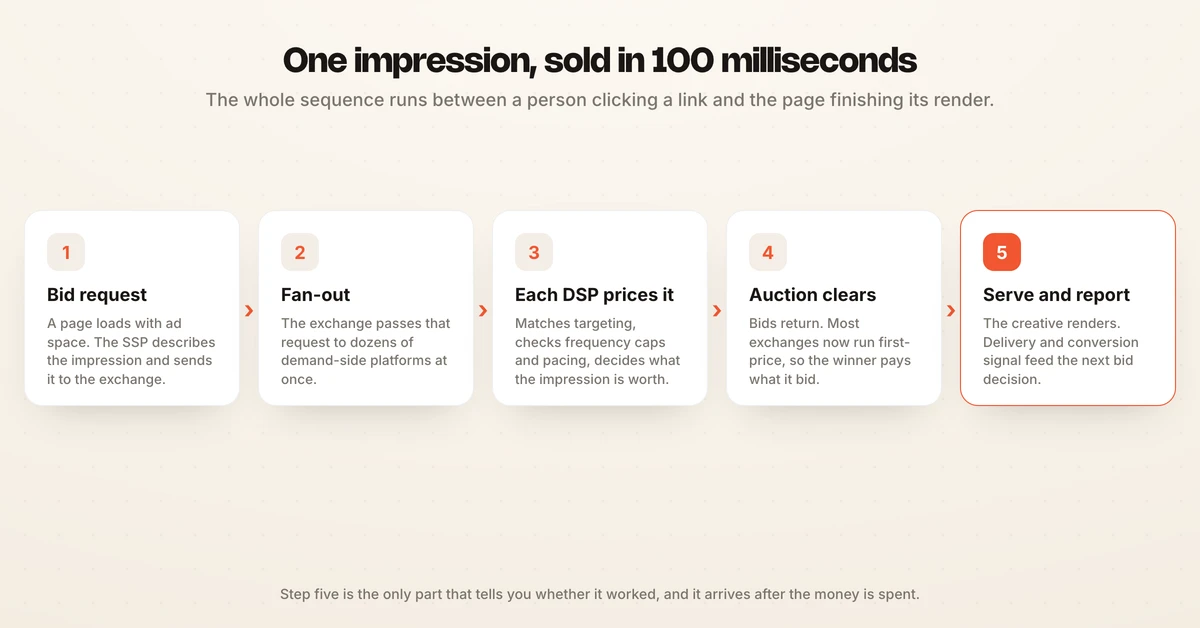
The entire sequence below happens between a person clicking a link and the page finishing its render. Typical auction timeouts sit around 100 to 120 milliseconds.
- A person opens a page or app that has ad space to sell.
- The publisher's supply-side platform sends a bid request. It describes the impression: page content, ad slot size, device, approximate location, and whatever audience signal is available and permitted. The format is standardised as OpenRTB, maintained by IAB Tech Lab.
- The ad exchange passes that request to demand-side platforms, often dozens at once.
- Each DSP decides whether to bid. It matches the impression against every active campaign's targeting, checks frequency caps and budget pacing, and calculates what the impression is worth against that campaign's goal.
- Bids return and the auction clears. Most exchanges now run first-price auctions, where the winner pays what it bid. Google Ad Manager moved to a unified first price auction in 2019, and the rest of the open market followed.
- The winning ad is served and the creative renders on the page.
- The impression reports back with delivery, viewability and any downstream conversion signal, which feeds the next bid decision.
Two details decide whether this works in your favour. The first is that your DSP is guessing at the value of an impression from a bid request that is mostly metadata, so the quality of your targeting data sets a ceiling on performance. The second is that step 7 is the only part that tells you whether any of it worked, and it arrives after the money is spent.
The programmatic ecosystem: who does what
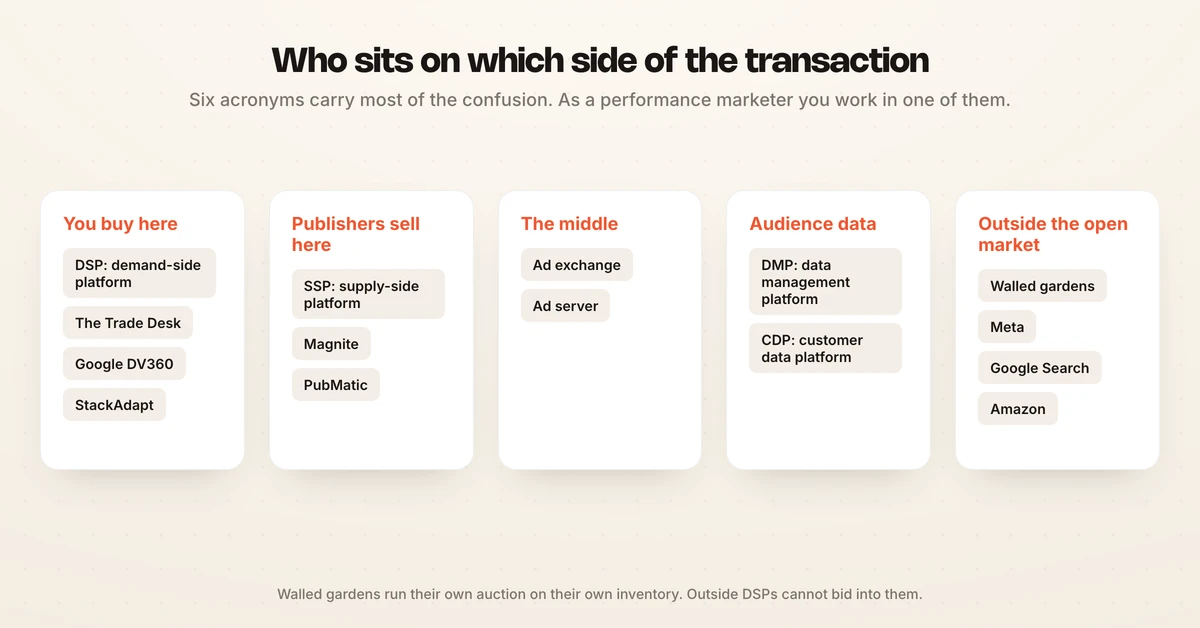
The programmatic supply chain has six main components, and each sits on the buy side, the sell side, or in the middle. Six acronyms carry most of the confusion, and they map onto that one question.
| Component | Full name | Whose side | What it does |
|---|---|---|---|
| DSP | Demand-side platform | Advertiser | Where you set budgets, targeting and bids. The Trade Desk, DV360, StackAdapt. |
| SSP | Supply-side platform | Publisher | Where publishers list inventory and set floor prices. Magnite, PubMatic. |
| Ad exchange | Ad exchange | Neutral | The marketplace where bid requests and bids meet. |
| DMP | Data management platform | Either | Stores and segments audience data used for targeting. |
| CDP | Customer data platform | Advertiser | Holds first-party customer data, increasingly the DMP's replacement. |
| Ad server | Ad server | Either | Stores creative, serves the winning ad, counts the impression. |
For a performance marketer the practical takeaway is short. You work in a DSP. Everything else is plumbing that determines what inventory reaches you and at what price, and you rarely touch it directly.
One more term worth knowing: a walled garden is a platform that runs its own auction on its own inventory and does not let outside DSPs bid. Meta, Google Search and Amazon are walled gardens. They are bought programmatically in the sense that software sets the bids, but you buy them inside the platform's own tools rather than through an open exchange. This is why a team that buys programmatic and a team that buys Meta describe different workflows, even though both let software set the bids.
Programmatic buying: the four ways to buy
Programmatic buying is the advertiser side of the transaction, and it is not one mechanism. There are four, they differ in who gets access and who sets the price, and picking the wrong one is a common and expensive mistake.
| Deal type | Inventory access | Price set by | Best for |
|---|---|---|---|
| Open RTB | Anyone bidding on the exchange | Live auction | Reach and prospecting at low CPMs |
| Private marketplace (PMP) | Invited buyers only | Auction with a floor | Better inventory quality, brand safety |
| Preferred deal | One buyer, first refusal | Fixed, negotiated | Priority access without a volume commitment |
| Programmatic guaranteed | One buyer, reserved | Fixed, negotiated | Guaranteed volume on premium placements |
Open real-time bidding is what most people mean by programmatic buying. It has the most inventory, the lowest prices, and the most fraud and brand-safety exposure, because anyone can list inventory on an exchange.
Private marketplaces are the usual answer to that. The publisher invites specific buyers to a closed auction on named inventory, so you know where your ads run. You pay more per thousand impressions and you generally get better attention for it.
Programmatic guaranteed is the closest thing to the old insertion order, executed through programmatic pipes. You negotiate a fixed price and a fixed volume, and the inventory is reserved. Brands use it for launches and takeovers where reach must be certain.
The honest guidance: start on open RTB only if you have fraud filtering in place, because open exchanges are where invalid traffic concentrates. Most performance teams get better results moving prospecting budget into PMPs once they know which inventory converts.
Programmatic vs. the alternatives
Programmatic differs from direct media buying, from paid social, and from traditional display in three specific ways. These three comparisons cover the confusion most people arrive with.
Programmatic vs. direct media buying. Direct buying means negotiating with a publisher for a fixed block of inventory at a fixed price. Programmatic buys impressions individually through software. Direct gives you certainty of placement and volume; programmatic gives you audience precision and the ability to stop instantly. Programmatic guaranteed sits between the two.
Programmatic vs. paid social. Paid social is programmatic in the loose sense that an algorithm sets bids, but Meta, TikTok and LinkedIn are walled gardens running their own auctions on their own inventory. Open programmatic reaches the rest of the internet: news sites, apps, streaming TV, podcasts. Most performance teams run both and the budgets rarely sit in the same tool, which is where cross-channel measurement falls apart.
Programmatic vs. traditional display. Traditional display was bought by site and slot. Programmatic display buys the same ad units by audience and impression. The format did not change; the purchasing logic did.
Formats and channels you can buy programmatically
Programmatic is a buying method, so the channel list keeps growing as inventory becomes biddable.
- Display. Banners and rich media across the open web. The oldest and cheapest programmatic inventory, and the most exposed to viewability and fraud problems.
- Video. In-stream, out-stream and in-app video. Higher CPMs, stronger attention, and the format where completion-rate measurement matters most.
- Connected TV (CTV). Streaming inventory on smart TVs and devices. It buys like digital and behaves like television, with limited click-through and measurement that leans on incrementality rather than last click.
- Native. Ads matched to the look of the surrounding content. Higher engagement, and easier to get wrong on brand safety.
- Audio. Streaming music and podcast inventory, bought on listener audience rather than show.
- Digital out-of-home (DOOH). Screens in physical space, bought by audience movement data and time of day.
- Retail media. Inventory on retailer sites and apps, sold with the retailer's purchase data attached. The fastest-growing category, and mostly a walled garden per retailer.
What programmatic advertising costs
Programmatic is priced on CPM, the cost per thousand impressions, and the number you see is rarely the number you pay.
Open-exchange display sits at the low end, typically a few dollars per thousand impressions. Video and CTV run substantially higher. Private marketplaces carry a premium over open RTB for the same audience, because you are paying for inventory quality.
The part that surprises new buyers is the tech tax: the share of your budget consumed between your DSP and the publisher. DSP fees, exchange fees, data fees and verification fees all come out of the media budget, and the total working-media share is routinely well below what advertisers assume. Ask any partner for the working-media percentage in writing before you sign, and ask what each fee in the chain is for.
Two practical consequences. First, compare partners on working media, not on headline CPM. Second, a supply path with fewer intermediaries generally delivers more of your budget to the publisher, which is the whole argument for supply path optimisation.
The drawbacks vendors skip
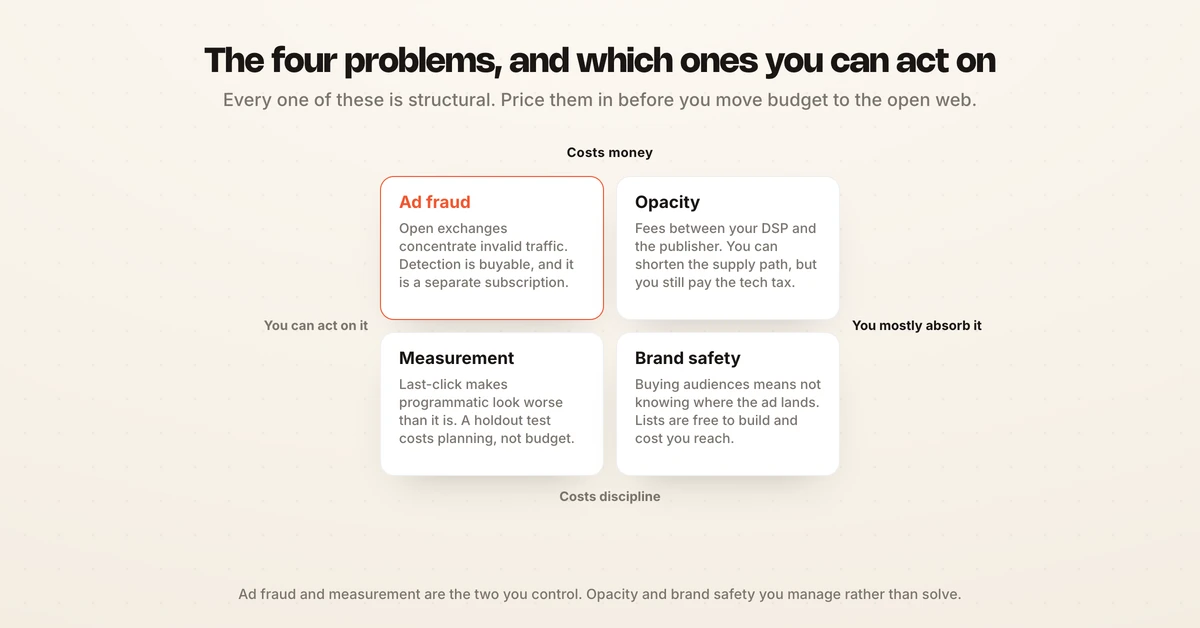
Programmatic earns its budget, and it has four structural problems worth pricing in before you commit.
Ad fraud. Open exchanges are the natural home of invalid traffic, because listing inventory is easy and the buyer cannot see the site. Bot traffic, domain spoofing and ad stacking are all programmatic-native problems, and the industry's own answer, ads.txt, exists specifically to make spoofing harder. Invalid traffic itself is classified against the Media Rating Council taxonomy, which is the standard any vendor's accuracy claim should be read against. Budget for detection, and read the best ad fraud software before you scale open RTB.
Brand safety. Buying audiences rather than sites means you do not know where the ad lands until it has landed. Inclusion lists, exclusion lists and verification vendors exist because of this, and they cost money and reach.
Opacity. The supply chain has enough intermediaries that tracing a dollar from your DSP to a publisher is genuinely hard. This is not an accident of complexity; several parties benefit from it.
Measurement. Most programmatic inventory produces few clicks, and CTV produces almost none. If your reporting rewards last-click conversions, programmatic will look worse than it is, and you will cut the channel for the wrong reason. Measure it with incrementality testing instead, and see what incrementality means in practice for how to run one.
How to get started with programmatic advertising
Getting started with programmatic advertising takes five steps, and running them out of order is how teams waste the first quarter.
- Decide whether you need the open web at all. If Meta and Google are still scaling profitably, add budget there first. Programmatic earns its place when native channels saturate, or when your audience is somewhere those platforms cannot reach. The complete guide to AI media buying covers how the wider buying function fits together.
- Pick the buying route. Self-serve on a DSP gives control and needs a person who knows the platform. A managed service or agency gives expertise and adds a fee layer. Most brands under roughly $50k a month in programmatic spend are better served managed, because DSP seat minimums and the learning curve both bite.
- Choose the platform. The DSP decides your inventory access, data options and fee structure. The best media buying tools compares The Trade Desk, DV360, StackAdapt and the rest on exactly those terms.
- Start with a PMP, not open RTB. Higher CPMs, far fewer fraud and brand-safety problems, and a cleaner read on whether the channel works for you. Open the taps to open exchange once you know which inventory converts.
- Set up measurement before the first impression. Decide the KPI, connect conversion tracking across channels, and plan a holdout test. Programmatic without an incrementality plan becomes an argument you cannot win.
How programmatic fits alongside everything else you buy
Programmatic spend sits in a DSP while Meta and TikTok sit in their own managers and Google sits in Google Ads, so nothing reports on all four at once. That is the practical problem for a performance team in 2026.
Each of them reports on itself, each claims the conversions it can see, and reconciling the four is somebody's Monday morning.
That reconciliation gap is where budget quietly goes wrong. A channel outperforming its budget share keeps its old share until someone notices at the weekly review, and on most teams the interval between a number changing and a budget moving is measured in days.
Hawky is connected to 40+ DSPs, so programmatic spend reports into the same account view as Meta, Google, YouTube, TikTok and LinkedIn. Worth being precise about the boundary: Hawky's Performance Agent operates those five native channels, and the DSP connections are integration coverage, which means your programmatic spend is visible next to everything else rather than bought by the agent. For a performance lead the value is one reconciled picture, and one place where the reallocation decision actually gets made.
Programmatic advertising examples
A DTC brand extending reach past Meta saturation. Meta CPMs climb as the addressable audience gets fully covered, so the brand moves prospecting budget into a PMP across news and lifestyle inventory, targeting lookalikes from its own customer file. Success is measured on blended CAC and a geo holdout, not on display click-through, which will be roughly nothing.
A B2B SaaS company running account-based display. The target list is 400 named accounts. A DSP matches company IP ranges and firmographic segments, serves display and video to people at those accounts, and the measurement is pipeline created in accounts that saw ads versus a matched holdout. Nobody clicks a B2B banner, and that is fine.
A retailer buying CTV before a seasonal peak. Six weeks of streaming inventory in specific regions, frequency-capped at three exposures a week, bought programmatic guaranteed so the volume is certain. Measured with a regional holdout against same-store sales.
The pattern across all three: the channel is bought on audience, and measured on incrementality rather than clicks.
Frequently asked questions
What is programmatic advertising?
Programmatic advertising is the automated buying and selling of digital ad inventory through real-time auctions. Software decides which impression to bid on, how much to pay, and which ad to serve, all in the time it takes a page to load. It replaces negotiated insertion orders with per-impression auctions, and it covers display, video, connected TV, audio, native and digital out-of-home inventory.
What is programmatic buying?
Programmatic buying is the advertiser's side of programmatic advertising: using a demand-side platform to bid on individual ad impressions automatically rather than negotiating blocks of inventory with publishers. It happens four ways: open real-time bidding on public exchanges, private marketplaces limited to invited buyers, preferred deals at a fixed negotiated price, and programmatic guaranteed, where volume and price are both reserved in advance.
What is the difference between direct media buying and programmatic media buying?
Direct media buying means negotiating with a publisher for a fixed block of inventory at a fixed price, agreed in an insertion order before anything runs. Programmatic media buying uses software to bid on impressions one at a time, so you buy an audience rather than a placement and can change or stop delivery instantly. Direct gives certainty of placement and volume; programmatic gives audience precision and speed. Programmatic guaranteed combines the two by reserving fixed volume through programmatic pipes.
What is an example of programmatic advertising?
A retailer buys six weeks of connected TV inventory in three regions ahead of a seasonal peak, frequency-capped at three exposures per household per week, at a fixed price and guaranteed volume. No human negotiates each placement; the DSP handles delivery against those rules, and the campaign is measured against a regional holdout rather than clicks. Account-based B2B display and post-saturation DTC prospecting are two other common patterns.
Is programmatic advertising the same as paid social?
No, though the line blurs. Meta, TikTok and LinkedIn run their own auctions on their own inventory, which makes them walled gardens: you buy them inside the platform's tools rather than through an open exchange. Open programmatic reaches everything else, including news sites, apps, streaming TV, podcasts and outdoor screens. Both use software to set bids, but the inventory, the tooling and usually the team are different.
How much does programmatic advertising cost?
Programmatic is priced on CPM, the cost per thousand impressions. Open-exchange display is the cheapest inventory, while video, connected TV and private marketplace deals cost considerably more for the same audience. The figure that matters more than CPM is working media: the share of your budget that reaches the publisher after DSP, exchange, data and verification fees. Ask any partner for that percentage in writing before signing.
Programmatic gives you access to almost every screen a person looks at. What it does not give you is a single view of whether that spend is beating the channels you already buy, or the speed to move budget the day the answer changes. If your programmatic spend and your native channels are being reconciled by hand on Monday mornings, Hawky's Performance Agent is built for that job.
Ready to hire your first AI performance team? Book Demo