10 Best Ad Tracking Software Tools in 2026 (Compared by Job and Price)
The best ad tracking software in 2026 is Hawky for tracking creative performance and acting on it, Triple Whale for DTC revenue attribution, and RedTrack for media buyers who want published pricing. Which one is right depends entirely on which of three different jobs you are actually hiring the software to do.
"Ad tracking software" is sold as one category and is really three. Some tools track conversions and assign revenue to channels. Others do click tracking across networks and offers, and a third group tracks which creative earned the result.
Buying the wrong one is how teams end up with a $300 monthly subscription that produces a second dashboard nobody trusts.
This guide sorts the ten tools worth paying for by job, with the prices vendors actually publish, and starts with the question most listicles skip: whether you need one at all.
What ad tracking software actually does
Ad tracking software records what happened after an ad was served, links that event back to the specific ad, campaign or partner that caused it, and reports the result independently of the ad platform that sold you the click. The independence is the product. Meta and Google both grade their own homework, and they each count the same purchase as their own win.
The category splits into three jobs.
| Job | What it answers | Typical buyer | Example tools |
|---|---|---|---|
| Revenue attribution | Which channel and campaign produced this order or lead | DTC brands, lead-gen teams | Triple Whale, Northbeam, Cometly, Polar Analytics |
| Click and conversion tracking | Which click, offer or partner produced this action | Media buyers, affiliates, agencies | Voluum, RedTrack, ClickMagick, AnyTrack |
| Creative performance tracking | Which ad, hook or format produced the result | Performance and creative teams | Hawky, Motion |
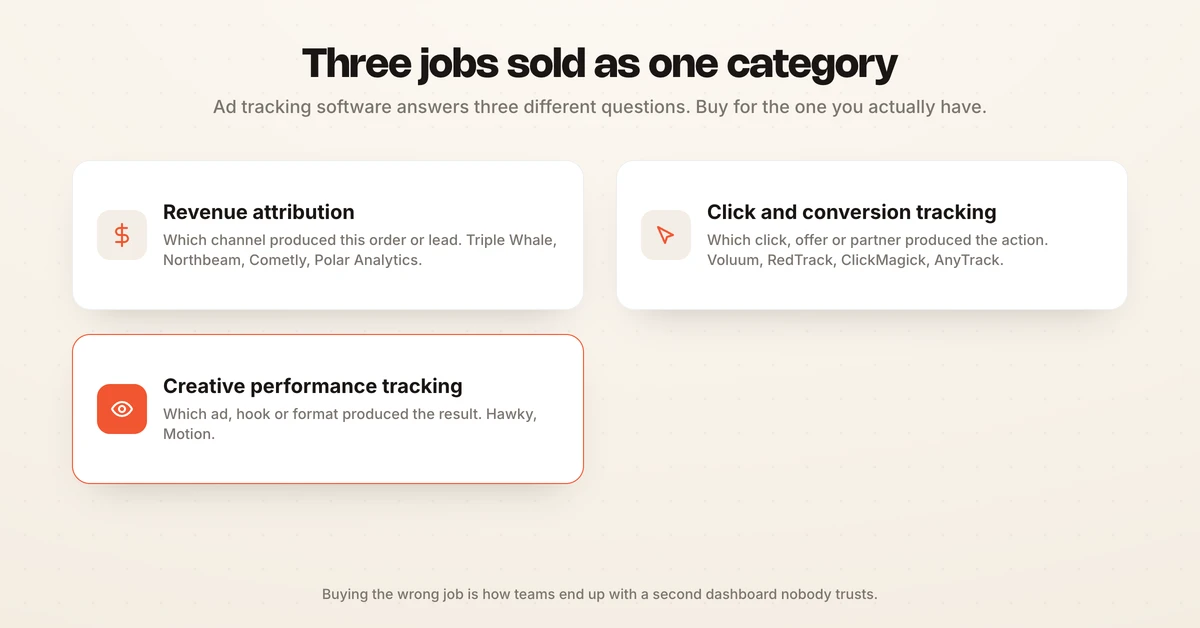
A tool built for one job does the other two badly. A click tracker will not tell you which hook is fatiguing. A creative analytics platform will not reconcile Shopify orders against six ad accounts. Decide the job first, then read the list.
There is a fourth job the good ones do quietly, and it is the one that pays for itself. Conversions collected first-party get pushed back into Meta, Google and TikTok as server-side events, which is the data their bidding models actually optimise against. Better signal going in moves performance more reliably than better charts coming out, so when you compare two tools, compare what each one sends back to the platforms, not only what it draws for you. If reporting rather than optimisation is the job, advertising analytics tools is the closer-fitting list.
Do you need third-party ad tracking at all?
Probably not, if none of the following four conditions is true. This is the honest starting point, and it is the question working PPC practitioners raise most often about this category.
1. Your platform-reported conversions exceed your real orders. Add up conversions claimed by Meta, Google, TikTok and your email tool, then compare the total against orders in Shopify or your CRM. When the sum is 30% or 40% higher than reality, every channel is claiming the same sale and your allocation decisions are running on inflated numbers.
2. You buy on more than two channels. Meta attributes conversions on its own click and view windows, and Google Ads uses data-driven attribution by default, having retired first click, linear, time decay and position-based models. Two different accounting systems cannot be added together, and a spreadsheet will not fix that.
3. Your revenue lands somewhere the pixel cannot see. Phone sales, long B2B cycles, subscription renewals and offline closes all break in-platform tracking, because the conversion happens weeks later in a CRM the ad platform never touches.
4. You pay partners per action. Affiliate and influencer payouts need verification that is not controlled by the party being paid.
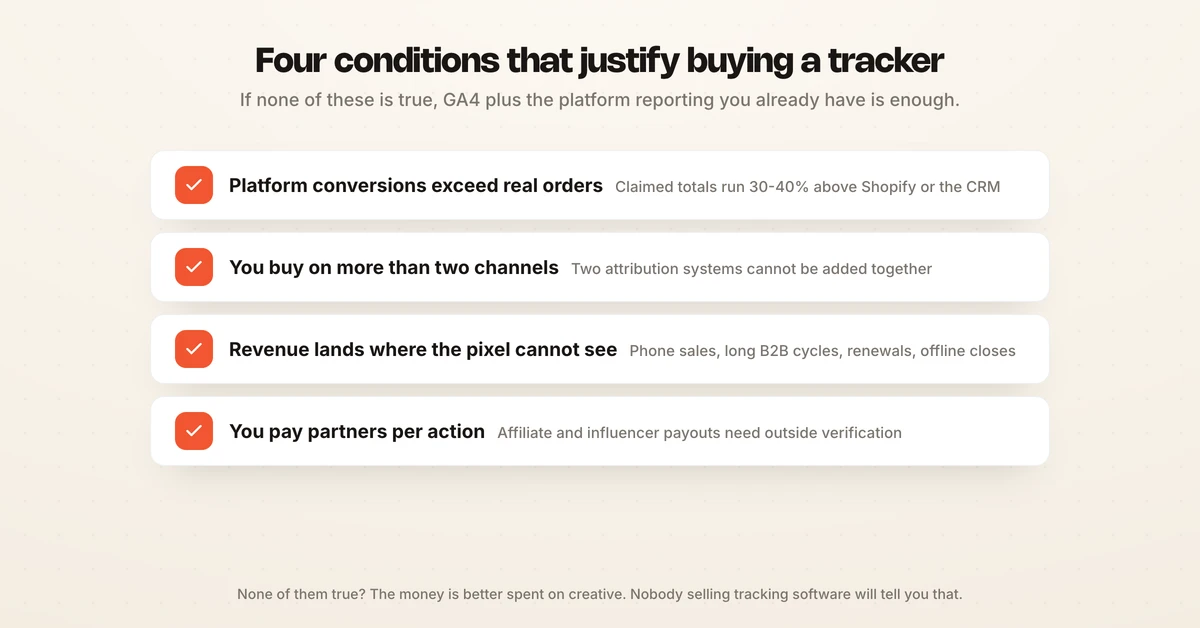
If none of those apply, GA4 plus the platform reporting you already have is enough, and the money is better spent on creative. Nobody selling tracking software will tell you that.
The cookie deadline that never arrived
Most articles in this category still sell tracking software on the death of the third-party cookie. That deadline was cancelled.
Google confirmed in April 2025 that it would "maintain our current approach to offering users third-party cookie choice in Chrome, and will not be rolling out a new standalone prompt for third-party cookies". In October 2025 it went further and retired most of the Privacy Sandbox technologies built to replace cookies, naming the Attribution Reporting API, Topics, Protected Audience, Private Aggregation and others. Only CHIPS, FedCM and Private State Tokens continue.
So the reason to buy tracking software in 2026 is not a cookie apocalypse. It is that Apple's App Tracking Transparency still suppresses in-app signal, walled gardens still report on themselves, and no platform will ever tell you it deserves less budget. Those problems are structural, and they were never going to be solved by a browser API.
Two things ad tracking software is not
Ad tracking software does not detect invalid traffic, and it does not obtain consent to collect data. Both get bought by mistake in this category, and neither is solved by anything on the list below.
It does not judge whether a human made the click. A tracker counts the event; it does not ask who fired it. Bots, click farms and competitors clicking your search ads all arrive as clean, attributable, perfectly reported data, which is how a campaign shows an acceptable CPA on traffic that was never going to convert. Detection and exclusion is a separate product category with separate pricing. The best ad fraud software covers what those tools catch and what they cost. Separately, if the question is what rivals are running rather than what your own traffic did, that is an ad spy tool, not a tracker.
It does not give you permission to collect the data. Every tool here records behaviour, and in the EU and UK that needs a lawful basis before the first event fires: GDPR requires consent for non-essential tracking, US state privacy laws require a working opt-out, and Google requires consent mode signals so its tags can adjust behaviour and model the conversions consent removes. Apple's App Tracking Transparency applies the same brake on iOS. A tracker installed without a consent management platform in front of it produces numbers you cannot lawfully use, and on European traffic, fewer of them. That shortfall then reads as a tracking bug, and it is not one.
The 10 best ad tracking software tools in 2026
The ten tools below are the ad tracking software worth paying for in 2026, ordered by job and by fit rather than alphabetically. Prices are the vendor's published figures at the time of writing, and vendors that do not publish are marked as such rather than guessed.
1. Hawky, best for tracking creative performance and acting on it
Start with the scope, because this category confuses people: Hawky is not a pixel or server-side attribution platform. It does not reconcile order-level revenue the way Triple Whale or Northbeam do, and a brand whose core problem is duplicate conversion counting should pair it with one of those.
What Hawky tracks is the thing that decides paid performance: which ad, hook, frame, format and audience is working right now, across Meta, Google, YouTube, TikTok and LinkedIn, with 40+ connected DSPs feeding the same account view. Creative Analysis breaks each ad into hook, frames, copy, audio, CTA and audience fit, scores every element against your own winners, and flags predictive fatigue two to three days before the metrics sag.
The difference from the rest of this list is what happens after the tracking. Most tools hand you a chart. Hawky's Performance Agent acts on the reading, reallocating, scaling and killing against the KPI you set, whether that is ROAS, CAC, LTV or contribution margin. Autonomy is configurable and gated: most teams run shadow mode for around two weeks with a human confirming each move, then approval-gated, then fully autonomous, with the same audit trail and a rollback button at every stage.
- Job: Creative performance tracking, plus execution
- Channels: Meta, Google, YouTube, TikTok, LinkedIn, with 40+ connected DSPs visible in the same view
- Bottom-funnel data: GA4 and CRM connected on the Ask tier and above
- Proof: Cars24 ships 1,000+ creatives a month at 15 to 20% lower CPA
Strength: Element-level creative tracking tied to spend decisions, with guardrails, an audit trail and reversible moves. Limitation: Not a replacement for order-level attribution. Statics today, with video the next major release. Best for: Teams spending $50k to $5M+ a month where creative testing is the main lever. Pricing: Platform tiers per brand with unlimited users, plus an outcome-based model for the Performance Agent and a 30-day pilot. See pricing.
2. Triple Whale, best for DTC revenue attribution on Shopify
Triple Whale is the default attribution layer for Shopify brands, combining pixel-based multi-touch attribution, blended metrics and creative reporting in a dashboard built for daily standups rather than analysts. Its appeal is breadth: one screen that reconciles ad spend, orders and contribution margin for a DTC operator.
The trade-off is that breadth costs focus. Teams that only need clean channel attribution often find they are paying for a BI suite, and the pricing scales with store revenue rather than sitting flat.
Strength: The most complete DTC picture in one place, with a large Shopify integration ecosystem. Limitation: Pricing is quoted per store and scales as you grow, so model the cost at next year's revenue, not this year's. Best for: Shopify brands that want attribution and reporting from a single vendor. Pricing: Published on Triple Whale's pricing page, including a free Founders Dash tier, with paid plans banded by your trailing twelve-month GMV. Because the band rather than the plan name sets the number, quote your own GMV before comparing it against a flat-rate tool.
3. Northbeam, best for DTC brands above $200k a month in spend
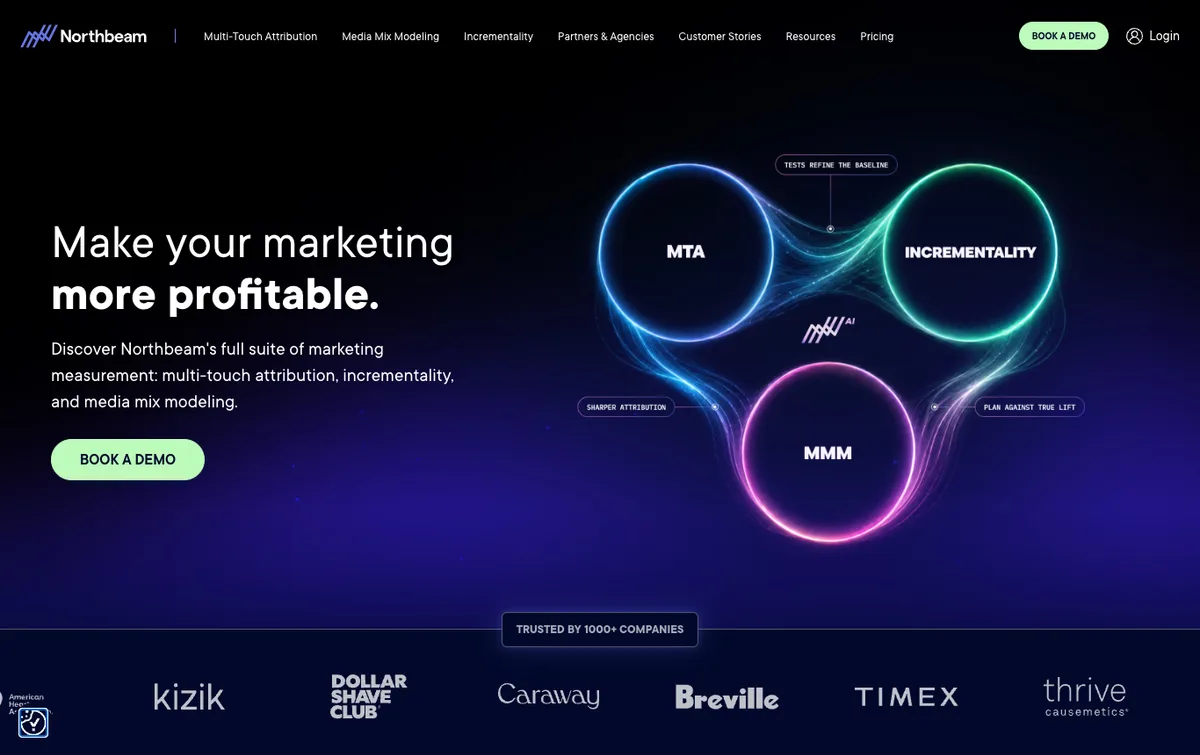
Northbeam is the serious end of multi-touch attribution, built for brands with enough spend that a 5% allocation error is worth more than the subscription. It models first-party touchpoints across channels, credits view-through revenue, and offers incrementality and media mix modelling on higher tiers.
It publishes its prices, which is rare in this tier, and they are honest about the audience: this is not a $10k-a-month advertiser's tool.
Strength: Rigorous multi-touch attribution with incrementality and MMM available as you scale, and published pricing. Limitation: Starter is month-to-month for Shopify brands, but Professional and Enterprise require annual terms. Best for: DTC brands spending $200k+ a month that already have an analyst to act on the model. Pricing: Starter $1,500/mo for brands spending under $1.5M a year, Professional $3,500/mo for spend up to $500k a month, with Growth (seven-figure brands under $200k a month) and Enterprise (above $500k a month) quoted. Note that the published tiers mix annual and monthly thresholds and overlap, so confirm which band you land in before you budget.
4. AnyTrack, best for lean first-party conversion tracking
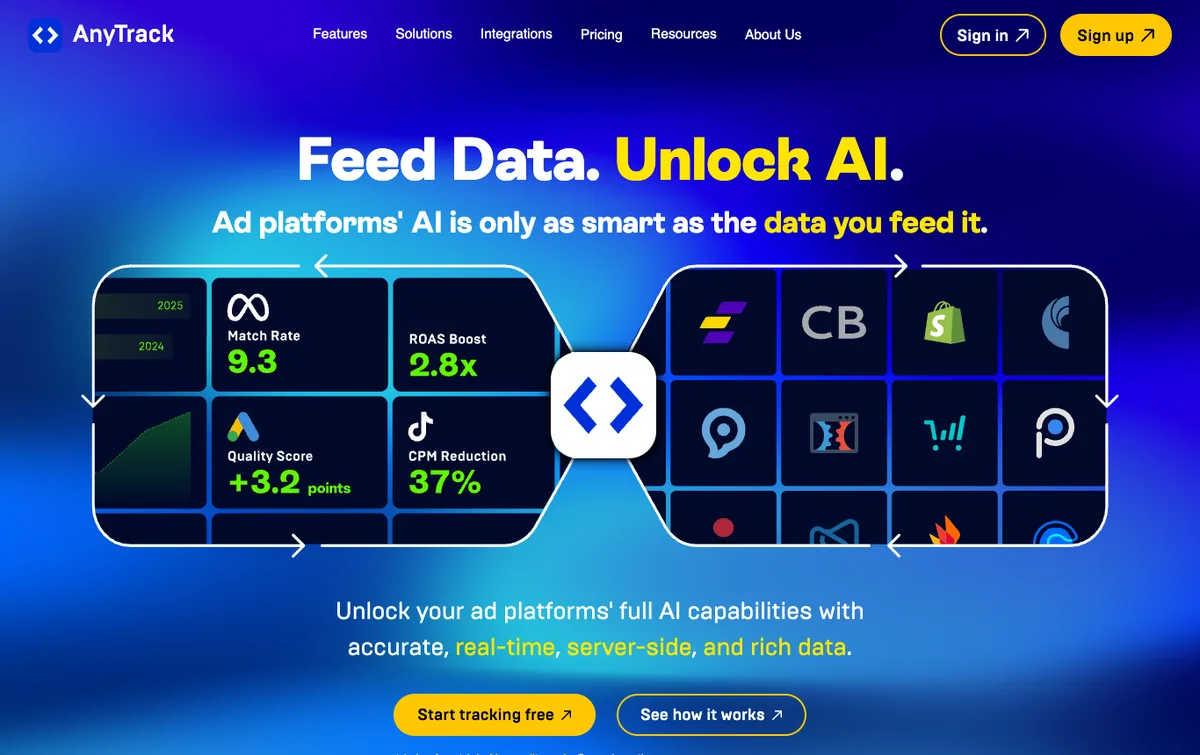
AnyTrack sits between a click tracker and an attribution platform, syncing conversions from your site, CRM and affiliate networks back into the ad platforms as server-side events. For small teams, the free tier makes it the cheapest way to stop flying blind.
It is the most integration-heavy option here, with over 100 integrations including 90+ affiliate networks, which is why affiliates and hybrid DTC operators gravitate to it.
Strength: A genuine free tier, published prices at every step above it, and conversion sync back into the platforms. Limitation: Session-metered, and overages are billed per 1,000 sessions, so traffic spikes cost money. Best for: Solo operators, affiliates and small DTC teams that need first-party tracking without an enterprise contract. Pricing: Free (5,000 sessions/mo, 1 site, 1 ad platform), Starter $100/mo (100,000 sessions), Personal $150/mo (500,000), Advance $300/mo (3,000,000). 14-day trial on paid plans.
5. RedTrack, best for media buyers and agencies that want published pricing
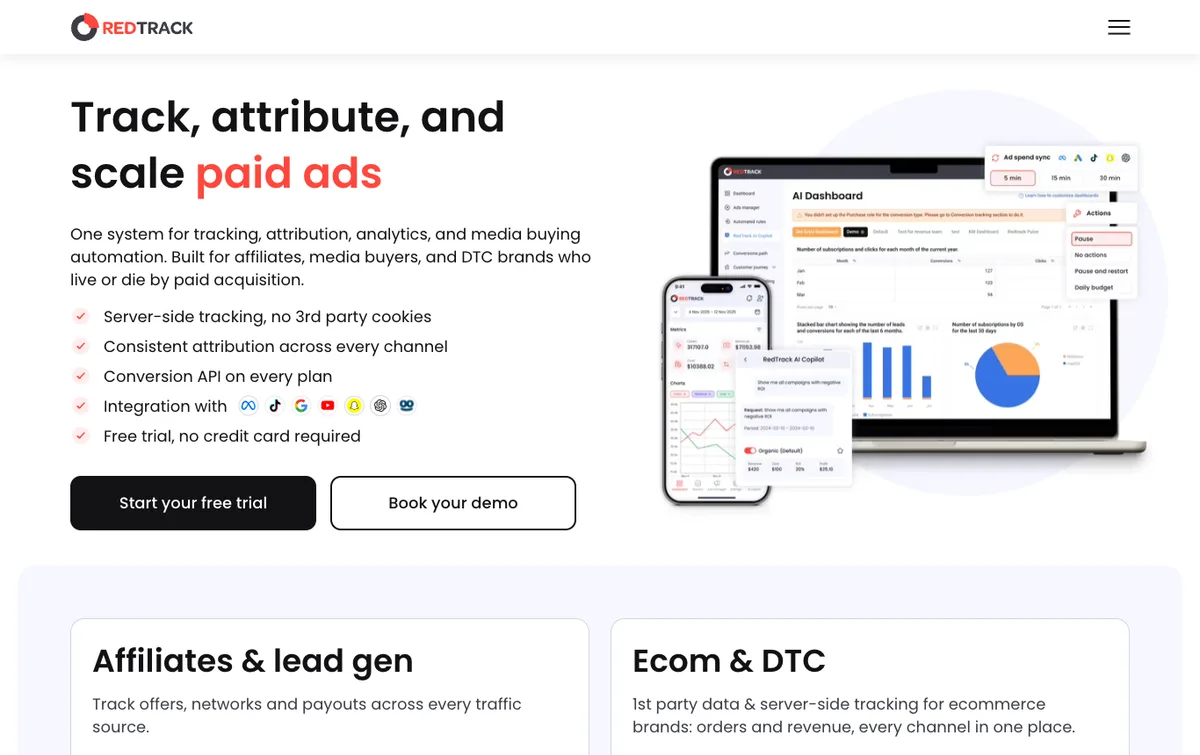
RedTrack is a click and conversion tracker with two distinct product lines, one for affiliates and lead gen priced on events, one for ecommerce priced per store. It covers the media buyer's core need, which is attributing actions to a specific click, creative and partner across networks the ad platforms cannot see.
Its ecommerce free tier is honest about what free means: UTM-based attribution only, with no ad-level spend sync.
Strength: Transparent event-based pricing, conversion API support, and unlimited ad accounts from the $399 tier. Limitation: Two pricing models to navigate, and event ceilings are easy to breach at scale. Best for: Affiliates, agencies and DTC teams running many offers or many client accounts. Pricing: Affiliate plans Builder $79/mo (2M events), Solo $169/mo (5M), Team $399/mo (20M), Enterprise $999/mo (75M). Ecommerce plans Relay free, Brand $99/mo, Agency $599/mo. 14 days free.
6. Voluum, best for high-volume performance media buyers
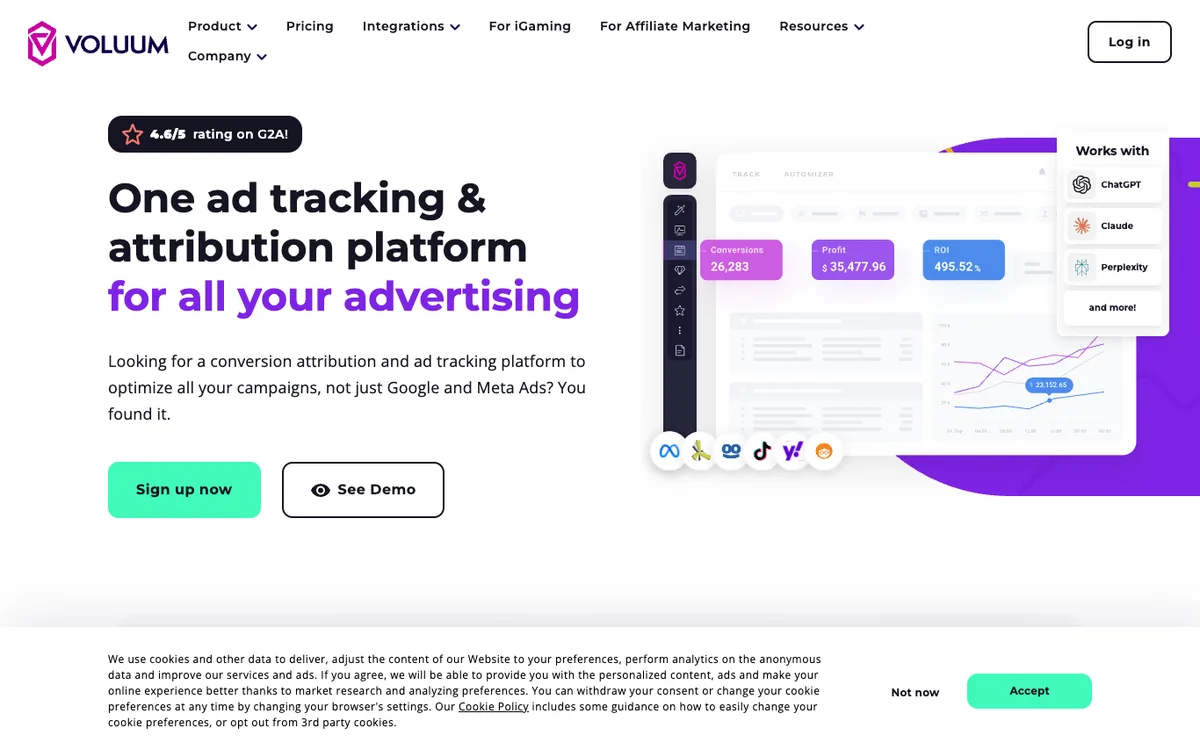
Voluum is the incumbent in affiliate and performance media tracking, built for buyers running hundreds of campaigns across networks with traffic distribution, anti-fraud and automated rules on top of tracking. Its pricing ladder is the most granular in the category and runs a long way up.
Note the shape of that ladder: the entry plan allows 20 active campaigns, which most serious media buyers exhaust quickly.
Strength: Depth for high-volume buying, with rule-based automation and long data retention on higher tiers. Limitation: Campaign and event caps push real users up the ladder fast, and it is not built for DTC revenue reporting. Best for: Affiliate and performance buyers running volume across multiple traffic sources. Pricing: Every published tier is billed annually: Profit $119/mo (20 campaigns, 1M events), Scale $299/mo, Start-up $539/mo, Agency $799/mo, Enterprise $1,599/mo, then Corporate $3,999/mo and Executive $7,999/mo. Monthly billing costs more, so compare it against the flat monthly tools on the same terms. 14-day preview without payment details.
7. ClickMagick, best for solo advertisers and small budgets
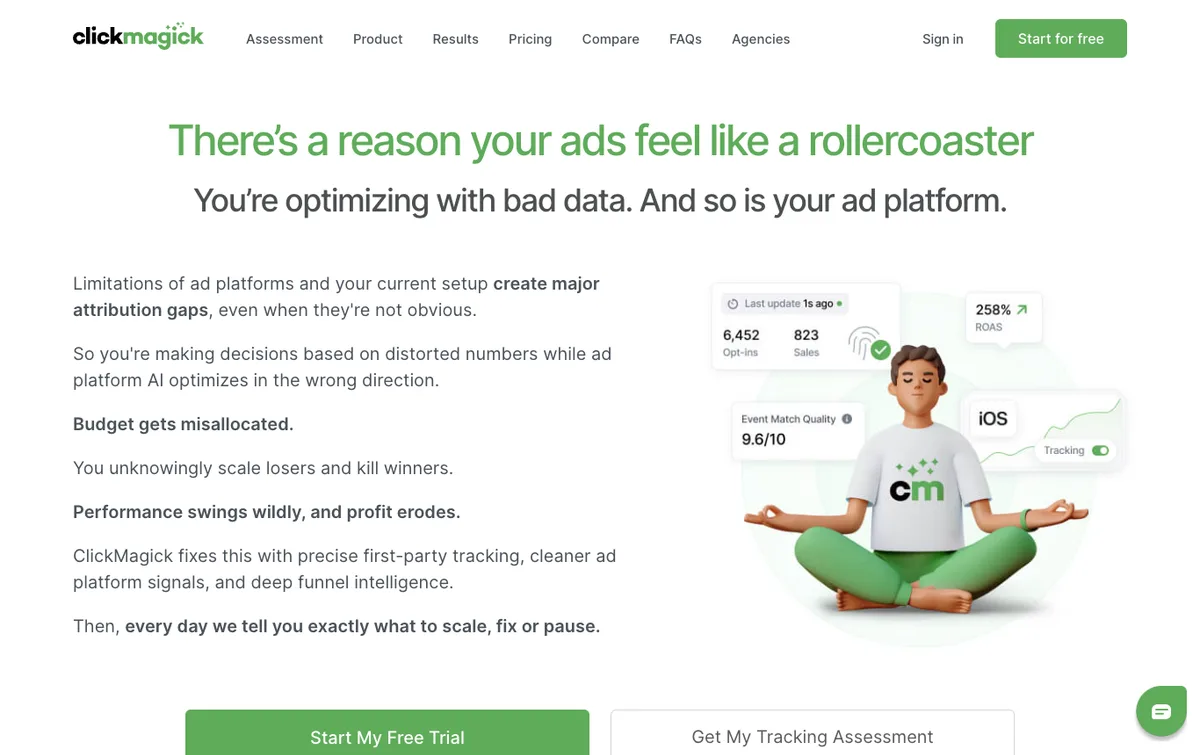
ClickMagick is the most approachable tracker on this list, aimed at individual advertisers and small teams who need link tracking, conversion tracking and simple attribution without a data team. Every plan ships its "ClickMagick Insights" daily analysis.
It is priced on tracked visitors rather than events, which suits low-traffic, high-value funnels better than high-traffic ecommerce.
Strength: Clear published tiers, fast setup, and a genuinely usable interface for non-analysts. Limitation: 10,000 tracked visitors on the entry plan is tight, and the platform is not built for multi-brand agency use. Best for: Solo advertisers, coaches, info products and small lead-gen businesses. Pricing: Starter $79/mo (10,000 tracked visitors), Standard $199/mo (100,000), Pro $349/mo (1,000,000) on monthly billing, falling to $66, $166 and $291 a month on annual billing, which adds two months free. 14-day free trial.
8. Cometly, best for B2B and lead generation with a CRM
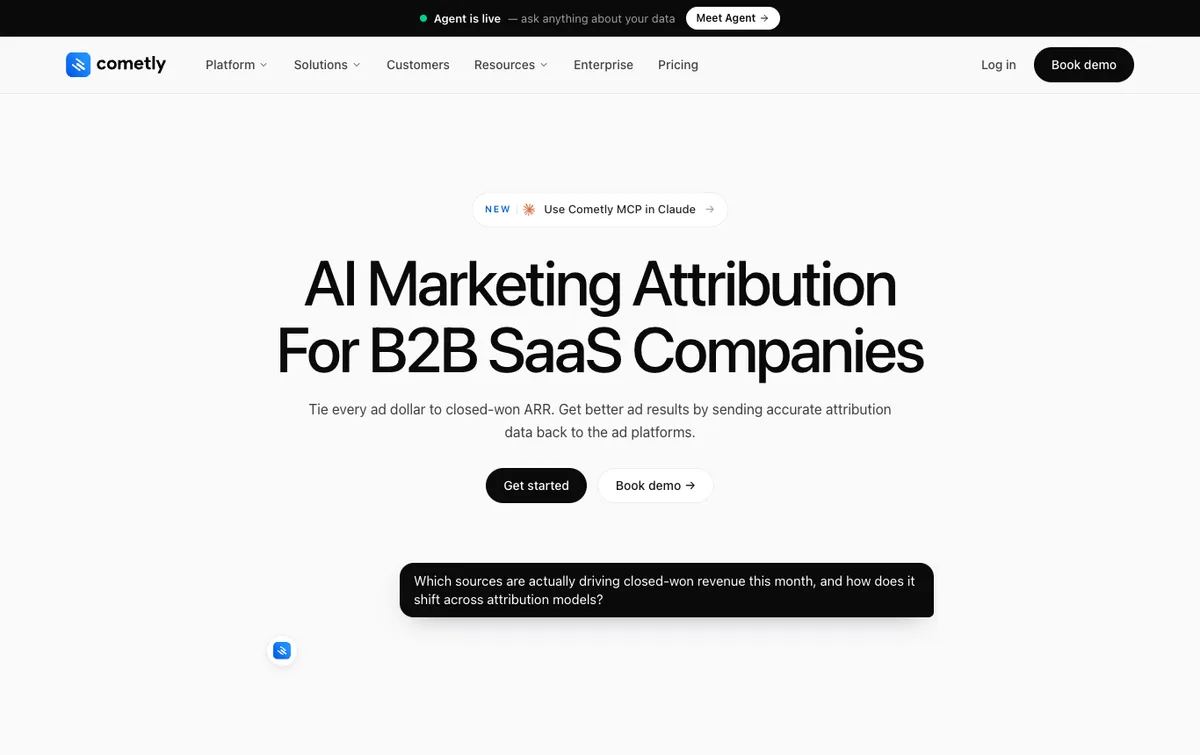
Cometly targets the case the DTC tools handle worst: revenue that closes in a CRM weeks after the click. It combines pixel and server-side tracking with multi-touch attribution and syncs closed-won revenue back to the ad platforms.
The company is unusually direct about why it offers no free trial, stating that "attribution requires CRM and ad-platform setup to be useful". That is correct, and it is also a hint about implementation effort.
Strength: Full-funnel attribution built for lead-gen sales cycles, with 70+ integrations and warehouse sync on Enterprise. Limitation: No free trial, no published prices, and it needs a working CRM before it produces anything. Best for: B2B, SaaS and high-ticket lead-gen advertisers where the sale closes off-site. Pricing: Core and Enterprise, usage-based on pageviews, quoted per account.
9. Polar Analytics, best for ecommerce reporting beyond ads
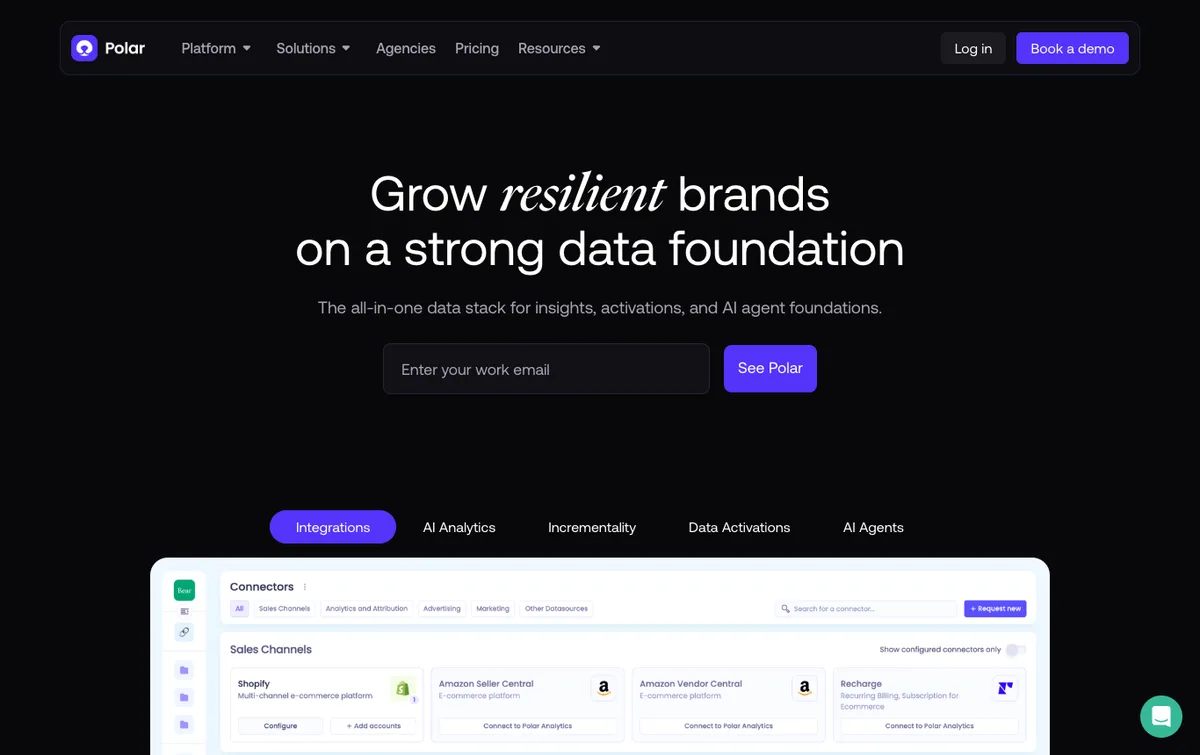
Polar Analytics is an ecommerce BI platform rather than a pure tracker, pulling ads, store, email and retention data into one place, with incrementality testing available alongside. Brands adopt it when the question widens from "which ad worked" to "what is happening in this business".
Pricing scales with annual gross merchandise value and is quoted rather than published, which is worth factoring into a comparison against flat-rate tools.
Strength: One warehouse-grade view across ads, store and retention, with unlimited users. Limitation: Priced on GMV and quoted per account, and it overlaps heavily with tools you may already run. Best for: Ecommerce brands consolidating several reporting tools into one stack. Pricing: Core and Custom plans, quoted on annual GMV.
10. Motion, best for creative reporting to stakeholders
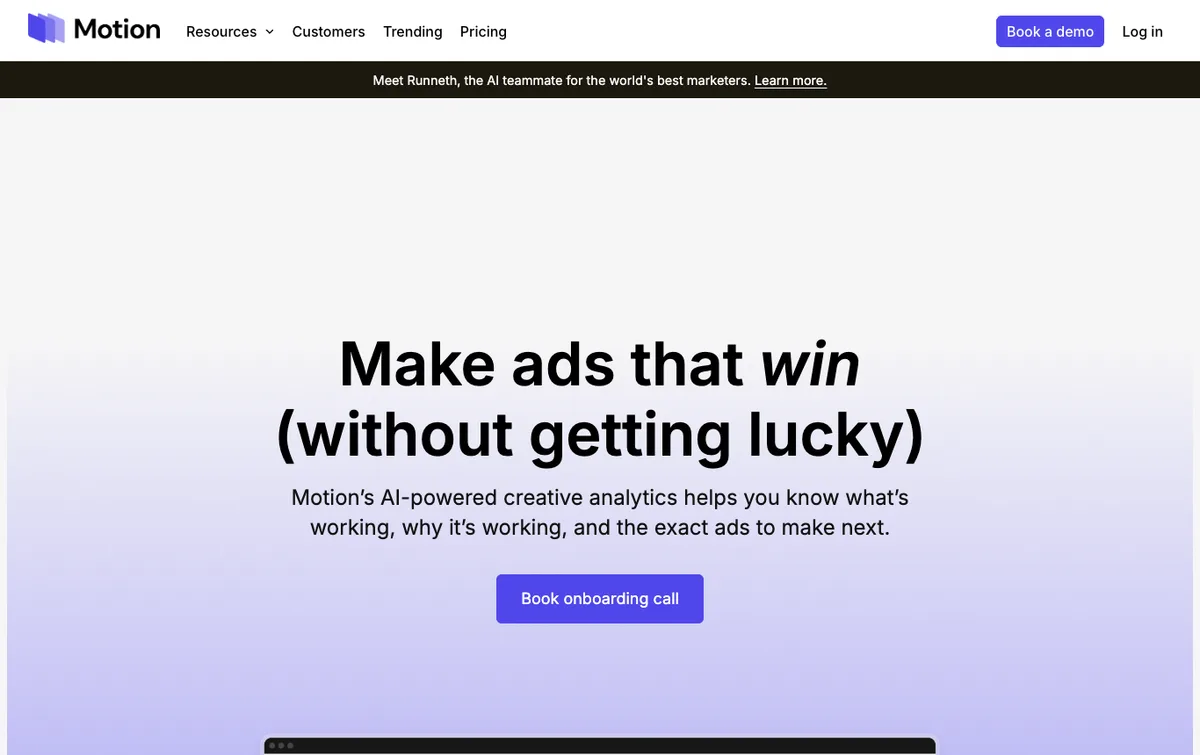
Motion is a creative analytics and reporting tool that turns ad performance into visual reports a client or executive can read without a walkthrough. Teams that need a weekly creative readout, rather than an operating layer, get there fastest with it.
Motion has moved past pure dashboards and now sells an AI analyst layer on top of them, but the output is still a read: it surfaces what happened and a human decides what to do next. That is the distinction from entry 1, and it is a difference in scope rather than quality.
Its pricing is also the clearest benchmark in the creative half of this category, because it is banded by the ad spend you run through it rather than by seats.
Strength: Clean creative reporting and tagging, unlimited seats and ad accounts on every tier, and strong for agencies presenting to clients. Limitation: The analysis stops at the recommendation, and channel coverage is narrower than a cross-platform tracker's. Best for: Agencies and in-house teams whose deliverable is a creative report. Pricing: Starter $750/mo (up to $50k monthly ad spend), Pro $1,200/mo (above $50k), Growth quoted (above $125k). Unlimited seats and ad accounts on all tiers.
Also worth knowing: GA4 remains the free baseline and is enough for many advertisers. Elevar and Stape sell the server-side plumbing that makes every tool above more accurate. Hyros and Wicked Reports serve info-product and high-ticket funnels specifically.
Feature and pricing comparison
| Tool | Job | Entry price | Free tier or trial | Best for |
|---|---|---|---|---|
| Hawky | Creative performance and execution | Quoted per brand, outcome-based option | 30-day pilot | $50k to $5M+ monthly spend |
| Triple Whale | Revenue attribution | Banded by trailing 12-month GMV | Free Founders Dash tier | Shopify DTC |
| Northbeam | Revenue attribution | $1,500/mo | No | $200k+ monthly spend |
| AnyTrack | Click and conversion tracking | $100/mo | Free tier, 14-day trial | Lean teams and affiliates |
| RedTrack | Click and conversion tracking | $79/mo | Free ecommerce tier, 14 days | Agencies and affiliates |
| Voluum | Click and conversion tracking | $119/mo | 14-day preview | High-volume media buyers |
| ClickMagick | Click and conversion tracking | $79/mo | 14-day trial | Solo advertisers |
| Cometly | Revenue attribution | Quoted on pageviews | No trial | B2B and lead gen |
| Polar Analytics | Ecommerce BI | Quoted on GMV | No | Consolidating reporting |
| Motion | Creative reporting | $750/mo | No free tier | Agency creative reports |
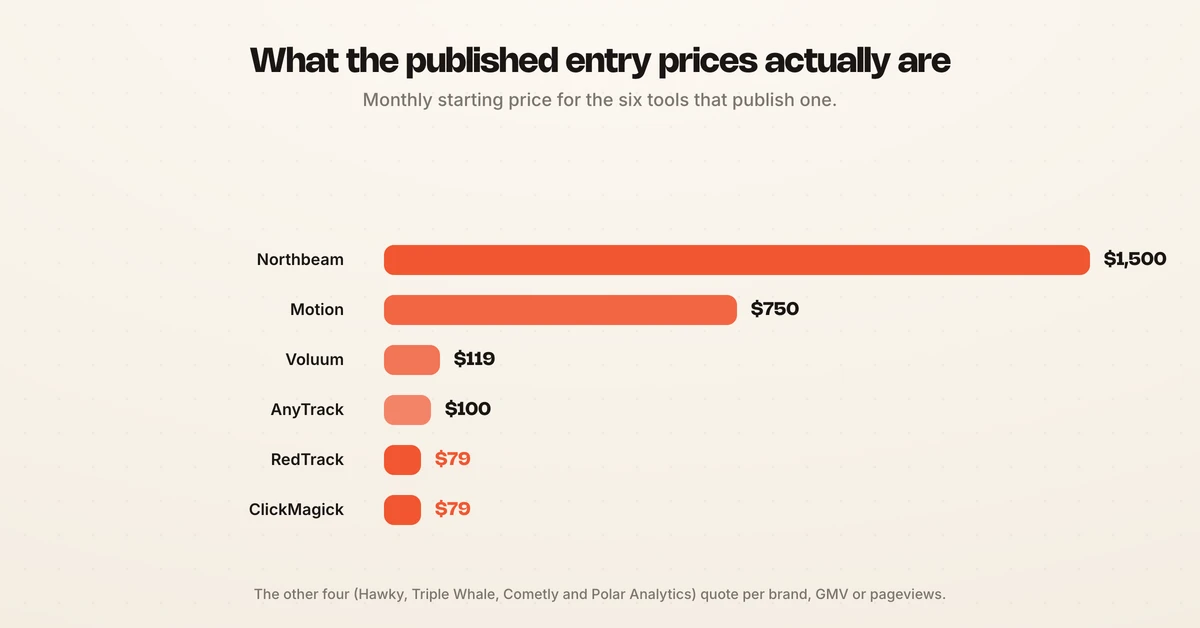
Is there free ad tracking software?
Yes, and for a single-channel advertiser the free layer is genuinely enough. Four options cost nothing:
- GA4 is the free baseline. One channel, on-site conversions, no partner payouts: you do not need anything else.
- AnyTrack's free tier covers 5,000 sessions a month on one site with one ad platform, and it still syncs conversions back to that platform, which makes it a product rather than a demo.
- RedTrack's Relay plan is free for ecommerce but UTM-based only, with no ad-level spend sync. It answers "which link", not "which ad cost what".
- Your platform pixels plus a Conversions API connection cost nothing and stay the most accurate input for in-platform bidding, whatever else you buy on top.
What free will not do is reconcile several channels against one order count, which is the job you start paying for at the $79 to $1,500 tier. Free tiers are session- or feature-capped at precisely the point that work begins. Start free, and upgrade the month you can name the budget decision the paid data would change.
What ad tracking software will not fix
Tracking tells you what happened. It does not change what happens next, and that gap is where most of the value leaks out.
Three failures survive a perfect tracking setup, and each one is visible in the data long before anyone acts on it.
| What the tracker shows | What happens meanwhile | What it costs |
|---|---|---|
| Campaign trending below target CPA | Budget keeps delivering at full rate | Days of spend at a known loss |
| Creative fatigue in the metrics | Ads keep serving until someone reads the report | Rising CPM on a dying asset |
| A channel outperforming its budget share | Reallocation waits for the weekly review | Volume left unbought at the better rate |
The interval between measurement and action is the real cost, and it is measured in days on most teams. A tracker shortens the first half of that loop. Closing the second half is a different job, which is why Hawky's Performance Agent acts on the reading continuously inside spend caps, daily-change ceilings and allow-listed campaigns rather than waiting for Monday. Every decision ships with the data that triggered it, a confidence score and a rollback button.
Buy tracking to know the truth. Buy an operating layer to act on it before the money is gone.
How to choose ad tracking software for your team
If you run a Shopify store under $100k a month in spend: start with AnyTrack's free tier or RedTrack's Relay plan, then upgrade once you can name the decision the data would change. Most brands at this level do not need a $1,500 platform.
If you are a DTC brand spending $100k to $500k a month: Triple Whale for one consolidated view, or Northbeam if allocation accuracy matters more than dashboards. Both cost less than the misallocation they correct at this spend level.
If you are an agency or affiliate running many accounts: RedTrack or Voluum. Unlimited ad accounts and event-based pricing scale better than per-store pricing when you add clients.
If your sales close in a CRM: Cometly. Pixel-based DTC tools cannot see a deal that closes 40 days later, and multi-touch attribution only helps when the touchpoints include the closed-won event.
If your tracking is already fine and performance still is not: the problem is creative and allocation, not measurement. Track creative at element level and act on it. See the best Facebook ad reporting tools for the reporting layer and incrementality testing for proving what actually caused the lift.
How to validate a tracker before you buy
Validating an ad tracker takes two weeks of running it in parallel with your existing setup, and it settles the argument with numbers rather than vendor claims. Run it during the trial.
- Fix the source of truth first. Take order or closed-won counts from Shopify, Stripe or the CRM for the last 30 days. Every number the tracker produces gets measured against this, not against another dashboard.
- Clean your UTMs before you connect anything. Inconsistent campaign naming produces attribution noise that looks like a tracking failure and is not. One naming convention, applied everywhere.
- Run 14 days in parallel. Keep the platform reporting and conversions API setup exactly as they are, and let the tracker run alongside without changing bids.
- Compare three numbers, not one. Total conversions, channel split, and cost per acquisition by channel. A tracker that matches your order count but reshuffles the channel split is telling you something real. Hawky's free marketing calculators will do the ROAS, CPA and CPC arithmetic on both sets of figures so you are comparing like with like.
- Name the decision it changes. If the new data would not move a single budget line, cancel the trial. Tracking that changes no decision is a subscription to a nicer chart.
Frequently asked questions
What is the best ad tracking software?
The best ad tracking software depends on the job. For DTC revenue attribution on Shopify, Triple Whale and Northbeam lead, with Northbeam stronger above $200k a month in spend. For click and conversion tracking across networks, RedTrack and Voluum are the standards, and AnyTrack is the cheapest credible entry with a free tier. For tracking which creative is working and acting on it, Hawky covers Meta, Google, YouTube, TikTok and LinkedIn in one loop.
Do I need a third-party ad tracker if I already have GA4 and the platform pixels?
Only if one of four things is true: your platform-reported conversions exceed your real orders, you buy on more than two channels, your revenue closes somewhere the pixel cannot see, or you pay partners per action. If none of those apply, GA4 plus native platform reporting is enough, and the budget is better spent on creative testing.
How much does AnyTrack cost?
AnyTrack publishes four tiers: Free at $0 a month for 5,000 sessions on one site with one ad platform, Starter at $100 a month for 100,000 sessions, Personal at $150 a month for 500,000 sessions, and Advance at $300 a month for 3,000,000 sessions. Paid plans come with a 14-day trial, annual billing includes two months free, and overage is billed per 1,000 sessions.
How do you track your ads?
Start with the platform's own conversion tracking, which means a correctly installed pixel plus a server-side connection such as the Conversions API, and consistent UTM parameters on every link. That gives you in-platform numbers. Layer third-party tracking on top when you need one independent count across channels, then reconcile both against orders in your store or CRM, which is the only number that is not self-reported.
Do ad trackers still work now that third-party cookies are staying in Chrome?
Yes, and the ground shifted in their favour. Google confirmed in April 2025 that it would keep third-party cookie choice in Chrome without a new prompt, and in October 2025 it retired most Privacy Sandbox technologies, including the Attribution Reporting API. Trackers now rely mainly on first-party data, server-side events and platform APIs, which is more durable than either cookies or the replacement that was withdrawn.
What is the difference between ad tracking and attribution software?
Ad tracking records events: a click happened, a page loaded, a purchase completed, and it ties each event to a specific ad or link. Attribution decides which of several touchpoints deserves credit for the outcome, using a model such as last click, data-driven or multi-touch. Every attribution tool tracks, but not every tracker attributes, and the difference matters most when a customer sees four ads on three channels before buying.
Knowing which ad worked is the easy half. Acting on it before the budget is spent is the half that decides the quarter. If the gap between what your tracking shows and what your account does is measured in days, Hawky's Performance Agent is built for that job.
Ready to hire your first AI performance team? Book Demo