10 Best Ad Fraud Software Tools in 2026 (Compared by Channel and Price)
The best ad fraud software in 2026 is ClickCease for mid-market PPC teams, Lunio for advertisers running over $1M a year in paid media, and HUMAN Security for programmatic buyers who need MRC-accredited pre-bid filtering. The right pick depends less on detection accuracy than on which channels you buy and who signs off on the invoice.
Invalid traffic is not a rounding error. Fraudlogix analysed 105.7 billion ad impressions across 2025 and found 20.64% carried invalid traffic signals, while Lunio's Global Invalid Traffic Report 2026, covered by the ANA, put the cross-channel average at 8.5% and the global bill at $63 billion.
Those two numbers disagree by a factor of two, and that gap is the first thing this guide explains. Every vendor measures fraud with its own definition, on its own inventory, and every one of them sells the number it measures.
What ad fraud software actually does
Ad fraud software identifies invalid traffic in paid campaigns, blocks it before or during the auction, and pushes exclusions back into the ad platform so the same sources stop consuming budget. It does not recover money already spent. It changes who gets to see your ads tomorrow.
The industry splits invalid traffic into two tiers, using the taxonomy set by the Media Rating Council. General invalid traffic (GIVT) is the obvious layer: declared bots, crawlers, data-centre IP ranges, and activity that a published filter list catches. Sophisticated invalid traffic (SIVT) is everything that imitates a person, including hijacked devices, click farms staffed by humans, and falsified location or device signals.
GIVT filtering is close to a commodity. SIVT detection is the part you are actually paying for, and it is where ad fraud detection tools separate themselves, because it needs behavioural analysis rather than a list.
The second split is timing. Pre-bid filtering stops a bid from being placed on suspect inventory, which matters in programmatic buying where you choose the impression. Post-bid detection catches fraud after the click lands, then feeds exclusion lists to Google Ads, Meta and Microsoft Ads so the source is denied next time. Click fraud protection on search and social is almost entirely post-bid, because the platform runs the auction.
How the detection actually works
Every vendor markets its own model, but the signals underneath are the same four, and knowing them is how you read a vendor's accuracy claim.
- Network signals. IP reputation, data-centre and proxy ranges, VPN and hosting ASNs. Cheap, fast, and the layer that catches GIVT.
- Device fingerprinting. Browser, screen, font, timezone and hardware signals combined into an identifier that survives a cleared cookie, which is how repeat offenders are recognised across sessions.
- Behavioural analysis. Mouse movement, scroll depth, dwell time, click cadence and the interval between page load and click. This is the layer that separates a click farm from a customer, and it is what SIVT detection actually means.
- Outcome correlation. Traffic that clicks at a normal rate and converts at close to zero, repeatedly, from the same source. The slowest signal and the most reliable one.
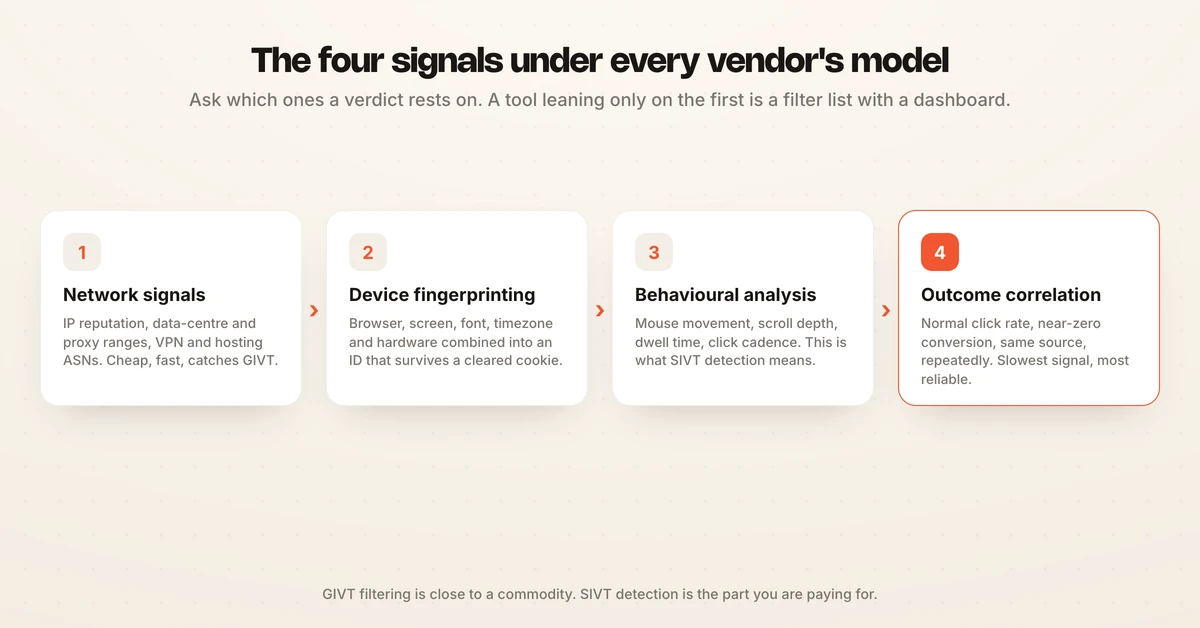
Ask a vendor which of the four its verdict rests on. A tool leaning only on the first is selling a filter list with a dashboard.
A tool worth its subscription does five things: covers the channels you actually buy, explains why each block happened, keeps false positives low enough that real customers are never turned away, pushes exclusions into the ad platform automatically, and reports in a format you can hand to a network when you ask for credit.
The seven types of ad fraud, and which tools see them
Fraud is not one behaviour. It is seven, they cost different amounts, and no single product catches all of them. Match the type you are exposed to against the category that detects it.
| Type | How it works | Where it hits | Caught by |
|---|---|---|---|
| Click fraud | Repeated or automated clicks on paid search and social ads | Google, Meta, Microsoft Ads | PPC click blockers |
| Impression fraud | Ads served to bots, or stacked and hidden so nobody sees them | Programmatic display, video | Verification vendors, pre-bid |
| Attribution fraud | Click injection and click spamming steal credit for organic installs | Mobile app install campaigns | App and affiliate fraud tools |
| Affiliate fraud | Partners manufacture the actions they are paid for | Affiliate and influencer programmes | App and affiliate fraud tools |
| Lead generation fraud | Bots and farms submit real-looking forms | Lead-gen forms, gated content | Form validation, PPC blockers |
| Domain and app spoofing | Inventory misrepresents the site or app the ad ran on | Programmatic, in-app | Verification vendors, ads.txt |
| Ad stacking and pixel stuffing | Many ads layered in one slot, or shrunk to a single pixel | Programmatic display | Verification vendors, pre-bid |
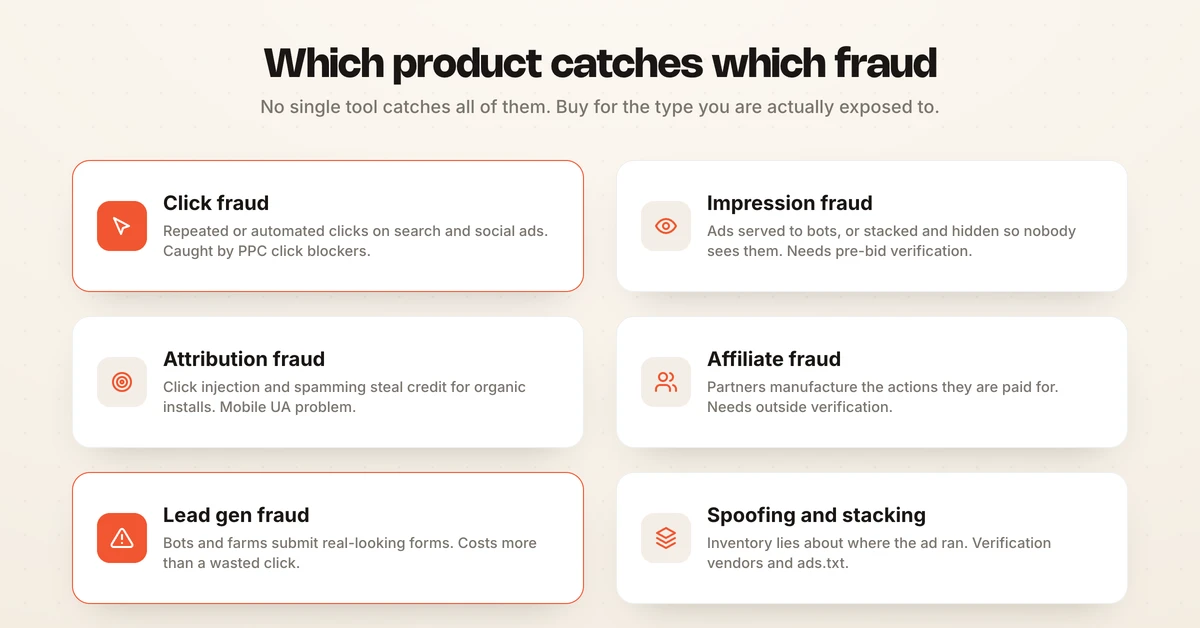
Two patterns fall out of that table. Search and social advertisers are almost entirely exposed to the first and fifth rows, which is why a $99 click blocker covers most of their risk. Programmatic and mobile buyers are exposed to rows two, three, six and seven, which a click blocker cannot see at all, because the fraud happens at the impression or the install rather than the click.
The three categories of ad fraud software buyers keep confusing
Most shortlists mix three different product categories into one list, which is why comparisons go nowhere. These tools do not compete with each other so much as sit at different points in the buy.
| Category | What it protects | Typical buyer | Pricing style |
|---|---|---|---|
| PPC click fraud blockers | Google, Meta and Microsoft Ads clicks, plus form submissions | In-house PPC lead or agency, $5k to $250k monthly spend | Published tiers, self-serve |
| Enterprise verification vendors | Programmatic, CTV, display and social impressions, pre-bid and post-bid | Media or brand-safety lead at a large advertiser or agency | Custom, priced on media volume |
| App and affiliate fraud tools | Installs, in-app events and partner conversions | Mobile UA and partnerships teams | Custom, often per-event |
If you spend on Google Search and Meta and nothing else, a verification vendor is the wrong tool and an expensive one. If you buy programmatic display at scale, a click blocker cannot see most of your exposure, because the fraud happens at the impression rather than the click.
The 10 best ad fraud software tools in 2026
The ten tools below are the ad fraud software worth paying for in 2026, ordered by who the tool fits rather than alphabetically. The strongest options for a performance team buying search and social come first.
1. ClickCease, best for mid-market PPC teams that want published pricing
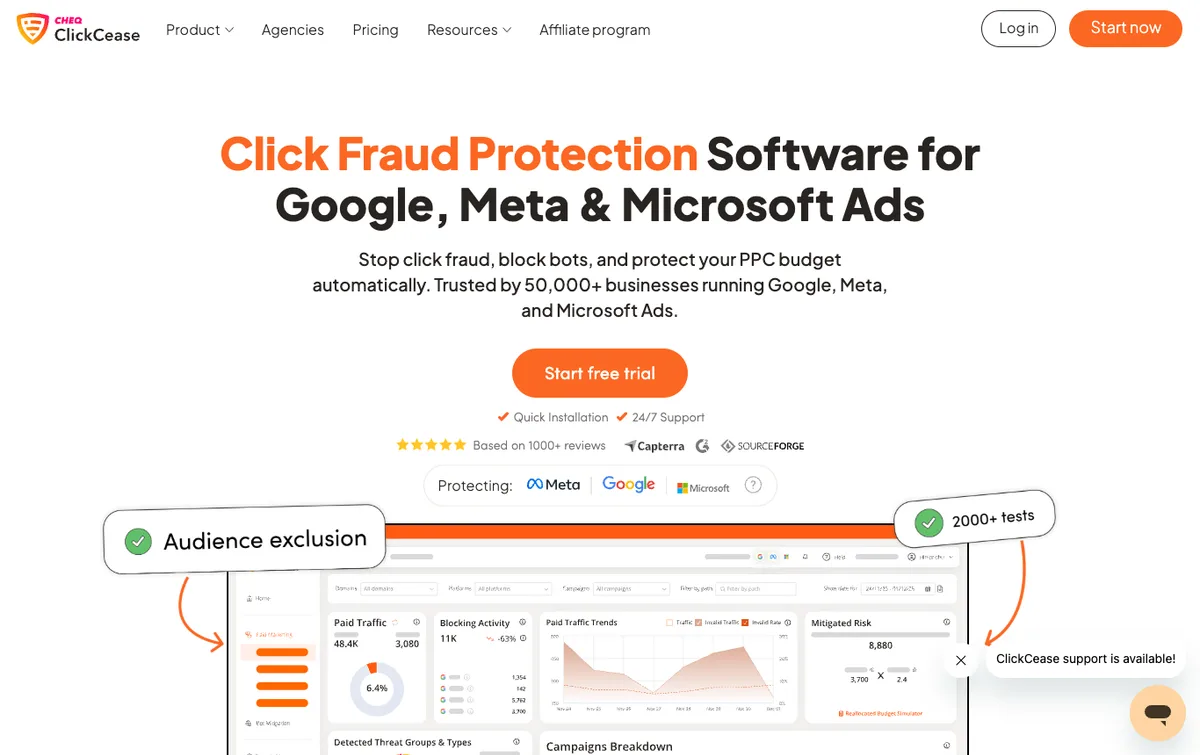
ClickCease is the most widely adopted click fraud protection software in the mid-market, and it is now part of CHEQ, where it is listed as a CHEQ company. It monitors Google Ads, Meta Ads and Microsoft Ads, scores each click, and writes offending IPs and device signatures straight into platform exclusion lists.
The company states it runs "2,000+ behavioral tests per click in real time" and protects more than 50,000 businesses. Setup is a tag plus an ad account connection, which puts first data inside a day rather than a quarter.
-
Channels: Google Ads, Meta Ads, Microsoft Ads, plus WordPress bot protection and HubSpot form validation
-
Detection: Post-bid click scoring with automated IP and placement exclusions
-
Evidence: Per-click detail with session recordings and threat reasons
-
Reporting: Exportable reports formatted for network credit requests
-
Strength: Published prices, fast setup, and the broadest review base in the category.
-
Limitation: Click-level and search-led. It does not address programmatic impression fraud or CTV.
-
Best for: Teams spending $10k to $250k a month on paid search and social who want protection running this week.
-
Pricing: Starter $99/mo, Pro $149/mo, Advanced $349/mo, dropping to $69, $104 and $244 on annual billing. Seven-day free trial.
2. Lunio, best for teams spending over $1M a year in paid media
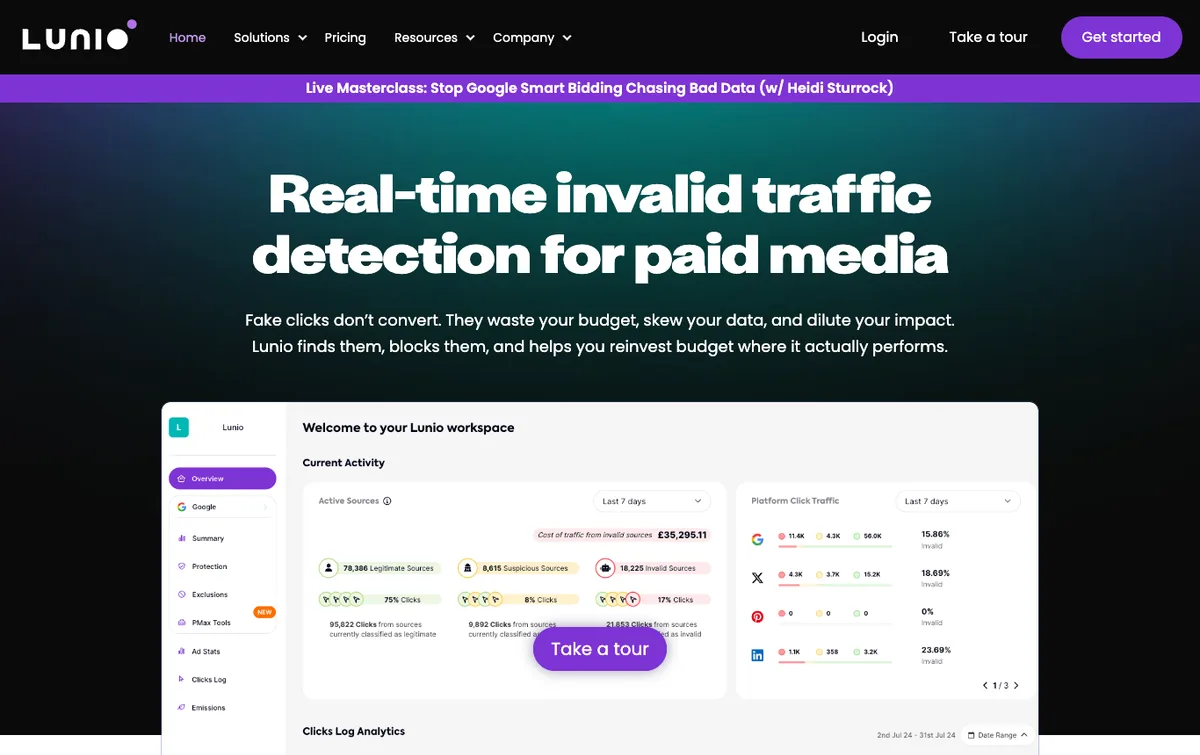
Lunio frames the problem differently from its competitors: the company says it "tackles invalid traffic as a marketing problem, not a security one". In practice that means the reporting is built around wasted ad spend and conversion-rate recovery rather than threat counts, which is the language a CMO will actually read.
Coverage spans Google Ads, Meta, Microsoft Ads and Performance Max, and the detection is cookieless. Lunio also publishes the Global Invalid Traffic Report, the source of the 8.5% cross-channel figure the ANA covered in January 2026.
- Strength: Marketing-native reporting and multi-channel coverage including Performance Max.
- Limitation: No published pricing, which slows down evaluation and rules it out for smaller budgets.
- Best for: Advertisers above roughly $1M in annual paid media, especially lead generation in high-CPC categories.
- Pricing: Custom. The entry point is a 14-day free traffic audit.
3. TrafficGuard, best for omnichannel coverage including mobile and affiliate
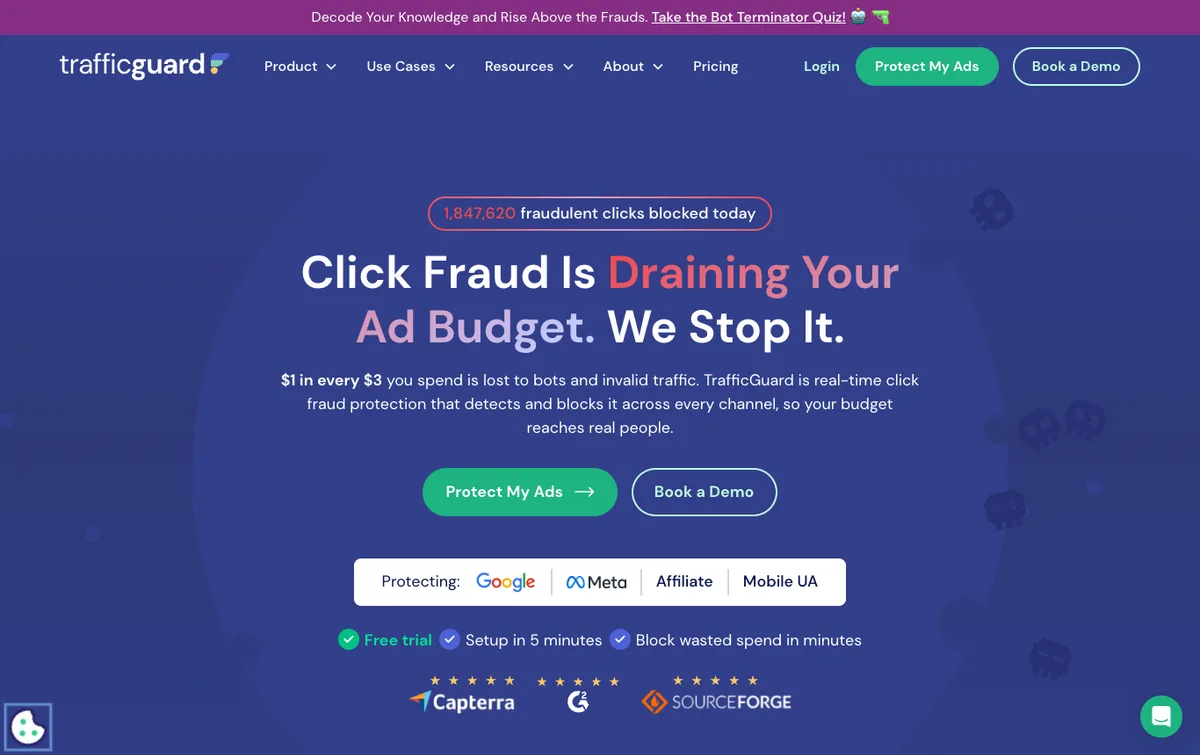
TrafficGuard is one of the few vendors that covers search, social, affiliate and mobile user acquisition in one platform, which matters when the same budget moves between those channels each quarter. Its Performance Max protection and affiliate conversion checks are the differentiators.
It is also the only tool here with a genuinely cheap published entry point, though that tier is narrow: $49 a month covers Google Search on a single domain, up to $30k in monthly ad spend.
- Strength: One vendor across search, social, affiliate and app installs.
- Limitation: Everything past the entry tier is custom-priced, and the channels are separately packaged.
- Best for: Performance teams running paid search alongside affiliate or mobile UA.
- Pricing: Shield from $49/mo (Google Search, up to $30k monthly spend, 30-day free trial). Scale and the enterprise social, affiliate and mobile plans are custom.
4. Anura, best for lead generation and human fraud farms
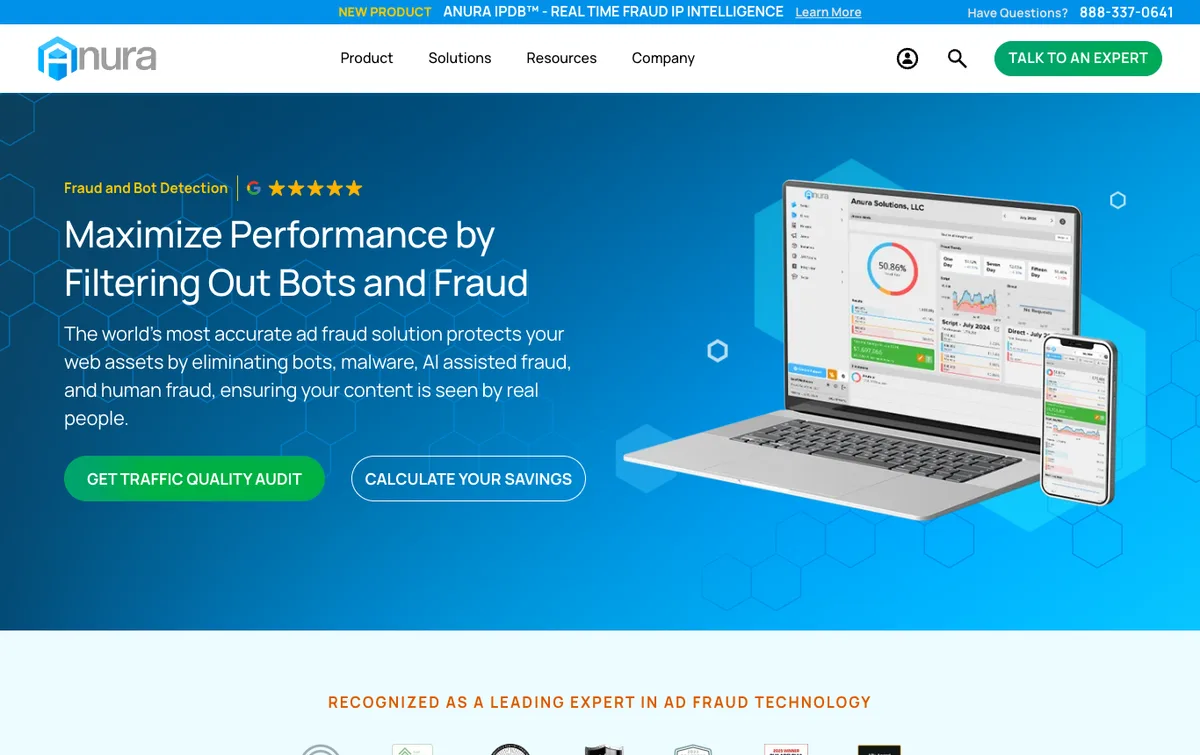
Anura separates invalid traffic into bots, malware and human fraud, and its positioning rests on that third category. Human fraud, as Anura puts it, "relies on a network of humans, instead of using bots or malware, to interact with ads and create false transactions", and it is the hardest type to catch with rule-based filters.
The company claims 99.999% accuracy on bad classifications and markets hard on avoiding false positives. Treat both as vendor claims and validate them against your own conversion data during the trial.
- Strength: Depth on human fraud farms and lead-form abuse, where lead-gen advertisers lose the most.
- Limitation: No published pricing, and the product assumes you have somewhere to send the verdict.
- Best for: Lead generation, affiliate marketing and any business paying per submitted form.
- Pricing: Custom, with a 15-day free trial.
5. CHEQ, best for enterprise go-to-market security beyond advertising
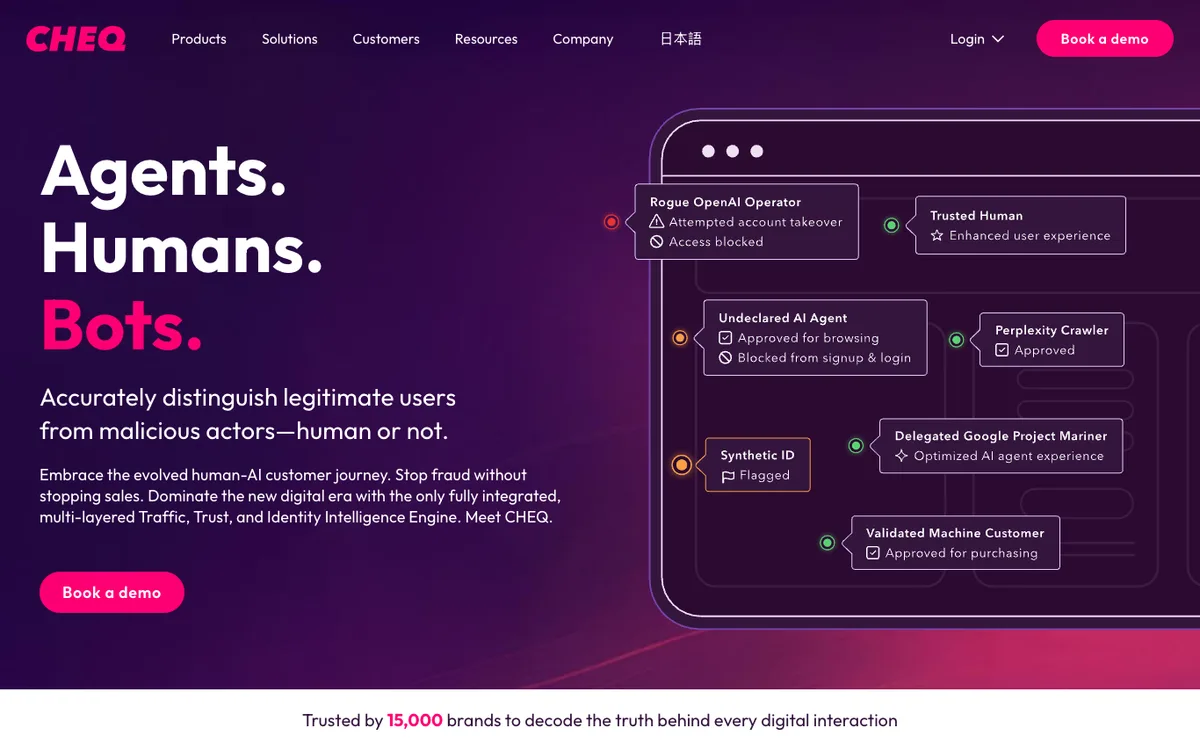
CHEQ has moved past click fraud into what it calls traffic, trust and identity intelligence across the full go-to-market motion. The modules run from CHEQ Acquisition for paid campaigns to Form Guard, Analytics, Manage, Enforce, and Agent Intent for assessing AI-agent visitors.
The company reports processing "6T signals" a day and a "0.009% false positive rate". CHEQ also owns ClickCease, so an evaluation of one is effectively an evaluation of the same detection stack at two price points.
- Strength: One vendor covering ads, forms, analytics hygiene and privacy compliance.
- Limitation: Enterprise scope and enterprise sales cycle. Overkill if the only problem is Google Ads clicks.
- Best for: Large advertisers where fake traffic corrupts analytics and CRM, not just ad spend.
- Pricing: Custom, enterprise.
6. HUMAN Security, best for MRC-accredited pre-bid protection
HUMAN Security, formerly White Ops, was the first company to receive MRC accreditation for sophisticated invalid traffic detection, and it holds accreditation across both pre-bid and post-bid mitigation. The company reports verifying more than 10 trillion interactions a week.
Pre-bid matters in programmatic: a bid never placed costs nothing, while a click blocked after the fact has already been paid for. If your spend sits in DSPs and exchanges, this is the tier of tool that applies.
- Strength: Independently audited SIVT detection at a scale no click blocker approaches.
- Limitation: Built for programmatic and platform-scale buyers. It is not a self-serve Google Ads product.
- Best for: Advertisers, DSPs and publishers operating in programmatic and CTV.
- Pricing: Custom, enterprise.
7. DoubleVerify, best for enterprise media verification across social and CTV
DoubleVerify sells verification rather than click blocking: fraud and IVT avoidance, viewability, brand safety and attention measurement, reported back into the media plan. Its accreditations cover fraud and IVT avoidance across desktop, mobile web, in-app and CTV, and in April 2026 it became the first measurement provider accredited by the MRC for TikTok video viewability.
For teams whose agency already reports on viewability, this is usually the incumbent rather than a new purchase.
- Strength: Broad MRC accreditation and one measurement layer across every major channel.
- Limitation: Measurement-led. It tells you where not to buy, it does not sit on your Google Ads account blocking clicks.
- Best for: Brands and agencies buying video, CTV and programmatic at scale.
- Pricing: Custom, priced on media volume.
8. Integral Ad Science, best for verification inside walled gardens
Integral Ad Science is DoubleVerify's closest equivalent and competes on the same criteria. IAS holds MRC accreditation for SIVT filtration in connected TV, and separately for measurement and reporting on Amazon properties including GIVT and SIVT filtration through a server-to-server DSP integration.
Where an advertiser's spend concentrates inside retail media and walled gardens, that integration depth is the deciding factor rather than detection philosophy.
- Strength: Accredited coverage in CTV and retail media environments that are hard to measure.
- Limitation: Same as DoubleVerify. Verification and avoidance, not account-level click blocking.
- Best for: Enterprise advertisers with heavy CTV, retail media or Amazon investment.
- Pricing: Custom, priced on media volume.
9. Fraud Blocker, best for small budgets that still need real protection
Fraud Blocker is the cheapest credible entry into click fraud prevention with a published price, and it covers the two channels most small advertisers actually run. Pricing is metered on ad clicks rather than ad spend, which suits low-CPC, high-volume accounts.
- Strength: Transparent tiers starting at $79 a month, and quick self-serve setup.
- Limitation: Google and Meta only natively. Microsoft Ads and AdRoll are handled by exporting IP lists.
- Best for: Small businesses and agencies running under roughly $25k a month in paid search.
- Pricing: Standard $79/mo (5,000 ad clicks), Pro $99/mo (25,000), Enterprise from $489/mo (250,000+). Seven-day trial.
10. Spider AF, best for wide platform coverage and a detection-only trial
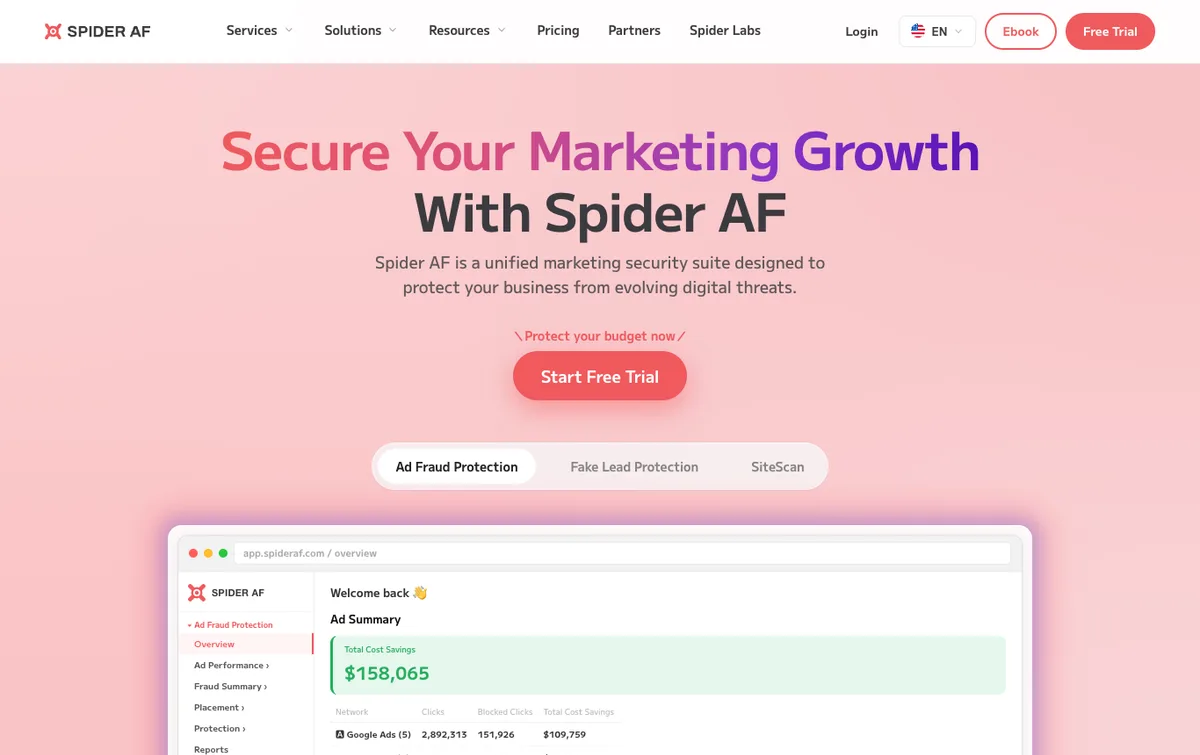
Spider AF covers a wider native platform list than most of the category, including Google Ads, Meta, Microsoft Ads, TikTok, Yahoo and Pinterest, alongside fake-lead blocking and third-party script monitoring. It reports a 5.58% average ad fraud rate across accounts in the first half of 2026.
Its trial design is the smart part: two weeks of full detection with blocking switched off, so you see the scale of the problem on your own account before anything is filtered.
- Strength: Broad channel coverage and a risk-free measurement period.
- Limitation: Smaller customer base than the leaders, and results take 10 to 14 days to become meaningful.
- Best for: Teams running TikTok or Pinterest alongside Google and Meta.
- Pricing: Custom, with a two-week free trial of the Elite plan.
Also worth knowing: ClickGUARD publishes Google, Meta and Microsoft protection from $74 a month for accounts under $5k in monthly spend, rising to $159 for accounts up to $100k. Fraudlogix and Opticks sell detection data to platforms and networks rather than to advertisers.
Feature and pricing comparison
| Tool | Best for | Channels | Detection point | Published pricing | Trial |
|---|---|---|---|---|---|
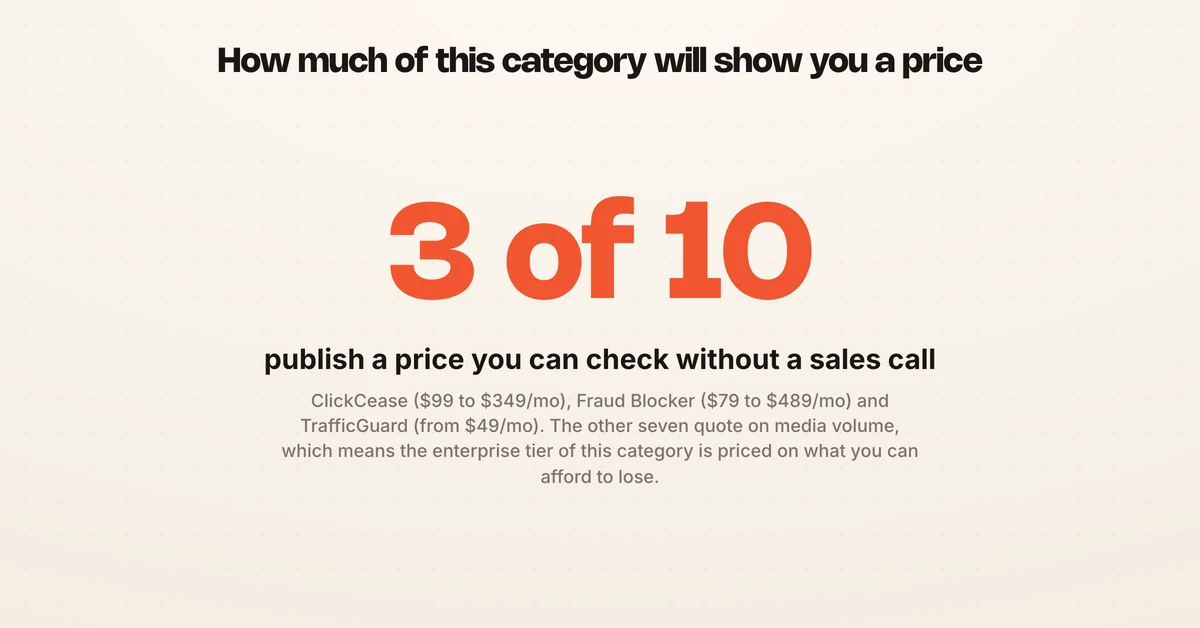
| ClickCease | Mid-market PPC | Google, Meta, Microsoft | Post-bid | $99 to $349/mo | 7 days |
| Lunio | $1M+ paid media | Google, Meta, Microsoft, PMax | Post-bid | No | 14-day audit |
| TrafficGuard | Omnichannel and mobile UA | Search, Meta, affiliate, app | Pre and post-bid | From $49/mo | 30 days |
| Anura | Lead gen and human fraud | Ads, forms, affiliate | Post-bid | No | 15 days |
| CHEQ | Enterprise GTM security | Ads, forms, analytics | Post-bid | No | On request |
| HUMAN Security | Programmatic at scale | Programmatic, CTV, in-app | Pre and post-bid | No | On request |
| DoubleVerify | Enterprise verification | Programmatic, social, CTV | Pre and post-bid | No | On request |
| Integral Ad Science | Walled gardens and CTV | Programmatic, CTV, retail media | Pre and post-bid | No | On request |
| Fraud Blocker | Small budgets | Google, Meta | Post-bid | $79 to $489/mo | 7 days |
| Spider AF | Multi-platform social | Google, Meta, Microsoft, TikTok, Yahoo, Pinterest | Post-bid | No | 14 days |
What ad fraud software cannot fix
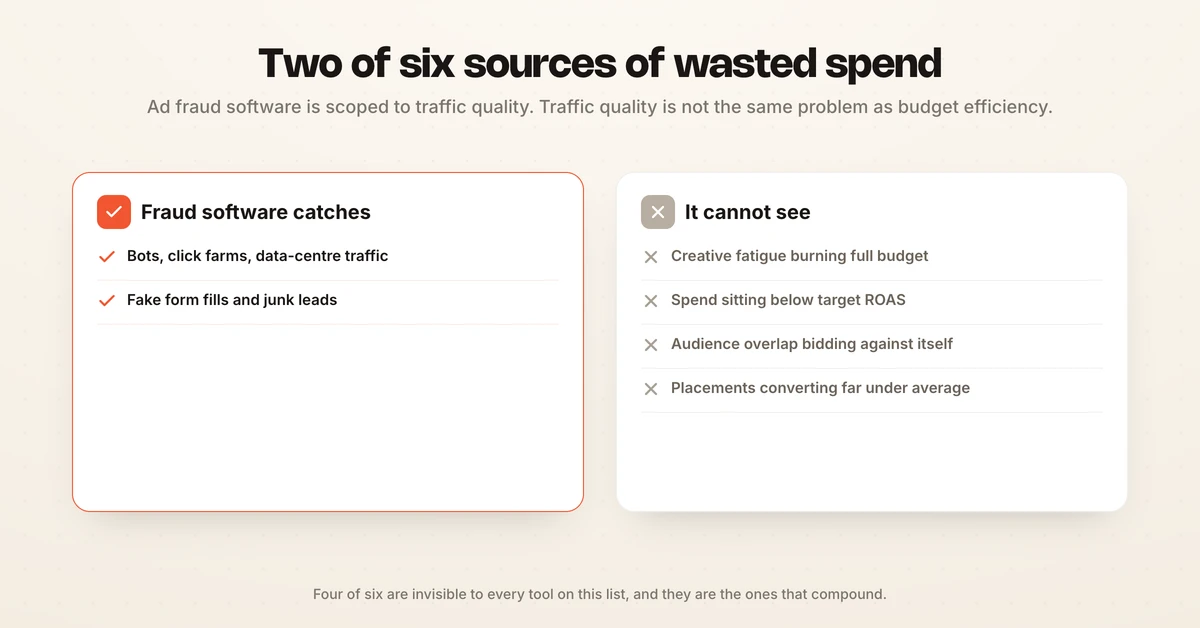
Ad fraud software is scoped to traffic quality, and traffic quality is not the same problem as budget efficiency. Fraud is one line item in wasted ad spend, and for most performance accounts it is not the biggest one.
Start with what the platforms already do. Google states that invalid traffic caught before billing "is automatically removed from your billing and campaign reports, so no refunds are necessary", and that anything caught after billing comes back as a credit. Third-party ad fraud software earns its money on what Google's filters miss and on the exclusions it pushes back, not on money the platform was going to charge you anyway.
Now look at where the rest of the budget goes. Counting it correctly in the first place is a different purchase again. The best ad tracking software covers the tools that attribute real clicks to real revenue.
| Source of waste | Detectable by fraud software | Who fixes it |
|---|---|---|
| Bots, click farms, data-centre traffic | Yes | Ad fraud software |
| Fake form fills and junk leads | Yes | Ad fraud software, form validation |
| Creative fatigue, spend running on ads that stopped working | No | Creative analysis and rotation |
| Budget sitting in campaigns below target ROAS | No | Reallocation, daily or faster |
| Audience overlap bidding against yourself | No | Campaign structure |
| Spend on placements that convert at a fraction of account average | No | Placement-level optimisation |
Four of those six are invisible to every tool on this list, and they are the ones that compound. A campaign that lost 30% of its efficiency to creative fatigue keeps spending at full rate until a human notices, and the average human notices at the weekly review.
This is the job Hawky does, and the distinction matters enough to state plainly: Hawky is not ad fraud detection software. It does not block bots, filter invalid traffic, or hold MRC accreditation, and it is not a substitute for anything in the ten above.
What Hawky's Performance Agent does is operate the account against the KPI you set. It reallocates, scales and kills campaigns around ROAS, CAC, LTV or contribution margin, running continuously rather than at the weekly review, with 40+ connected DSPs feeding the same account view so programmatic exposure is visible alongside native channels. Every move ships with the data that triggered it, a confidence score, and a rollback button.
Autonomy is configurable and gated. Most teams start in shadow mode for roughly two weeks, where the agent proposes every move and a person confirms it, then move to approval-gated, then to fully autonomous, with the same audit trail at every stage. Spend caps, daily-change ceilings and allow-listed campaigns define the rails, and the agent cannot act outside them.
The Creative Analysis layer handles the fatigue problem the fraud tools cannot see, breaking each ad into hook, frames, copy, audio and CTA, scoring each element against past winners, and catching fatigue two to three days earlier than a dashboard review. Hiveminds ran this and reported 27% lower CPL with 160+ hours saved per brand each month.
The honest sequencing: buy fraud protection to stop paying for traffic that was never a person, then fix the larger share of waste that involves real people seeing the wrong ad. The two problems need different software.
How to choose ad fraud software for your team
If you spend under $25k a month on Google and Meta: Fraud Blocker or ClickCease. Both publish prices, install in an afternoon, and pay for themselves if they recover even 2% of spend. Skip anything that requires a sales call at this budget.
If you spend $25k to $250k a month on paid search and social: ClickCease or Spider AF, with Lunio worth a look if lead quality rather than click volume is the pain. Run the free trial in detection-only mode first so you have a measured baseline to argue with.
If you spend over $1M a year and the CFO asks about ROI: Lunio or TrafficGuard. Both report in recovered ad spend terms rather than threat counts, and both cover Performance Max, where a surprising amount of unexamined budget sits. Check Google Ads benchmarks for your category before accepting any vendor's claim about how much your account is losing.
If you buy programmatic, CTV or retail media: HUMAN Security, DoubleVerify or IAS. Insist on MRC accreditation for the specific environment and metric you care about, because accreditation is granted channel by channel, not company-wide.
If your problem is junk leads rather than junk clicks: Anura or CHEQ Form Guard. Fraud that arrives as a completed form costs far more than a wasted click, because it also consumes sales time.
If click fraud protection is already in place and spend is still leaking: the problem is allocation and creative, not traffic quality. That is where an agent that operates the account continuously, inside guardrails, beats another detection subscription. See the best PPC tools for the wider stack, and stop wasting budget on the wrong creatives for the creative side of the same problem.
How to audit your traffic before you buy
Auditing your own traffic for invalid activity takes 30 days, costs nothing, and produces a number the vendor did not generate. Run it before any sales call.
- Set the baseline. Export 90 days of campaign data with clicks, CPC, conversion rate and CPA by campaign, placement and geo. This is what you will compare against.
- Find the outliers. Look for placements or geos with normal click volume and near-zero conversion rate, repeat clicks from single IP ranges, and sessions with sub-two-second dwell time. Those are the candidates.
- Run one trial in detection-only mode. Spider AF, TrafficGuard and Lunio all allow a measurement period with blocking off. Blocking immediately makes the before-and-after impossible to read.
- Compare verdicts against outcomes. Take the traffic the tool flagged and check whether it ever converted. A flagged segment that produces real customers is a false positive, and that is the number that decides the purchase.
- Measure the right metric after switching blocking on. Blocked-click counts are the vendor's metric. CPA, conversion rate and cost per qualified lead are yours. If those do not move within 30 days, the fraud was not your main leak.
Frequently asked questions
What is the best ad fraud software?
For most performance marketing teams buying Google and Meta, ClickCease is the strongest all-round choice because it covers the three main search and social platforms, publishes its pricing from $99 a month, and deploys in a day. Advertisers above $1M in annual paid media get more from Lunio's spend-recovery reporting, and programmatic buyers should use an MRC-accredited vendor such as HUMAN Security, DoubleVerify or IAS.
How does ad fraud work?
Ad fraud works by generating ad interactions that look human but are not, so the party serving or referring the traffic gets paid for attention that never existed. The common methods are bot networks driving clicks and impressions, hijacked consumer devices running ads invisibly in the background, human click farms paid to interact with ads, and domain or app spoofing that misrepresents where an ad actually ran. Sophisticated invalid traffic mimics real browsing behaviour closely enough that list-based filters miss it, which is why behavioural detection exists.
How does ad fraud make money?
Fraudsters earn on the publisher side of the transaction. A fraudulent site, app or affiliate collects revenue for impressions, clicks or conversions that were manufactured rather than earned, and the advertiser pays for them through the auction. In affiliate and app-install fraud the payout is larger per event, which is why those channels attract organised operations rather than opportunistic bots.
How much does ClickCease cost per month?
ClickCease publishes three tiers: Starter at $99 a month, Pro at $149 and Advanced at $349, falling to $69, $104 and $244 respectively on annual billing. Every tier covers Google Ads, Meta Ads and Microsoft Ads, and the differences are website count, monthly traffic volume and HubSpot lead validation limits. A seven-day free trial runs without a credit card.
Does Google already refund click fraud?
Partly. Google filters invalid traffic it detects before billing, so those clicks are removed from billing and reports with no refund needed, and traffic detected after billing returns as an account credit. Third-party ad fraud software targets what those filters miss and, more usefully, pushes exclusion lists back into the account so repeat offenders stop being served at all.
Is ad fraud software worth it for a small advertiser?
It depends on your cost per click, not your total spend. At a $1 CPC, a 10% invalid traffic rate on $5,000 a month is $500 lost against a $79 subscription, which pays back comfortably. At a $12 CPC in legal, insurance or B2B software, the case is overwhelming. Run a detection-only trial first, because the actual invalid rate on your account is the only number that settles it.
Fraud protection stops you paying for traffic that was never a person. It does nothing about the larger share of budget that real people waste by seeing the wrong ad, in the wrong campaign, three days after it stopped working. If wasted spend survives your fraud filters, Hawky's Performance Agent is built for that job.
Ready to hire your first AI performance team? Book Demo