How to Create Effective UGC Ads: Hooks, Briefs, and Examples
An effective UGC ad looks like content, not an ad: it opens with a scroll-stopping hook, shows a real person using the product in a believable context, and proves the benefit before it asks for the click. Getting there reliably comes down to three things, a strong hook, a tight creative brief, and studying what already works. This guide covers all three, with real UGC ads from brands running them right now.
UGC, or user-generated content, is ad creative shot in the raw, personal style of a real customer or creator rather than a polished studio spot. It works because it feels native to a feed of friends and creators, so the viewer lowers their guard. This is the playbook for briefing and building UGC ads that actually convert, not just look authentic.
What makes a UGC ad effective in 2026
An effective UGC ad earns attention in the first three seconds, holds it with a relatable story or demo, and converts by making the product the obvious answer to a problem the viewer already feels. The format is casual and creator-led, but the structure underneath is deliberate.
UGC outperforms polished brand film in most DTC feeds because it matches the content around it. A selfie-style video from someone who looks like the buyer reads as a recommendation, while a glossy commercial reads as an interruption. That native feel is the entire advantage, and it disappears the moment the ad looks over-produced.
The catch is that "authentic" is not the same as "effective." A UGC ad still needs a job: one clear message, one hook, one call to action. The brands that win treat UGC as a tested, briefed format, not a happy accident a creator stumbles into.
The anatomy of a high-performing UGC ad
Every strong UGC ad follows the same four-part spine, even when it feels improvised. Each part has a job, and skipping one is where most UGC ads leak performance.
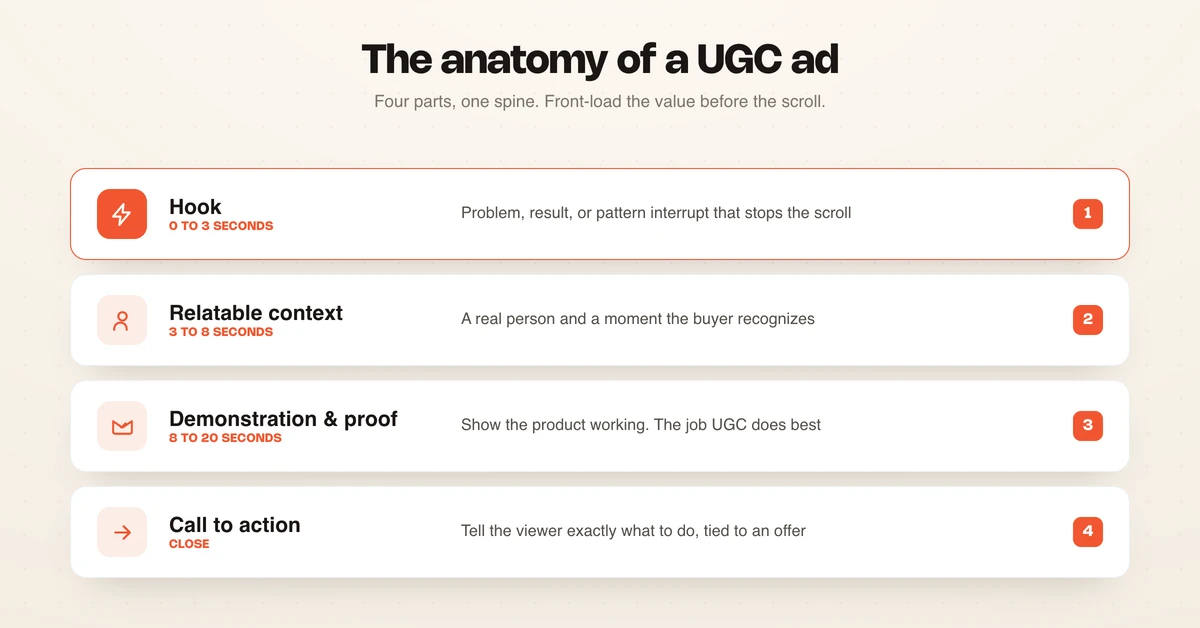
The hook (first 1 to 3 seconds) stops the scroll with a problem, a result, or a pattern interrupt. The relatable context establishes who is talking and why you should care, usually a real-life moment the buyer recognizes. The demonstration and proof shows the product working, the single most important job UGC does better than any other format. The call to action tells the viewer exactly what to do next, ideally tied to an offer.
Front-load the value. A viewer who drops at second five should still have seen the hook and the core promise, because most never reach the CTA. The demo is the heart: show the result, do not just describe it.
UGC ad hooks that stop the scroll
The hook is where most UGC ads are won or lost, and UGC hooks are spoken or shown, not just written as a headline. The strongest ones sound like a person talking to a friend, not a brand talking to a market.
A few hook patterns consistently work for UGC. The problem callout ("If you're tired of X, watch this") names a pain in the first second. The skeptic-turned-believer ("I did not think this would work, but...") preempts the objection the viewer already has. The result-first ("This is 3 weeks of using it") leads with the payoff. The POV or pattern interrupt ("POV: you finally found a deodorant that lasts") drops the viewer into a scene. For a deeper library of openers with live examples, see our breakdown of real DTC Meta ad hook examples.
Whatever the pattern, the rule is the same: be specific and lead with the viewer, not the product. Write at least five hook variants per concept and test them, because the opener you love is rarely the one that wins.
How to write a UGC creative brief
A UGC ad is only as good as the brief behind it. The brief is what turns "make us a video" into a creator deliverable that matches a tested hypothesis, and it is the single biggest lever on UGC quality. A vague brief is why most UGC comes back unusable.
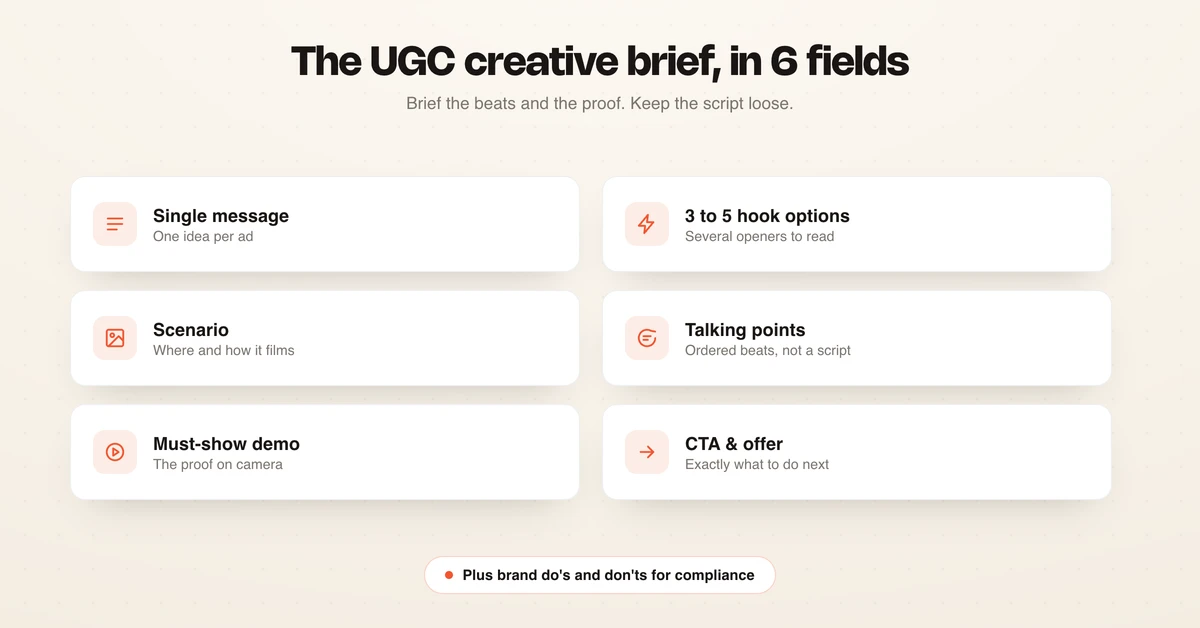
A strong UGC brief covers seven things. State the single message (one idea per ad). Give three to five hook options so the creator can read several openers. Define the scenario (where and how it is filmed, kept casual and real). List the talking points in order, without scripting word for word. Specify the must-show demo and any b-roll needed for the proof. Name the call to action and offer. Add do's and don'ts for brand and compliance.
Keep the script loose. The fastest way to kill the native feel is to hand a creator a word-for-word script they read like a teleprompter. Brief the beats and the proof, then let the creator sound like themselves.
5 real UGC ad examples worth studying
Each example below is a real ad running now, captured from the public Meta Ad Library. Study the hook, the context, and how each brand proves its claim, then borrow the structure for your own brief.
1. Jones Road Beauty: the problem-swap hook
Jones Road Beauty runs creator-led ads around "Ditch Your Heavy Makeup," opening on the problem (cakey, heavy makeup) before showing the lighter alternative on real skin. The hook works because it names what the viewer already dislikes, then demonstrates the fix on camera. View this ad in the Meta Ad Library.
2. Hero Cosmetics: the problem-solution demo
Hero Cosmetics leans on "The original pimple patch," pairing a relatable skin problem with a close-up demo of the patch doing its job. The proof is visual and fast, which is exactly what UGC does better than studio film. View this ad in the Meta Ad Library.
3. Vegamour: the curiosity hook
Vegamour opens with "Your hair is hungry for this," a curiosity-led line that pairs a metaphor with a result the viewer wants. Hair and skin categories suit UGC because the before-and-after is visible and personal. View this ad in the Meta Ad Library.
4. Vessi: the benefit demonstration
Vessi runs "Start dry. Stay comfortable," then proves it on camera, often by pouring water on the waterproof shoe. A product with a visible, almost magical demo is a perfect UGC candidate, because seeing beats claiming. View this ad in the Meta Ad Library.
5. OLIPOP: the taste-test moment
OLIPOP uses flavor-forward, creator-led ads like "Drink OLIPOP," built around the sensory moment of trying it. For food and beverage, the taste-test reaction is the demo, and a genuine first sip on camera sells better than any tasting-note copy. View this ad in the Meta Ad Library.
How to source creators and scale UGC
You need a steady supply of creators to keep UGC fresh, because the format fatigues fast once an audience has seen it. Build a small roster you brief repeatedly rather than chasing one-off videos, and brief them with the framework above. For the sourcing side, see our guides on how to find UGC creators for paid ads and the UGC sourcing platforms compared.
Volume is the real constraint. Automated delivery on Meta rewards a deep, varied creative pool, so one great UGC ad is not enough, you need a pipeline of hooks and angles always in test, and a way to retire them before they fatigue.
How AI agents help you scale UGC creative
AI does not replace the creator, but it removes the work around them that slows UGC down. Hawky runs an agentic performance marketing platform whose agents handle the briefing, analysis, and testing labor so your creators can focus on filming, with every action logged and reversible.
Element-level creative analysis tells you which UGC hooks, scenes, and CTAs actually drove results, so your next briefs are built on evidence instead of taste. The Creative Agent reads your winners and competitor patterns to generate fresh hook angles and on-brand concepts to brief, and the Performance Agent tests UGC variants, scales winners, and refreshes fatigued creative against your KPI, 24/7. Configurable autonomy keeps humans in command, from shadow mode to approval-gated to fully autonomous, with the same audit trail throughout. The Man Company doubled creative performance and cut iteration cycles 50% running this loop.
If turning UGC into a tested, always-on pipeline is your bottleneck, Hawky's Creative Agent and Performance Agent are built for that job.
Frequently asked questions
What is a UGC ad?
A UGC ad is a paid ad built from user-generated-style content: video or images shot in the raw, personal style of a real customer or creator rather than a polished studio production. It works because it looks native to a social feed, so viewers treat it like a recommendation instead of an interruption. Brands either source it from real customers or commission creators to produce it.
How do you make an effective UGC ad?
Start with one clear message, open with a strong hook in the first three seconds, show a real person using the product in a believable context, demonstrate the benefit, and end with a clear call to action. Brief the creator on the beats and the must-show demo rather than handing them a word-for-word script. Then test multiple hooks against the same concept and scale the winner.
What makes a good UGC hook?
A good UGC hook sounds like a person talking to a friend and lands in the first one to three seconds. The strongest patterns are the problem callout, the skeptic-turned-believer, the result-first reveal, and the POV pattern interrupt. It should be specific and lead with the viewer's problem or desire, not the product name.
What should a UGC creative brief include?
A strong UGC brief includes a single message, three to five hook options, the filming scenario, ordered talking points, the must-show demonstration, any b-roll for proof, and the call to action and offer, plus brand do's and don'ts. Keep the script loose so the creator sounds natural. The brief should tie back to a specific hypothesis you want to test.
Where can I find real UGC ad examples?
The Meta Ad Library is the best public source for real UGC ads, since it shows every ad a brand is currently running. Search for UGC-heavy DTC brands in your category and study their hooks, scenarios, and demos. Every example in this article links to its live Ad Library entry so you can see the full creative.
Can AI create UGC ads?
AI cannot replace a real creator filming an authentic video, but it removes most of the surrounding work. Agents can generate hook angles and brief concepts, analyze which UGC elements actually convert, and test and scale variants automatically. The trustworthy approach keeps humans and creators in command while the agent handles the briefing, analysis, and optimization labor.
If turning UGC from one-off videos into a tested, always-on creative pipeline is your bottleneck, Hawky's Creative Agent generates the hooks and concepts to brief and the Performance Agent tests and scales the winners, with guardrails and a full audit trail keeping you in command.
Ready to hire your first AI performance team? Book Demo