Brand Lift Study
Last updated
A controlled survey method that measures how a campaign shifts perception metrics like ad recall, consideration, and purchase intent by comparing an exposed group against a control group. It gives upper-funnel spend the proof clicks cannot provide, so brand budgets stop getting cut blind.
Brand Lift Study
A Brand Lift Study is a controlled measurement method that quantifies how an ad campaign changes perception metrics like awareness, ad recall, consideration, and purchase intent by surveying an exposed group against a matched control group. Instead of counting clicks or conversions, it measures the shift in how people think and feel about a brand, which is the real objective of upper-funnel advertising. The output is a percentage lift that shows whether the campaign moved minds.
Why It Matters
Awareness and consideration campaigns rarely produce an immediate click or sale, so judging them on performance metrics alone makes them look like dead weight. A brand lift study gives upper-funnel video and display the measurement it actually deserves, proving whether the spend changed perception even when no one clicked. Without it, the brand-building budget is flying blind and is usually the first line cut in a downturn.
The connection to revenue is well documented. Platforms report that a measurable lift in ad recall and consideration correlates with stronger downstream conversion rates, and meta-analyses of brand lift data show that a 5 to 10 point lift in purchase intent often precedes a real sales increase weeks later. When brand lift is ignored, teams starve the upper funnel, the retargeting and warm audiences shrink, and lower-funnel CPA rises because fewer prospects arrive already familiar with the brand. Brand lift keeps that pipeline visible.
How It Works
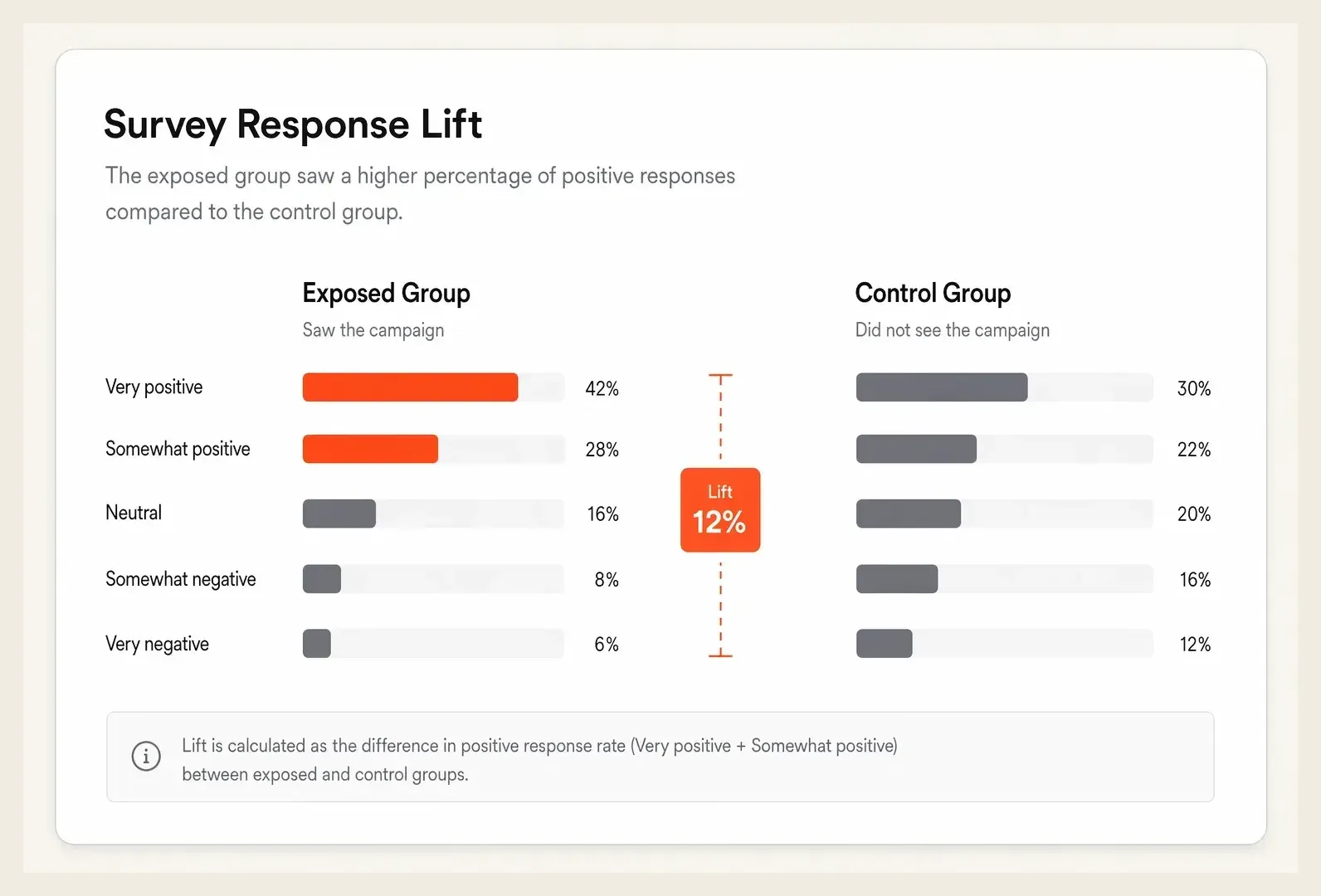
A brand lift study works by randomly splitting an audience into an exposed group that sees the campaign and a control group that does not, then surveying both with the same questions. The difference in positive responses between the two groups is the lift.
- Control vs Exposed: A randomized holdout group that never saw the ad establishes the baseline perception.
- Survey Metrics: Standard questions measure ad recall, awareness, brand favorability, consideration, and purchase intent.
- Lift Calculation: The exposed group's positive response rate minus the control group's, shown as absolute or relative lift.
- Significance: Adequate sample size and statistical significance confirm the lift is real, not survey noise.
In practice, platforms like Meta and YouTube run these studies natively by serving the survey to a slice of the exposed and control audiences during or just after the campaign. The cleaner the randomization and the larger the response base, the more reliable the lift figure, which is why these studies usually require a minimum spend and audience size to run.
A Real Example
A beverage startup launched a $200,000 YouTube and Reels awareness campaign and faced pressure from finance to prove it was not wasted because direct conversions were minimal.
The team enabled a brand lift study with a randomized control group across both platforms. After three weeks, the survey showed a 14 point absolute lift in aided ad recall (38 percent exposed versus 24 percent control) and a 6 point lift in purchase intent, both statistically significant. Over the following six weeks, branded search volume rose 31 percent and the brand's view-through rate on follow-up campaigns climbed as the warmer audience converted more readily. The finance team approved a larger awareness budget the next quarter, now anchored to a measurable lift target rather than a click count.
Common Mistakes
| The Mistake | ❌ Wrong Approach | ✅ Better Approach |
|---|---|---|
| Measuring brand with clicks | Judging awareness video on CTR and CPA | Running a survey-based brand lift study for perception |
| No control group | Surveying only the exposed audience | Comparing against a randomized holdout group |
| Underpowered survey | Reading lift from a tiny response base | Ensuring enough responses for statistical significance |
| Ignoring the funnel link | Treating brand lift as disconnected from sales | Tracking how lift feeds branded search and warm-audience conversion |
How Hawky Helps
Upper-funnel campaigns get cut when no one can prove they worked, and brand lift is the proof clicks cannot provide. Hawky's Performance Agent reads brand lift and view-through signals alongside lower-funnel cost data, so it values awareness spend on the perception shift and warm-audience growth it creates, not just the immediate conversions. It protects the upper-funnel budget that feeds the rest of the account instead of defaulting to the campaigns with the fastest click.
The Creative Agent builds the assets that actually move recall and consideration, generating hooks and messaging tuned to land the brand in the first seconds where lift is won or lost. Each finding about which creative and placements drove measurable lift is stored in FeatherDB as living context, so future awareness campaigns start from what shifted perception before. The result is brand building that is measured and defended, not guessed and cut.
Frequently Asked Questions
What does a brand lift study measure?
A brand lift study measures the change in perception metrics caused by a campaign, including ad recall, brand awareness, favorability, consideration, and purchase intent. It does this by surveying an exposed group and a control group, then reporting the difference as a lift. Unlike conversion metrics, it captures whether the advertising changed how people think about the brand.
How is brand lift calculated?
Brand lift is calculated by subtracting the control group's positive survey response rate from the exposed group's rate. For example, if 38 percent of the exposed group recalls the ad versus 24 percent of the control, the absolute lift is 14 points. The result must be statistically significant, which requires a large enough survey response base in both groups.
What is a good brand lift percentage?
A good brand lift varies by metric and campaign goal, but a 5 to 10 point absolute lift in ad recall is generally considered strong, while a few points of lift in purchase intent is meaningful because intent moves slowly. The figure should always be statistically significant. Comparing lift against your own past campaigns is more useful than chasing a universal benchmark.
How long should a brand lift study run?
A brand lift study typically runs for the duration of the campaign flight, often two to four weeks, to gather enough survey responses for a reliable read. The study needs sufficient impressions and responses in both the exposed and control groups to reach statistical significance. Ending it too early risks a result driven by survey noise rather than a real perception shift.
Quick Takeaway
A Brand Lift Study proves whether awareness and consideration campaigns actually changed perception, giving upper-funnel spend the measurement that clicks never could. Anchor brand-building budgets to a measurable lift target so the funnel that feeds every conversion campaign does not get cut for lack of proof.
Struggling to prove your awareness campaigns are worth the spend? Ready to hire your first AI performance team? Book Demo