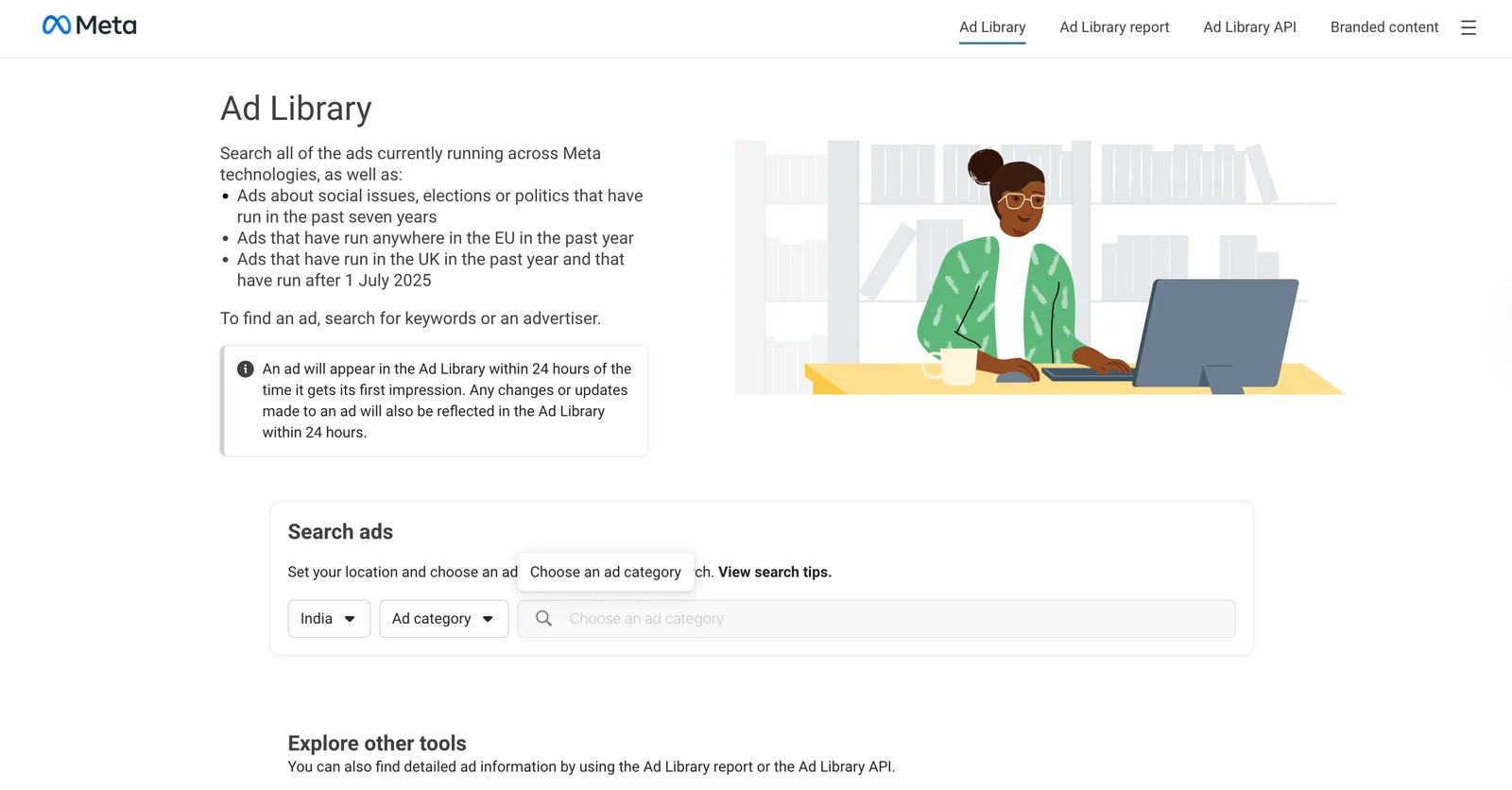
Facebook Ad Library

Facebook Ad Library

Facebook Ad Library

Facebook Ad Library shows every active Meta ad for free. Learn how to use it for competitor research, spot winning patterns, and build smarter creative briefs.

Facebook Ad Library shows every active Meta ad for free. Learn how to use it for competitor research, spot winning patterns, and build smarter creative briefs.

Facebook Ad Library shows every active Meta ad for free. Learn how to use it for competitor research, spot winning patterns, and build smarter creative briefs.

If you've ever wanted to look over a competitor's shoulder and see exactly what ads they're running right now - the Facebook Ad Library is your starting point. It's free, it requires no login, and it shows every active ad on Meta's platforms in real time.

What Is the Facebook Ad Library?

The Facebook Ad Library (also called the Meta Ad Library) is a free public database where you can search and view every active ad currently running on Facebook, Instagram, Messenger, and Meta's Audience Network. Any advertiser, any brand, any industry — it's all searchable by anyone, anywhere.

Meta launched it in 2018 as a transparency tool for political advertising, then opened it to all ad categories in 2019. Today it's one of the most widely used free resources in performance marketing for competitive research and creative inspiration.

Why It Matters

Your competitors are spending real money testing creative. The Ad Library lets you see what they've decided to keep running - which is one of the strongest signals you have that something is working. Instead of building your creative strategy from scratch, you can identify patterns in your category and make smarter decisions about what to test first. Combined with competitor ad analysis, it becomes a genuine competitive edge.

How It Works

  • Search by brand or keyword: Enter any competitor's Page name (or a relevant keyword) to pull up all their currently active ads. You can filter by country, platform, ad type, and date range.

  • Read the signals: Since there's no performance data, you look for proxy indicators - ads that have been running 30+ days without changing are typically profitable. Brands testing 50+ active variants are investing heavily in creative iteration.

  • Spot repeating patterns: When the same hook style, visual format, or offer structure shows up across multiple ads from the same brand, that's a formula they've validated. It's not coincidence, it's evidence.

  • Track creative refresh cycles: Brands battling creative fatigue rotate new creative frequently. If a competitor is launching fresh ads every 7–10 days, their newest content is what to pay closest attention to.

Real-World Example

Say you're a DTC supplement brand preparing to launch a new protein product. Before spending a dollar on production, you search the Ad Library for three of your biggest competitors.

Competitor A is running 64 active ad variants. After scanning them, a clear pattern emerges: every top-format ad opens with a before/after visual in the first 2 seconds, uses a bold price callout in the headline, and ends with a "Subscribe & Save" CTA. You notice 11 of their ads use this exact structure - they've clearly found something that converts.
You brief your creative team on this pattern. Your first launch batch tests this structure against your existing format. The new approach delivers a CTR of 3.8% vs. 1.9% for your control - and your CPA comes in 34% lower than your category average on launch day. You skipped weeks of blind testing by reading what was already working in the market.

Common Mistakes

Mistake

❌ What Marketers Do

✅ What to Do Instead

Treating Ad Library data as performance proof

Assume that any ad that's running must be working well

Long run time and high variation count are signals, not proof - pair Ad Library research with category benchmarks and your own test data to validate assumptions

Only searching direct competitors

Search only the 2–3 brands they already know

Search by keyword (e.g., "collagen supplement" or "running shoes") to surface creative patterns across your full category - inspiration often comes from adjacent players you weren't watching

One-time research sessions

Do a competitive audit once per quarter and consider it done

Build regular Ad Library checks into your creative workflow - the library only shows active ads, so creative that performed poorly disappears fast. Checking weekly captures the full picture

How Hawky Helps

The Ad Library shows you what competitors are running. Hawky shows you why it's likely working. Hawky's Competitor Analysis layer uses AI to break down the creative patterns, hook structures, and messaging frameworks behind ads in your category - turning surface-level visibility into actionable creative intelligence you can immediately apply to your own campaigns.

Learn More

Quick Takeaway

The Facebook Ad Library is the best free tool for seeing what competitors are running right now - use long run times and high variation counts as performance proxies, look for repeating creative patterns, and let that research inform your next creative brief rather than your next copy-paste.

If you've ever wanted to look over a competitor's shoulder and see exactly what ads they're running right now - the Facebook Ad Library is your starting point. It's free, it requires no login, and it shows every active ad on Meta's platforms in real time.

What Is the Facebook Ad Library?

The Facebook Ad Library (also called the Meta Ad Library) is a free public database where you can search and view every active ad currently running on Facebook, Instagram, Messenger, and Meta's Audience Network. Any advertiser, any brand, any industry — it's all searchable by anyone, anywhere.

Meta launched it in 2018 as a transparency tool for political advertising, then opened it to all ad categories in 2019. Today it's one of the most widely used free resources in performance marketing for competitive research and creative inspiration.

Why It Matters

Your competitors are spending real money testing creative. The Ad Library lets you see what they've decided to keep running - which is one of the strongest signals you have that something is working. Instead of building your creative strategy from scratch, you can identify patterns in your category and make smarter decisions about what to test first. Combined with competitor ad analysis, it becomes a genuine competitive edge.

How It Works

  • Search by brand or keyword: Enter any competitor's Page name (or a relevant keyword) to pull up all their currently active ads. You can filter by country, platform, ad type, and date range.

  • Read the signals: Since there's no performance data, you look for proxy indicators - ads that have been running 30+ days without changing are typically profitable. Brands testing 50+ active variants are investing heavily in creative iteration.

  • Spot repeating patterns: When the same hook style, visual format, or offer structure shows up across multiple ads from the same brand, that's a formula they've validated. It's not coincidence, it's evidence.

  • Track creative refresh cycles: Brands battling creative fatigue rotate new creative frequently. If a competitor is launching fresh ads every 7–10 days, their newest content is what to pay closest attention to.

Real-World Example

Say you're a DTC supplement brand preparing to launch a new protein product. Before spending a dollar on production, you search the Ad Library for three of your biggest competitors.

Competitor A is running 64 active ad variants. After scanning them, a clear pattern emerges: every top-format ad opens with a before/after visual in the first 2 seconds, uses a bold price callout in the headline, and ends with a "Subscribe & Save" CTA. You notice 11 of their ads use this exact structure - they've clearly found something that converts.
You brief your creative team on this pattern. Your first launch batch tests this structure against your existing format. The new approach delivers a CTR of 3.8% vs. 1.9% for your control - and your CPA comes in 34% lower than your category average on launch day. You skipped weeks of blind testing by reading what was already working in the market.

Common Mistakes

Mistake

❌ What Marketers Do

✅ What to Do Instead

Treating Ad Library data as performance proof

Assume that any ad that's running must be working well

Long run time and high variation count are signals, not proof - pair Ad Library research with category benchmarks and your own test data to validate assumptions

Only searching direct competitors

Search only the 2–3 brands they already know

Search by keyword (e.g., "collagen supplement" or "running shoes") to surface creative patterns across your full category - inspiration often comes from adjacent players you weren't watching

One-time research sessions

Do a competitive audit once per quarter and consider it done

Build regular Ad Library checks into your creative workflow - the library only shows active ads, so creative that performed poorly disappears fast. Checking weekly captures the full picture

How Hawky Helps

The Ad Library shows you what competitors are running. Hawky shows you why it's likely working. Hawky's Competitor Analysis layer uses AI to break down the creative patterns, hook structures, and messaging frameworks behind ads in your category - turning surface-level visibility into actionable creative intelligence you can immediately apply to your own campaigns.

Learn More

Quick Takeaway

The Facebook Ad Library is the best free tool for seeing what competitors are running right now - use long run times and high variation counts as performance proxies, look for repeating creative patterns, and let that research inform your next creative brief rather than your next copy-paste.

If you've ever wanted to look over a competitor's shoulder and see exactly what ads they're running right now - the Facebook Ad Library is your starting point. It's free, it requires no login, and it shows every active ad on Meta's platforms in real time.

What Is the Facebook Ad Library?

The Facebook Ad Library (also called the Meta Ad Library) is a free public database where you can search and view every active ad currently running on Facebook, Instagram, Messenger, and Meta's Audience Network. Any advertiser, any brand, any industry — it's all searchable by anyone, anywhere.

Meta launched it in 2018 as a transparency tool for political advertising, then opened it to all ad categories in 2019. Today it's one of the most widely used free resources in performance marketing for competitive research and creative inspiration.

Why It Matters

Your competitors are spending real money testing creative. The Ad Library lets you see what they've decided to keep running - which is one of the strongest signals you have that something is working. Instead of building your creative strategy from scratch, you can identify patterns in your category and make smarter decisions about what to test first. Combined with competitor ad analysis, it becomes a genuine competitive edge.

How It Works

  • Search by brand or keyword: Enter any competitor's Page name (or a relevant keyword) to pull up all their currently active ads. You can filter by country, platform, ad type, and date range.

  • Read the signals: Since there's no performance data, you look for proxy indicators - ads that have been running 30+ days without changing are typically profitable. Brands testing 50+ active variants are investing heavily in creative iteration.

  • Spot repeating patterns: When the same hook style, visual format, or offer structure shows up across multiple ads from the same brand, that's a formula they've validated. It's not coincidence, it's evidence.

  • Track creative refresh cycles: Brands battling creative fatigue rotate new creative frequently. If a competitor is launching fresh ads every 7–10 days, their newest content is what to pay closest attention to.

Real-World Example

Say you're a DTC supplement brand preparing to launch a new protein product. Before spending a dollar on production, you search the Ad Library for three of your biggest competitors.

Competitor A is running 64 active ad variants. After scanning them, a clear pattern emerges: every top-format ad opens with a before/after visual in the first 2 seconds, uses a bold price callout in the headline, and ends with a "Subscribe & Save" CTA. You notice 11 of their ads use this exact structure - they've clearly found something that converts.
You brief your creative team on this pattern. Your first launch batch tests this structure against your existing format. The new approach delivers a CTR of 3.8% vs. 1.9% for your control - and your CPA comes in 34% lower than your category average on launch day. You skipped weeks of blind testing by reading what was already working in the market.

Common Mistakes

Mistake

❌ What Marketers Do

✅ What to Do Instead

Treating Ad Library data as performance proof

Assume that any ad that's running must be working well

Long run time and high variation count are signals, not proof - pair Ad Library research with category benchmarks and your own test data to validate assumptions

Only searching direct competitors

Search only the 2–3 brands they already know

Search by keyword (e.g., "collagen supplement" or "running shoes") to surface creative patterns across your full category - inspiration often comes from adjacent players you weren't watching

One-time research sessions

Do a competitive audit once per quarter and consider it done

Build regular Ad Library checks into your creative workflow - the library only shows active ads, so creative that performed poorly disappears fast. Checking weekly captures the full picture

How Hawky Helps

The Ad Library shows you what competitors are running. Hawky shows you why it's likely working. Hawky's Competitor Analysis layer uses AI to break down the creative patterns, hook structures, and messaging frameworks behind ads in your category - turning surface-level visibility into actionable creative intelligence you can immediately apply to your own campaigns.

Learn More

Quick Takeaway

The Facebook Ad Library is the best free tool for seeing what competitors are running right now - use long run times and high variation counts as performance proxies, look for repeating creative patterns, and let that research inform your next creative brief rather than your next copy-paste.

Make Every Ad a Winner

Hooks, CTAs, visuals - decode every detail.

Ready to Stop Guessing and Start Winning with Creative Intelligence?

Creative Intelligence for Performance Marketing

© 2025 Hawky AI, All rights reserved

Ready to Stop Guessing and Start Winning with Creative Intelligence?

Creative Intelligence for Performance Marketing

© 2025 Hawky AI, All rights reserved

Ready to Stop Guessing and Start Winning with Creative Intelligence?

Creative Intelligence for Performance Marketing

© 2025 Hawky AI, All rights reserved