Bing Ads vs Google Ads: Reach, Cost and Which to Run in 2026
Google Ads reaches roughly twenty times more searches than Microsoft Advertising, and Microsoft's clicks usually cost less because fewer advertisers compete for them. For almost every advertiser the honest answer is not one or the other: run Google as the primary channel, then import those campaigns into Microsoft, cap the budget, and let the conversion data decide whether it stays.
Two things make this comparison harder than it should be. Bing Ads has not been called Bing Ads since 2019. And most articles frame it as a choice, when the setup cost of running both is close to zero.
This guide covers what each platform actually reaches, whether Microsoft is genuinely cheaper, the one targeting capability Google cannot match, and how to test it properly in an afternoon.
Bing Ads is now Microsoft Advertising
The platform was renamed Microsoft Advertising in 2019. The name still matters because it describes the product more accurately: you are not buying Bing, you are buying a network.
Microsoft Advertising places search ads on Bing, on Yahoo, on DuckDuckGo, on Ecosia and AOL, inside Windows search, and increasingly inside Microsoft Copilot. It also runs the Microsoft Audience Network for native placements on MSN, Outlook.com and partner properties.
So when someone says "nobody uses Bing", they are measuring the wrong thing. The question is not whether people visit bing.com. It is how many searches across that whole network match your keywords, and that number is bigger than Bing's brand suggests. It is still much smaller than Google's.
Reach: how much smaller is Microsoft, really?
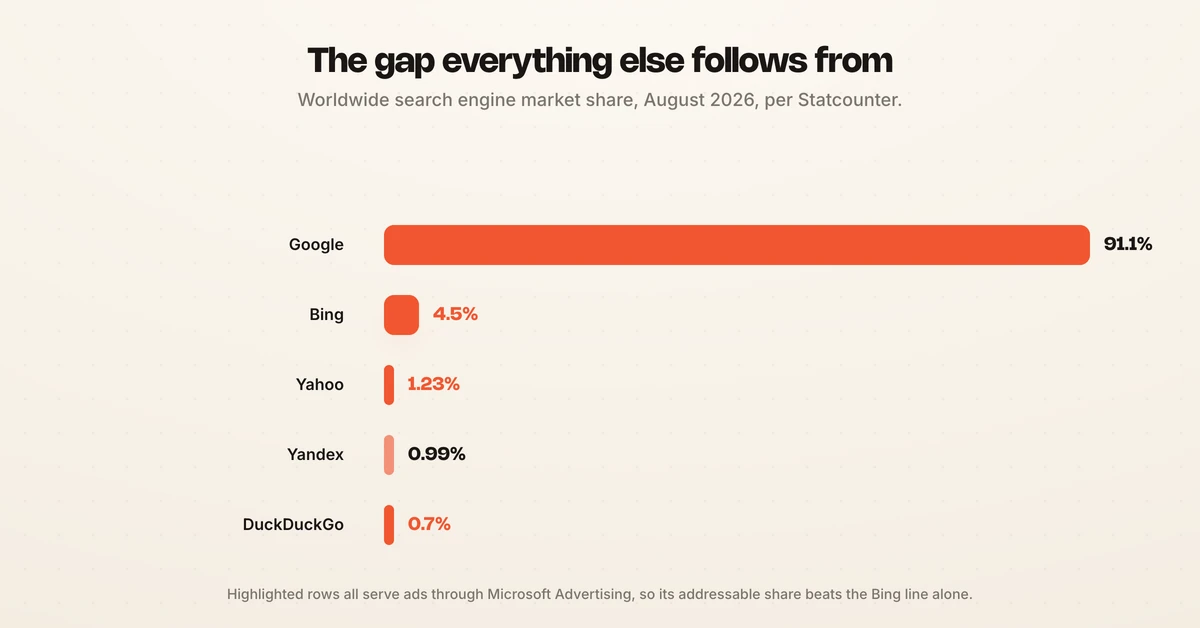
Microsoft Advertising reaches roughly a twentieth of Google's search volume, and that single ratio determines everything else in this comparison. Use a source that publishes a method rather than a vendor's own figure.
Statcounter puts worldwide search engine share in August 2026 at Google 91.1%, Bing 4.5%, Yahoo 1.23%, Yandex 0.99% and DuckDuckGo 0.7%.
Read that carefully, because two of those rows are also Microsoft inventory. Yahoo and DuckDuckGo both serve ads through Microsoft Advertising, so the addressable share is meaningfully larger than the Bing line alone. It is still around a twentieth of Google's.
Three consequences follow, and they are the ones advertisers get wrong:
- Microsoft cannot replace Google. At that share, moving your budget across would starve your volume. It is an addition, not a substitution.
- Your absolute volume will look disappointing. A campaign delivering 10,000 clicks a month on Google may deliver a few hundred on Microsoft. That is the expected result, not a setup failure.
- Efficiency is the metric, not scale. Judge Microsoft on CPA and conversion rate against your target, never on click volume against Google.
Share also varies sharply by market and by segment. Microsoft's share is higher in the US than worldwide, higher on desktop than mobile, and higher in some B2B and older demographics. Your own account data beats every published average.
Are Bing Ads cheaper than Google Ads?
Usually, and for a structural reason rather than a discount.
Cost per click is set by auction pressure. Fewer advertisers bid on Microsoft, so the auction for the same keyword tends to clear lower. That is the whole mechanism, and it means the size of the gap is entirely specific to your keywords: hotly contested commercial terms show the biggest difference, long-tail terms often show almost none.
Be careful with the cheaper-CPC claim in either direction. A lower CPC is only good news if the traffic converts at a comparable rate, and what counts as a good CPC varies enormously by category. The number that decides the question is cost per acquisition, and the only reliable source for it is 30 days of your own spend. Any published average, including the ones in competing articles, is describing somebody else's keywords.
One cost note that is frequently missed: lower CPCs with lower volume can still mean a higher cost per acquisition, if your conversion rate on the smaller platform is weaker. Check the full funnel before concluding Microsoft is cheaper for you. Google Ads benchmarks gives you the baseline to compare against.
Where Microsoft Advertising genuinely wins
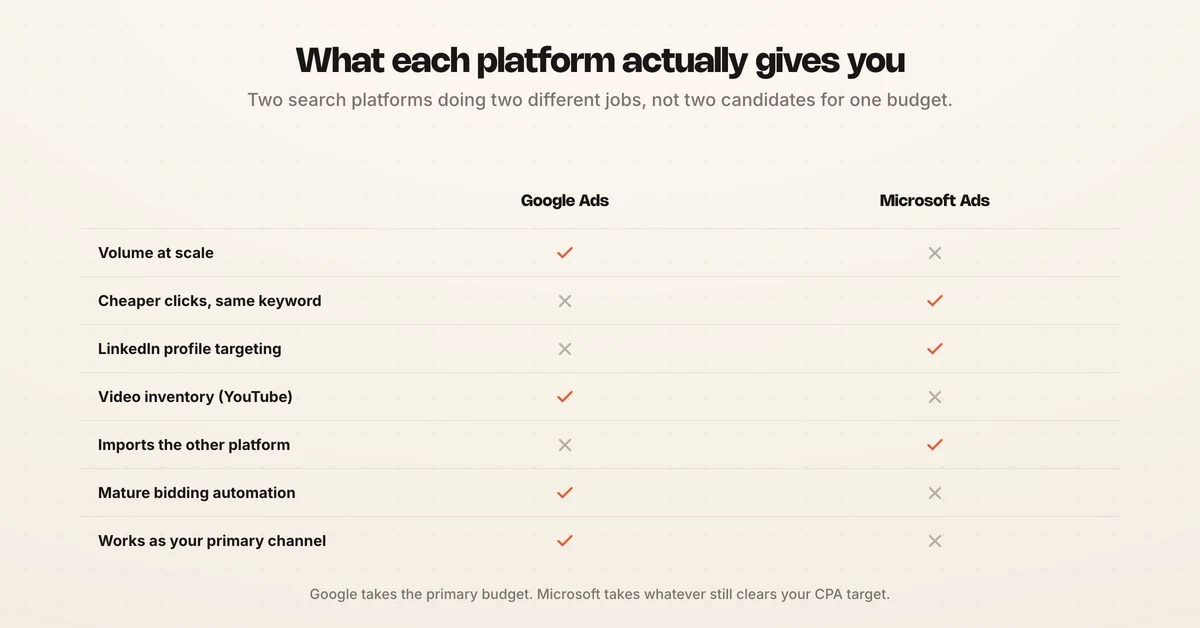
Microsoft Advertising beats Google Ads on four counts: LinkedIn profile targeting, lighter auction competition, audience composition, and an import tool that makes testing it nearly free.
LinkedIn profile targeting. This is the one Google cannot match. Microsoft Advertising is the only platform other than LinkedIn itself that lets you target by LinkedIn profile data: company, industry and job function. It works on Search, Dynamic Search, Shopping, Audience and Performance Max campaigns, with a limit of 1,000 companies per ad group or campaign. For B2B advertisers this single feature justifies testing the platform.
Less auction competition. Lower CPCs, and often an easier path to the top of the page on terms where Google's first page is unaffordable.
Audience composition. Microsoft's search audience skews older, more desktop, and in many markets higher income than Google's. That suits some categories, particularly B2B, finance, and considered purchases, and suits others poorly.
Import from Google Ads. Microsoft ships import tools that copy your Google campaigns across, and imports can be scheduled to repeat daily so changes stay in sync. The setup cost of testing Microsoft is genuinely close to zero, which is the strongest argument in this article.
Where Google wins
Being fair about the other side matters, because the reasons Google dominates are not only inertia.
Volume, by a factor of twenty. If you need scale, there is no substitute.
Auction data and automation maturity. More queries mean smart bidding has more signal to learn from, and Google's automated bidding generally reaches stable performance faster.
Product depth. YouTube, Performance Max, Demand Gen and a far larger display network sit inside one account.
Ecosystem and talent. More integrations, more documentation, and more people who already know the platform.
None of that is an argument against also running Microsoft. It is an argument against treating Microsoft as a replacement.
Side by side
| Google Ads | Microsoft Advertising | |
|---|---|---|
| Search share (Aug 2026) | 91.1% | 4.5% Bing, plus Yahoo and DuckDuckGo inventory |
| Typical CPC | Higher | Usually lower on the same keyword |
| Auction competition | Heavy | Lighter |
| LinkedIn profile targeting | No | Yes, company, industry, job function |
| Video | YouTube | No equivalent |
| Native and display | Google Display Network | Microsoft Audience Network |
| Import from the other platform | No | Yes, schedulable |
| Automation maturity | More signal, faster learning | Less signal, slower learning |
| Best treated as | The primary search channel | An efficiency add-on |
Targeting and audience: what actually differs
Google Ads and Microsoft Advertising offer nearly identical targeting toolkits, and only three differences are real. Strip out the marketing and the surfaces are more alike than either vendor implies. Keywords, match types, negative keywords, location, device, schedule, in-market and remarketing audiences all exist on both, and a campaign imported from Google will find its equivalent for nearly everything.
Three differences are real.
LinkedIn profile data, Microsoft only. Covered above, and it is the single targeting capability with no Google equivalent.
Device and demographic granularity. Microsoft has historically allowed tighter device-level bid control than Google's more automated approach. If you have evidence that desktop converts very differently from mobile for you, that control is worth something.
Audience composition. Microsoft's search audience tends to skew older and more desktop-weighted than Google's, and in several markets more affluent, which is why B2B, finance and considered purchases often perform disproportionately well there. Treat that as a tendency rather than a fact about your account. Category and country move it more than the platform does, and 30 days of your own conversion data settles it better than any published demographic profile.
The practical read: do not expect a different targeting toolkit. Expect the same toolkit pointed at a smaller, differently composed pool, plus one B2B capability Google does not offer.
Ad formats: what transfers and what does not
Most Google Ads formats import into Microsoft Advertising cleanly, but YouTube and Demand Gen have no equivalent and broad match needs rebuilding. This decides how much of the import you can actually keep.
Transfers cleanly. Responsive search ads, keywords and match types, negative lists, sitelinks and most extensions, shopping campaigns, and audience or remarketing lists. Microsoft also runs Performance Max, so those campaigns have a counterpart rather than being dropped.
Has no real equivalent. YouTube, and anything built on it. Demand Gen has no direct counterpart either. Google's display network is substantially larger than the Microsoft Audience Network, so display campaigns import but deliver far less.
Needs rebuilding rather than importing. Anything whose performance depended on Google-scale volume. Broad match with smart bidding is the clearest example: it works on Google because the auction supplies enough signal to learn from, and on a platform with a twentieth of the queries it mostly finds expensive irrelevance. Tighten match types after importing.
That last point is the most common reason a Microsoft test fails for reasons that have nothing to do with Microsoft.
The answer most comparisons skip: run both
Google Ads and Microsoft Advertising are not competing for the same budget, so for most advertisers the right answer is to run both rather than choose. Framing it as a choice only makes sense if the two platforms competed under the same constraints, and they do not.
Google is where the demand is, so it takes the primary budget. Microsoft is a smaller pool of the same intent at a lower clearing price, and it takes whatever budget still hits your CPA target. Those are different jobs, and the second one is a test with a bounded downside rather than a strategic bet.
The case for skipping Microsoft entirely is narrow, and it is about attention rather than economics. If nobody on the team can monitor a second platform, a neglected account that quietly spends on broad match is worse than no account. Capacity is the real constraint, not the platform.
The case for testing it is much wider. Your campaigns already exist, the import copies them, and 30 days of capped spend answers the question with your own data instead of somebody's benchmark.
How to test Microsoft Advertising in an afternoon
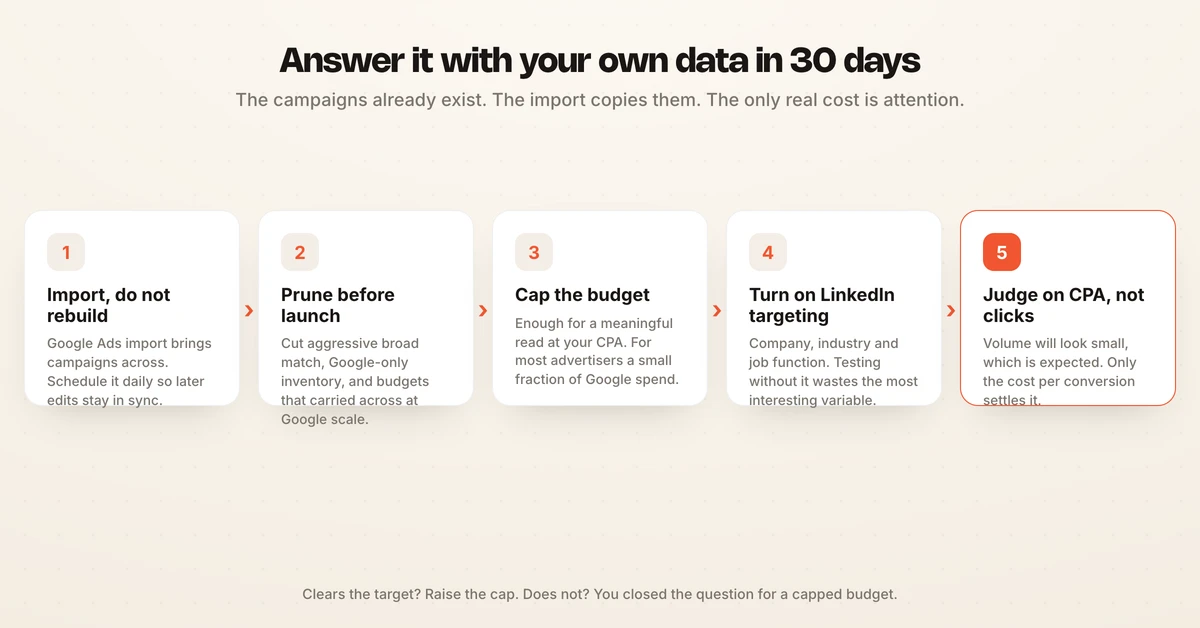
Testing Microsoft Advertising takes five steps and 30 days of capped spend, and the sequence matters more than the speed.
- Import, do not rebuild. Use the Google Ads import to bring campaigns across, then schedule it to repeat so edits stay in sync. Rebuilding by hand is the most common reason this test never happens.
- Prune before you launch. Import brings everything, including Google-specific settings that make no sense on a smaller platform. Cut aggressive broad match, drop campaigns whose volume depends on Google-only inventory, and check that budgets did not carry across at Google scale.
- Set the budget by what you can afford to learn. Enough for a statistically meaningful read at your CPA, not a mirror of your Google budget. For most advertisers that is a small fraction of Google spend.
- Turn on LinkedIn profile targeting if you sell to businesses. This is the capability that does not exist on Google, so testing Microsoft without it wastes the most interesting variable.
- Judge it after 30 days on CPA, not clicks. Volume will look small and that is expected. The question is only whether the conversions cost less than your target.
If it clears the target, keep it and raise the cap. If it does not, you spent a capped budget to close the question permanently, which is worth more than continuing to wonder.
Running two search platforms without doubling the work
The practical cost of this recommendation is not budget, it is attention. A second search platform means a second set of dashboards, a second place where creative fatigues, and a second account that keeps spending when nobody is looking.
Worth being precise about where tooling helps here. Hawky operates Meta, Google, YouTube, TikTok and LinkedIn, and Microsoft Advertising is not one of the channels its agents buy on. What the Performance Agent does is take the Google side off your plate, reallocating and pausing against the KPI you set, so the attention you free up is available for the smaller account that actually needs a human watching it. Hawky reports an average 25% ROAS uplift within 90 days on accounts it operates.
If you would rather keep both in-house, the best PPC tools covers the reporting and automation layer for multi-platform search.
Frequently asked questions
Is Bing worth advertising on?
For most advertisers already running Google Ads, yes, as an addition rather than a replacement. The import tools copy your existing campaigns across, so the setup cost is close to zero, and the lighter auction usually produces cheaper clicks. Volume will be a small fraction of Google's, so judge it on cost per acquisition over 30 days rather than click count. It is least worth it if nobody on the team has capacity to monitor a second account.
Are Bing Ads cheaper than Google Ads?
Usually, because fewer advertisers compete in the auction, so the same keyword tends to clear at a lower price. The size of the gap depends entirely on your keywords: contested commercial terms show the biggest difference and long-tail terms often show almost none. A lower cost per click only matters if the traffic converts, so compare cost per acquisition rather than CPC, using 30 days of your own data.
Why would anyone use Bing over Google?
Few advertisers use Microsoft instead of Google, and that is rarely the right framing. They add it for three reasons: cheaper clicks in a lighter auction, an audience that skews older, more desktop and in many markets higher income, and LinkedIn profile targeting, which lets you target by company, industry and job function and is not available on Google. For B2B advertisers the third reason is usually the decisive one.
What is the difference between Bing Ads and Microsoft Advertising?
They are the same product. Bing Ads was renamed Microsoft Advertising in 2019, and the new name is more accurate because ads run well beyond Bing. The network includes Yahoo, DuckDuckGo, Ecosia, AOL, Windows search and Microsoft Copilot, plus the Microsoft Audience Network for native placements on MSN and Outlook.com. People still search for the old name, which is why both appear together in most guides.
How much smaller is Bing than Google?
Statcounter put worldwide search engine share in August 2026 at 91.1% for Google and 4.5% for Bing, with Yahoo at 1.23% and DuckDuckGo at 0.7%. Because Yahoo and DuckDuckGo also serve ads through Microsoft Advertising, the addressable share is larger than the Bing figure alone, though still roughly a twentieth of Google's. Microsoft's share runs higher in the US, on desktop, and in some B2B segments.
Can I copy my Google Ads campaigns into Microsoft Advertising?
Yes. Microsoft provides import tools that bring campaigns, ad groups, keywords and ads across from Google Ads, and imports can be scheduled to repeat daily so later Google edits stay in sync. Prune after importing rather than launching as-is, because Google-specific settings, aggressive broad match and Google-scale budgets all come across and rarely suit a smaller platform.
The comparison people ask for is which platform to pick. The one worth making is whether a second search account earns its keep at your CPA, and that is answered with 30 days of capped spend rather than an article. If the work of watching the primary account is what stops you running the test, Hawky's Performance Agent is built for that job.
Ready to hire your first AI performance team? Book Demo