A good Facebook ad creative wins the first three seconds with a strong hook, is designed mobile-first and sound-off, follows a clear problem-solution narrative, and ends on a specific call to action. The hook matters most, because a weak angle is rarely saved by better button text, while a strong hook can carry average design. Everything else supports that opening.
Creative is the single biggest lever on Facebook ad performance, and most ads fail in the first three seconds. This guide covers the creative best practices that convert in 2026, from the hook to the format to the testing rhythm that keeps winners coming.
What makes a good Facebook ad creative?
A good Facebook ad creative shares three traits: a strong hook in the first two to three seconds, a clear problem-solution narrative, and a specific call to action. Miss the hook and nothing downstream matters, because the viewer has already scrolled past. Nail it, and the rest of the ad gets a chance to work.
The context that shapes everything is the feed. Facebook is a fast-scrolling, mobile-first, sound-off environment, so creative that assumes a seated viewer with sound on will lose. The best ads are built for how people actually watch: thumb moving, sound off, attention measured in seconds.
The through-line of 2026 best practice is native feel over polish. Ads that look like organic content outperform highly produced ones in most feed environments, because they earn attention instead of announcing themselves as ads. Design for the feed, not for a brand deck.
Best practice 1: Win the first three seconds
The hook is the first three seconds of your ad, and it decides the ad's fate by interrupting the scroll. Build it around one of three psychological triggers, per AdStellar:
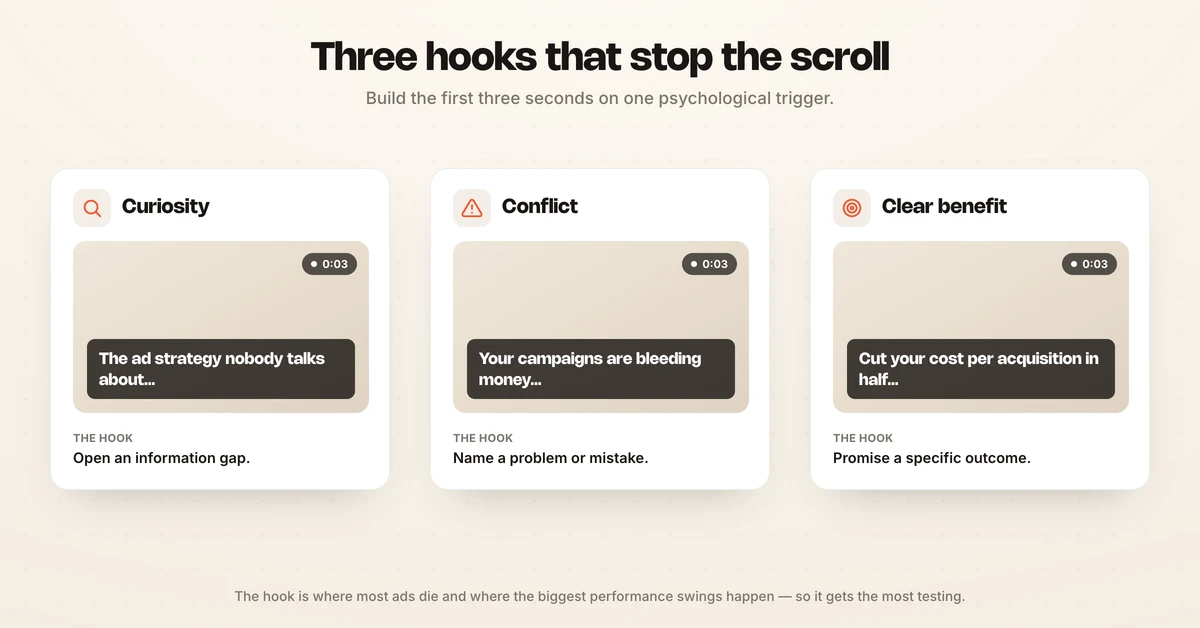
- Curiosity: open an information gap ("The ad strategy nobody talks about...").
- Conflict: name a problem or mistake ("Your campaigns are bleeding money because of this...").
- Clear benefit: promise a specific outcome ("Cut your cost per acquisition in half...").
Use a surprising visual, bold on-screen text, or a provocative question to make the hook land in the first second, not the fifth. The hook is where most ads die and where the biggest performance swings happen, so it deserves the most attention and the most testing. A striking hook on average design beats polished design with a weak opening.
Best practice 2: Design mobile-first and sound-off
Most people watch Facebook ads on mobile with the sound off, so your creative must convey its message visually. Burn in captions using large, high-contrast fonts so the ad works silently, because an ad that needs sound to make sense loses most of its audience.
Design for the screen real estate. Use a 9:16 aspect ratio for Reels and Stories and 4:5 for the feed to fill the screen and feel native, rather than a square or landscape crop that wastes space. Vertical, full-screen creative simply commands more attention on a phone.
The principle is to assume the hardest viewing conditions and design for them. If your ad works on mute, at a glance, on a small screen, it will work everywhere. For the metrics that confirm it is landing, see how to measure ad creative performance.
Best practice 3: Match the creative to the placement
An ad that wins in Reels can lose in Feed, because pacing, framing, and text treatment work differently on each surface. Reels reward fast, native, full-screen video that mirrors organic content; Feed tolerates a wider range and more text. Treating them as one placement leaves performance on the table.
Tailor the hook, pacing, and style to each surface rather than reusing one asset everywhere. A Reels ad needs a punchy, vertical, organic-feeling opening; a Feed ad can carry a slightly more considered layout. Match the user's expectation for the surface they are on.
This is why creative volume matters: winning across placements means producing variations, not stretching one asset. The teams that ship placement-specific creative consistently outperform those that upload one file to all placements.
Best practice 4: Lead with UGC-style creative
UGC-style video is the dominant Facebook creative format in 2026, and the key word is style. It is not always actual user-generated content; it is brand content designed to look authentic and low-production, because that look outperforms polished ads in the feed, per Adligator.
The reason is trust and native feel. A talking-head testimonial, a phone-shot demonstration, or a creator-style unboxing reads as a recommendation rather than an advertisement, which lowers the viewer's guard. Authentic-feeling creative earns the stop that polished production often does not.
Use UGC-style as your workhorse format, then support it with the occasional polished asset for brand moments. For a deeper look at the format, see the UGC ads guide.
Best practice 5: Structure the ad and end with a specific CTA
High-converting Facebook creative follows a clear narrative: hook, problem, solution, proof, and a specific call to action. The structure carries the viewer from attention to action without a gap, which is what turns a watched ad into a click.
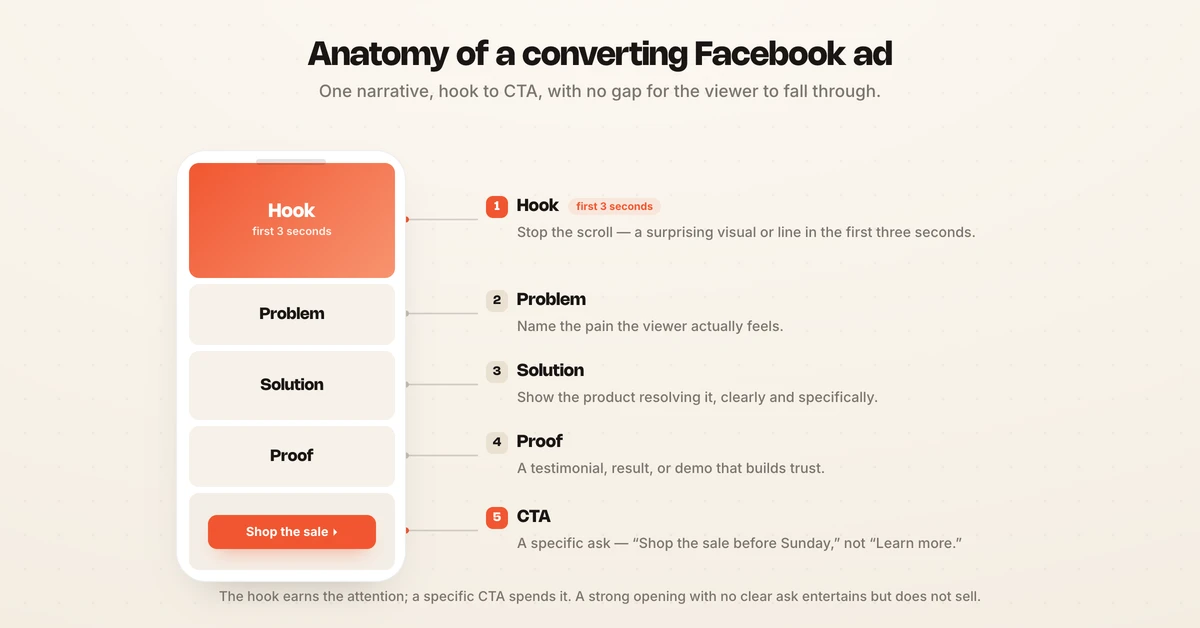
Make the call to action specific, not generic. "Shop the sale before Sunday" beats "Learn more" because it tells the viewer exactly what to do and why now. A vague CTA wastes the attention the hook earned. Match the ask to the funnel stage: softer for cold audiences, direct for warm ones.
The narrative and CTA are where a good hook converts into a result. A strong opening with no clear ask entertains but does not sell, so every creative needs both the stop and the direction.
Best practice 6: Test the hook first and iterate
Creative is won through testing, and the hook is what to test first. The first line, headline, and opening visual drive the biggest performance swings, so a weak angle rarely gets fixed by better button text. Test three to five distinct hooks before optimizing anything downstream.
Balance your testing roughly 70 to 80% iteration on proven patterns and 20 to 30% exploration of new hooks, offers, and treatments, per Sovran. Iteration compounds your winners; exploration finds the next breakout. Too much exploration wastes budget, too little lets winners fatigue.
The bottleneck is production: winning on Facebook means shipping a steady stream of fresh creative. Hawky's Creative Agent generates on-brand variations from your winners so the testing pipeline never stalls, and AI Creative Generation produces placement-ready formats from a single winning concept. For the testing method, see how to test Facebook ad creatives.
Common Facebook ad creative mistakes
Most Facebook creative underperforms for the same reasons. Avoid these:
- A slow hook. Burying the point past three seconds loses the viewer. Lead with the strongest moment.
- Designing for sound-on. If the ad needs audio to make sense, most people miss it. Caption everything.
- One asset for all placements. Reels and Feed need different creative. Tailor to each surface.
- Over-produced ads. Polished creative often reads as an ad and gets skipped. Lead with UGC-style.
- A generic CTA. "Learn more" wastes attention. Tell the viewer exactly what to do and why now.
Frequently asked questions
What makes a good Facebook ad creative?
A good Facebook ad creative wins the first three seconds with a strong hook, is designed mobile-first and sound-off with burn-in captions, follows a clear problem-solution narrative, and ends on a specific call to action. It feels native to the feed, usually in a UGC style rather than polished production. The hook matters most, because a weak opening is rarely saved by better design or button text.
What are Facebook ad creative best practices?
The core best practices are: lead with a strong hook built on curiosity, conflict, or clear benefit; design mobile-first and sound-off with captions in a 4:5 or 9:16 ratio; match the creative to the placement, since Reels and Feed differ; use UGC-style creative that feels authentic; structure the ad from hook to specific CTA; and test the hook first, iterating 70 to 80% on winners and exploring 20 to 30%.
How do you design a Facebook ad that converts?
Design for the feed: assume a mobile viewer with sound off, so caption everything and use vertical or 4:5 full-screen creative. Open with a hook in the first three seconds using a surprising visual or provocative line, then carry a clear problem-solution narrative to a specific call to action. Make it feel native with a UGC style rather than polished production, and test the hook first since it drives the biggest swings.
What is the best Facebook ad format in 2026?
UGC-style video is the dominant and best-performing Facebook ad format in 2026, because authentic, low-production creative outperforms polished ads in the feed. Vertical video for Reels and Stories (9:16) and 4:5 video for the feed maximize screen space and native feel. Static images and carousels still work for certain products, but the workhorse format for most brands is UGC-style video tailored to each placement.
How important is the hook in a Facebook ad?
The hook is the single most important part of a Facebook ad, because the first three seconds decide whether the viewer keeps watching or scrolls past. A weak hook is rarely fixed by better design, targeting, or button text, while a strong hook can carry average creative. That is why the hook should get the most attention in design and be the first thing you test, using curiosity, conflict, or clear benefit.
If shipping enough fresh, placement-ready Facebook creative to keep testing is the problem, Hawky's Creative Agent and AI Creative Generation are built for that job.
Ready to hire your first AI performance team? Book Demo