UGC ads are paid advertisements that use authentic, creator-style content, a real person filming with their phone and talking about a product, so the ad looks like an organic social post rather than a commercial. They convert at 3 to 6% versus 1 to 3% for polished brand ads and generate two to four times the engagement, because people trust people more than branded messaging. You can make them through creators, UGC platforms, or AI generation.
UGC is the dominant ad creative format in 2026, and for good reason: it blends into the feed and earns trust that polished production cannot. This guide covers what UGC ads are, why they work, the types, how to make them, and how to test them.
What are UGC ads?
UGC ads are paid ads whose creative is user-generated content, or content produced in that style, rather than studio-polished brand assets. The classic example is a person holding your product and talking straight to camera in natural lighting, filmed on a phone. The whole point is that it looks like something a real user posted, not an ad.
The key word is style. Some UGC is genuinely made by customers, but most "UGC ads" are brand-commissioned content designed to look authentic, produced by creators who specialize in the format. What matters for performance is the native, unpolished feel, not who technically pressed record.
This is why UGC has taken over paid social. As feeds fill with authentic-looking content, ads that match that texture blend in and get watched, while ads that look like commercials get skipped. UGC is the format that survives the scroll.
Why UGC ads perform better
UGC ads outperform polished brand creative on nearly every metric, and the gap is large. They convert at 3 to 6% against 1 to 3% for produced ads, generate two to four times the engagement, and often earn lower CPCs thanks to higher relevance scores, per HighReach. Better relevance means cheaper delivery, so UGC wins on both conversion and cost.
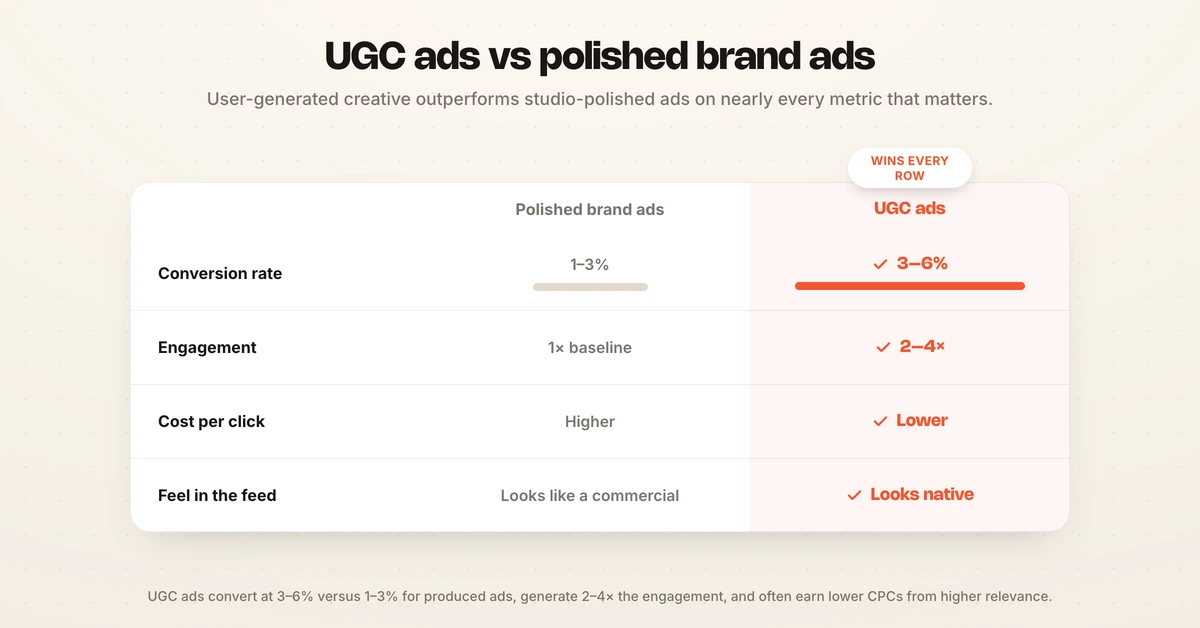
The reasons are psychology and platform mechanics. A real person recommending a product carries more weight than a branded graphic, because people trust people over polished messaging and real reactions feel more credible than scripted commercials. Trust lowers the viewer's guard in the first seconds.
The mechanics reinforce the psychology. UGC looks native to the platform, so it blends with the organic content users are already engaging with, which protects watch time and earns the algorithm's favor. Native feel plus trust is a combination polished ads struggle to match.
Types of UGC ads
UGC is a style, not a single format, and several proven types work across products. Match the type to what you are selling and the objection you need to overcome.
| Type | What it does |
|---|---|
| Testimonial | A creator shares a genuine before-and-after or result |
| Unboxing | The first-impression reveal of receiving the product |
| Tutorial / how-to | A creator demonstrates using the product |
| Problem-solution | Opens on a relatable problem the product solves |
| Review / reaction | An authentic, candid reaction to trying the product |
| Day-in-the-life | The product woven naturally into a routine |
Testimonials and problem-solution ads are the workhorses, because they combine proof with a clear reason to buy. Start with the type that best answers your audience's biggest hesitation, then expand into others as you learn what resonates.
How to make UGC ads
There are three ways to produce UGC ads, and most brands use a mix depending on speed and budget.
- Source creators directly: nano influencers (1,000 to 10,000 followers) typically charge $100 to $500 per video, offering authenticity at a low cost.
- Use a UGC platform: marketplaces like Billo connect you to creators with videos starting around $150 to $300, standardizing the process. The UGC sourcing platforms comparison has dated prices for ten of them.
- Generate with AI: AI UGC tools combine the authentic feel of user content with the speed of automation, producing ads in hours instead of weeks, per Cometly.
Each approach trades off authenticity, cost, and speed. Real creators bring the most credibility but take longest; AI generation delivers volume fastest. Many teams source a few genuine creator videos for their hero ads and use AI to produce the variations for testing, which is where a creative engine like Hawky's Creative Agent fits. The best AI ad creative tools guide compares the AI UGC video makers with dated prices.
The UGC ad structure that converts
High-converting UGC ads follow a consistent structure, with each segment doing a specific job. A common sequence maps to the seconds of a short video, per UGCFast.
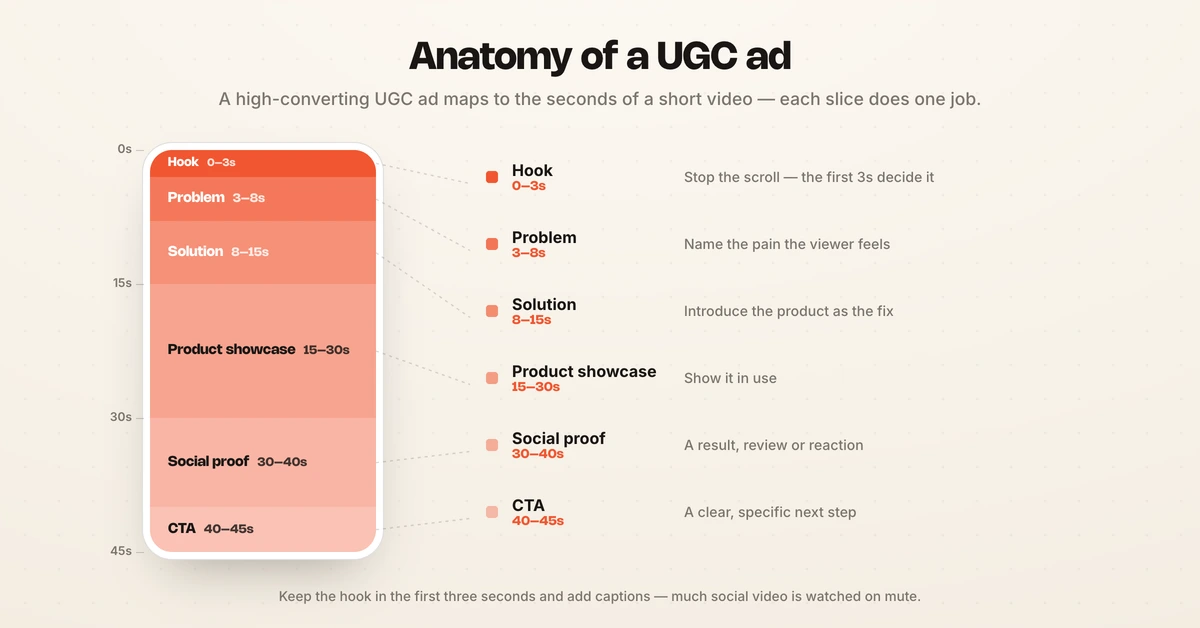
- Hook (0 to 3s): stop the scroll with a relatable line or visual.
- Problem (3 to 8s): name the pain the viewer feels.
- Solution (8 to 15s): introduce the product as the fix.
- Product showcase (15 to 30s): show it in use.
- Social proof (30 to 40s): a result, review, or genuine reaction.
- CTA (40 to 45s): a clear, specific next step.
Add captions to every UGC ad, since a large share of social video is watched on mute and captions drive both comprehension and conversion. Keep the hook in the first three seconds, because a UGC ad that opens slowly loses the native advantage it is built on. For more on the opening, see Facebook ad creative best practices.
Where UGC ads perform best and how to test them
UGC ads perform best on short-form video placements: TikTok, Instagram Reels, Facebook, and YouTube Shorts. Short-form video UGC is the highest-performing ad creative format in 2026, because those feeds are built for exactly the authentic, vertical content UGC provides. Design UGC vertical and native to the platform it runs on.
Test in volume. Start with five to ten creative variations per product angle, then expand the winners, because UGC fatigues like any creative and volume is how you find breakout performers. Vary the hook, the creator, and the angle rather than making ten near-identical clips.
Production volume is the constant bottleneck, since sourcing and editing enough UGC to test is slow and expensive. Hawky's Creative Agent generates on-brand, UGC-style variations from your winning concepts, so the testing pipeline stays full without waiting weeks for new creator footage. For the testing method, see the ad creative testing framework.
Frequently asked questions
What are UGC ads?
UGC ads are paid advertisements that use user-generated content, or content made in that style, as the creative, so the ad looks like an authentic organic post rather than a commercial. The classic format is a real person filming on their phone in natural lighting, talking about a product. Most UGC ads are brand-commissioned content produced by creators to look authentic, since the native, unpolished feel is what drives performance.
How do you make UGC ads?
Make UGC ads in one of three ways: source creators directly (nano influencers charge roughly $100 to $500 per video), use a UGC platform like Billo (videos from around $150 to $300), or generate them with AI tools that produce UGC-style content in hours. Then structure each ad from a hook in the first three seconds through problem, solution, product showcase, social proof, and a clear CTA, and add captions since much social video is watched on mute.
Why do UGC ads perform well?
UGC ads perform well because they build trust and feel native. A real person recommending a product carries more weight than a branded graphic, and the unpolished style blends into feeds full of organic content, so viewers watch instead of skipping. The results show it: UGC ads convert at 3 to 6% versus 1 to 3% for polished ads, generate two to four times the engagement, and often earn lower CPCs from higher relevance.
How much do UGC ads cost?
UGC ad production costs vary by method. Nano influencers typically charge $100 to $500 per video, UGC platforms like Billo start around $150 to $300 per video, and AI UGC generation can produce content for less at higher volume. On top of production, you pay for the media to run the ads. The cost efficiency of UGC comes from its higher conversion and lower CPCs, which usually more than offset the production spend.
What is the best format for UGC ads?
Short-form vertical video is the best format for UGC ads, running on TikTok, Instagram Reels, Facebook, and YouTube Shorts. These placements are built for authentic, phone-shot content, so UGC blends in and performs. Design vertical (9:16) with the hook in the first three seconds, captions for mute viewing, and a native, conversational tone rather than a polished commercial look.
If producing enough UGC-style creative to test at volume without waiting weeks for footage is the problem, Hawky's Creative Agent is built for that job.
Ready to hire your first AI performance team? Book Demo