AI Ad Generation
Last updated
AI ad generation is the use of artificial intelligence to produce ad creative (images, video, headlines, copy) from prompts, brand inputs, and performance data. It collapses the cost between an idea and a testable ad, so accounts test far more and fatigue slower.
AI Ad Generation
AI ad generation is the use of artificial intelligence to produce ad creative, such as images, video, headlines, and copy, from prompts, brand inputs, and performance data rather than building each asset by hand. It collapses the time and cost between a creative idea and a testable ad. Teams that use it well ship far more variations and learn faster, while teams that rely on manual production stay bottlenecked at a few assets per cycle.
Why It Matters
AI ad generation removes the single biggest constraint in modern paid media: creative volume. Because creative drives roughly 56% of campaign performance according to Nielsen and Meta, the bottleneck on creative production is a bottleneck on results. A team that can only make three ads a week can only test three ideas a week, no matter how much budget or targeting sophistication sits behind them.
The economics shift sharply when generation is automated. Producing a video ad traditionally takes days and real budget, which is why most accounts under-test and over-rely on a few hero assets that then fatigue. AI generation pushes the cost per variation toward near zero, so an account can feed its creative testing framework properly and sustain a healthy creative refresh rate instead of rationing creative. The strategic point is not that AI replaces creative judgment. It is that abundant, on-brand variations let the account test more hypotheses, fatigue slower, and pour the saved time into strategy rather than asset assembly.
How It Works
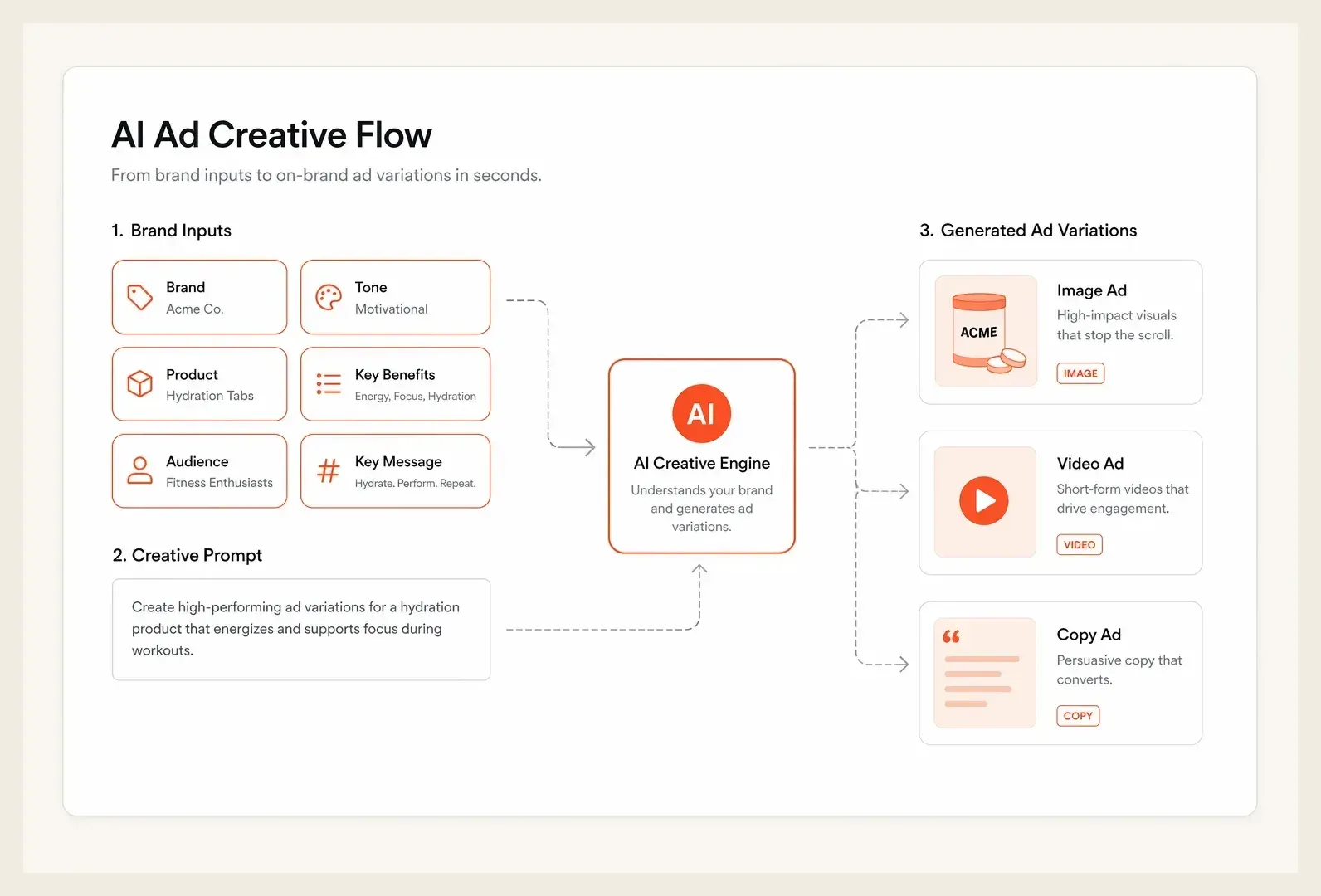
AI ad generation works best when it is grounded in brand assets and past performance, not a cold prompt. The quality of the output tracks the quality of the inputs: brand guidelines, proven hooks, and real performance data steer the model toward variations worth testing.
- Feed it brand inputs. Logos, fonts, colors, and tone keep generated assets on-brand and usable without heavy editing.
- Ground it in winners. Past high-performing hooks, formats, and angles tell the model what already resonates in your account.
- Generate across formats. Modern systems produce static images, short video, headlines, and copy, covering the full set of placements.
- Keep a human in the loop on strategy. AI handles volume and execution; people steer offer, positioning, and which directions to explore.
A Real Example
A subscription fitness app could produce about four new video ads per month through a freelance editor, at roughly $600 each and a one-week turnaround. With so few assets, the team rotated the same creative until it fatigued, and CPA drifted from $24 at launch to $52 by the back half of each month as frequency climbed.
The team adopted AI ad generation, feeding the system its brand kit and its three best-performing hooks. It produced 30 on-brand variations in a single afternoon at a fraction of the prior cost. Testing that volume surfaced two new winning hooks the team would never have had the budget to try manually, and rotating fresh creative held CPA near $26 across the full month while frequency stayed under 3.5. Production cost fell, test velocity rose roughly sevenfold, and the saved editor budget went into media. The creative direction still came from the team. The volume came from AI.
Common Mistakes
| ❌ Mistake | ✅ Better Approach |
|---|---|
| Prompting from scratch with no brand or performance inputs | Ground generation in brand assets and proven winning hooks from your account |
| Shipping raw AI output without review | Keep a human in the loop on offer, positioning, and which variations to run |
| Generating volume but never testing it systematically | Feed the variations into a real testing framework so the winners actually surface |
How Hawky Helps
Hawky's Creative Agent generates ad creative grounded in your brand and your account's history, not blank prompts. It reads the hooks, formats, and angles that already performed and renders fresh, on-brand ad creative variations at the volume testing and refresh actually need, so the bottleneck moves from production capacity to strategy. Generation is the start of the loop, not the whole of it.
The Performance Agent reads which generated assets win and routes that signal back, so the next batch leans into what is working rather than repeating the same prompts. Everything proven is written to FeatherDB, so each generation cycle is smarter than the last instead of starting from zero. Hawky generates, tests, and acts on the creative as a connected operation; it does not just hand you a pile of AI images.
Frequently Asked Questions
What is AI ad generation?
AI ad generation is the use of artificial intelligence to produce ad creative, including images, video, headlines, and copy, from prompts, brand inputs, and performance data rather than building each asset manually. It dramatically lowers the time and cost of producing testable ads, which lets accounts run far more variations. The strongest results come when generation is grounded in brand assets and proven hooks rather than cold prompts.
Can AI generate ads that actually perform?
Yes, when the generation is grounded in real brand assets and past winning creative rather than generic prompts. AI excels at producing on-brand volume, which lets a testing program surface winners that a low-volume manual workflow would never reach. Human judgment still steers the offer, positioning, and creative direction, so the best results come from AI volume plus human strategy.
Does AI ad generation replace creative teams?
No. AI ad generation replaces the manual labor of assembling many variations, not the strategic work of deciding the offer, positioning, and creative direction. It frees creative teams from production bottlenecks so they can focus on hypotheses and brand, while the system handles execution at volume. The most effective setups keep a human in the loop on strategy.
How does AI ad generation reduce creative costs?
AI ad generation reduces creative costs by pushing the marginal cost of an additional variation toward near zero, replacing day-long production cycles and per-asset fees with near-instant output. That lets accounts test broadly without rationing creative and stop over-relying on a few expensive hero ads that fatigue. The saved production budget typically shifts into media or strategy.
Quick Takeaway
AI ad generation removes the creative volume bottleneck by producing on-brand images, video, and copy at near-zero marginal cost, which lets an account test more and fatigue slower. Ground it in brand assets and proven winners, and keep human judgment on strategy.
Manual production caps you at a few ads a cycle while your competitors test dozens. Ready to hire your first AI performance team? Book Demo