Black Friday Facebook Ads: The Timeline, Creative and Budget That Work
Black Friday Facebook ads work on a different calendar to the rest of the year: audiences are built in October, creative is tested in early November, and the discount campaign itself runs on pre-warmed audiences at CPMs that typically run well above baseline. The teams that win the week decided what to say six weeks earlier.
The mistake that costs the most is treating Black Friday as a campaign rather than a season. An account that switches on a discount offer in the third week of November is bidding against every competitor at the most expensive moment of the year, with cold audiences and untested creative.
This guide covers the timeline that actually works, why CPMs rise and what to do about it, the creative that performs in a discount-saturated feed, and how to avoid spending the whole budget on people who were going to buy anyway.
When to start Black Friday Facebook ads
Start six to eight weeks before Black Friday, because the expensive part of the week is acquisition and acquisition is cheaper in October.
| Window | What runs | Why then |
|---|---|---|
| 8 weeks out (early October) | Prospecting at normal CPMs, no discount | Build retargeting pools while inventory is cheap |
| 4 weeks out (late October) | Creative testing, teaser content | Find the winning hook before CPMs climb |
| 2 weeks out (mid November) | Early-access and waitlist offers | Capture intent before the noise peaks |
| Black Friday week | Full offer to warm audiences | Harvest, do not prospect |
| Cyber Monday to December | Last-chance, bundles, shipping cut-offs | Different urgency, same audience |
| Post-season | Retention, second purchase | The margin is here, not in the discount |
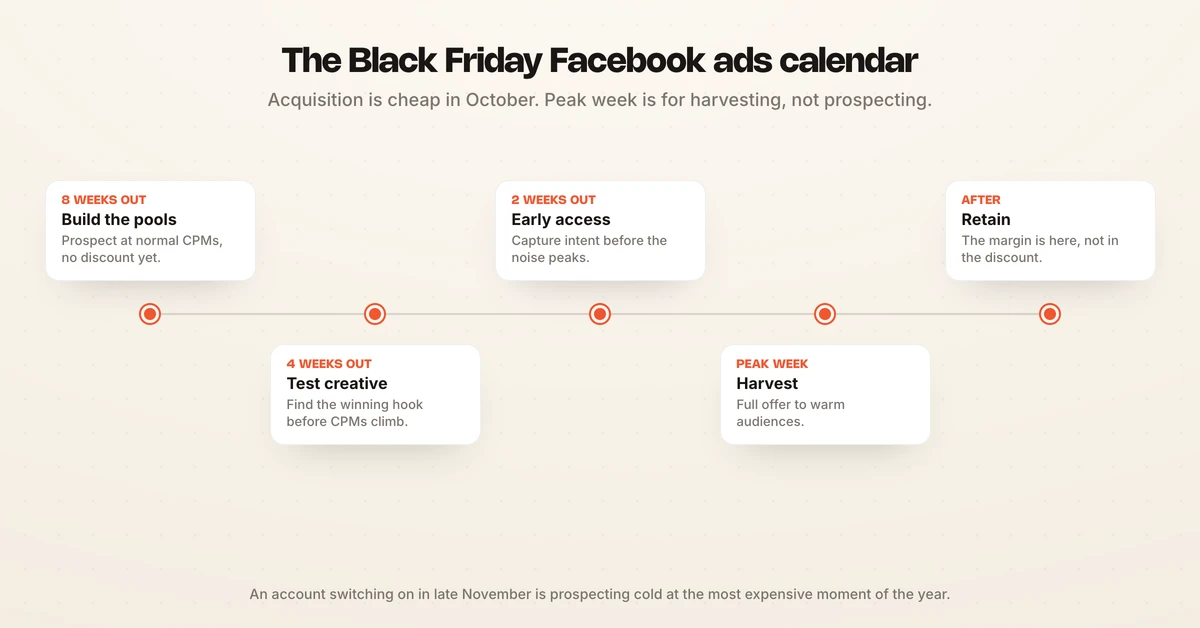
The logic behind the sequence is that a retargeting pool is an asset you buy in advance. Every visitor, video viewer and engager collected in October is someone you do not have to pay peak CPMs to reach in November.
Why Facebook ad costs rise for Black Friday
Costs rise because the auction is an auction: more advertisers bid for the same finite inventory in the same fortnight, and CPM is the price of that competition.
Three consequences follow, and each has a specific response.
- Your CPM goes up even if nothing in your account changed. This is not a setup failure. Budget for it rather than diagnosing it, and read it against Meta's own guidance on auction and delivery rather than assuming something broke.
- Your learning phase gets more expensive. A campaign entering learning during peak week burns costly impressions while it calibrates, which is the argument for testing creative in October.
- Weak creative gets punished harder. When inventory costs more, a mediocre click-through rate costs more per click than it did in September.
The strategic answer is not to outbid everyone. It is to arrive at peak week with warm audiences, proven creative and a campaign that is already out of learning, so the expensive impressions are the ones most likely to convert. Track your own baseline against the Facebook ads benchmarks rather than against a published average.
Black Friday Facebook ads creative that works in a saturated feed
The feed in Black Friday week is wall-to-wall percentages, which means the discount itself is not a differentiator and cannot carry the ad.
What separates ads that work:
- Lead with the product, not the percentage. Everyone has a percentage. The reason to want this specific thing is the scarce part.
- Make the offer legible in under a second. The number, the product and the deadline should be readable without sound and without reading the primary text.
- Use urgency that is true. A countdown that resets destroys trust and invites the kind of feedback that drags page quality down, and misleading urgency claims sit squarely inside Meta's advertising standards.
- Show the thing in use. Demonstration outperforms studio product shots when the viewer is comparing twelve similar offers.
- Burn the offer into the creative. Stories and Reels drop the headline entirely, per Meta's own placement specs, so an offer that lives only in a text field disappears on two placements. The anatomy of a Facebook ad covers which fields survive where.
The decision that moves the most is the first three seconds, because the scroll is faster and the competition is denser. Hook rate is the diagnostic worth watching daily through the season rather than weekly.
Campaign structure for Black Friday Facebook ads
Keep the structure simple, because peak week is the worst possible time to be debugging a complicated account.
| Campaign | Audience | Budget share | Offer |
|---|---|---|---|
| Prospecting | Broad, lookalikes | 30 to 40% | Product-led, discount secondary |
| Retargeting, high intent | Cart, checkout, product views 14 days | 30 to 40% | Full offer, urgency |
| Retargeting, low intent | Video viewers, engagers, site visitors 180 days | 15 to 25% | Offer plus reason to believe |
| Existing customers | Purchasers, email list | 10 to 15% | Early access, bundles |
Two structural rules matter more than the split. Consolidate rather than fragment, because splitting budget across many small ad sets starves each of the events it needs to exit learning. And separate prospecting from retargeting reporting, because a blended ROAS during Black Friday is dominated by people who were already going to buy.
That second point is where most Black Friday post-mortems go wrong. An account showing 8x blended ROAS in November is usually showing you a retargeting pool converting, not an acquisition engine working.
The incrementality problem nobody reports
Black Friday produces the most flattering numbers of the year, and the least incremental ones, because a large share of the revenue would have arrived without the ad.
Someone who already had the product in their cart, already follows the brand and already intended to buy on Friday will convert whether or not they are served a retargeting ad. That conversion still gets attributed to the ad, which inflates reported ROAS precisely when budgets are largest.
The clean way to know is a holdout: suppress ads to a defined share of your retargeting pool and compare conversion rates. Incrementality testing measures the lift the spend actually caused, and the guide to incrementality in marketing covers how to run one without disrupting the season.
If a holdout is not feasible during peak, the cheaper substitute is to read prospecting performance separately and judge the season on new-customer acquisition cost rather than blended return.
Getting through the week without being awake for it
Black Friday breaks the weekly optimisation rhythm, because a day is now what a week normally is. Budgets that would be reviewed on Monday need reviewing every few hours, creative fatigues inside 48 hours rather than a fortnight, and a winning ad set can exhaust its audience overnight.
Three things are worth pre-deciding, in writing, before the week starts:
- The kill rule. At what cost per acquisition does an ad set get paused, and who is allowed to pause it.
- The scale rule. What increment, how often. Doubling a budget mid-peak commonly resets learning at the worst moment.
- The fallback creative. What ships when the winner fatigues on Saturday morning.
The Command Center is where those rules live as a prioritised action queue rather than a shared doc nobody opens at 2am. Pre-deciding these is the difference between a team executing and a team improvising while tired. It is also the part of the season that suits automation: Hawky's Performance Agent operates against the KPI you set, reallocating and pausing inside guardrails you draw, with an audit trail and a rollback on every move, which is how the 2am budget decision gets made without anyone being awake for it.
Frequently asked questions
When should I start running Black Friday Facebook ads?
Start six to eight weeks out, in early to mid October. The purpose of the early window is not selling, it is building retargeting pools at normal CPMs and testing creative before auction prices climb. Accounts that switch on in the third week of November are prospecting cold audiences with untested creative at the most expensive moment of the year.
How much do Facebook ads cost during Black Friday?
CPMs typically run well above the account's own baseline because more advertisers compete for the same inventory in the same fortnight. The increase is auction dynamics rather than an account problem, so budget for it rather than diagnosing it. Compare against your own October baseline rather than a published industry average, since the size of the rise varies sharply by vertical.
What should Black Friday Facebook ad creative look like?
Lead with the product rather than the percentage, because every competitor has a percentage. Make the offer, the product and the deadline readable in under a second without sound, use urgency that is genuinely true, and burn the offer into the creative rather than leaving it in a headline, because Stories and Reels do not render text fields.
Should I use a broad audience or retargeting for Black Friday?
Both, with different jobs. Prospecting should run earlier and lead with product rather than discount, while retargeting should carry the full offer during peak week. Keep their reporting separate, because a blended ROAS in November is dominated by retargeting and will tell you the season went better than it did.
Why is my Black Friday ROAS high but profit flat?
Usually because the reported return is not incremental. Retargeting captures people who were already going to buy, and those conversions still get attributed to the ad, so ROAS inflates exactly when budgets are largest. Judge the season on new-customer acquisition cost and run a holdout on part of the retargeting pool to measure the lift the spend actually caused.
How often should I check campaigns during Black Friday week?
Far more often than usual. Creative that would fatigue over a fortnight fatigues in about 48 hours at peak frequency, and a winning ad set can exhaust its audience overnight. Decide the kill rule, the scale increment and the fallback creative in writing before the week starts, so decisions during it are executed rather than invented.
Black Friday rewards preparation and punishes improvisation, and the hardest part is not the strategy but the execution rhythm: budget calls every few hours, creative fatiguing in two days, and the biggest spend of the year moving faster than a human review cycle. If peak week is the week your team runs on adrenaline, Hawky's Performance Agent is built for that job.
Ready to hire your first AI performance team? Book Demo