Instagram Ad Formats: All 5 Types, Specs and When to Use Each
There are five Instagram ad formats: image, video, carousel, collection and Reels ads. They run across four placements, Feed, Stories, Reels and Explore, and the same format changes shape and loses text fields depending on where it lands.
Format and placement get treated as one decision, which is why so many Instagram ads arrive cropped or with their headline missing. They are two separate choices, and the second one quietly rewrites the first.
This guide covers each Instagram ad format, the specs Meta actually publishes, which placements support which fields, and how to pick a format for the job rather than for the asset you happen to have.
What are the Instagram ad formats?
The five Instagram ad formats are image, video, carousel, collection and Reels, and each one is defined by what the user can do with it rather than by how it looks.
| Format | What it is | Best for |
|---|---|---|
| Image | A single static asset | Clear single offers, testing hooks cheaply |
| Video | A single video up to 60 minutes in feed | Demonstration, storytelling, higher-consideration products |
| Carousel | 2 to 10 swipeable cards, each with its own link | Multiple products, sequential arguments, objection handling |
| Collection | A cover asset over a product grid, opening to Instant Experience | Catalogue-driven ecommerce |
| Reels | Full-screen vertical video in the Reels feed | Reach and discovery at the lowest cost per view |
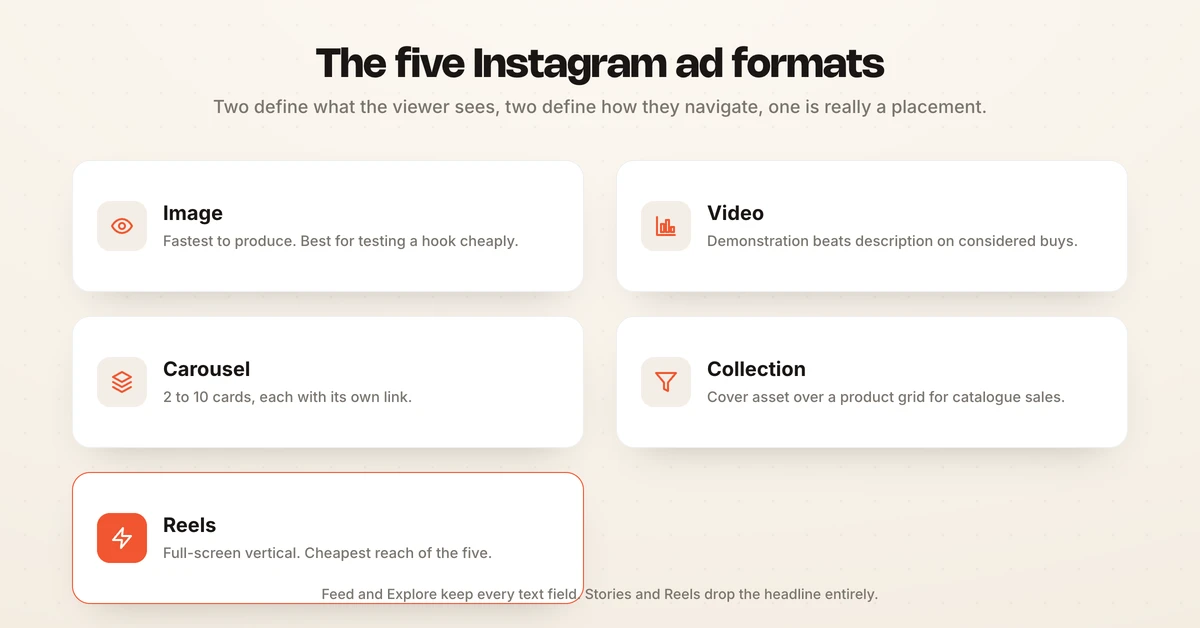
Two of these are containers rather than creative types. Collection and carousel decide how the user navigates; image and video decide what they see. Reels is the one entry that is really a placement with its own creative rules, which is why Meta lists it both ways.
Instagram ad specs by format
Meta publishes recommendations per placement rather than per format, and the recommendations are where truncation begins rather than where upload fails.
| Placement | Ratio | Resolution | Primary text | Headline |
|---|---|---|---|---|
| Instagram Feed | 4:5 | 1440 x 1800 | 125 characters | 40 characters |
| Instagram Stories | 9:16 | 1080 x 1920 | Not rendered | Not rendered |
| Instagram Reels | 9:16 | 1080 x 1920 | Heavily truncated | Not rendered |
| Instagram Explore | 4:5 | 1440 x 1800 | 125 characters | 40 characters |
The feed figures come from Meta's Instagram feed ad spec. The number worth noting is the headline: Instagram allows 40 characters where the Facebook feed recommends 27, so a headline written once for both platforms is being written to the tighter limit. Full cross-platform dimensions live in the Facebook and Instagram ad sizes guide.
How placement changes the format
The same uploaded ad renders differently in each placement, and the fields that disappear are the ones advertisers most often rely on.
- Feed and Explore keep the full unit: primary text, creative, headline and call to action button.
- Stories strips it to the creative and an interaction bar. No primary text, no headline.
- Reels overlays truncated primary text on the video itself and drops the headline.
The fastest way to see which fields survive a given placement is to mock it up: the free Instagram ad mockup generator renders all five formats with the real caption fold and CTA bar. The practical rule that follows: if a claim has to be read, burn it into the creative rather than typing it into a text field. Anything living only in the headline vanishes on two of four placements.
This is also why automatic placements and a single 1:1 asset underperform. The asset gets letterboxed in Reels and Stories, wasting the vertical space that drives cost efficiency there. Producing 4:5 and 9:16 versions of every concept is the baseline, which the Facebook ad creative best practices guide covers in more depth.
Choosing an Instagram ad format
Pick the format from the job the ad has to do, not from the asset already sitting in the folder.
| If the job is | Use | Why |
|---|---|---|
| Testing a new hook cheaply | Image | Fastest to produce, isolates the message |
| Showing how something works | Video | Demonstration beats description |
| Selling several products at once | Carousel | Each card carries its own link |
| Handling objections in order | Carousel | Sequential cards let you argue in steps |
| Driving catalogue sales | Collection | Shortest path from ad to product |
| Buying reach efficiently | Reels | Lowest cost per view of the five |
| Retargeting warm audiences | Image or carousel | Cheap, and the audience needs no convincing |
Carousel is the most underused of the five, because most teams treat it as a product grid. Used as a sequential argument, card one raising the objection and card two answering it, it does work no single image can.
What actually decides performance
The format matters less than most format guides imply. The creative inside it decides the outcome, and the evidence for that is how differently two ads in the same format perform in the same account.
Format choice sets the ceiling, and the first three seconds decide whether you reach it. Reels and Stories are unforgiving in particular, because a full-screen vertical placement gives the viewer nothing else to look at and a single thumb movement to leave. Hook rate is the metric that tells you whether an opening is doing its job, and it is worth tracking per placement rather than blended.
Creative Analysis breaks each asset into hook, frames, copy and CTA and scores them per placement, so a format that works on Reels and dies in feed shows up as a element-level answer rather than a hunch. The second thing that decides performance is rotation. Every format fatigues, and vertical video fatigues fastest because the audience sees more of it per session. Creative fatigue shows up as rising CPM and falling click-through rate on an asset that was working a fortnight ago.
Producing four placement variants of every concept, then rotating them before they fatigue, is a volume problem rather than a creative one. Hawky's Creative Agent generates platform-native sizing for each placement from the account's own winners, bound to a specific campaign and ad set, with approval before anything ships.
Instagram ad formats that no longer exist
Older guides still list two Instagram ad formats that Meta has retired, and building creative for either wastes production time.
IGTV ads are gone. IGTV was folded into Instagram Video and then into Reels, so long-form vertical inventory is now bought through Reels and in-feed video rather than as its own format.
Instagram Stories ads with separate "swipe up" mechanics have been replaced by link stickers, so creative built around a swipe-up gesture is dated. The interaction is a tap, and the design should point at the sticker rather than at the bottom edge. Meta's advertising standards apply the same way across all five formats, so a creative that passes in feed can still fail on a Reels overlay that obscures required disclosure.
Frequently asked questions
What are the Instagram ad formats?
Instagram has five ad formats: image, video, carousel, collection and Reels. They run across four placements, Feed, Stories, Reels and Explore. Image and video define what the viewer sees, carousel and collection define how they navigate, and Reels is effectively a placement with its own full-screen vertical creative rules.
What size should an Instagram ad be?
Use 4:5 at 1440 x 1800 pixels for Feed and Explore, and 9:16 at 1080 x 1920 for Stories and Reels. Producing both versions of every concept is the baseline, because a single square asset gets letterboxed in the vertical placements and wastes the screen space that makes them cost-efficient.
How many characters can an Instagram ad have?
Meta recommends 125 characters of primary text and a 40-character headline for Instagram Feed and Explore. Stories renders neither field, and Reels overlays heavily truncated primary text with no headline. Anything essential should be burned into the creative rather than typed into a text field.
Which Instagram ad format performs best?
No format wins universally, and the creative inside the format explains far more variance than the format itself. Reels typically buys reach most cheaply, carousel converts best on warm audiences with multiple products, and single image is the cheapest way to test a new hook. Choose from the job the ad has to do, then test creative inside that choice.
Does Instagram still have IGTV ads?
No. IGTV was folded into Instagram Video and then into Reels, so long-form vertical inventory is now bought through Reels and in-feed video. Guides still referencing IGTV as a separate format are out of date.
Can I run the same ad on Facebook and Instagram?
Yes, and Meta encourages it through automatic placements, but the same ad renders differently on each. Facebook feed recommends a 27-character headline against Instagram's 40, and Stories and Reels drop the text fields entirely. Preview every placement before launching rather than assuming the feed version travels.
Picking the format is the easy decision. Producing every concept in four placement variants, then rotating them before they fatigue, is the part that quietly caps most accounts. If your team is shipping one asset per concept because there is no time for four, Hawky's Creative Agent is built for that job.
Ready to hire your first AI performance team? Book Demo