Facebook Ad Sizes & Specs: The Complete 2026 Guide
The main Facebook ad sizes are 1080x1080 (1:1) and 1080x1350 (4:5) for the feed, and 1080x1920 (9:16) for Stories and Reels, with carousel ads at 1:1 or 4:5. Images upload as JPG or PNG up to 30 MB, and video as MP4 or MOV up to 4 GB. For most campaigns, design 4:5 for the feed and 9:16 for Reels to fill the screen. Because Meta runs Facebook and Instagram together, these specs cover both. Which of those sizes is actually earning results is a separate question, and one Creative Analysis answers by scoring each asset per placement.
Using the wrong size crops your creative, wastes screen space, and lowers performance, and it shows up first as a falling CTR. This guide lists every Facebook and Instagram ad size and spec for 2026, the safe zones to respect, and the 2026 changes worth knowing.
What are Facebook ad sizes?
Facebook ad sizes are the pixel dimensions and aspect ratios your creative must match for each placement across Meta's platforms. Because Meta serves Facebook and Instagram from the same ad system, one set of specs covers feeds, Stories, Reels, and carousels on both apps.
The key idea in 2026 is designing by aspect ratio, not by a single fixed size. Vertical formats (4:5 and 9:16) dominate because they fill more of a phone screen, so most of your effort should go into vertical creative. Square (1:1) remains a safe, flexible option that works across many placements.
Getting the ratio right matters more than hitting an exact pixel count, because Meta scales within a ratio but crops across ratios. A 1:1 image forced into a 9:16 Reel gets cut, wasting the creative. Match the ratio to the placement and the pixels take care of themselves.
Facebook image ad sizes by placement
Each placement has a preferred aspect ratio and recommended dimensions. The table below covers the sizes that matter in 2026, per Ryze.
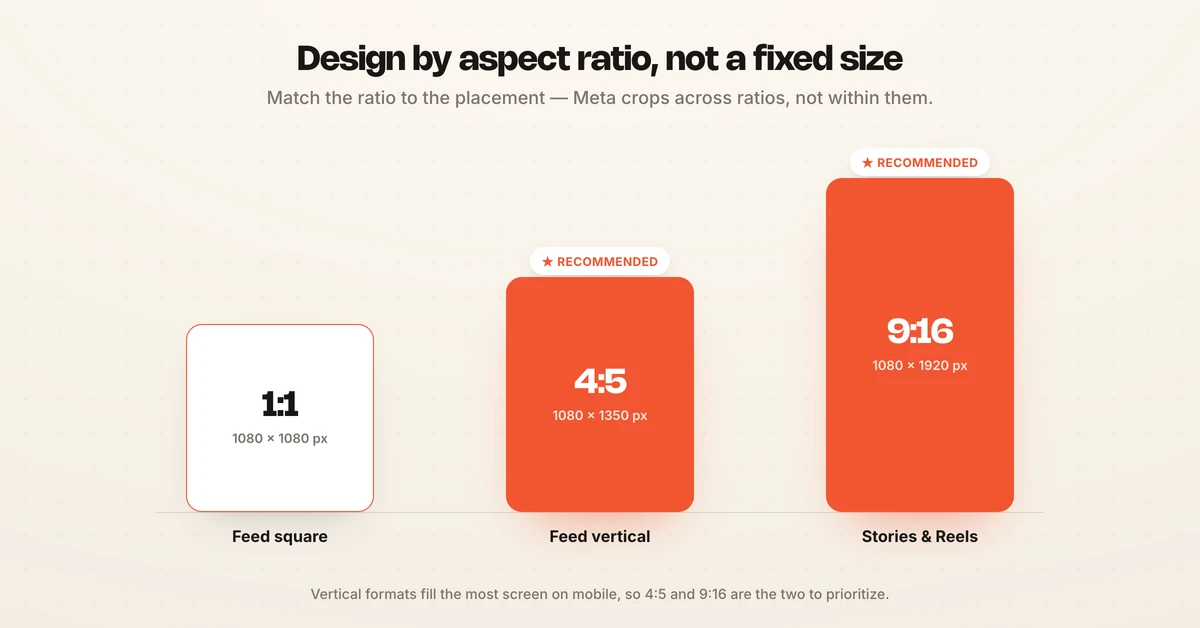
| Placement | Aspect ratio | Recommended size |
|---|---|---|
| Feed (square) | 1:1 | 1080x1080 px |
| Feed (vertical) | 4:5 | 1080x1350 px |
| Stories & Reels | 9:16 | 1080x1920 px |
| Carousel | 1:1 or 4:5 | 1080x1080 px |
| Right column (desktop) | 1:1 | 1080x1080 px |
The 4:5 vertical feed size (1080x1350) and the 9:16 Stories and Reels size (1080x1920) are the two to prioritize, because they claim the most screen on mobile. Meta now recommends higher-resolution uploads, around 1440x1440 for square and 1440x1800 for vertical, to look sharp on high-density screens, though 1080 versions still work fine.
Facebook video ad specs
Video is the dominant Facebook ad format, and it follows the same aspect-ratio logic as images. Use 4:5 for the feed and 9:16 for Stories and Reels, designing vertical from the start rather than cropping a landscape file.
The technical specs are generous:
- File type: MP4 or MOV.
- Max file size: 4 GB.
- Length: 1 second to 240 minutes, but Reels ads cap at 90 seconds.
- Performance sweet spot: 15 to 30 seconds, with the hook in the first 2 seconds.
Keep most performance video short. Even though Meta allows very long videos, ads under 15 seconds with a strong first-two-seconds hook perform best, because attention drops fast in the feed. For the creative principles behind this, see Facebook ad creative best practices.
Facebook ad character limits
Text has limits too, and exceeding them gets your copy truncated with an ellipsis. Keep the important words within the visible range for each field.
- Primary text: 125 characters is safe before it truncates, though the field allows more.
- Headline: 27 to 40 characters, with 27 the safe display limit.
- Description: around 30 characters, often not shown on all placements.
Front-load the message so it lands before any "See more" cutoff. Since much of the description and longer primary text may be hidden depending on placement, the first line has to carry the weight.
Before producing at any of these sizes, drop a draft into the free Facebook ad mockup generator to see where the copy truncates in the real feed layout.
Safe zones: keep the edges clear
Meta's interface overlays part of your creative with buttons, captions, and profile elements, so keep those areas clear of key content. Ignoring safe zones means your headline or logo gets covered by a UI element.
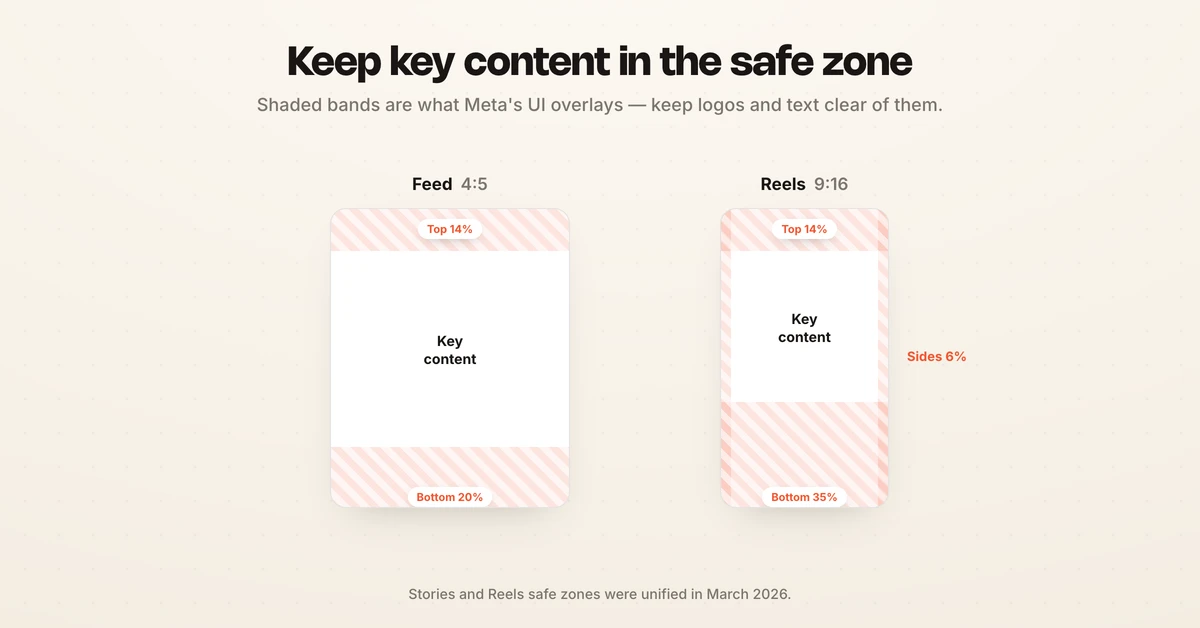
For feed placements, Meta's UI covers roughly the top 14% and bottom 20% of the creative. For Reels, keep about 14% clear at the top, 35% at the bottom, and 6% on the sides, since the interface is heavier there, per TheOptimizer. Meta unified the Stories and Reels safe zones in March 2026, so you no longer need separate specs for each. Design with these margins in mind, keeping text and logos centered and away from the edges.
Facebook ad file requirements and 2026 changes
The file specs are straightforward, and Meta's own ads guide lists them per format: images upload as JPG or PNG up to 30 MB, and video as MP4 or MOV up to 4 GB. Higher-resolution source files are better, since Meta compresses on delivery and a sharper original survives compression cleaner.
A couple of 2026 platform changes are worth noting. Instagram removed the Explore feed in January 2026, routing that traffic into Reels, which makes 9:16 vertical even more important. Meta also removed the Flexible Format option in March 2026, distributing its features across Flexible Media and Advantage+ Creative, so the system increasingly assembles the right size from your assets automatically. For running the campaigns these sizes feed, see how to run Facebook Ads.
How to produce every size efficiently
Designing a square, a vertical, and a 9:16 version of every concept multiplies the creative work, and doing it by hand is where quality slips. Building one strong concept and adapting it cleanly to each ratio keeps performance high without the manual resizing grind.
This is where automation helps. Tools that generate placement-ready formats from a single winning creative remove the resizing bottleneck, and Hawky's AI Creative Generation adapts one concept into the sizes each Meta placement needs. For the Google equivalent, see Google ad sizes and specs, and for the tools, the best creative automation software.
Frequently asked questions
What is the Facebook ad image size?
The main Facebook ad image sizes are 1080x1080 pixels (1:1 square) and 1080x1350 pixels (4:5 vertical) for the feed, and 1080x1920 pixels (9:16) for Stories and Reels. Carousel ads use 1:1 or 4:5. Meta now recommends higher-resolution uploads (around 1440x1440 square and 1440x1800 vertical) for sharper display, though 1080 versions still work. Prioritize the 4:5 and 9:16 vertical sizes for the most screen space on mobile.
What are the Facebook ad specs?
Facebook ad specs in 2026 are: images in JPG or PNG up to 30 MB, and video in MP4 or MOV up to 4 GB. Feed creative uses 1:1 (1080x1080) or 4:5 (1080x1350), and Stories and Reels use 9:16 (1080x1920). Primary text should stay within about 125 characters, headlines within 27 to 40, and descriptions around 30. Keep key content inside the safe zones, away from Meta's UI overlays.
What size should a Facebook ad be?
For most campaigns, a Facebook ad should be 1080x1350 pixels (4:5) for the feed and 1080x1920 pixels (9:16) for Stories and Reels, because vertical formats fill the most screen on mobile. Use 1080x1080 (1:1) as a flexible option that works across placements. Design in the aspect ratio the placement expects rather than a single fixed size, since Meta crops when the ratio does not match.
What are Facebook Reels ad specs?
Facebook and Instagram Reels ads are full-screen 9:16 vertical video at 1080x1920 pixels, capped at 90 seconds, with 15 to 30 seconds the performance sweet spot. Upload MP4 or MOV up to 4 GB. Keep roughly 14% clear at the top, 35% at the bottom, and 6% on the sides for Meta's UI elements, following the unified Stories and Reels safe zones introduced in March 2026. Hook viewers in the first two seconds.
Do Facebook and Instagram use the same ad sizes?
Yes. Meta serves Facebook and Instagram from the same ad system, so both use the same core sizes: 1:1 (1080x1080) and 4:5 (1080x1350) for feeds, and 9:16 (1080x1920) for Stories and Reels. A single set of creative assets in these ratios covers placements across both apps. This is why designing by aspect ratio, rather than per platform, is the efficient approach.
Meta's specs are easy to follow; producing every size at quality is the real work. If adapting one winning concept into every Facebook and Instagram size without the manual grind is the problem, Hawky's AI Creative Generation is built for that job.
Ready to hire your first AI performance team? Book Demo