What Is a Creative Strategist? The Role, Skills and How to Become One
A creative strategist decides what ads a brand should make and why, using performance data rather than taste. The role sits between the media buyer who spends the budget and the designer or editor who produces the asset, and it owns the hypothesis: which audience, which message, which format, and what the ad is trying to prove.
The title has become the most in-demand and least consistent job in performance marketing. Two people with the same title at two companies can be doing entirely different work, and that inconsistency is the single most useful thing to understand before hiring one or becoming one.
This guide covers what a creative strategist actually does day to day, the skills that separate the real ones from the title, how the role differs from creative director and media buyer, what drives compensation, and how to get into it.
What is the role of a creative strategist?
A creative strategist turns performance data into creative direction. They study what has already worked in the account, what competitors are running, and where the portfolio has gaps, then write the brief that tells a designer or editor exactly what to make and what result it should produce.
The job exists because paid social broke the old division of labour. When creative was produced quarterly and ran for months, a creative director's judgement was enough. When an account needs dozens of new assets a month and the algorithm decides distribution, someone has to decide what to test next, and that decision has to be evidence-led rather than a matter of taste.
Three responsibilities define the role in practice:
- Diagnosis. Reading the account to find which hooks, formats, angles and audiences are working, and which have fatigued.
- The hypothesis. Deciding what to test next and what a result would prove, rather than producing variations for their own sake.
- The brief. Writing direction specific enough that a creator can execute it without a meeting.
Everything else, including scripting, sourcing creators and reviewing edits, is downstream of those three.
What a creative strategist actually does, week to week
The week splits roughly into analysis, briefing, and review, and the ratio is the clearest signal of whether a role is genuinely strategic.
| Activity | Share of the week | What it produces |
|---|---|---|
| Reading performance data | 25% | Which concepts to kill, scale or iterate |
| Competitor and market research | 15% | Angles the brand has not tried |
| Writing briefs and scripts | 30% | The actual direction creators execute |
| Reviewing and approving edits | 20% | Assets that ship |
| Reporting and stakeholder work | 10% | The case for next month's budget |
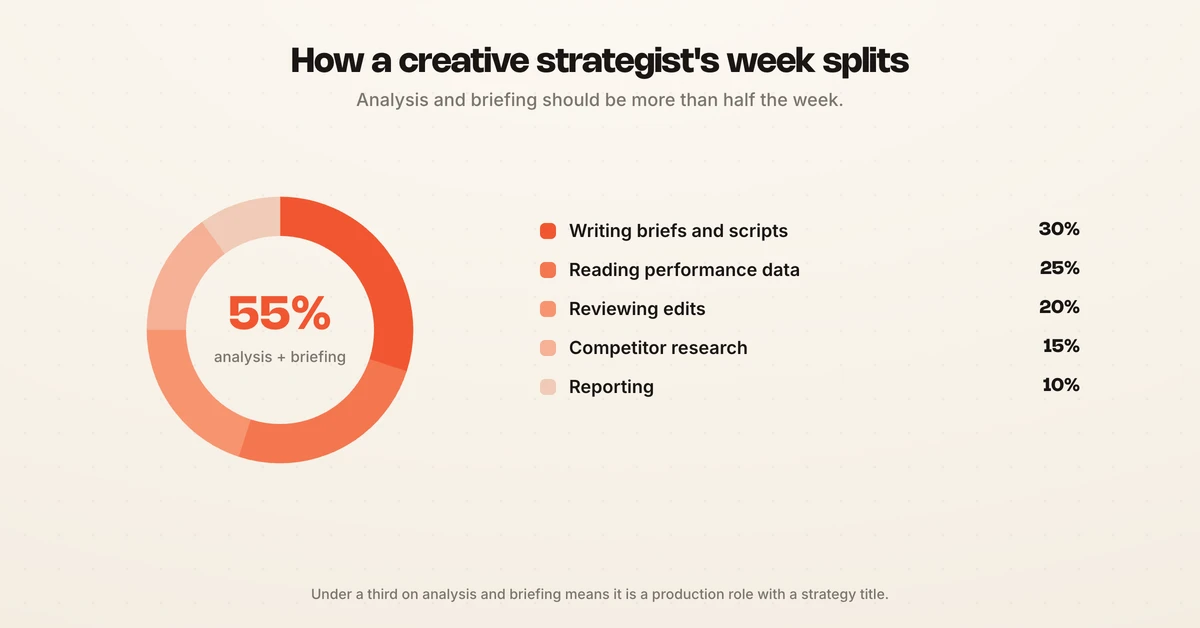
A role where analysis and briefing are under a third of the week is a production job with a strategy title. That distinction matters to anyone evaluating an offer.
The analysis half of that week is the part that scales badly by hand. Tagging every asset by hook, format and angle, then joining that to spend and outcome data, is the work that makes the rest possible, and it is why creative analytics tooling now sits underneath most serious creative strategy teams.
The skills that separate a creative strategist from the title
The market is full of people who hold the title without the underlying capability, and the gap is almost always on the same side: analysis, not craft.
- Reading an ad account. Being able to open Ads Manager and form a view without someone else's dashboard. This is the most commonly missing skill.
- Knowing the platforms as media, not just canvases. Understanding ad objectives, the learning phase, and why a creative test can be invalidated by how it was set up.
- Writing a brief someone can execute. Specific enough to remove ambiguity, loose enough to leave room for craft.
- Hook craft. The first three seconds carry the outcome, which is why hook rate is the metric most strategists live in, alongside CTR and creative fatigue.
- Statistical restraint. Knowing when a difference is signal and when the test simply has not run long enough.
- Taste, last. It matters, but it is the qualification everyone already claims.
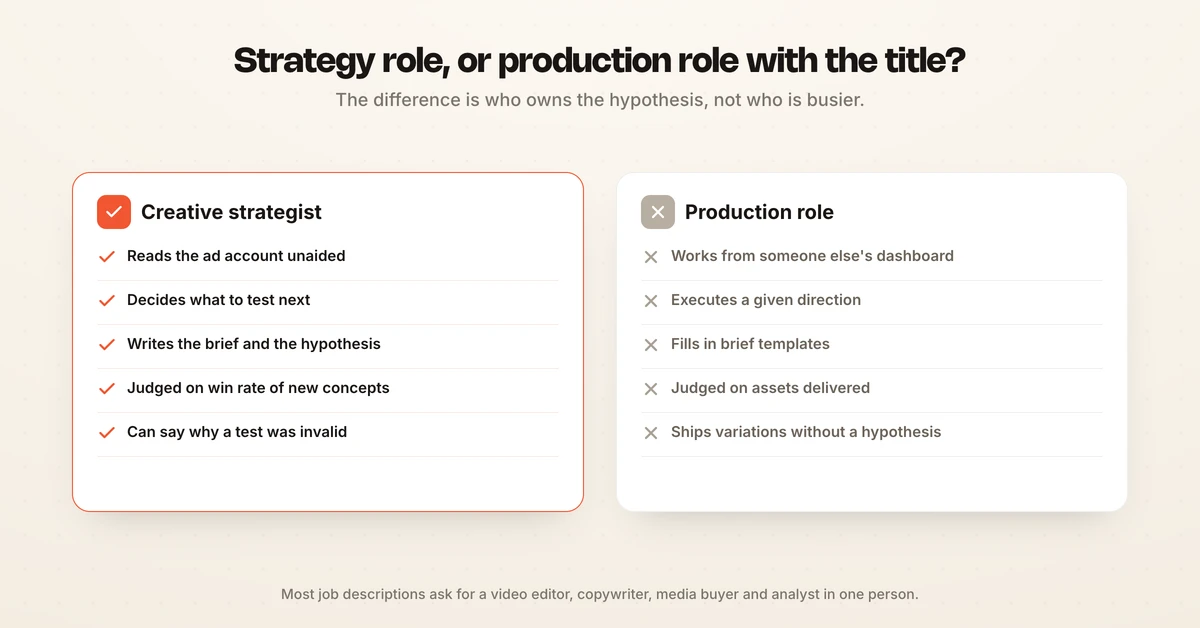
The honest framing circulating among people who hire for this role is that the job description usually asks for a video editor, copywriter, media buyer and analyst in one person, and that few candidates are genuinely all four. If you are hiring, decide which two matter most for your account and stop pretending the unicorn exists.
Creative strategist versus creative director versus media buyer
These three roles get conflated constantly, and the difference is which question each one owns.
| Creative strategist | Creative director | Media buyer | |
|---|---|---|---|
| Owns | What to make and why | How it looks and feels | Where budget goes |
| Starts from | Performance data | Brand and concept | Spend and targets |
| Output | Briefs, hypotheses, test plans | Art direction, brand standards | Campaign structure, bids, budgets |
| Judged on | Win rate of new concepts | Brand consistency and craft | ROAS, CPA, spend efficiency |
| Time horizon | Weekly to monthly | Quarterly to annual | Daily |
| Native to | Performance marketing | Brand advertising | Paid media |
A creative director protects what the brand is. A creative strategist decides what to test this week. A media buyer decides what gets the money. In small teams one person wears all three hats, and that is exactly where the title inflation comes from.
How much does a creative strategist earn?
Compensation for creative strategists varies more than for most marketing roles, and the reason is the title inconsistency rather than normal market spread. A published "average" for this role blends junior production coordinators with people running creative for eight-figure accounts, so the average describes nobody.
Four factors move the number far more than years of experience:
- Whether you own media. Strategists who also run the buying command materially more, because they own the outcome rather than an input to it.
- In-house versus agency versus freelance. Agencies pay less and teach faster. Freelance day rates can exceed salaried equivalents, without the floor.
- Account size. Owning creative on a $50k-a-month account and a $2M-a-month account are different jobs with the same title.
- Whether results are attributable to you. Strategists who can show which concepts they originated and what those concepts returned negotiate from evidence.
For live figures, read the postings rather than the aggregators: LinkedIn's creative strategist job listings show current ranges attached to actual scope, which is more useful than a blended national average. Indeed's role overview covers the general career framing.
How do I become a creative strategist?
The fastest route in is to do the job before you have the title, because the portfolio that gets hired is evidence of decisions, not a reel of pretty work.
- Learn to read an ad account. Get access to a real one, even a small one. This is the gate.
- Study ads that are already running. The Facebook Ad Library is free and shows every ad any brand is running right now. Pick a brand, catalogue their angles, and write down what you would test next.
- Build a brief portfolio, not a design portfolio. Five briefs showing the hypothesis, the asset produced and the result beat fifty screenshots.
- Learn the platforms formally. Meta's own learning material is free and covers the mechanics most self-taught strategists get wrong.
- Get reps on volume. Judgement here comes from having seen many tests, most of which failed.
- Specialise. Direct response for D2C, lead gen for B2B and app install work reward different instincts.
The candidates who struggle are usually the ones who came from design and skipped step one. The ones who move fastest came from media buying and learned craft second, because the analytical half is harder to teach.
Where the role is heading
The analysis half of the job is being automated faster than the judgement half, and that is reshaping what a creative strategist is paid for.
Element-level tagging, fatigue detection and performance attribution across hundreds of assets were the parts of the week that consumed the most hours and produced the least differentiation. Creative analysis tooling now breaks each ad into hook, frames, copy, audio and CTA, scores every element against the account's own winners, and flags fatigue before the metrics sag.
What does not automate is deciding which audience is worth talking to and what the brand should be arguing. The strategists whose value is rising are the ones spending their reclaimed hours on the hypothesis rather than on spreadsheets, with the Creative Agent handling variant production against the brief while a human keeps approval.
Frequently asked questions
What is a creative strategist?
A creative strategist decides what ads a brand should make and why, using performance data rather than personal taste. They sit between the media buyer who allocates budget and the designer or editor who produces the asset, and they own the creative hypothesis: which audience, which message, which format, and what each test is meant to prove. The role is native to performance marketing rather than brand advertising.
What is the role of a creative strategist?
The role covers three things: diagnosing what is and is not working in the ad account, forming a hypothesis about what to test next, and writing briefs specific enough for a creator to execute without a meeting. Scripting, sourcing creators and reviewing edits follow from those. A role where analysis and briefing take less than a third of the week is production work with a strategy title.
How do I become a creative strategist?
Learn to read an ad account first, because that is the gate most candidates fail. Then study live ads in the Facebook Ad Library, build a portfolio of briefs showing hypothesis and result rather than a design reel, take Meta's free platform training, and get volume reps on real tests. People arriving from media buying typically progress faster than people arriving from design, because the analytical half is harder to learn on your own.
How much does a creative strategist earn?
Published averages for this title are unusually unreliable, because the same title covers production coordinators and people running creative on eight-figure accounts. Four things move pay more than tenure: whether you also own media buying, whether the role is in-house, agency or freelance, the size of the account, and whether you can attribute specific results to concepts you originated. Read current job postings for ranges tied to real scope rather than national averages.
What is the difference between a creative strategist and a creative director?
A creative director owns how the brand looks and feels and is judged on craft and consistency, working on a quarterly to annual horizon. A creative strategist owns what to test next and is judged on the win rate of new concepts, working weekly. Creative directors come from brand advertising; creative strategists come from performance marketing. In small teams one person does both.
Do creative strategists need to be designers?
No, and most effective ones are not. The job is deciding what should be made and why, then briefing it clearly enough to be executed. Being able to mock something up is useful for communicating an idea quickly, but the skills that determine success are reading an account, forming a hypothesis and writing a brief. Design ability without account literacy produces a production role.
The hard part of creative strategy was never the ideas. It was having enough evidence to know which idea deserves the next test, and enough hours left in the week to act on it. If your strategists are spending their week tagging assets instead of deciding what to argue, Hawky's Creative Agent is built for that job.
Ready to hire your first AI performance team? Book Demo