Landing Page Conversion Rate
Last updated
The percentage of visitors to your landing page who complete the desired action. A critical metric that connects ad performance to actual business outcomes.
Landing Page Conversion Rate
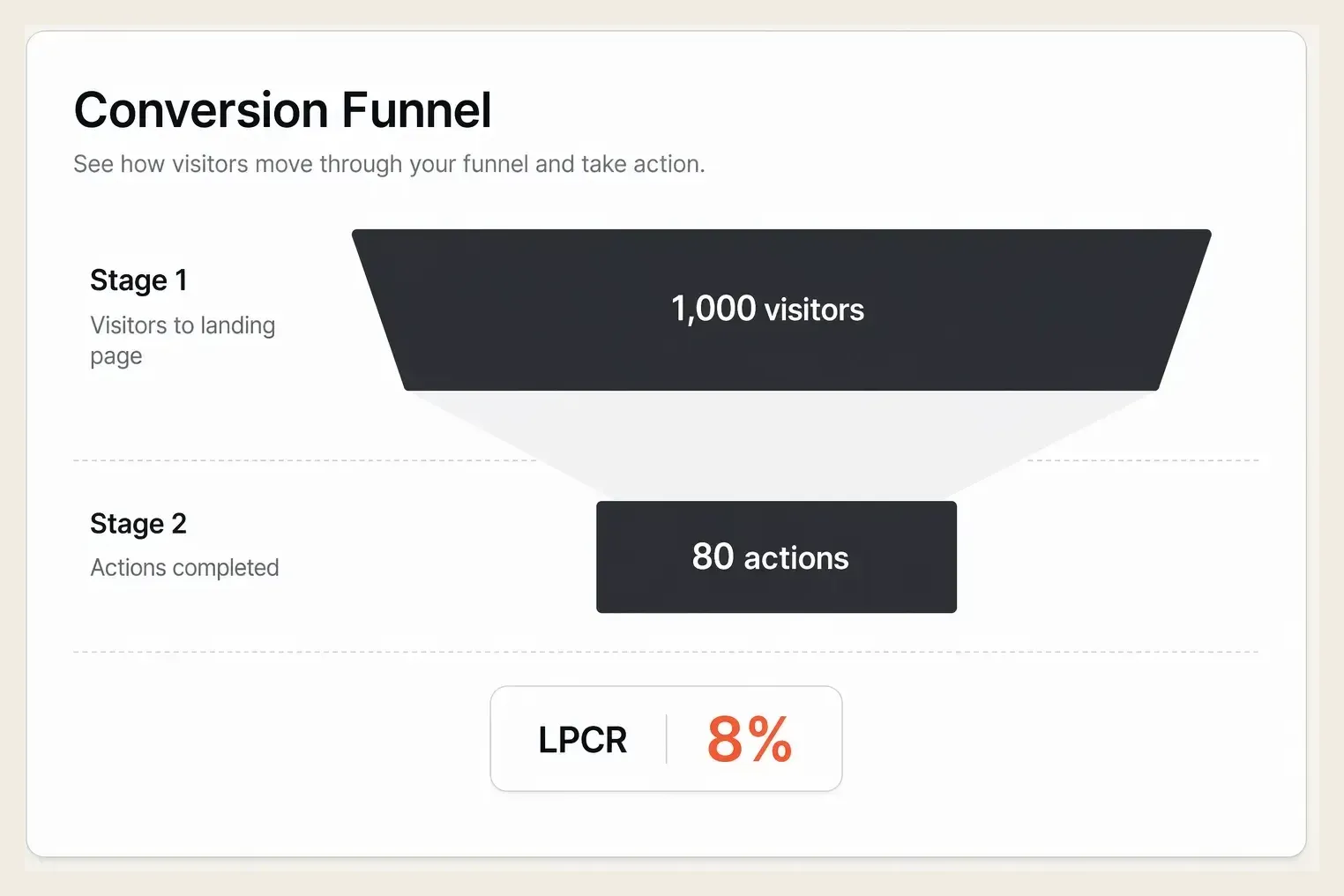
Landing Page Conversion Rate (LPCR) is the percentage of visitors who land on a specific page and complete a desired action, such as making a purchase, signing up for a newsletter, or filling out a lead form. It is calculated by dividing the total number of conversions by the total number of landing page sessions, then multiplying by 100.
Why It Matters
Your landing page is the final hurdle before a sale, which makes LPCR one of the highest-leverage numbers in your account. Even a 0.5 percentage point increase in your conversion rate can sharply lower your CPA and lift your ROAS without spending an extra dollar on media. The math compounds: if you double your LPCR, you effectively halve your cost per customer at the same traffic volume.
Most ecommerce landing pages convert somewhere between 2 and 5 percent, and the top quartile clears 8 to 10 percent. A page sitting at 1.5 percent is not a traffic problem, it is a conversion problem, and pouring more spend into it on platforms like Meta or TikTok only multiplies the waste. Fixing the page is almost always cheaper than buying your way around a leaky one.
Formula
LPCR = (Conversions / Landing Page Sessions) × 100
For example, a page that records 80 purchases from 2,000 sessions has an LPCR of 4 percent. Use sessions rather than raw pageviews so repeat visits from the same user do not distort the denominator.
Typical benchmark ranges:
- Below 2 percent: underperforming, usually a message-match or friction problem.
- 2 to 5 percent: average for most ecommerce and lead-gen pages.
- 5 to 8 percent: strong, well-optimized pages with tight ad-to-page alignment.
- 8 percent and above: top-tier, often dedicated campaign pages with proof and urgency.
Benchmarks vary by industry, price point, and traffic temperature, so always compare a page against its own history before comparing it to an external number.
How It Works
- Loading speed: A one-second delay in page load can drop conversions by up to 20 percent, so speed is a conversion feature, not just a technical one.
- Frictionless UX: Removing unnecessary form fields and distracting navigation links keeps the user focused on the call to action.
- Message match: The headline and hero image on the page should mirror the ad that drove the click, so the visitor instantly sees what they were promised.
- Social proof: Including reviews, star ratings, and UGC builds the trust necessary to push a hesitant visitor over the line.
The single biggest driver is message match. When the ad promises one thing and the page shows another, the visitor's confidence drops and they bounce before they ever evaluate the offer. A page that continues the exact story the ad started will almost always outconvert a generic destination, even if the generic page is technically well designed.
A Real Example
An athletic apparel brand is running a "Flash Sale" campaign on Instagram.
- Scenario A: The ad promises "50% Off Leggings," but the link goes to the general homepage. The LPCR is 1.2 percent.
- Scenario B: The ad links to a dedicated "Flash Sale" landing page that features the exact leggings from the ad and a countdown timer. The LPCR is 4.8 percent.
The result: By creating a dedicated experience, the brand got four times more customers from the same amount of ad spend. Matching the landing page hero image to the winning ad hook was the key driver of this success, because the visitor saw the same product and promise that made them click in the first place.
Common Mistakes
| The Mistake | ❌ Wrong Approach | ✅ Better Approach |
|---|---|---|
| Generic Destination | Sending all ad traffic to your website's homepage | Build a specific page for each ad concept so the page continues the ad's story |
| Too Many Options | Including your full header menu and footer links on a landing page | Remove all exit points except for the primary CTA |
| Slow Mobile Speed | Optimizing the page for desktop when 90 percent of your clicks come from mobile | Keep the page lightweight and thumb-friendly for mobile users |
How Hawky Helps
When your landing page conversion rate dips, the cause is usually a mismatch between the creative that earned the click and the page that received it. Hawky's Creative Agent generates new ad creative aligned to your highest-converting page elements, so the hook, visual, and offer carry straight through from feed to page. By learning from element-level patterns across a large library of ads, it identifies which visual hooks lead to genuine intent to buy.
Hawky's Performance Agent then acts on that signal in the account, shifting budget toward the ad-and-page pairings that convert and away from the ones that leak. FeatherDB keeps the memory of which page variants won so the agents do not relearn the same lessons each month. The agents operate the account, rather than handing you a report and leaving the optimization to you.
Frequently Asked Questions
What is a good landing page conversion rate?
Most ecommerce and lead-gen pages convert between 2 and 5 percent, while strong pages reach 5 to 8 percent and top performers exceed 8 percent. The right benchmark depends on your price point, industry, and traffic source, so judge a page against its own trend before comparing to outside numbers.
How do you calculate landing page conversion rate?
Divide the number of conversions by the number of landing page sessions, then multiply by 100. A page with 80 conversions from 2,000 sessions has a 4 percent LPCR. Use sessions rather than pageviews so repeat visits do not inflate the denominator.
Why is my landing page conversion rate low?
The most common causes are poor message match between the ad and page, slow mobile load times, too many distractions, and a weak or buried call to action. Start by confirming the page shows the exact product and promise from the ad, then remove friction one element at a time.
How can I improve my landing page conversion rate fast?
Match the page hero to the winning ad hook, cut every link that is not the primary CTA, and compress the page so it loads in under two seconds on mobile. These three changes address message match, focus, and speed, which together drive most of the gains.
Quick Takeaway
Landing Page Conversion Rate is where your traffic turns into profit, so keep it high by ensuring the page delivers exactly what your ad promised.
When your page converts below benchmark, the fastest path back to profitability is aligning creative and page, then letting the spend follow what works. Ready to hire your first AI performance team? Book Demo