Your Affiliate Program Didn't Fail. It Launched Too Early | Michael Cole
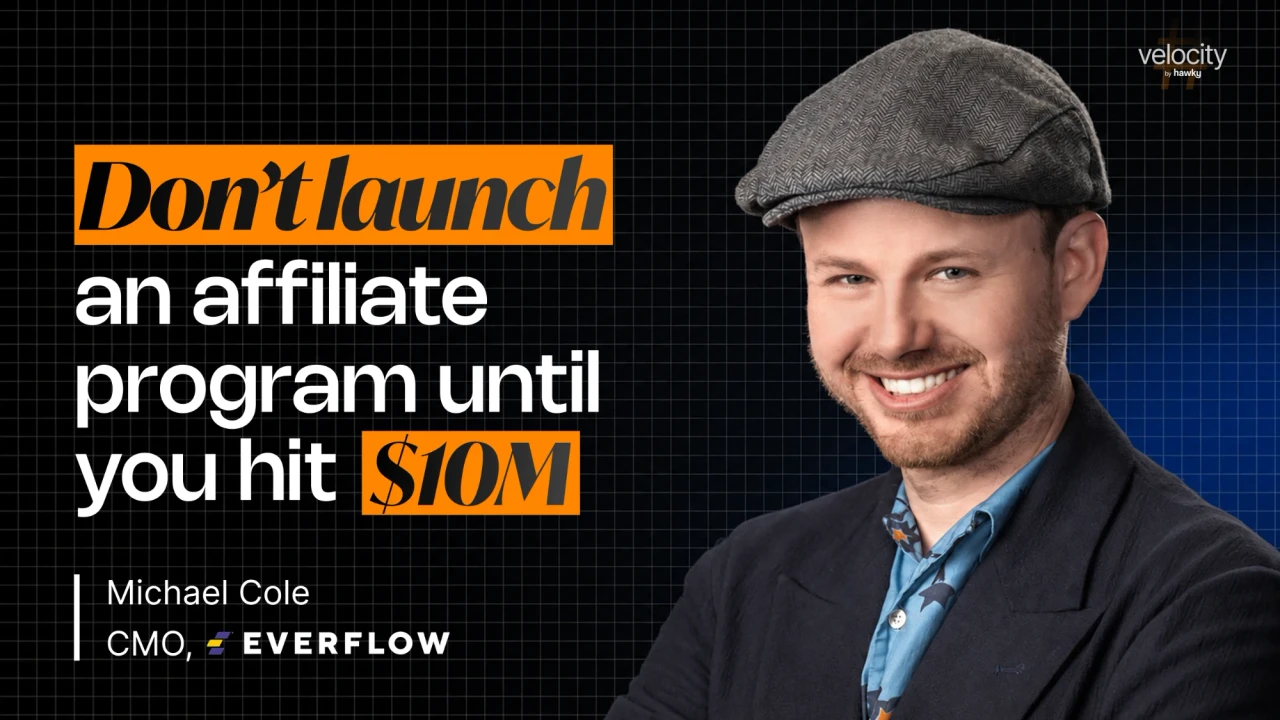
Read the write-up below, or follow Velocity to catch episode 21 when it drops.
Affiliates carry the risk in the deal. They spend their own time, and often their own ad budget, before anybody pays them.
Which is why Michael Cole puts the threshold for launching a program at roughly $10 million in revenue. Not because of what it costs you, but because of what an affiliate sees when they test an offer that is not ready. Nothing happens, and they quietly stop replying.
Michael is CMO at Everflow, the partner marketing platform that last year tracked more than 1.3 billion events and attributed more than 700 million conversions. The company has been bootstrapped to $35 million in ARR with no outside investors, and roughly sixty-five percent of its net new revenue arrives through referrals.
In the latest episode of Velocity: Performance Marketing Podcast by Hawky, host Surender (Co-Founder, Hawky.ai) asked him to walk through how partner programs actually get built, and what a platform that sells partner marketing learned from running its own. The answer ran through when a program is ready to exist at all, an affiliate recruiting rule most brands get backwards, a paid channel they killed while it was still profitable, and a self-reported number that is twenty times what their analytics can see.
About Michael Cole: A Customer Before He Was the CMO
Michael has been at Everflow for eight years, and he arrived the way the company's best referrals still do. He was one of the early customers first, then joined.
Everflow is hitting its ten year mark at around 140 to 145 employees, hiring purely against need as a profitable business, and serving 1,200 plus customers. The list skews toward finance, insurance, health and beauty, and telehealth, with names like Mutual of Omaha, JG Wentworth and Seeking Alpha on it.
The common thread is not the vertical, it is the shape of the journey. His standing example is telehealth: someone arrives wanting a GLP-1 prescription, submits paperwork, talks to a doctor on a call, and only then starts a subscription. The customer journey has several steps in it, and the lifetime value only resolves at the end.
"You need to know all of that to like sort of reward affiliates the right way."
That is the product in one sentence. Tracking and attributing the entire journey, rather than a click and a conversion, is what lets you pay partners on what actually happened.
When to Start: Referrals on Day One, Affiliates at $10 Million
These are two different decisions and most people collapse them into one.
Referral or ambassador programs should start immediately, at any stage, because getting existing customers to promote you is the cheapest growth available.
Affiliate programs are close to the last thing you do. His rough threshold is ten million in revenue, and the reason is the conversion funnel rather than the budget. You need a clean, proven path from cold traffic to purchase before you invite affiliates into it, and paid channels are how you establish that. If an affiliate tests your offer and sees nothing back, they turn it off and stop replying, whatever the payout says.
"This is why it's really important that you know that you are ready for their traffic before they start."
What you want instead is the reverse reaction, where the test works well enough that the affiliate goes looking for more channels to scale it with.
Product-led growth suits this better than sales-led, though sales-led is workable as long as the price is not enormous. The disqualifier is the sales cycle. A $50,000 product with a twelve month cycle and a committee attached means the affiliate has long since tuned out before anything closes. Enterprise B2B affiliate programs, when they exist, run on resellers and agencies instead, because those partners are built for long cycles.
Your Best Affiliates Are Already Promoting Your Competitors
Asked how affiliate structures usually work across industries, Michael starts somewhere earlier than the commission model, because he thinks the payout question is unanswerable until you know who you are paying.
"Your best affiliates are the people that are already promoting competitors in the space."
They know what your product does, they know how to reach your audience, and they have proven channels for converting that audience. Which turns program design into something closer to research than invention. Find which of your competitors are being promoted, look at what their programs offer, and build something competitive and slightly more generous.
How generous you can be is a margin question, not a courage question. Knowing lifetime value on the back end is what lets you pay well on the front end: if a customer returns ten times their acquisition cost within a year, the upfront payout can reflect that.
Then the part most brands underestimate. Affiliates carry the risk. They spend their own time, energy and in the case of media buyers their own ad budget, before anyone pays them. So the offer has to convert quickly once they test it, or they simply stop.
"A great affiliate is probably promoting the top five offers for every vertical." It is not zero sum, but it is not unlimited either. They will not promote twenty.
On channel mix he is deliberately uninterested: "with affiliate it doesn't really matter anyway. The affiliate's job is to figure out what channel works." Your job is picking the right affiliates for your vertical. In finance that tends to be content publishers running pages like the best five credit cards for people who travel every month, and those pages tell you exactly who to recruit.
Short form and influencer partnerships work too, and he is enthusiastic about the economics: micro influencers with ten thousand followers driving twenty to fifty sales a month, two or three hundred of them at once, adds up to a serious business. Tracking runs through QR codes, links, impression tracking, or the post-purchase "how did you hear about us" field firing back. The caveat is staffing. Influencer is the hardest performance channel to run because affiliates do this for a living and influencers do not, so the education burden is real and it needs a dedicated person or an agency.
Sixty-Five Percent From Referrals, and the Two Plays Behind It
Two motions produce almost all of it.
The first is turning happy customers into referral partners. The leverage is trust rather than reach: when a customer recommends you to their industry peers, the deal is already most of the way won. "There's so much trust there. And so it's a much easier win in that situation."
There is real work behind making that happen, mostly around incentives and how you open the conversation, but the model itself is proven and he thinks every B2B SaaS company should be running it.
The second is agencies. Affiliate programs take resources, knowledge and time, so the usual path is to start with an agency that launches the program and gets it to scale, then decide later whether to bring it in house. Those agencies send new customers back.
That second motion also explains his recruiting advice later in the episode. An agency that already knows your vertical is not selling you labour, it is selling you relationships that would take you a year to build.
$250, $500, $1,000: Why the Referral Structure Stays Boring
Everflow pays $250 on a qualified lead, another $500 at the opportunity stage in the CRM, and $1,000 at the customer stage. Salesforce and HubSpot feed into Everflow, which is how it gets tracked and paid.
Only about thirty percent of the referrals they receive come through the formal program at all. The rest arrive as introductions.
The design principle is friction, or the absence of it: "we keep it as simple as possible because with these things you want to make sure it's as least friction as you can make it."
Two things then do the quality control almost automatically. The first is the stage gate itself. A qualified lead referral where the person never gets on a call with the team was never a qualified referral, and the payout never fires. The second is the journey data. A real referral behaves like a real buyer, checking the pricing page, looking at the platform, taking the call, and the absence of that pattern is obvious.
"It sounds more complicated, but really as long as you're making it easy to send your referrals and if they're sending you like fraudulent stuff, you just remove them from the referral program."
The Channel They Turned Off Because It Was Working
Everflow ran Google Ads for a long time. By the numbers it worked: the channel was profitable, and they had the attribution to prove it.
They shut it off anyway.
The four to five hundred leads a month it produced were not free of cost once they landed. They occupied the sales team, and the team they occupied was the same team working the much warmer referral leads coming in from customers and agencies. Turning the channel off improved conversion rates and revenue.
Michael does not dress this up as a general principle, and calls it a weird edge case himself: "despite it being profitable, it was actually better for us to not."
The uncomfortable part is that no dashboard would have surfaced it. A profitable channel measured on its own terms stays profitable no matter how much sales capacity it consumes. The cost only shows up in what the pipeline did not close, which is not a line item anywhere. For B2B SaaS teams buying Google Ads, the question is not whether the channel returns more than it costs. It is what the leads are displacing on the way through.
Today the paid spend is small and mostly goes to LinkedIn posting.
Twenty-Two Percent From AI, and Ten Visits in the Analytics
This is the number worth writing down.
Everflow has been investing in answer engine optimisation, and they track organic traffic and referral sources in their own platform. From ChatGPT specifically they see about 110 users a month and roughly ten demo requests. A very high conversion rate on a very small number.
Then they looked at the self-reported field on the demo form. Last month, twenty-two percent of everyone who requested a demo said they came from ChatGPT, Gemini or another AI tool. Around eighty demo requests.
The gap is not a tracking bug, it is how people behave. "People go from ChatGPT or Gemini. They don't click through there. They instead go to Google, go through there." The influence is real and the click never happens, so the front end analytics have nothing to record.
"If you just do self reporting on that stuff, it's incredible how influential it already is with a good strategy."
Surender noted the same pattern at Hawky, with an added detail about lead quality: buyers arriving from an AI assistant have already researched the category, compared the top five or twenty players, and show up high intent. Two independent teams, the same finding, and in both cases the channel is nearly invisible to conventional measurement.
The practical instruction is almost embarrassingly cheap. Add the question to your form, and read the answers as a channel report rather than a nice-to-have field.
Why AI Companies Are the Affiliate Category Nobody Is Running Yet
His most interesting forward-looking take is that AI companies sit in an unusually good position for affiliate, and mostly are not using it.
The logic is the entry price. B2B has historically been too expensive at the top of the funnel for affiliates to work, but AI products start low. His example is Claude at $200 a month: "Affiliates can drive a $200 a month product all day, every day."
What makes it viable rather than merely cheap is the expansion underneath. The $200 is the first action, and the real revenue is ten more seats, or token usage that runs to five figures. The affiliate gets paid promptly on real money changing hands, while the business collects the upside over the following year. That only works if you can track past the signup, which is the whole argument for instrumenting the journey rather than the conversion.
The same shape shows up in trading and finance products: a small subscription at the top, then deposits, trades and exchanges underneath, with payouts varying by customer quality rather than a flat bounty.
He is equally clear about what affiliate cannot do. "Affiliates really can't drive a fifty thousand dollar product." Long enterprise cycles are the one category where the model genuinely does not fit, and that includes companies like his own at the top end.
Quality Control: Curation, Conversation, and Deterministic Fraud Signals
Everflow is not a network. Networks sit in the middle, provide a marketplace of fifty thousand affiliates, handle the payments and take a large cut for being the middleman. Everflow sells the platform on subscription, you bring your own relationships and set partners up directly, and the marketplace exists for one specific job: letting a brand switching off a network bring its twenty super affiliates across immediately.
Because the marketplace is curated, fraud is not really a marketplace problem. The team works with publishers regularly to keep it easy for them to find the advertisers they want.
For open recruitment, two things do the work. The first is communication, which is also why he keeps insisting the channel needs a dedicated person: an affiliate who talks to you regularly is rarely the one doing anything shady. The second is having more than one data point. A partner sending leads who never take a sales call, or insurance signups from people who never viewed another page and get rejected halfway through, is visible in the journey data without any detection model.
AI has made the deep data usable rather than merely present. Connect the platform's data to an assistant and ask whether there is fraud in the program: "60% of the traffic from this affiliate is coming from this ISP in this other country and it all looks like bot traffic."
His framing is the useful part: fraud detection is deterministic. Clear signals about engagement or device that make a partner suspicious, not a probabilistic score.
Optimising for Company Emails, Not Demo Requests
For paid media teams this is the most portable idea in the episode.
Everflow does tracking and attribution for paid media the same way it does for every other channel, and integrates with the major ad platforms so the attribution data fires back into Meta and Google. What matters is which event you send.
"A demo request really means nothing to you. A demo request from a company email is massively, massively more valuable."
Junk submissions and bot traffic will always be part of the volume, so optimising the campaign against raw demo requests teaches the algorithm to find more of them. Telling Google to optimise against demo requests from company email addresses instead changes what it goes looking for, and he says it makes a large difference to Google Ads performance.
The same mechanism has a second use that most brands never offer their partners. An affiliate running Meta ads for your telehealth product needs conversion data in their own account to optimise against, and normally cannot get it. Piping every conversion they drive straight back into their ad platform is a genuine competitive advantage in recruiting, and it costs you nothing you were not already tracking.
Buy the Data Layer, Build Everything on Top
Michael's rule for the marketing stack is a clean split.
Buy anything that captures or stores data. Tracking, attribution, the CRM. "There's so many thorny challenges there. There's so many compliance issues," including SOC 2, and those are not problems worth solving yourself.
Build the layer on top, wherever a generic product is almost right and would be genuinely useful if it were personalised to you. They replaced an interactive product guide tool with something they built, because the version that worked was the personalised one. His test for the category: "How do I take this like very generic platform and then provide three pieces of data that are the essential things our customer success team needs to know about?"
In practice the stack is Everflow for tracking and attribution across every channel including organic, HubSpot as the CRM and the record of every conversation, Gong for sales calls, Jira for product, Google Analytics and the web hosting tool as secondary checks, all feeding Supabase and Google Cloud as the two sources of truth, with Claude querying across them.
He is not calling time on CRMs, and is pointed about why: sales still needs a place to see how a deal is progressing, and you keep that easy for them. What changes is that the CRM is one input among several rather than the whole picture.
Then the piece he clearly cares most about, which is what happened to the team. Marketing is nine people, partnerships another fourteen or fifteen, and the biggest team in the company is customer success. Earlier this year two people moved into GTM engineering roles and started building with AI, with explicit exploration of when it helped and when it was a distraction.
The content workflow changed shape entirely. They run master classes built from expert interviews: talk to the expert, take the call transcript, transform it with AI, and have the content team edit. "The whole like writing from scratch is no longer needed. And everything is coming from an expert's perspective."
Which leads back to why customer success is the biggest team: "if you're talking more to your customers than your competitors, all of those conversations can now feed the context of your AI, which is a massive competitive advantage."
Key Takeaways from the Episode
- Referrals start on day one, affiliates at around $10 million. Getting customers to promote you is available at any stage. Affiliates need a proven cold-traffic funnel first, because they carry the risk and quit fast when a test returns nothing.
- A profitable channel can still cost you revenue. Everflow's Google Ads were profitable and tracked, and killing them raised conversion rates, because four to five hundred monthly leads were absorbing the sales capacity that warmer referrals needed.
- Recruit the affiliates already promoting your competitors. They understand the product, know the audience and have converting channels. Look at competitor programs to set your own payout, and be slightly more generous.
- Twenty-two percent of Everflow's demo requests self-report AI, while analytics sees ten. People research in ChatGPT or Gemini, then navigate through Google, so the click never exists. The fix is a "how did you hear about us" field read as a channel report.
- Keep the referral structure boring. $250 qualified lead, $500 opportunity, $1,000 customer, with the stage gates doing the quality filtering. Only thirty percent of their referrals use the formal program at all.
- AI companies are the affiliate category nobody is running. A $200 a month entry price is something affiliates can drive daily, and the seats and token spend that follow are where the business makes its money.
- Optimise Google against company emails, not demo requests. Sending the qualified event rather than the raw one changes what the algorithm hunts for, and passing conversion data back to your affiliates' own ad accounts is a recruiting advantage.
- Fraud detection is deterministic. Leads that never take a call, signups that never viewed a second page, traffic concentrated on one foreign ISP. The data always existed; AI made it easy to ask.
- Buy data capture and storage, build the layer above it. Compliance makes the bottom of the stack worth paying for, and personalisation makes the top worth building.