Automation Isn't Your Problem. Fragmentation Is | Anthony Higman
Read the write-up below, or follow Velocity to catch episode 22 when it drops.
Anthony Higman has run paid search for law firms through every wave of Google automation, from the recommendations tab to Performance Max and AI Max. None of it is what made the job harder. "The biggest change isn't automation for me," he says. "It's the fragmentation of ad platforms."
A law firm that says it wants to spend $10,000 a month used to mean one account to pace. Now it means Google Ads, Local Services Ads, YouTube and ChatGPT ads, and Google moves the pieces whenever it chooses.
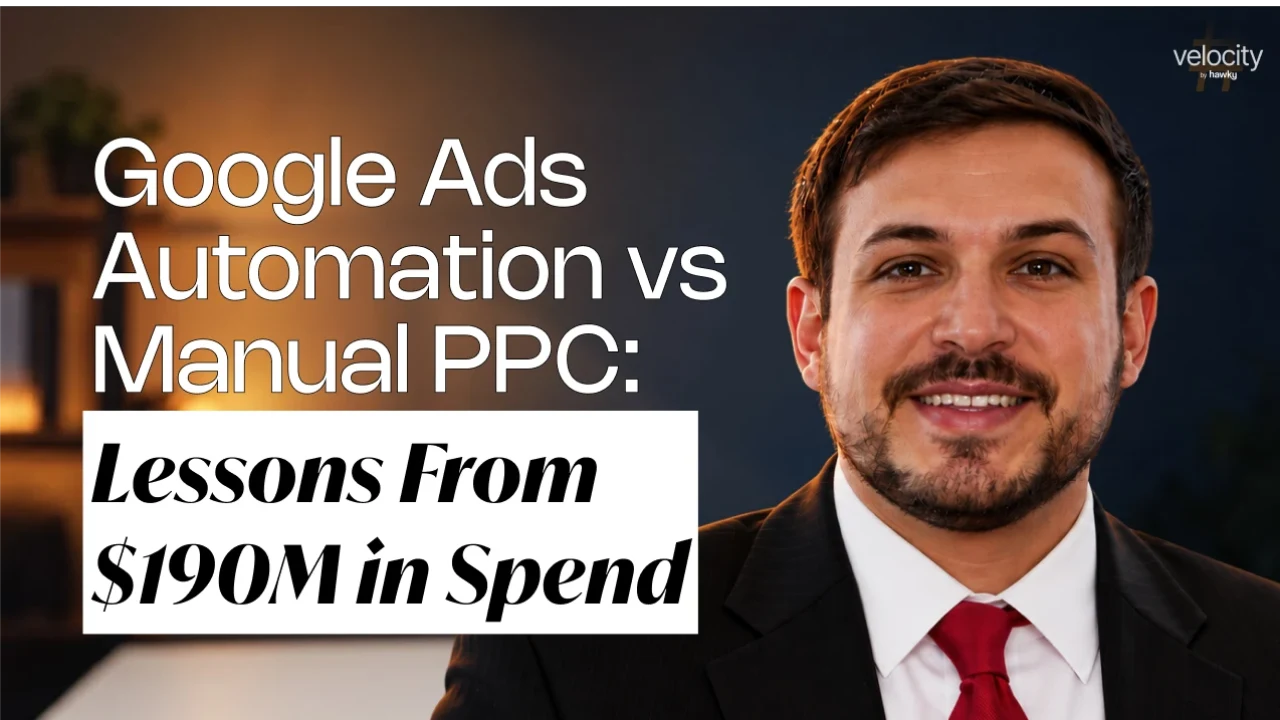
Anthony is CEO and founder of ADSQUIRE, a Philadelphia agency that runs paid search, Local Services Ads and now ChatGPT ads exclusively for law firms. He has managed around $190 million in legal ad spend across his career, and his agency is deliberately the opposite of what Google is pushing: five people, manual bidding, every client account touched every day.
In the latest episode of Velocity: Performance Marketing Podcast by Hawky, host Surender (Co-Founder, Hawky.ai) asked him why he keeps spotting Google's changes before Google announces them. The answer ran through why fragmentation hurt more than automation ever did, where the recommendations tab actually came from, the control he stopped fighting for, and how a lunch search exposed the way ChatGPT ads really target.
About Anthony Higman: Manual on Purpose
Anthony has run paid search for law firms for fifteen or sixteen years. ADSQUIRE, founded in 2021, is a Google Premier Partner with about thirty to thirty-five clients, and every account is worked by hand.
That is a choice, not a limitation. "We're very human first, we're very manual in accounts every day. So we're like the opposite of what Google's kind of pushing with the all automation, all AI stuff."
The payoff he claims for it is visibility. Being inside the accounts daily is what lets his team notice a change while everyone else is still reading about it, or before there is anything to read.
His planning rule is one sentence, and he returns to it every time the conversation turns to a new channel: "Where are the people and what are they looking for? That's where I wanna be."
The Hard Part Was Never Automation. It Was Fragmentation
The change that made Anthony's job harder was not automated bidding or AI. It was Google splitting one auction into several platforms.
Local Services Ads arrived for law firms around seven or eight years ago. What they did, in his description, was take the number one PPC position and "put 200 law firms in that one spot." And they launched as a separate, very buggy platform.
Asked whether automation had changed how ADSQUIRE works day to day, he said no. What changed the job was the budget. A client's $10,000 a month now has to be split across two, then three, then four platforms, while Google pushes LSA harder some months and moves where it shows. "Pacing four ad accounts versus pacing one ad account is the difficulty." Budget pacing across platforms that change underneath you has become the job.
The second difficulty is people, not software. Google has automated its support, and he says calling Google Ads or LSA support now gets you a chatbot that hangs up on you. The one thing it has not automated is its reps, and that outreach has increased "a thousandfold."
His agency gets around twelve calls a day and thirty emails. Worse, reps go around the agency to the client directly, even when the agency clearly holds the account, and the confusion that causes is its own workload.
Google's Recommendations Tab Started as a Churn Alarm
The recommendations column in Google Ads began as an internal retention tool, not an optimisation feature. That origin, in Anthony's account, explains most of what it still does.
Roughly eight or nine years ago, Google identified around a hundred settings that predicted churn. Advertisers without them enabled were more likely to leave than advertisers with them. Every day a system scanned the accounts, flagged the at-risk ones, and handed the list to sales reps, who called those advertisers with suggestions. He says the system was built by a third-party firm, Regalix, which still staffs part of Google's outbound rep team.
Over time the list went from a sales tool to a feature in every account, with an optimisation score attached and a queue of recommendations to accept or dismiss. The goal, in his view, never changed: lower the retention risk.
That is why blindly accepting them goes wrong. "People that blindly adopt all of the recommendations, or just hit the auto apply button, often come back and go, well, what the heck? This was supposed to work and it doesn't." The suggestions are generic by construction, and a personal injury firm in one city is not generic. The newer layer of Google Ads automation, Ask Advisor and AI reports, inherits the same problem. "We're not there yet."
The Control He Stopped Fighting For: Which Photo Ran With Which Ad
The Google Business Profile connection is the control Anthony argued about loudest and has since stopped fighting. It is also the clearest example of what the AI push takes away from a practitioner.
Start with auto-applied assets, which he says many Google Ads practitioners still do not know exist, because Google made them hard to find. People know about auto-applied recommendations. The asset version sits somewhere else, and plenty of accounts run everything in it by default. ADSQUIRE turns all of them off, with one exception: automated location assets.
That checkbox connects the firm's Google Business Profile photos to the ad account, and Google cycles through them in the ads. You can still upload your own image assets, but Google prioritises the profile connection. The catch is that you cannot see which photo showed with which ad.
So a result you could once act on becomes a result you cannot read. An ad with a higher click-through rate and a fifty percent better conversion rate used to be a clear decision: keep it, pause the loser, test a new one. Now the lift could have come from the copy or from a photo you did not choose. "You're really losing that ability with the AI push to gain actionable insights into what's working and why."
He still thinks it is wrong. He also stopped fighting it, and his reasoning is worth borrowing. Bad actors scammed people through ads, trust in ads dropped, and Google is rebuilding that trust by tying ads to a known asset it can police. It has cracked down hard on fake profiles over the last three years.
"Two things at the same time are true." Google is cutting down on fraud, and the same move removes decisions professional marketers used to make, which levels the playing field in a way he disagrees with.
ChatGPT Ads Follow Your Chat History, Not Your Query
ChatGPT ads target on conversational history more than on the question you just typed. Anthony did not read that anywhere. He worked it out by searching.
He had been trying to get in early for months, messaging people at OpenAI on LinkedIn about being the first legal marketing agency on the platform. That went nowhere, so he watched the news instead, and his team was among the first into the self-serve platform the day it opened.
They spent $15,000 in that first week. The phones rang off the hook and they signed clients from it. The next week everyone else found the platform, and the results fell off a cliff. They have now spent over $20,000 on it.
After the spike and the collapse, he did what he does with every platform he puts money into: he ran searches himself. He keeps three free-tier ChatGPT accounts, each with a different conversation history. The oldest had spent months searching phrases like "PPC for lawyers" and "best PPC agency for lawyers," because he wanted to see his own ads.
Then the queries stopped matching the ads. He would ask for the best lunch spot near him, or things to do in Philadelphia this weekend, and get an ad for selling your business. "That this ad has nothing to do with the thing that I typed in."
He kept testing until the pattern held, and settled on an estimate: roughly 60/40, weighted towards history over the live query. "We'll never know the actual weight." And it may not survive the month. "What's true right now, that it's weighted towards conversational history, that might not be true in 30 days."
A previous Velocity guest, Patrick Gilbert, described a ChatGPT ad that had nothing to do with the query in front of it. Asked whether he still sees the same thing, Anthony's answer was a flat yes. His explanation is the targeting model, not a matching bug.
Where ChatGPT Ads Work for Law Firms: Long Research Paths
If the platform targets on history, the practice areas that work are the ones where people build up history before they hire. That is exactly what his results show.
Bankruptcy law has produced the best results. People ask money questions for weeks before they ever ask who the best bankruptcy lawyer in Philadelphia is, so by the time they are ready there is a trail to target. Serious accident cases, truck accidents in particular, are the other bright spot, because the injured person does real research first.
Personal injury in general is the weak spot, and the reason is the conversion window. Someone has just been in an accident, and they hire within one to three days. There is not enough conversational history to target, and the audience, roughly thirty to eighty years old, goes to Google out of habit. "It still holds a large grip on the audiences that we're trying to capture."
That makes the platform close to the opposite of search. On Google, after sixteen years, he knows the core keywords. On ChatGPT there is no keyword list to own. You map the research path and write headlines that meet people partway along it.
He is broadly positive about how OpenAI is building it, with one caveat he keeps repeating: "They're building the plane as they're flying it." The data gaps are real, and he has a wish list, with negative context hints at the top.
Spend 10 to 15 Percent of Your Time Outside the Ad Platform
The chat-history discovery came from a working rule he gives his whole team: spend ten to fifteen percent of your time outside the ad platform, using the product the way a customer does.
The dashboard has plenty to look at, but it only shows what happened. As platforms automate more and change more often, the only way to understand the numbers is to see what is actually being served. "When you're doing that enough, these things click."
The rule has no end date. "You always have to be revisiting it or you fall off."
The Law Firm Channel Mix: Search First, YouTube Second, Then Billboards
Google Ads still carries the large majority of law firm results, and Anthony's budget split reflects it. His media mix is roughly eighty percent on direct Google keywords and around ten percent on YouTube.
In order, the channels are Google Ads, Local Services Ads, YouTube, ChatGPT ads, and a small amount of digital out-of-home. He has strong opinions about Local Services Ads, which can be great or awful depending on the practice area.
On YouTube, his favourite format is still the fifteen-second non-skippable in-stream ad, because it has to be watched before the viewer gets the content they came for. There are a million ways to run YouTube, and he is specific that it has to be done "the right ways."
Billboards, static and digital, are the quiet growth line of the last three or four years. He flags this as a hunch rather than a case study: when firms see results dip as the internet changes, they go looking for something else, and a lot of them land on out-of-home.
How Five People Run Thirty-Plus Law Firm Accounts by Hand
ADSQUIRE runs thirty to thirty-five clients with five people because the work is divided by what matters, not by client. Three people are account managers, Anthony handles the key accounts, and the fifth runs landing pages and project management so every client request is followed through.
One role is the unusual one. A person whose sole job is to listen to every call and read every form that comes in. Lead quality gets a full-time owner, which frees the account managers to do one thing: beat last month's performance.
No account manager carries more than ten to fifteen accounts, and nobody uses a management platform on top of Google Ads. The stack is CallRail for call tracking and a landing page tool for A/B testing and form capture. Negatives are added every day and bids are changed by hand. Anthony does not even use Google Ads Editor, and still builds and copies campaigns in the interface.
He is clear that this costs them. "It makes things more difficult for us. It's very much more labor intensive." He is equally clear that it is the source of the edge. "You'll go, that's new. That changed. What is that? And you'll go and investigate it."
He is not arguing that automation is bad for everyone, either. Some tools surface the important things well, and the right answer depends on how many accounts an agency handles.
What He Hires For: Creative Problem Solving, Then Humble and Hungry
The account manager's job has not changed as much as the automation push suggests. In Anthony's definition it is to watch the leads, judge their quality, and keep trying to beat the account's own performance month over month, using whatever metrics are still visible.
The number one trait he hires for is creative problem solving. "If there's these pieces of information and that's all you have, what can you do with it?"
Second is a willingness to test without breaking what works. People get so boxed in that they stop stepping outside it. He wants risk-taking with a backup plan: always a contingency, never messing with something that is working, and finding a creative way to test it anyway.
After that, two words: humble and hungry.
What He Is Watching Next: Social Lead Gen and Demand Gen's Branded Search Metric
Social media lead generation is the channel he is dipping into, after years of using social almost only for remarketing. Legal ads often fall into a sensitive category that blocks remarketing through Google, so social was always where ADSQUIRE sent retargeting. Now he keeps hearing that lead gen on social is rising, and he is testing it.
Pinterest is a no. Law firms like to brand, but he sees it as a consumer product platform, and it fails his first question about where the people are and what they are looking for.
On Google's own AI campaign types, his verdict is blunt. Performance Max, AI Max and Demand Gen have not been needle movers to date. Demand Gen is the one he is slightly more bullish on, because short-form video is where the attention is, his own included.
As a Premier Partner, ADSQUIRE is in a beta for a new branded search metric designed to show what Demand Gen and similar campaigns contribute. So far, he says, it looks "way too good to be true," and he suspects a lot of modelling behind the conversions. That makes it the right moment to ask about incrementality, and he is asking.
His other worry is the format itself. Shorts are easy to skip, so the creative has to land its message almost immediately. That is the code he is still trying to crack.
Key Takeaways from the Episode
- Fragmentation, not automation, made the job harder. LSA put 200 firms in the old top spot, and one $10,000 budget is now paced across four platforms.
- ChatGPT ads target on chat history more than the live query. Anthony's own estimate is roughly 60/40, found by searching from three free-tier accounts with different histories. He expects the weighting to keep changing.
- ChatGPT ads suit long research paths. Bankruptcy and truck accident cases produce results because people research first. Personal injury, with a one to three day conversion window, still belongs to Google.
- First-week results on a new platform are not a baseline. $15,000 in week one filled the phones. The following week, competitors piled in and results fell off a cliff.
- Google's recommendations began as a churn tool. Around a hundred settings that predicted churn became the optimisation score. Treat the suggestions as retention advice, not strategy for your practice area.
- Some lost controls cost you the ability to learn. With Google Business Profile photos rotating through ads, you cannot tell whether a CTR lift came from the copy or the image.
- Spend 10 to 15 percent of your time outside the ad platform. Using the product as a customer does is how his team spots changes before they are announced.
- Give lead quality its own owner. One person at ADSQUIRE listens to every call and reads every form, so account managers can focus on beating last month.