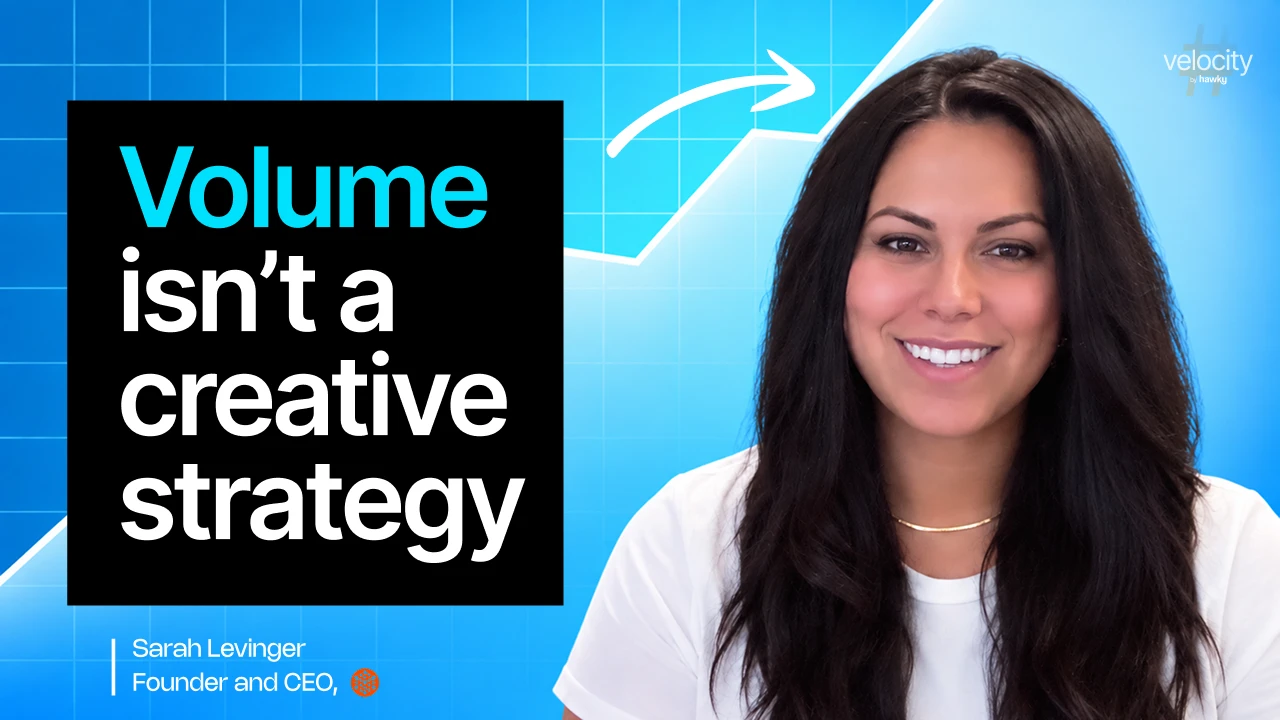
You Don't Have a Creative Strategy. You Have an Ad Factory | Sarah Levinger
Read the write-up below, or follow Velocity to catch episode 20 when it drops.
A consumer psychologist who has read more ads than most teams will run in a career. Her opening claim is that almost every brand she consults for has a system for making ads, and almost none of them have a creative strategy.
Those are not the same thing, and she does not think the gap is small.
Sarah Levinger is the founder of Tether Insights and a consumer psychologist who works with brands around the world on creative strategy. Her position is that the system most brands build is not wrong in structure, it is wrong in purpose: it was built to produce ads, and then somebody stapled "that scale" to the end of the brief without noticing those are two different jobs.
In the latest episode of Velocity: Performance Marketing Podcast by Hawky, host Surender (Co-Founder, Hawky.ai) asked her to build a creative strategy from scratch, live, for three brands at three very different spend levels. What came back was a sequence most teams run backwards, a funnel model that actually tells you what to make, and a brief that is deliberately shorter than the one you are writing now.
About Sarah Levinger: The Consumer Psychologist Behind the Creative
Sarah consults across a wide spread of brands, which is what makes the pattern visible to her. She sees the same org chart, the same production pipeline and the same weekly ritual repeated in company after company, and she sees what each one puts out the other end.
Her background is psychology rather than media buying, and it shows in what she tags creative on. She is less interested in whether an ad is a point-of-view ad or a testimonial than in which emotion it runs, which version of the viewer's self it speaks to, and how hard it pushes. That vocabulary runs through everything below.
The Ad Factory: Producing Ads and Producing Ads That Scale Are Opposing Goals
"The difference between having an actual creative strategy and just being able to produce a lot of ads is pretty wide."
The structure itself is not the problem. Brands decide they need a system, they hire people to run the system, and the system's job is to make ads. The distortion arrives with the extra clause at the end, that the ads also need to scale, because in her experience volume and scale pull against each other.
The ads that scale, she says, are usually unicorns. They turn up rarely and they turn up at random, often as something thrown into the account without much ceremony, carrying a few interesting things nobody deliberately put there. The ads that do not scale are frequently the ones the system worked hardest on, the ones a designer spent days on and an editor spent longer.
"Those are just ads for ad sake."
Crack open a brand's asset folder and she says you can tell within a minute which of the two goals is actually running the team. The tells are message, visuals, and how many are sitting in there.
The Four Steps, and Why the Ad Format Is the Last One
Almost everybody starts with the wrong question, which is what type of ad are we making. Point of view, before and after, us versus them.
"That's basically step four. That's the last step, is how should I wrap this message?"
Step one is customer insight, and specifically what sits underneath the insight. Most research comes back with pain points, which she treats as necessary but not sufficient: "That's a critical piece of information, but that's literally just like the symptom." Waking at 3am every night is a symptom. Fifty pounds you cannot lose is a symptom. What she wants is the thing under it.
Step two is the message, and here she expects disagreement. The message is not the solution: "Your message is not supposed to be here's your problem, here's the solution, take it." Every one of us has had a solution handed to us and pushed back on it. The core message she is aiming for is narrower and more personal. This is the right product for you, as an individual.
Her worked example is the 3am one. The message is not that you have a sleep problem. It is that waking at 3am is common, there is nothing wrong with you, and the actual issue is how long it takes to get back under: "3am wakeups are not a big deal if I can go back to sleep within 10 minutes."
Step three is how to carry that message, positive or negative. Reassurance that things will be fine, or pressure that this cannot go on. Only after that does she pick the ad type.
Her definition of the discipline follows the same shape. Creative strategy is the system, mostly mental with some physical parts, that takes a core insight, wraps it in a core message that fits the brand, and generates content that moves a business goal. And the goal moves: some months a brand wants scale, some months it wants cheaper customers, some months it does not care what it spends.
Why Creative Strategy Became a Job: iOS 14 and the TikTok Algorithm
Two years ago this was not on the performance marketing syllabus. She traces its arrival to two changes, neither of which was about creative.
The first is that the tracking went away. Between roughly 2015 and 2020, the golden age in her telling, Meta could follow people around the internet, and a technical capability was enough to put a customer in a particular place. After iOS 14 that capability was gone.
The second is TikTok. Its algorithm ranked on interest rather than followers or comments, people liked what it served them, and every other platform had to follow or die. The combined effect is that no one can buy their way past the content problem any more: "You gotta have a strategist to be able to handle both content and technicality."
Asked to rank the platforms by how much creative strategy matters, she declines to separate them much, with one observation. Meta tends to serve a creative strategist better than TikTok does, because the customer types on Instagram and Facebook are simply not the same people.
On the single metric she runs on, she is out of step with the industry on purpose. She does not watch ROAS nearly as closely as most, and reads CPA instead, not as a scale signal, which she is first to admit it is not, but as a read on the health of each incoming cohort against the last one.
TEEP: The Funnel Model That Tells You What to Actually Make
She has no use for TOFU/MOFU/BOFU or awareness levels, for a practical reason: neither one tells a marketer what to build. Knowing a customer is mid-funnel gets you as far as "a review ad, maybe," and stops.
So she works from a four-stage model she calls TEEP, which she credits to Google research on how people move through digital purchases.
Trigger. Something starts it. You bought a dog, you moved house and need furniture. Acute triggers fire once; chronic ones fire repeatedly, like ignoring the wrinkles on your skin for a year until your sister's wedding lands this weekend and suddenly it looks worse than it did.
Exploration. People start looking at the category, and these ads should mostly not be about your brand. What does skincare actually involve, what are the options, what are the ingredients.
Evaluation. Now it is you specifically. What makes you different, what is in your product, why buy from you.
Purchase. Run the actual offer. Fifty percent off, the bundle, the deal, on the creative.
The mix is set by the goal. Scaling means weighting the top, because you are reaching new people. Cutting cost means working the middle. A month where the business is haemorrhaging cash means more purchase ads and more offers. It changes, and she expects it to.
She also mirrors the model in the account structure: one campaign, with an ad set per stage.
Three Budgets, Three Strategies
$5,000 a month, one performance marketer
The first constraint she checks is not the customer, it is capacity. One marketer building and running everything means going deliberately slow: three to five ads a week, mostly statics, video only if it can genuinely be produced.
The reason is arithmetic before it is taste. Dump ten ads a week into that budget and ninety percent of them never get enough spend to say anything, and the account becomes unreadable on top of it. Winners get scaled ten to fifteen percent a day, and no faster.
Research at this size is bounded by one question: "Any research you do has to come with one question up front, which is what will this research help me decide?" She is not going to go read generational psychology for a brand running three ads a week. Reviews, a post-purchase survey, customer service tickets. Why are people buying, how do they feel about it, what were they trying to solve. "I don't want to re-research things that I already know."
Competitor ads are explicitly off the list, and she is aware that is an unpopular position. She will look only when the brand is up against a category monster, and only to find what to do differently. Copying costs twice: "Meta's probably gonna ding us over time, especially if we copy a lot," which pushes CPAs up, and "if we copy a lot, we start to look too much like everybody else."
A designer is worth hiring somewhere around $30,000 to $50,000 a month in spend, and even then output only moves to five to ten ads a week.
On AI creative, her read is empirical rather than ideological. Brands running an entirely AI ecosystem "tend to struggle" and have trouble holding performance stable, and she does not claim to know exactly why. It could be that people do not like it, or that Meta does not serve it as much. She avoids generating humans specifically, even though the models are good now: "The vibe is off, and humans are real sensitive to it right now." A mix is what works.
$60,000 a month, a three-person growth team
Budget is no longer the constraint, so the job changes to diversity. And she is emphatic about what diversity is not: "Diversity doesn't mean more volume."
Ten to twenty ads a week, roughly eighty to a hundred a month, with every ad reaching at least about $100 in spend so it can say something. She does not want Meta splitting this budget across hundreds of ads.
The diversity runs on two axes. Format is static, UGC, GIF, carousel. Story is before and after, point of view, us versus them. The point is that they are independent: before-and-after can be a static, a script, a carousel, or a GIF that flashes between the two. One story can populate every format you have.
Which then raises the real decision: one story across five formats, or five stories one per format. Her answer is to read the account rather than the theory. If one angle is working, keep running it: "You could run an ad account on one angle for years and years and years." She is blunt about the instinct to change everything: be selective about angles, then branch each angle into as many stories as you can, "because it's the content that Meta wants now, not differentiation of angle."
Her cadence holds at quarterly, monthly, weekly across every size. Quarterly sets the objective, scale or cut cost. Monthly covers seasonality and culture. Weekly looks one week back and one week forward, with launches every other week so ads get room to reach significance. At this size she reviews one TEEP ad set at a time, once or twice a week, rather than the whole account, because "humans are not great at remembering things," and a strategist drowning in numbers stops being able to tell whether anything is working.
She could hand that to AI and does not, for a reason worth hearing: "If I just always give it to AI, then I forget how to do this stuff."
$600,000 a month, a pod plus an agency
Two things change. Products get segmented, one category to one product at a time, which she calls very important for Meta right now. And scale gets more aggressive, which still does not mean more ads.
She sees brands in this range running anywhere from 200 to 1,000 ads a month and does not love it, but concedes this is the one tier where volume genuinely works, because the budget can absorb it and the diversification is real. The structure is the mid-tier structure expanded: instead of ten formats carrying one story, ten formats carrying ten stories.
The Brief: Write Less of It, and Write It Like a Director
Her creative brief for creators inverts the norm: "I try really hard to give my creators the least amount of information possible so that they will be able to do their jobs."
Brand history, full ingredient decks and customer personas do not help, because creators are incentivised differently from marketers and already know their own audience better than the brief does. What they need is character.
So the top of her brief is the character's history. You are playing the burned-out mom who cannot take on anything else, and critically, she has been like this for years, so she is chronically depleted rather than having a bad week. Then where the character is heading: she is not trying to fix her whole life, she wants one specific thing back, like working out more often. Then the product, with exactly one ingredient called out, not five, which she says is too much for the creator and worse for the consumer. The ending is left to them. Hooks go in only if the creator asks.
Direction is scenic rather than informational. She will specify a background or a change of shirt depending on how experienced the creator is, and a new creator gets real staging: "Give me a kitchen. And I want it to face the stove in particular, don't face the refrigerator." The framing she wants marketers to adopt: "A lot of these briefs need to be written as if we are Hollywood directors." Your job is where they stand and what the scene is. Their job is the delivery. Three to five clips per section, spliced after.
How She Scores Creative, and Why Fatigue Is Usually Misdiagnosed
She scores creative on three axes, none of which are performance metrics.
Valence and intensity zone: which emotion, positive or negative, across four zones. Self-discrepancy theory: which version of the viewer you are talking to: the aspirational future self, the past self carrying guilt over what they should have done, or the actual self as they are today. Story type and emotional depth: which story ran, and how hard it pushed, versus merely poking at people to see if they get frustrated.
The payoff is diagnostic. When an ad dies she can ask whether it died because the story was too intense or not intense enough, which is an answerable question. "I'd rather understand how I communicated the message first," and then the metric tells you what to fix rather than just that something is broken.
On creative fatigue she thinks the industry is over-indexed, and that the algorithm change is why. She has seen ads sitting at a fatigue score of six that are still converting, still spending and still cheap, and turning those off makes no sense.
A genuinely fatiguing ad shows several things going wrong at once: ROAS falling hard, frequency creeping up, spend dropping. "A truly fatiguing ad has a lot of metrics that aren't looking good. It's not just frequency's going up. That's not a fatiguing ad to me." If ROAS is tanking while spend holds, she will often leave it running, because it is reaching people and may come back.
And before diagnosing the creative at all, she checks the account: did you launch ten new ads into this ad set this week? "Those 10 ads just ate the budget of this particular ad. So of course it's gonna fatigue, because it's getting less budget."
On how much spend an ad needs before the call, the industry standard is two to three times CPA; her own benchmark is about $100 an ad. Under that, run fewer ads and choose them more carefully.
Where AI Belongs, and What Andromeda Changes
The split she draws is objectivity versus context. AI is genuinely better than people at pulling information together and reporting what is in it without emotional bias, which is why she uses it for research, data collection and analytics.
What it cannot do is read the situation behind the data. Ask it why people buy and it will return a clean ranked list. "It won't be able to tell whether people purchased on a Tuesday. Does that mean they purchased at work when they were tired?" Or at home, with a child screaming, needing anything that buys ten minutes. The only way to find out is to ask customers qualitatively, and that stays human, along with anything emotional, psychological or context-dependent.
Meta's Andromeda update she reads as a net positive, because it pushes marketers back toward the thing they stopped doing. For years the job was technical: run the ad, get the money out. "This is forcing us to be good content creators, which is a totally different skill set." That skill set means understanding what content is, why people consume it, and which trends are forming.
Which produces the line the episode turns on: "Purchasing is a symptom of a good movie. It's not technically the goal, even though it is."
Judgment, she argues, comes from the same place. Not from the dashboard: "That's way downstream. That's like task number 26." It comes from knowing precisely what the goal is, because goals compete, and conversion sales at a particular price is a different goal from conversion sales to a specific customer.
Her post-mortem on a flop runs three ecosystems in order. The account first: did we raise budget too fast, add too many ads, add too few. Then the psychological one: how intense was it, which story, which emotion, did the creator deliver it strangely. Then culture, which is the one time competitor data comes out: did a competitor run a promotion that took all the attention this week, or did something seasonal simply kill it.
She does not pretend this is easy work: creative strategy is, in her view, one of the most difficult jobs in the industry, because of how many things you have to hold at once.
Key Takeaways from the Episode
- Producing ads and producing ads that scale are competing goals. The scalers tend to be near-random unicorns; the ads the system worked hardest on are often the ones that go nowhere.
- Ad format is step four, not step one. Insight under the pain point, then the message, then positive or negative framing, then the wrapper.
- The message is not the solution. "Here's your problem, here's the solution, take it" gets pushed back on. The message is that this is the right product for you specifically.
- TEEP beats TOFU/MOFU/BOFU because it tells you what to make. Trigger, Exploration, Evaluation, Purchase. And exploration ads should mostly not be about your brand.
- Diversity is format times story, not volume. One angle can run for years if it is working; branch it into more stories rather than inventing new angles.
- Under $5K a month, run three to five ads a week and ignore competitors. Copying gets punished by the algorithm and erases your identity.
- Brief for character, not for information. Who they are playing, what they want, one ingredient. Write it like a director: face the stove, not the refrigerator.
- Frequency alone is not fatigue. Check whether ten new ads just ate the budget before you blame the creative.
- Stop running volume, start surveying customers. "We send a lot of emails to get people to buy from us. We send almost none to see what they want to buy."