Three of China's Top Five Micro Dramas Are Now AI-Made | Summer Liu
Read the write-up below, or follow Velocity to catch episode 19 when it drops.
On the biggest micro drama app in China, three of the top five shows have no actors in them. The characters are generated. The studios behind them are a dozen people. And one of those characters is now on the cover of a fashion magazine.
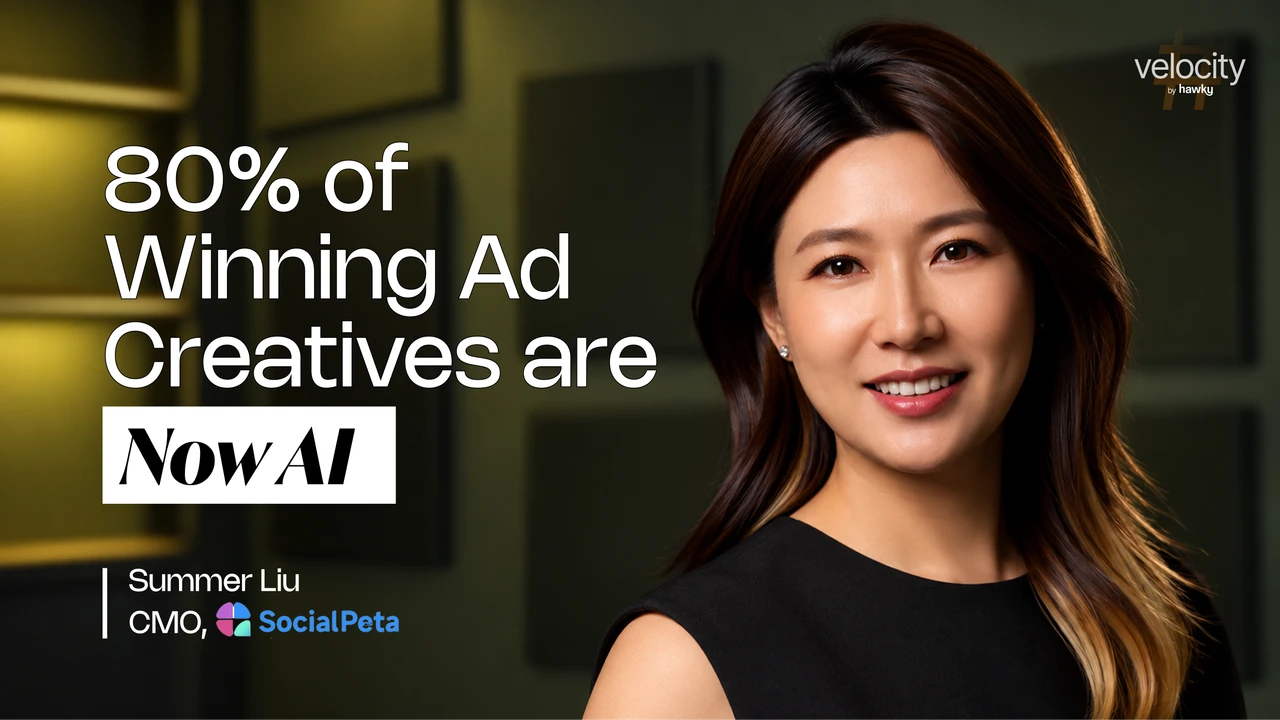
Summer Liu is CMO and head of overseas business at SocialPeta, an ad intelligence platform tracking more than 1.7 billion creatives across 80-plus countries. She has been there ten years of the company's eleven, which means she watched Chinese mobile marketing go global from the inside, one genre at a time.
In the latest episode of Velocity: Performance Marketing Podcast by Hawky, host Surender (Co-Founder, Hawky.ai) asked her to walk through the wildest category in mobile right now: micro dramas. The answer covered where the format came from, why it landed in the United States first, how AI took a third of the top of the chart in roughly a year, and why "should I shoot original or translate?" is an economics question rather than a creative one.
About Summer Liu: Ten Years Watching the Market From Above the Account
SocialPeta started as a tool for Chinese developers. Between roughly 2015 and 2020 it worked with most of the top gaming and non-gaming publishers going overseas. Around 2019 the founder concluded the dashboard was just as useful pointed the other way, at global developers looking in. The company now runs teams in Vietnam, Turkey, India and Argentina, with clients across Europe, Asia, and North and South America.
Summer's framing of what changed in that decade is the one every performance marketer will recognise: "It used to be, you know, like the blue sea what we call." Then the traffic on Meta and Google hit its ceiling. "We have already reached like the peak of all the mobile traffic on those platforms and on the marketing side it's becoming more and more competitive."
Her description of what a third-party platform sees is deliberately unglamorous: "If like you are you know like a single or an independent developer, you may mostly see the business based on your own perspective." Everyone else's creative is the part you are structurally blind to, and on Meta it is the part that decides performance.
The Genre Clock: Farming Games, Fitness Apps, AI Apps, Micro Dramas
Watching every creative in a category at once produces something like a seismograph for genres. Summer's read of the last ten years:
- 2015 to 2018. Gaming apps scaled to the top tier fast. Farming games, strategy games, studios out of North America, Europe and China all reaching the first tier quickly.
- 2018 to 2020. The market got competitive. New studios kept adding genres, and non-gaming caught up, "from a very normal utility to a business" category.
- COVID. Fitness apps spiked because "people cannot go outside and people want to keep fit so they exercise in their home." A very short trend. "And after that everything goes back to normal."
- Post-ChatGPT. AI apps from 2022 onward, including AIGC apps that used to be plain photo tools and can now shoot and restyle images. Perplexity is the scale example she names.
- Now. Micro dramas, which she flags as "purely a new thing."
Each of those is a wave someone rode and someone else read about afterwards. The difference between the two groups is usually visibility.
Where Micro Dramas Actually Came From
The origin is more specific than most coverage suggests, and it is not a TV story.
A Chinese gaming studio was building successful interactive games set against the backdrop of American TV shows, the Mean Girls and Gossip Girl register. Those games proved dramatic content converted. So the team tested a different container for the same material: three to five minute episodes.
They ran it in the United States first, and it worked there first.
The second thing they changed was the money. Not in-app currency, not weapons, not a subscription: "Okay, you can see the first three episodes for free, but if you want to see more, you should charge it and unlock it." Free entry, paywall at the cliffhanger.
Once the model was proven, two very different groups walked in behind it.
The first was novel apps sitting on large libraries of IP, who could convert a novel into a drama at almost no acquisition cost. The second was long-form TV directors and producers who were not the mainstream names. Summer's account of their reasoning is the clearest line in the episode: "If I do not have the chance to make a very huge budget and the one will go to the movie theater thing, then maybe macro drama is a lighter version, a lighter model for me to produce my talent."
Their production answer was geographic. Shoot outside the metropolitan cities, in mid-tier Chinese cities with lower salaries, and finish a show in a week. Launch, take the revenue, scale.
Who Is Winning Outside China
From 2022 the format compounded, and from last year the studios stopped being only Chinese.
Central and Eastern Europe produced one of the strongest operators in Holywater, which now launches shows in the United States as well. And India is, in her words, one of the fastest growing micro drama markets, with the interesting detail that it is growing on both tracks at once. Domestically made shows are popular, and so are the translated and dubbed ones: a show "proved in successful in China, they could be translated and become popular in India as well."
Asked which markets are growing fastest, she puts the United States first, for a reason that has nothing to do with taste: "The United States all the viewers they have very good habits. They have good habits for the payment."
What has changed there is the supply side. The producers used to be based somewhere else. Now domestic studios are entering, many of them out of film. The same thing is happening in South America, where "filmmakers entering the business" is the pattern she sees.
Three of the Top Five Are AI
This is the number that reframes the category.
On the biggest micro drama app in China, three of the top five shows are AI animation dramas. Her definition is strict: "What we define AI animation is it's pure like a AI made, AI characters," produced on the Chinese video models: Seedance, Kling and their peers.
The timeline is short. Two and a half years ago the fast-made shows still had real people in them, shot in a week. Then the video models started shipping versions quickly: "You can see that all the AI characters are becoming more and more vivid. They can have very gentle expressions in their face and their performing and the videos are becoming more closing to a real human being."
She sees that proportion rising in China, India and Korea.
Two structural things follow, and the second matters more than the first.
The teams are tiny. An AI micro drama studio can be "just two or dozen of persons" against a normal micro drama company.
The monetization blueprint is longer. These producers are not thinking one show. They produce one season to test whether the story lands. If it does, the IP becomes a series. One show she cites has reached eleven seasons. "Can you imagine? They have eleven seasons for one story?"
And then the third step, which is where the economics stop looking like video and start looking like talent management. A character that proves popular becomes a virtual idol. "This virtual idol can become a real celebrity to present, to earn advertising income in your real life. Like he could be the KOL for Nike shoes. He could be a KOL for maybe a car."
She has a live case: a purely AI-generated character who went from her first micro drama to commercials and a fashion magazine cover. "The pace is very fast. It happens just in several months."
A mature monetization chain on a much lighter cost structure. That combination is why she calls it a phenomenon rather than an experiment.
Original, Translated, or AI: This Is a Budget Question
Surender pushed on the obvious comparison: does an original show with real actors beat an AI or translated one? Summer declined the premise twice, and her reasoning is the most useful part of the answer.
"There is not you know a certain or a fixed conclusion that local show is better than AI or better than translated." The reason is that the market has already resolved it by budget: "Only the top players in the market they can afford all the original cost, original script, original directors to make real people with original local costs."
So for anyone else the choice was never open: "If you want to enter the market now, your only choice is basically start from AI or start from translated to test whether your story can be successful in this place."
India follows the same split. Top players like Kuku FM have the resources to localize scripts and hire local cast, and have also been launching AI-made shows since last year. The two tracks are not rivals, they are different rungs.
On the narrower question of whether viewers can tell, she is careful but not evasive. On production efficiency, "definitely AI has much more advantage." On the audience, she gives the specific condition where AI wins outright: two shows with similar stories, where the real-actor version has visible flaws: inexperienced actors, a performance that does not land. "Maybe they will reckon, okay, the stories are similar and I prefer the AI shows. It could be. I think it's possible with those conditions."
Which is a more interesting answer than a blanket one. AI is not beating good acting. It is beating mediocre acting, at a fraction of the cost, at speed.
How to Tell a Hit Is Happening: Read the Creative Volume
For performance marketers, this is the transferable method, and it does not need access to anyone's revenue.
SocialPeta judges whether a micro drama is working by watching ad creative output. A sudden surge of creatives behind one show tells you the platform is pushing it. If the platform produced the show itself, the push is a signal in its own right: "In most cases if it's like they made the show by themselves always means that this is an important project. They may like spend a lot of budget on it."
Then the feedback loop. They watch how the campaign performs, and "if it becomes popular they will devote more resources on the shows, on the marketing." Sustained creative volume is the tell that it worked.
The creatives themselves are cut from the product: the first or second episode, or the most dramatic moment lifted out of the show and used as the hook.
Her example of how long that tail runs: a city drama show finished broadcasting within a month at the end of last year. "But in the first half of this year, I can still see like the ad creatives on my cell phone of that show because that was a very successful one."
Six months of paid support after the show ended. That is what a genuine hit looks like from the outside, and it is visible to anyone doing competitive creative research rather than only reading their own dashboard.
How Micro Dramas Make Money, In Order
Summer's monetization ladder, from rarest to most common:
- IP into a virtual celebrity. Only for the top tier, and it has a hard prerequisite: "they have accumulated very loyal funds with a very big quantity." Without the fanbase there is no endorsement business.
- Free app, pay to unlock episodes. Still the mainstream model and still the main revenue line.
- Brand insertion inside the show. Product placement while you watch. She calls it the emerging one, not the replacement.
Asked whether anything else is being tried, she was direct that this is the set. The interesting shift is not a fourth model. It is that the top of the ladder now includes characters who do not exist.
Two Opposite Trends Leaving China at the Same Time
Asked what is happening in China now that will travel, she named two directions that point away from each other.
Upmarket. The platforms that already proved the format are investing in quality: professional cast from drama academies, real costumes, directors and full operations teams, longer shoots, and marketing budget behind the launch. "They're heading to the directions to make the macro drama more and more similar with like the long drama or even with the scenes look like movies." The result is what she calls an elegant micro drama, explicitly different from the fast-made one.
Downmarket and synthetic. At the same time, AI-model shows are testing IPs pulled from online novels. Two themes she singles out: the adorable-kid format, told from a child's point of view surviving inside a large family, and romance, with a rich man or with a much older man. Both are travelling. "Not only popular in China but also popular maybe in Europe."
The same category is simultaneously becoming cinema and becoming synthetic, and both ends are exporting.
Key Takeaways from the Episode
- Micro dramas came out of gaming, not television. A Chinese interactive-game studio proved dramatic content converted, then tested it as three to five minute episodes and launched in the United States first.
- The monetization model came with the format. Three episodes free, then pay to unlock. It is still the mainstream revenue line for the category worldwide.
- AI took a third of the top of the chart in about a year. Three of the top five shows on China's biggest micro drama app are pure AI animation, made by teams of two to a dozen people.
- The end state is a virtual celebrity, not a show. Test one season, turn a hit into a series, then turn the character into a KOL earning real endorsement income. One character went from first episode to fashion magazine cover in months.
- Original versus translated is settled by budget, not quality. Only top players can afford original scripts, directors and local cast. Everyone else starts on AI or translated content to test whether the story works at all.
- AI beats weak acting, not good acting. Where two shows carry similar stories and the live-action version has visible performance flaws, viewers may pick the AI one.
- Creative volume is the public signal of a hit. A surge of creatives means a push; sustained creatives months after a show finished airing means it worked. One show was still running ads six months after broadcast ended.
- The category is splitting in two directions at once. Top platforms are moving toward movie-grade production while AI studios mine online-novel IP (kid-POV family dramas and romance), and both are exporting out of China.