Banner Ads
Last updated
Banner Ads are graphical display units placed in dedicated ad slots across websites and apps for cheap, web-wide reach, strongest in retargeting, where relevance and a full set of sizes decide whether they convert or feed banner blindness.
Banner Ads
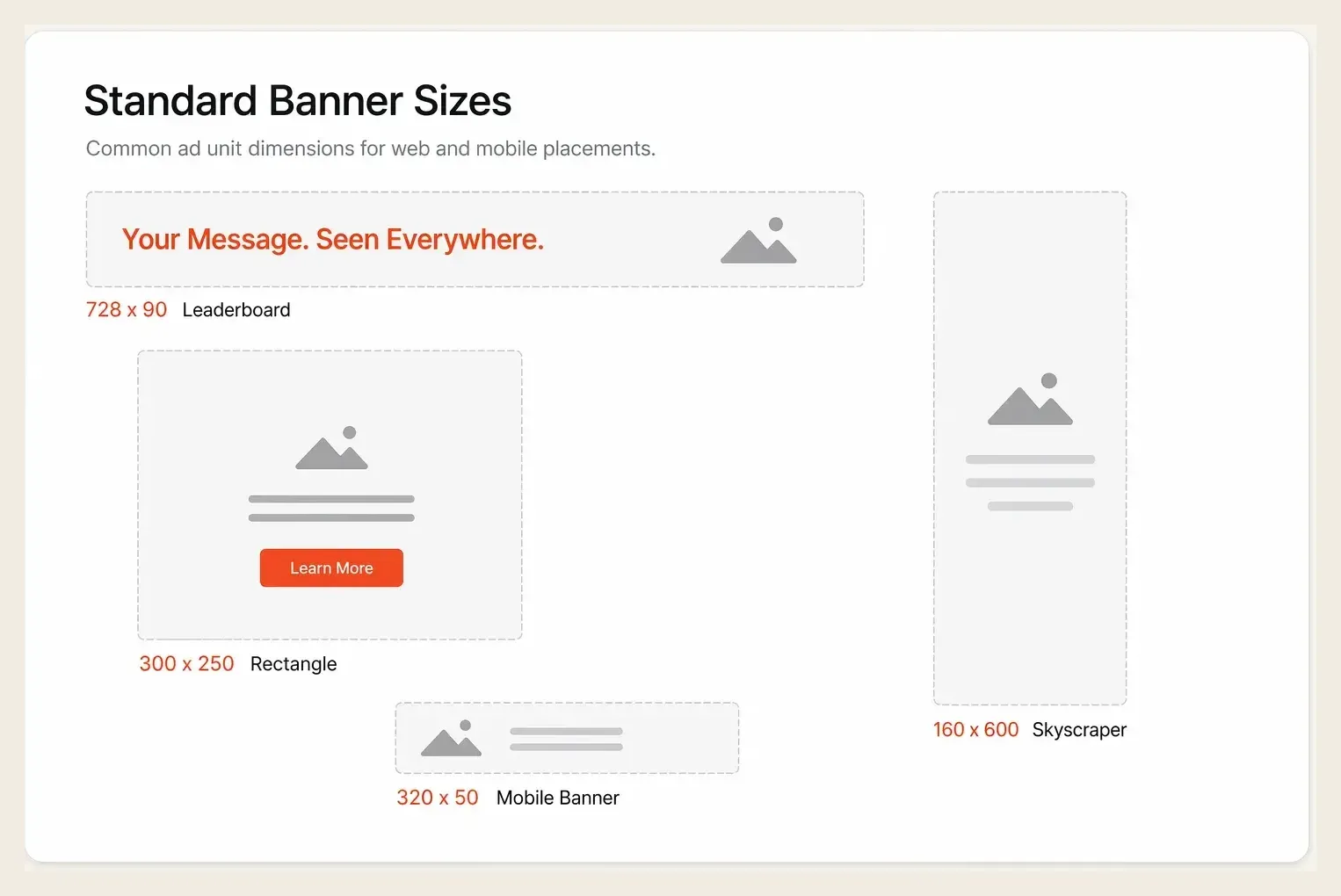
Banner Ads are graphical display units, usually rectangular images or animations, placed in dedicated ad slots on websites and apps to drive clicks, awareness, or retargeting at scale. They are the oldest digital ad format, served programmatically across networks like the Google Display Network in standard sizes such as the 728x90 leaderboard, the 300x250 medium rectangle, and the 160x600 skyscraper. Because they are cheap to serve and reach enormous inventory, banners remain a foundational tool for staying visible across the web, even as audiences have trained themselves to skim past them.
Why It Matters
Banner Ads matter because they deliver massive, low-cost reach and are the backbone of retargeting, where their economics are strongest. The average display banner CTR sits at roughly 0.46%, and many awareness banners run well below that, but the CPM is often a fraction of social or video inventory, so the cost per impression stays low enough to keep a brand present everywhere its audience browses. For a retargeting audience that already knows the brand, that cheap, repeated visibility can convert at a far better rate than the headline CTR suggests.
The format also fights its own biggest weakness, banner blindness, the trained habit of ignoring rectangular ad slots. That habit is exactly why creative and placement discipline decide whether banners work at all. A relevant offer served to a warm audience in a viewable slot performs, while a generic banner sprayed at cold traffic burns budget against people who never look. Knowing that distinction is what separates banners as a cheap workhorse from banners as wasted spend.
How It Works
Banner Ads work by serving an image or animated creative into a publisher's ad slot through an ad network or exchange, usually bought on a CPM or CPC basis and targeted by audience, context, or retargeting list. The creative carries a headline, a visual, and a call-to-action, and clicking it sends the user to a landing page, so both the banner and the destination have to align.
- Produce the full set of standard sizes, since a campaign needs leaderboard, rectangle, skyscraper, and mobile units to win available inventory.
- Lead with one clear message and a single call-to-action, because a banner has seconds and very little space.
- Prioritize viewable, above-the-fold placements, since an impression that never enters the screen cannot perform.
- Lean into retargeting and warm audiences, where banner relevance and response are highest.
Because the unit is small and easily ignored, creative clarity and audience relevance are the levers that move results. A banner shown to the right person with the right offer earns the click that a generic blast never will.
A Real Example
An e-commerce furniture brand runs a broad prospecting banner campaign on the Google Display Network and sees a 0.06% CTR with a $9 CPM on $20,000 of monthly spend, generating clicks that rarely convert. The campaign looks like a failure until the team splits it by audience and finds the cold prospecting banners are dragging everything down.
The brand reallocates 70% of the budget into retargeting banners aimed at recent product viewers and abandoned carts, refreshing the creative with the exact products each user browsed. The retargeting banners post a 0.7% CTR, more than ten times the prospecting units, and a $14 cost per purchase on a product line averaging $190, which is a strong return. Total purchases from display triple even though overall spend stays flat, because the budget moved from cold reach to warm, relevant placements where banners actually convert.
Common Mistakes
| ❌ Mistake | ✅ Better Approach |
|---|---|
| Spraying generic banners at cold traffic | Concentrate banner budget on retargeting and warm audiences |
| Shipping only one or two ad sizes | Produce the full set of standard sizes to win all available inventory |
| Cramming multiple offers and CTAs into one unit | Lead with a single message and one clear call-to-action |
| Ignoring viewability and paying for off-screen impressions | Prioritize viewable, above-the-fold placements that can actually be seen |
How Hawky Helps
Banner campaigns need many sizes and constant creative refreshes to fight banner blindness, and producing that volume on-brand is the real bottleneck. Hawky's Creative Agent generates on-brand banner sets across every standard size at once, adapting one concept into leaderboard, rectangle, skyscraper, and mobile units while keeping the message and a single call-to-action consistent. It studies which layouts, offers, and visuals are earning clicks for warm audiences and briefs fresh variants in that proven direction, so the account always has new banner creative ready before the current set fatigues.
On delivery, Hawky's Performance Agent decides where banner budget goes, concentrating spend on viewable, high-intent placements and retargeting pools while pulling back on cold inventory that only burns impressions. Both agents read from FeatherDB, the account's living memory, so every banner is informed by which sizes, offers, and audiences already converted instead of guessing. The result is a complete, on-brand banner set placed against the audiences where the format actually performs.
Frequently Asked Questions
What are the most common banner ad sizes?
The most common banner sizes are the 728x90 leaderboard, the 300x250 medium rectangle, the 160x600 wide skyscraper, the 320x50 mobile banner, and the 300x600 half-page unit. The 300x250 and 728x90 tend to deliver the most inventory and the strongest performance, which is why most campaigns prioritize them while still shipping the full set to maximize reach.
Do banner ads still work in 2026?
Yes, banner ads still work, but mainly as a cheap reach and retargeting tool rather than a primary direct-response driver. Their average CTR is low at around 0.46%, so they perform best when served to warm audiences who already know the brand, where relevance and repeated visibility convert far better than the headline click rate implies.
What is a good CTR for banner ads?
A typical display banner CTR is around 0.46%, and many cold prospecting banners fall below 0.1%, while well-targeted retargeting banners can reach 0.5% to 1% or higher. Rather than chasing CTR alone, it is better to judge banners on cost per result, since cheap impressions to the right audience can convert even at a modest click rate.
What is the difference between banner ads and native ads?
Banner ads sit in clearly separate, standardized ad slots and look distinct from the surrounding page, while native ads are designed to match the form and feel of the content around them so they blend into the feed. Native typically earns higher engagement by sidestepping banner blindness, whereas banners offer cheaper, more standardized reach and are especially efficient for retargeting.
How do I stop my banner ads from being ignored?
The most effective fixes are to serve banners to warm and retargeting audiences instead of cold traffic, keep the creative to one clear message and call-to-action, and refresh the design before it fatigues. Prioritizing viewable, above-the-fold placements also helps, since an impression that never enters the screen cannot earn attention no matter how strong the creative is.
Quick Takeaway
Banner Ads deliver cheap, web-wide reach and are strongest in retargeting, but banner blindness means relevance and a full set of sizes decide whether they convert or waste budget. Aim them at warm audiences and keep the creative fresh.
When your banners get ignored and producing every size on-brand is the bottleneck, the fix is agents that generate the full banner set and place it where it actually performs. Ready to hire your first AI performance team? Book Demo