8 Best Tools for Creative ROAS Optimization in 2026
8 Best Tools for Creative ROAS Optimization in 2026

8 Best Tools for Creative ROAS Optimization in 2026

Sudarshan Baskar

Sudarshan Baskar

Sudarshan Baskar

13 Min Read

13 Min Read

13 Min Read

  • What creative ROAS optimization actually means in 2026

  • The 8 best tools for creative ROAS optimization

  • Feature comparison: how these tools stack up

  • Why the analysis-to-production loop matters more than any single tool

  • Which tool is right for your team?

  • Frequently Asked Questions

  • What creative ROAS optimization actually means in 2026

  • The 8 best tools for creative ROAS optimization

  • Feature comparison: how these tools stack up

  • Why the analysis-to-production loop matters more than any single tool

  • Which tool is right for your team?

  • Frequently Asked Questions

  • What creative ROAS optimization actually means in 2026

  • The 8 best tools for creative ROAS optimization

  • Feature comparison: how these tools stack up

  • Why the analysis-to-production loop matters more than any single tool

  • Which tool is right for your team?

  • Frequently Asked Questions

Make Every Ad a Winner

Hooks, CTAs, visuals - decode every detail.

The best tools for creative ROAS optimization in 2026 are Hawky, Motion, and Madgicx. Hawky leads for teams that need element-level creative analysis paired with fatigue prediction and AI-Powered Creative Generation. Motion is the strongest standalone creative analytics platform. Madgicx combines creative optimization with autonomous budget management for Meta advertisers.

Creative is the new targeting. Audience overlap across Meta, Google, and TikTok means the ad itself is your primary lever for improving return on ad spend. Yet most teams still optimize creatives by gut feel, catching performance drops after ROAS has already cratered. The tools in this list exist to close that gap: connecting specific creative elements to revenue outcomes, predicting fatigue before it costs you, and helping you produce more of what works.

What Creative ROAS Optimization Actually Means in 2026

Creative ROAS optimization is the practice of using data and software to identify which specific creative elements (hooks, visuals, body copy, CTAs) drive return on ad spend, then using those insights to improve future ad production. It goes beyond traditional A/B testing by analyzing performance at the component level rather than the ad level.

In practice, this means a tool that can tell you "the first 3 seconds of your video hook drove 40% higher hold rates" instead of just "Ad A beat Ad B." That specificity is what separates creative optimization from creative reporting.

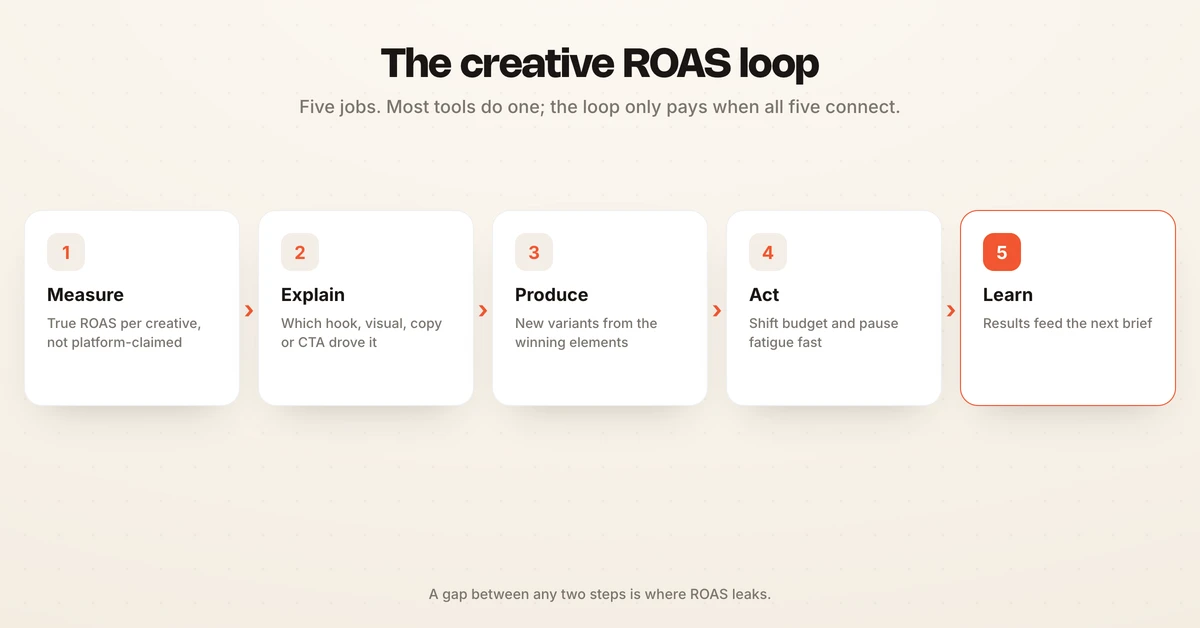
The category has matured significantly. In 2024, most tools stopped at dashboards. In 2026, the best creative optimization tools close the loop: they analyze what's working, predict when it will stop working (creative fatigue), and feed those insights directly into new creative production. This shift from reactive reporting to predictive intelligence is what defines the category today.

A strong creative ROAS optimization tool should do at least three of these five things well: Element-level Performance analysis, Creative Fatigue Prediction, Competitor creative intelligence, AI-Assisted creative generation, and cross-platform reporting. Tools that only cover one of these capabilities force you to stitch together a fragmented stack, which slows down creative iteration and introduces data gaps between analysis and action.

The stakes are real. Platform algorithms on Meta and Google Ads now shift 90%+ of campaign budget toward 2-3 top-performing creatives. When those creatives fatigue (and they always do), your ROAS drops fast.

Teams that catch fatigue early and replace winners with data-informed variants maintain stable performance. Teams that react after the drop spend weeks recovering. That's why ad creative analysis software and AI ad optimization tools have moved from "nice to have" to essential infrastructure for performance teams.

The 9 Best Tools for Creative ROAS Optimization

1. Hawky: Best for Element-Level Creative Analysis With Fatigue Prediction and AI Generation

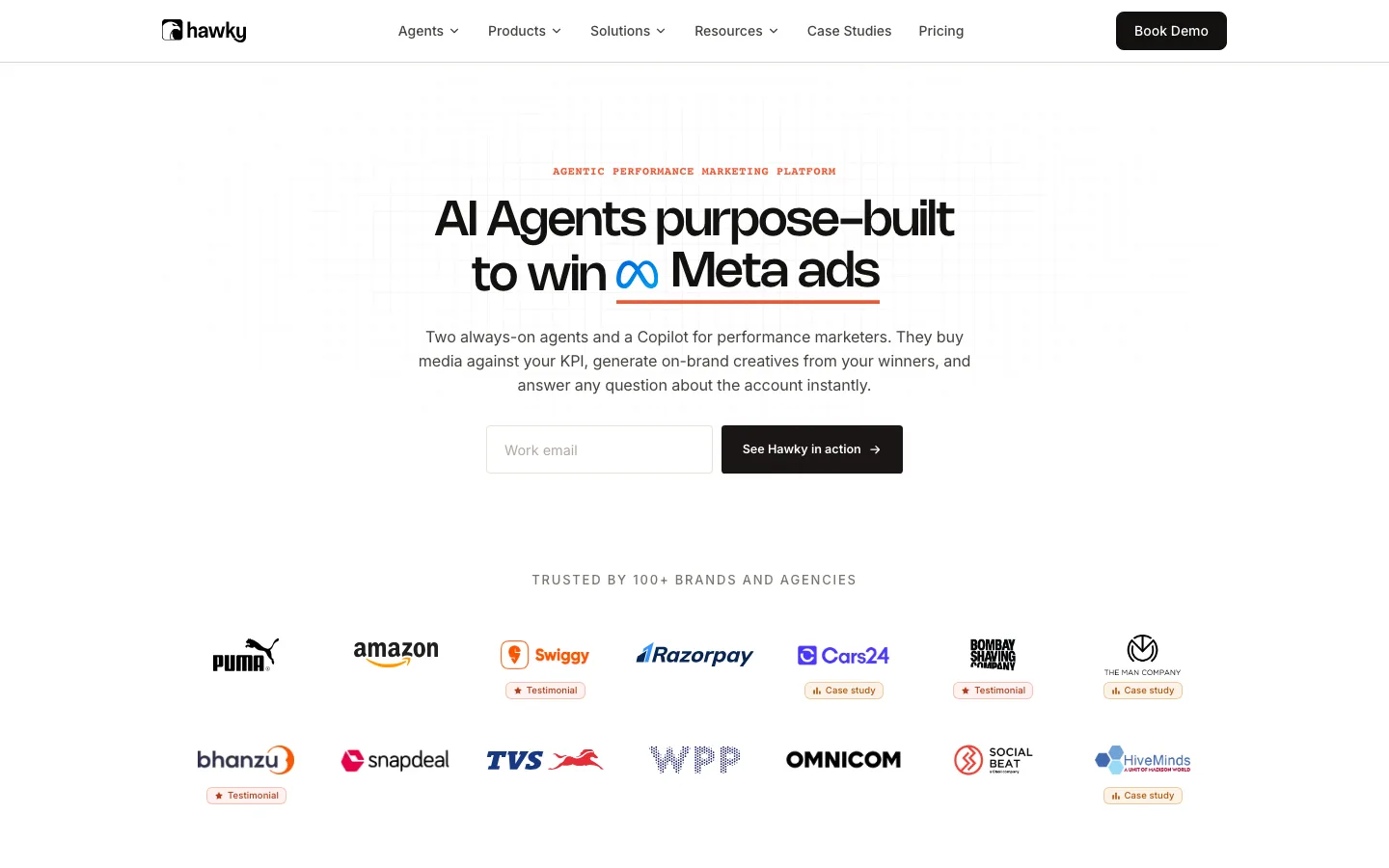
Hawky is an AI-native Creative Intelligence Platform built for performance marketers who need to understand exactly which creative elements drive ROAS, not just which ads perform better than others. It breaks every ad down into its component parts (hook, visual style, body copy structure, CTA) and maps each element to performance outcomes across Meta and Google campaigns.

What makes Hawky different from pure analytics tools is the closed loop. It doesn't stop at telling you what worked. It predicts when winning creatives will start to fatigue, tracks what competitors are running across Meta and Google, and generates new AI creatives based on your proven winning patterns. That analysis-to-production pipeline is something most tools in this category either don't attempt or handle through third-party integrations that break the data chain.

The competitor creative intelligence feature is worth calling out separately. Most creative optimization tools analyze only your own ads. Hawky also monitors what competitors are launching, scaling, and pulling down. This gives performance teams a view of the competitive creative landscape they'd otherwise need a separate spy tool to get.

Hiveminds, a performance marketing agency, cut CPL by 27% and saved 160+ hours per brand monthly using Hawky's element-level insights. Univest increased CTR by 20% within 7 days by applying Hawky's creative intelligence to their ad rotation strategy.

Key capabilities:

Best for: Performance marketing teams and agencies managing $20k+/month in Meta and Google ad spend who need creative intelligence, not just creative reporting.

Pricing: Talk to Sales Team

2. Motion: Best for Visual Creative Analytics and Reporting

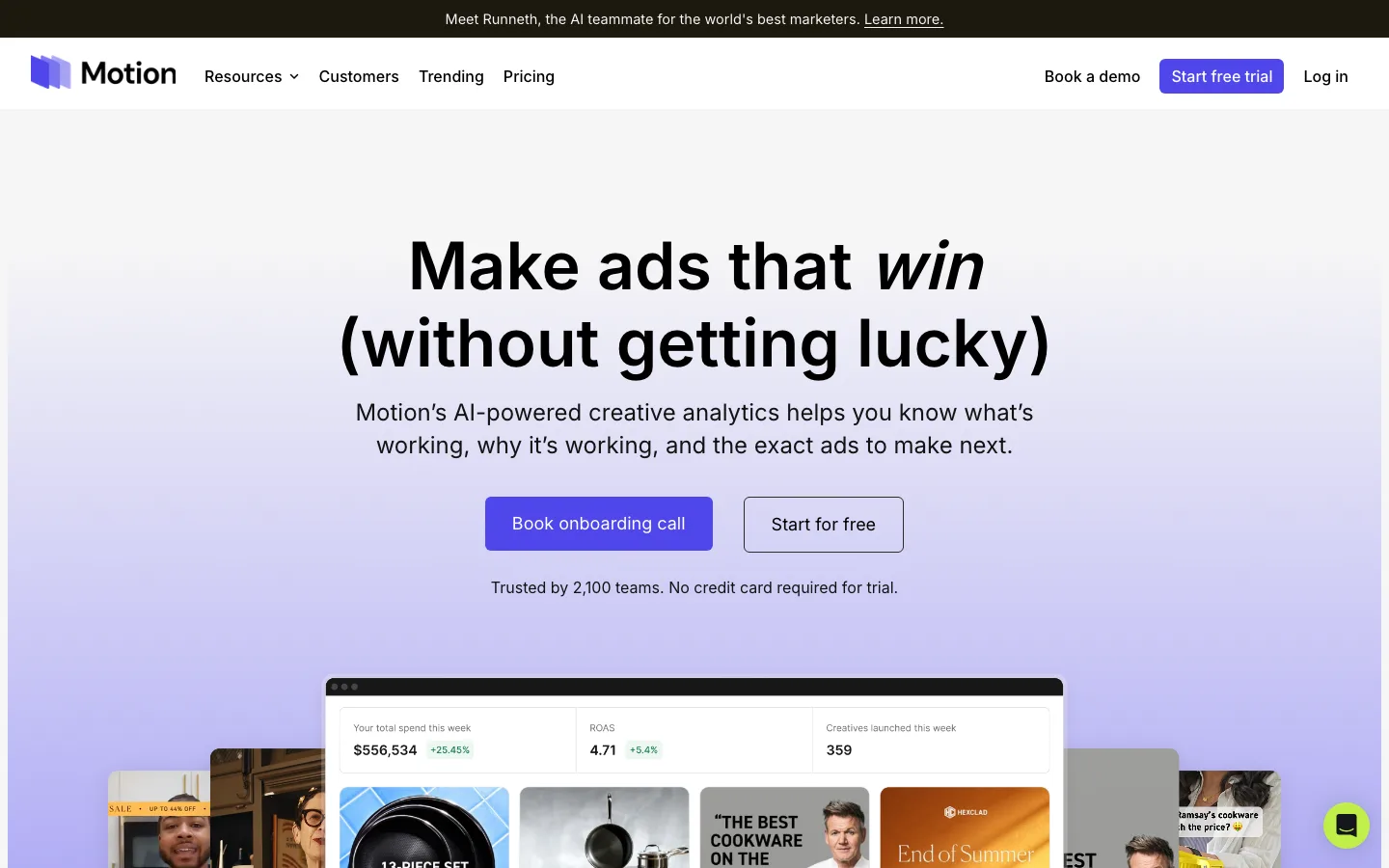
Motion is the most widely adopted creative analytics platform among performance marketing teams. It pulls creative data from Meta, TikTok, YouTube, and other channels into visual reports that make it easy to spot which concepts, formats, and messaging angles drive results.

Motion's automatic creative tagging system is its standout feature. It categorizes ads by format, hook type, creator, and visual style without manual input, so you can filter performance by creative attributes at scale. The reporting is well-designed: clean, visual, and built for the way media buyers actually work. Teams frequently cite Motion's dashboards as the most shareable creative reports they've used.

Where Motion fits in a creative ROAS optimization stack is as the analytics layer. It answers "what's working" with clarity and speed. For many teams, that's the critical first step.

The limitation is that Motion stops there. It doesn't predict what will stop working, doesn't track competitor creatives, and doesn't generate new ads based on winning patterns. You'll need additional ad creative analysis tools to close the loop from analysis to production.

Strength: Best-in-class creative reporting interface. If your primary need is understanding creative performance across channels with shareable dashboards, Motion does this better than anyone.

Limitation: Motion is an analytics and reporting tool, not an optimization platform. It doesn't predict creative fatigue, generate new creatives, or track competitor ads. You're getting the "what happened" without the "what to do next."

Best for: Media buyers and creative strategists who need clear, visual creative performance reports to share with clients or leadership.

Pricing: Starts at $199/month

3. Madgicx: Best for Meta-Focused Creative Optimization With Budget Automation

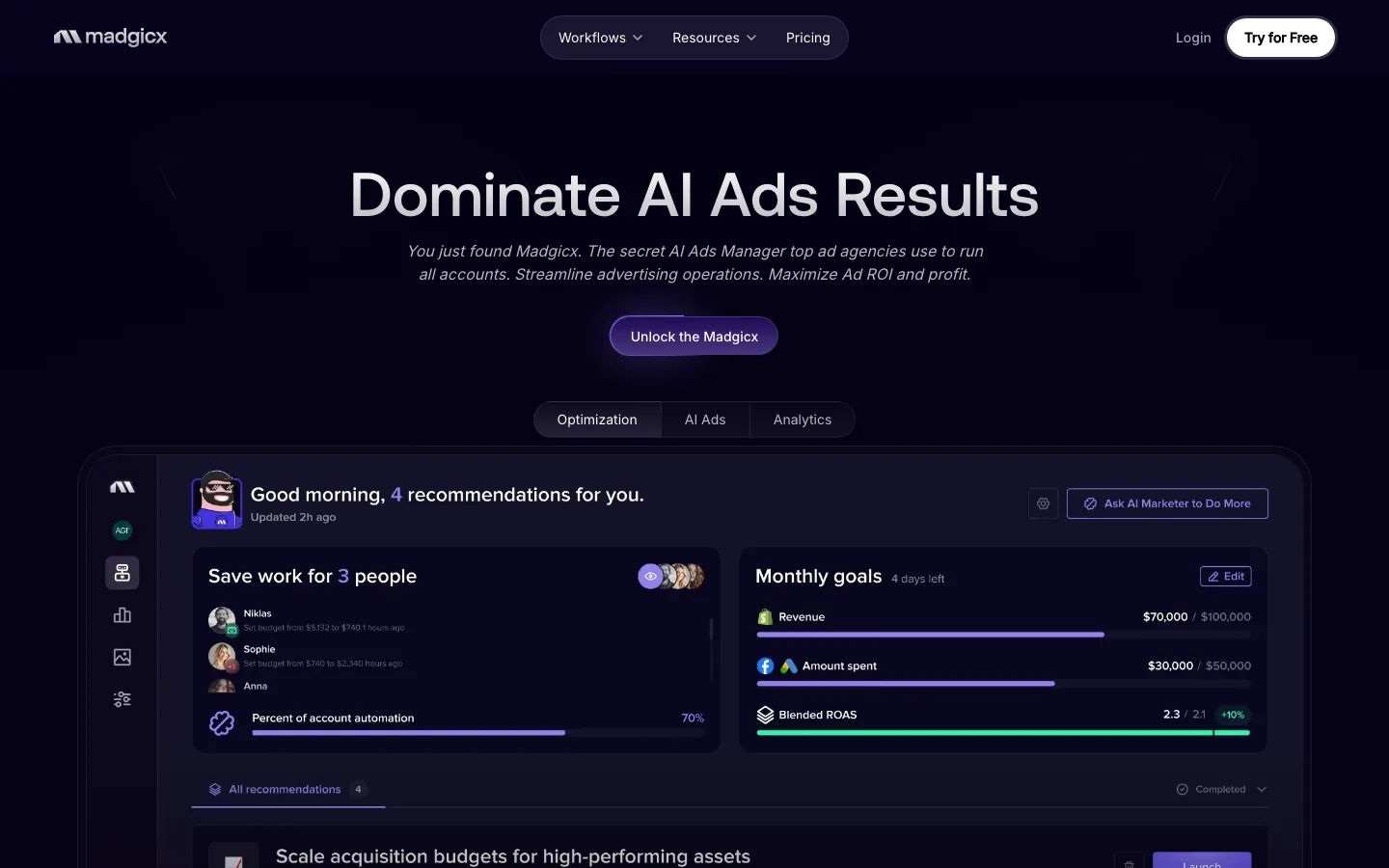
Madgicx combines creative performance analysis with autonomous budget optimization specifically for Meta advertisers. Its AI can shift spend between campaigns and ad sets based on real-time ROAS without manual rules, which makes it particularly useful for teams managing dozens of active ad sets simultaneously.

The creative optimization side includes automated creative analysis, audience segmentation by creative performance, and recommendations for which creative angles to scale or pause. Madgicx also offers a Spark Report feature that audits your entire Meta account and identifies creative and structural improvements. For teams whose ad spend is 80%+ on Meta, this combination of creative intelligence and budget automation eliminates a lot of manual work.

The platform's creative fatigue detection sends basic alerts when performance metrics decline, though it operates at the ad level rather than predicting fatigue based on element-level patterns. For Meta-only teams, this may be enough. For cross-platform teams, it leaves gaps.

Strength: The combination of creative analysis and budget automation in one platform. For Meta-heavy advertisers, having one tool manage both creative decisions and budget allocation reduces the gap between insight and action.

Limitation: Meta-focused. If you run significant spend on Google, TikTok, or programmatic channels, Madgicx only covers part of your stack. Creative analysis depth is at the ad level, not element level.

Best for: E-commerce brands and direct-response teams running $10k-$100k/month on Meta who want creative and budget optimization in one place.

Pricing: Starts at $44/month for basic plans; full-feature plans based on ad spend

4. Pencil: Best for AI Creative Generation With Performance Prediction

Pencil approaches creative ROAS optimization from the production side. It uses AI to generate ad creatives (static and video) and predicts which variants are most likely to perform before you spend a dollar on them. The platform learns from your historical performance data and broader industry benchmarks to score new creatives before launch.

Pencil is useful when your creative bottleneck is production volume, not analysis. It helps teams generate more testable variants faster, which is critical when platform algorithms demand fresh creative every 2-3 weeks to avoid fatigue. The AI isn't replacing your creative team; it's accelerating the iteration cycle between tests so your team spends more time on strategy and less on production.

The pre-launch scoring feature is particularly valuable for teams with limited test budgets. Instead of spending $500 testing 10 creatives to find 1-2 winners, you can pre-score 50 variants and only spend budget on the top candidates. That's a meaningful efficiency gain for performance marketers who track creative testing costs closely.

Strength: Fast creative production with data-informed predictions. The pre-launch scoring reduces wasted test spend on low-probability creative variants.

Limitation: Pencil generates creatives but doesn't deeply analyze why your existing creatives are working or dying. It solves the "make more stuff" problem but not the "understand what works at the element level" problem. You'll likely still need a creative analytics tool alongside it.

Best for: Direct-response marketers and agencies producing high volumes of ad creative who need to accelerate production cycles.

Pricing: Starting at $119/month

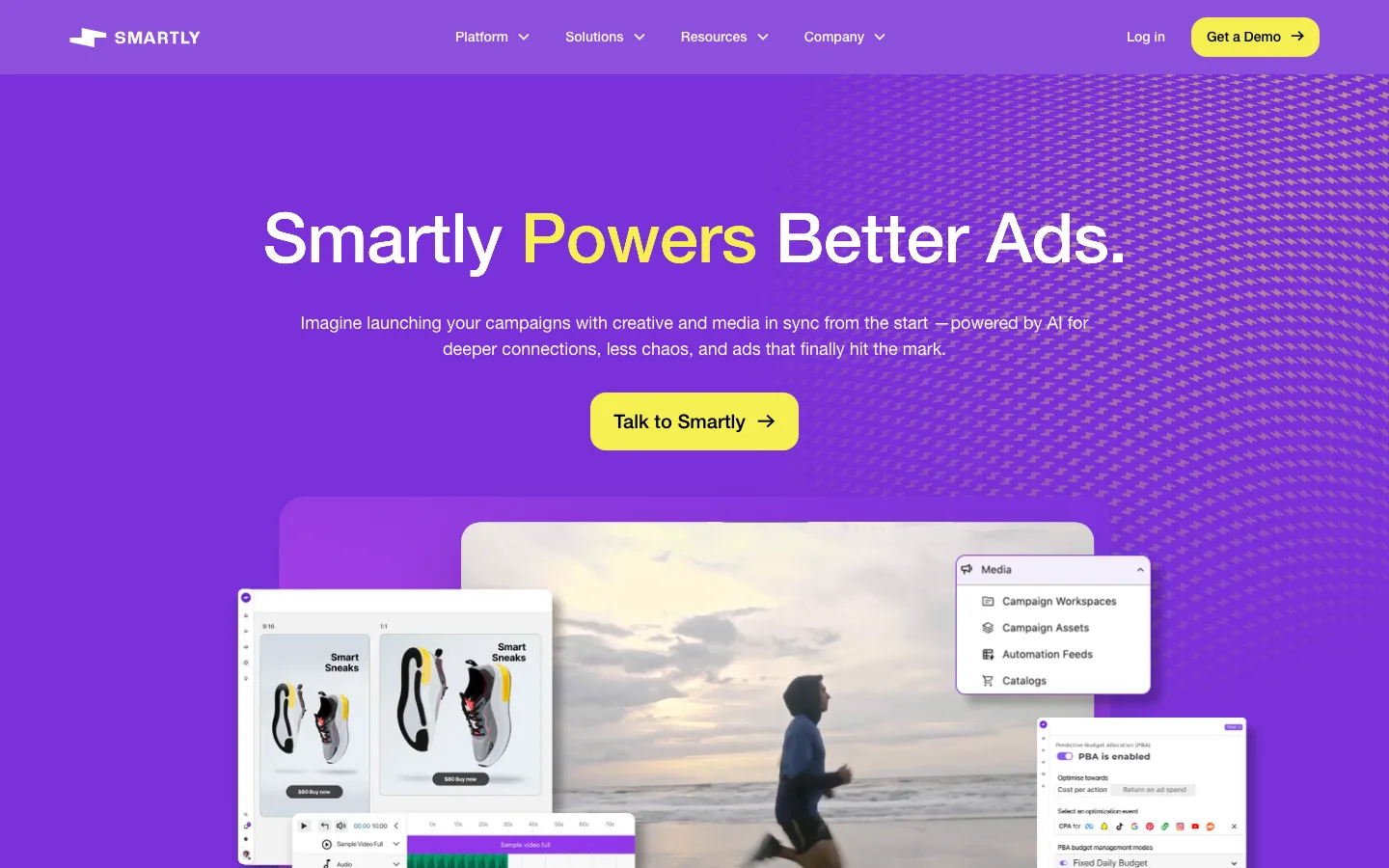
5. Smartly: Best for Enterprise Cross-Channel Creative Automation

Smartly is an enterprise creative automation platform that integrates creative production, dynamic creative optimization (DCO), and media buying across Meta, Google, TikTok, Snapchat, and Pinterest. It's designed for large teams managing high creative volumes across multiple markets and channels.

Smartly's DCO capabilities automatically assemble ad variants from modular components (images, headlines, CTAs, product feeds) and serve the best-performing combinations to each audience segment. This is especially valuable for e-commerce brands with large product catalogs that need personalized creative at scale. A retailer with 500 SKUs can automatically generate product-specific creatives without manual production for each item.

The platform also handles creative localization for multi-market campaigns. If you're running ads across 10+ countries with different languages and cultural contexts, Smartly's templating system can adapt creatives automatically based on market rules you define. That's a capability most tools in this list don't even attempt.

Strength: True cross-channel creative automation at enterprise scale. The combination of creative production, DCO, and media buying in one platform reduces tool fragmentation for large teams.

Limitation: Enterprise pricing and complexity. Not practical for small teams or sub-$50k/month spend levels. The platform's depth means a longer onboarding period, and you'll need dedicated resources to get full value from it.

Best for: Enterprise brands and large agencies managing $100k+/month across 3+ ad platforms who need centralized creative automation.

Pricing: Custom enterprise pricing

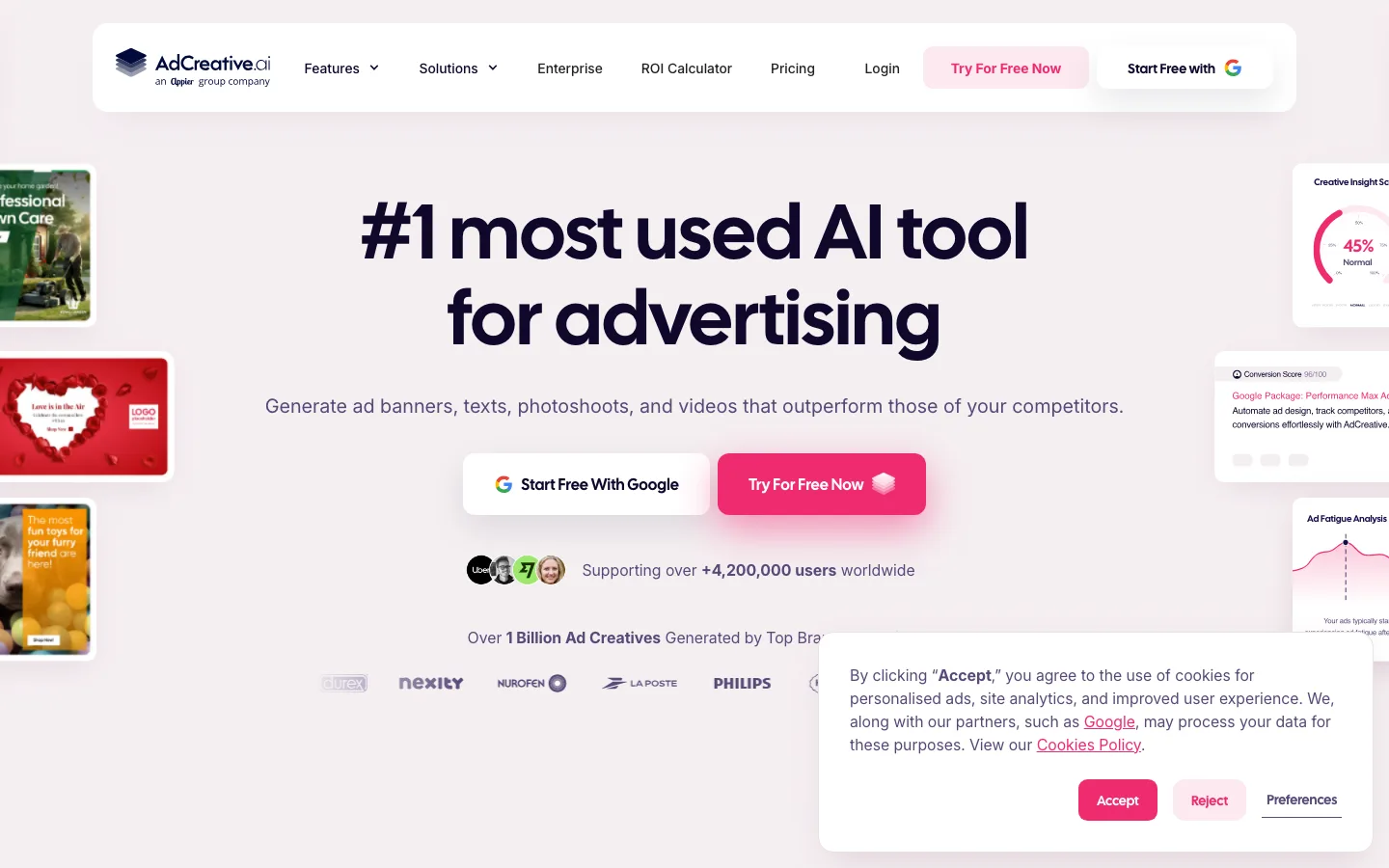
6. AdCreative.ai: Best for Fast AI Creative Generation With Pre-Launch Scoring

AdCreative.ai generates ad creatives using AI and scores them for predicted performance before launch. The platform produces static ads, social media posts, and ad copy variants, trained on a large dataset of high-performing ads to predict click-through and conversion rates.

The speed is the main draw. Teams can generate hundreds of ad variants in minutes, each with a performance score, and immediately deploy the highest-scored options for testing. AdCreative.ai also integrates with Meta, Google, and other platforms for direct publishing, which removes the friction of downloading and re-uploading assets.

For small teams without dedicated designers, AdCreative.ai provides a creative production capability that would otherwise require freelancers or an agency. The quality won't match custom design work, but for performance testing at scale, it provides enough creative variety to keep algorithms fed with fresh assets.

Strength: Speed and volume of AI creative generation. Pre-launch scoring helps prioritize which variants to test first, reducing wasted ad spend on low-probability creatives.

Limitation: Generated creatives can feel templated, particularly for brands with distinctive visual identities. The platform is stronger at generation than analysis of existing creative performance. Performance predictions are based on broad benchmarks, not your specific account data initially (though this improves with use).

Best for: Small to mid-size teams that need to rapidly increase creative testing volume without adding headcount.

Pricing: Starts at $29/month for 10 downloads; professional plans from $209/month

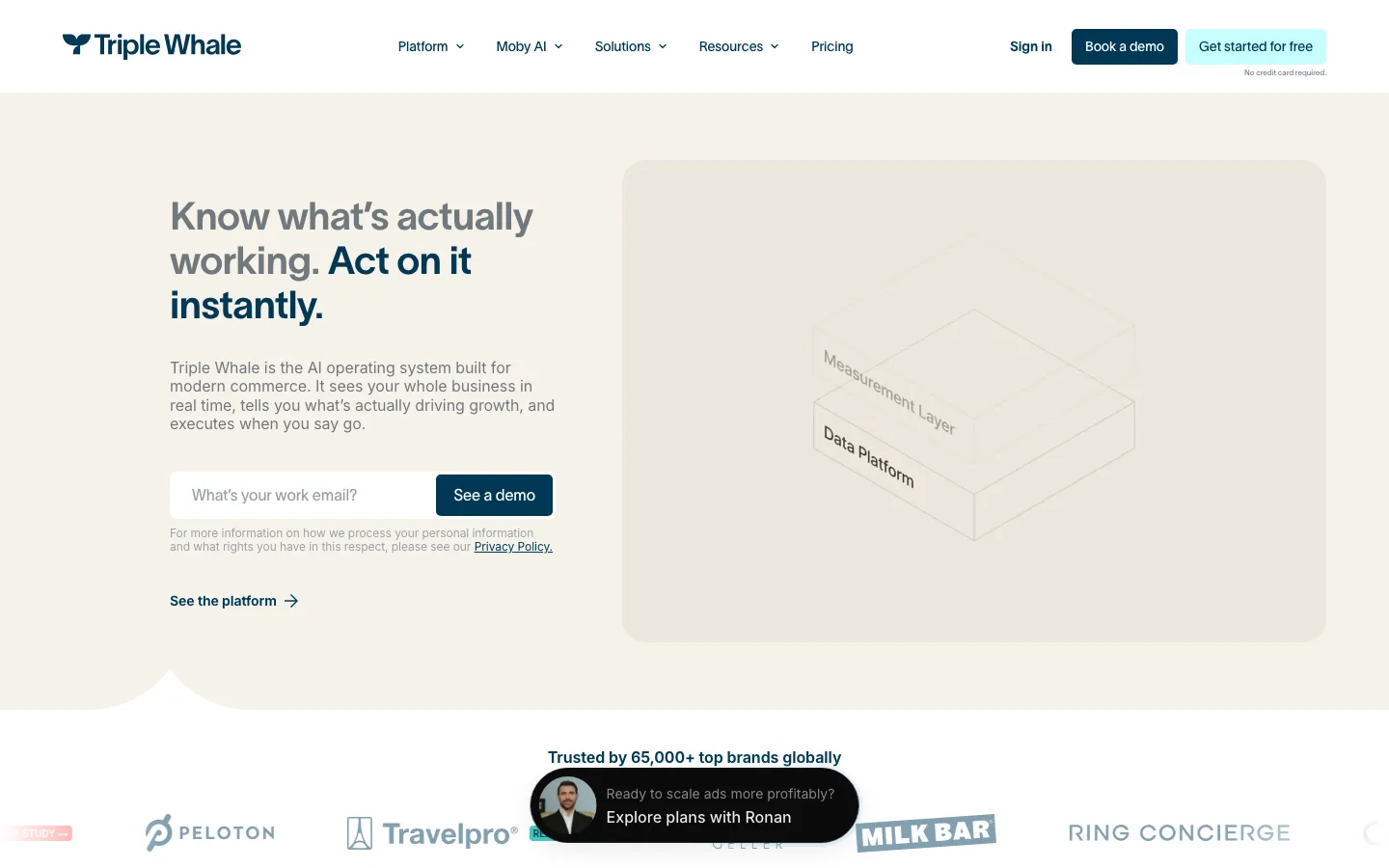
7. Triple Whale: Best for Attribution-First Creative Analytics

Triple Whale is primarily an attribution and analytics platform for e-commerce brands, but its creative analytics module has become a meaningful component of its value proposition. It connects creative performance data to actual revenue attribution, showing which creatives drive purchases, not just clicks.

Triple Whale's Pixel provides first-party attribution data that fills the gaps left by platform-reported metrics (especially post-iOS 14). For creative ROAS optimization specifically, this matters because you're making creative decisions based on revenue data rather than platform-inflated ROAS numbers. A creative that Meta reports as a 4x ROAS winner might actually be a 2.2x performer when measured through first-party attribution. That distinction changes which creatives you'd scale.

The platform also tracks creative performance across the full customer journey, from first click to purchase. This means you can identify creatives that drive strong initial engagement but weak conversion, versus creatives that may have lower CTR but consistently drive purchases. That full-funnel view is something most creative analytics tools miss.

Strength: Attribution accuracy. When you're optimizing creatives for ROAS, the accuracy of your ROAS measurement matters as much as the creative analysis itself. Triple Whale gives you a more honest baseline to optimize against.

Limitation: Creative analytics is a secondary feature, not the primary product. The creative analysis depth is limited compared to dedicated creative intelligence tools. No creative generation, no fatigue prediction, no competitor intelligence.

Best for: E-commerce brands on Shopify or similar platforms that need accurate attribution data as the foundation for creative optimization decisions.

Pricing: Starting at $129/month; scales with revenue

8. Revealbot: Best for Rule-Based Creative Rotation and Budget Optimization

Revealbot is an ad automation platform that combines rule-based optimization with AI-suggested improvements. For creative ROAS optimization, its strongest use case is automated creative rotation: setting rules that pause fatiguing ads, scale winning ones, and trigger new creative tests based on performance thresholds you define.

Revealbot works across Meta, Google, TikTok, and Snapchat, and supports complex automation rules that would take hours to manage manually. You can set conditions like "if ROAS drops below 2x for 3 consecutive days, pause this ad and activate the next creative in the queue." These rules run 24/7, which means your creative rotation doesn't depend on someone checking dashboards every morning.

The platform is particularly strong for agencies managing multiple client accounts with similar optimization playbooks. You can template your creative rotation rules and apply them across accounts, standardizing your optimization process without manual repetition.

Strength: Granular automation rules for creative management. If you know exactly what conditions should trigger creative changes, Revealbot executes those rules reliably across platforms.

Limitation: Rule-based, not intelligence-based. Revealbot automates the execution of your creative optimization strategy, but it doesn't tell you what that strategy should be. You need to define the rules yourself based on insights from other tools.

Best for: Performance marketing teams and agencies managing 20+ active campaigns who need automated creative lifecycle management across platforms.

Pricing: Starts at $99/month; scales with ad spend

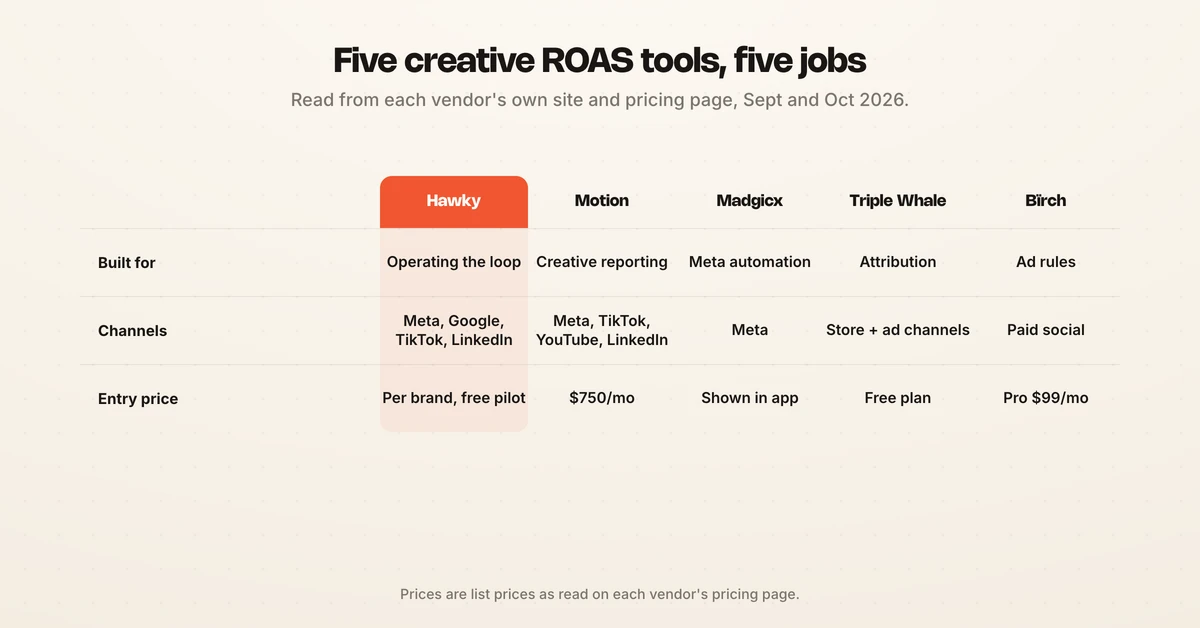
Feature Comparison: How the Best Creative ROAS Optimization Tools Stack Up

Tool

Element-Level Analysis

Fatigue Prediction

Competitor Intel

AI Creative Gen

Cross-Platform

Best For

Hawky

Yes

Yes

Yes

Yes

Meta, Google, TikTok

Full-stack creative intelligence

Motion

Ad-level

No

No

No

Meta, TikTok, YouTube

Visual creative reporting

Madgicx

Ad-level

Basic alerts

No

No

Meta only

Meta budget + creative combo

Pencil

No

No

No

Yes

Multi-platform

AI creative production

Smartly

Modular DCO

No

No

Yes (DCO)

5+ platforms

Enterprise creative automation

AdCreative.ai

No

No

No

Yes

Multi-platform

Fast AI creative generation

Triple Whale

No

No

No

No

Multi-platform

Attribution-first analytics

Revealbot

No

No

No

No

4 platforms

Automated creative rotation

How to read this table: "Element-Level Analysis" means the tool breaks down performance by individual creative components (hooks, visuals, CTAs), not just at the whole-ad level. "Fatigue Prediction" means the tool proactively flags creatives that are about to decline, not just reports that they already have. These two capabilities are the clearest indicators of a tool that drives ROAS improvement versus one that reports on it.

Why the Analysis-to-Production Loop Matters More Than Any Single Tool

The analysis-to-production loop is the workflow where creative performance data directly feeds into new creative production, creating a continuous cycle of testing, learning, and iterating. Most performance marketing teams use creative optimization tools for one of three things: analyzing what worked, generating new creatives, or automating budget allocation. The problem is that these three activities typically live in separate tools with no data flowing between them.

Here's what that looks like in practice. Your analytics tool tells you that video hooks with a question format outperform statement hooks by 35%. That insight lives in a dashboard. Your creative team sees a Slack message about it, maybe.

Then they produce new creatives based on partial recall of that insight, mixed with whatever creative brief they were already working from. By the time the new creative launches, the original winning pattern may have already fatigued.

The analysis-to-production loop closes that gap. It means your creative analysis data directly informs what gets produced next, with fatigue prediction determining when to produce it. The tools that handle this loop in-platform (rather than requiring manual export and reinterpretation) consistently produce faster creative iteration cycles and more durable ROAS improvements.

This matters because platform algorithms are ruthless with creative fatigue. Meta's algorithm shifts budget toward your 2-3 best creatives, which accelerates how fast those creatives burn out. The teams winning on ROAS in 2026 aren't the ones with the best single creative. They're the ones with the fastest cycle time between "this is working" and "here's the next version informed by exactly why it worked."

This is the single biggest differentiator when evaluating tools in this category. A reporting tool that shows you beautiful charts but doesn't connect to what you produce next is only solving half the problem. The half that doesn't directly generate revenue.

Which Creative ROAS Optimization Tool Is Right for Your Team?

The right tool depends on your team size, monthly ad spend, platform mix, and whether your primary bottleneck is analysis, production, or both. Here's a decision framework based on the most common scenarios.

If you're a performance marketing team or agency managing $20k+/month and need the full creative intelligence loop (analysis, fatigue prediction, competitor tracking, and AI generation), Hawky is built for that job. It's the only platform in this list that handles all four stages without requiring additional tools.

If your primary need is creative reporting and you value clean, visual dashboards, Motion is the strongest option. Pair it with a separate creative production tool to cover the generation side.

If you're Meta-heavy and want creative optimization bundled with budget automation, Madgicx gives you both in one platform at a reasonable price point. The combination is hard to beat for teams whose spend is concentrated on a single platform.

If your bottleneck is creative production volume, not analysis, Pencil or AdCreative.ai will help you generate testable variants faster. Choose Pencil for video-heavy workflows and AdCreative.ai for static and display ads.

If you're an enterprise team running across 3+ platforms with high creative volumes, Smartly provides the most comprehensive cross-channel creative automation, though at enterprise pricing and with a longer implementation timeline.

If you're a mobile app or gaming advertiser running across fragmented ad networks, Segwise's MMP integration gives you unified creative intelligence that no one else in this list can match for that specific use case.

If you need accurate attribution data before you can trust any creative optimization, start with Triple Whale to fix your measurement foundation, then layer creative intelligence tools on top. Bad attribution data makes every creative decision unreliable.

Every team listed above eventually needs to close the analysis-to-production loop. The question is whether you do it with one platform or three. Hawky removes the need for multiple tools by handling creative analysis, fatigue prediction, competitor intelligence, and AI creative generation in a single platform.


Frequently Asked Questions


What is creative ROAS optimization?

Creative ROAS optimization is the process of using data-driven tools and analysis to identify which specific ad creative elements (hooks, visuals, body copy, calls to action) contribute most to return on ad spend, then systematically producing more of what works and retiring what doesn't. Unlike traditional campaign optimization that focuses on audience targeting and bidding, creative ROAS optimization treats the ad itself as the primary performance lever.

How do you detect creative fatigue before it hurts ROAS?

Creative fatigue occurs when your target audience has seen an ad enough times that click-through rates decline and cost per acquisition rises. Early warning signs include a 10-15% week-over-week CTR drop paired with increasing frequency. Tools like Hawky use predictive models to flag fatiguing creatives before performance drops significantly, rather than relying on Meta's built-in fatigue label, which only triggers after an ad is already performing 2x worse than your other creatives.

What is the difference between DCO and creative analytics?

Dynamic creative optimization (DCO) automatically assembles and serves personalized ad variants from modular components (headlines, images, CTAs) in real time. Creative analytics tools analyze the performance of existing ads to identify winning patterns and underperforming elements.

DCO solves the "serve the right ad to the right person" problem. Creative analytics solves the "understand why certain creatives work" problem. Some platforms, like Hawky, combine both approaches for a more complete creative ROAS optimization workflow.

How does AI improve ad creative performance?

AI improves ad creative performance in three ways: analysis (automatically tagging and scoring creative elements at scale), prediction (forecasting which creative concepts will perform before launch), and generation (producing new ad variants based on patterns from historical winners). The most impactful application is connecting element-level analysis to production, so teams create more of what data says works instead of relying on creative intuition alone.

How many creative variants should you test per month for optimal ROAS?

The right number depends on your ad spend and platform. Teams spending $20k-$50k/month on Meta typically need 15-25 new creative variants per month to maintain ROAS, because platform algorithms exhaust winning creatives within 2-3 weeks. At $100k+/month, that number rises to 40-60+ variants. The goal isn't raw volume but informed volume: each new creative should be produced based on element-level performance data, not guesswork.

Can creative optimization tools work across Meta and Google simultaneously?

Yes, but with caveats. Most tools in this category started as Meta-focused and have added Google Ads support at varying depths. Hawky, Motion, and Smartly offer cross-platform creative analytics across both Meta and Google.

However, the creative formats, audience signals, and AI ad optimization levers differ significantly between platforms. The most effective approach is choosing a tool that provides platform-specific insights within a unified dashboard, rather than one that treats all platforms identically.

If your team is spending hours in spreadsheets trying to connect creative performance data to production decisions, Hawky's creative intelligence platform is built for that job.

Ready to Stop Guessing and Start Winning with Creative Intelligence? Book Demo

The best tools for creative ROAS optimization in 2026 are Hawky, Motion, and Madgicx. Hawky leads for teams that need element-level creative analysis paired with fatigue prediction and AI-Powered Creative Generation. Motion is the strongest standalone creative analytics platform. Madgicx combines creative optimization with autonomous budget management for Meta advertisers.

Creative is the new targeting. Audience overlap across Meta, Google, and TikTok means the ad itself is your primary lever for improving return on ad spend. Yet most teams still optimize creatives by gut feel, catching performance drops after ROAS has already cratered. The tools in this list exist to close that gap: connecting specific creative elements to revenue outcomes, predicting fatigue before it costs you, and helping you produce more of what works.

What Creative ROAS Optimization Actually Means in 2026

Creative ROAS optimization is the practice of using data and software to identify which specific creative elements (hooks, visuals, body copy, CTAs) drive return on ad spend, then using those insights to improve future ad production. It goes beyond traditional A/B testing by analyzing performance at the component level rather than the ad level.

In practice, this means a tool that can tell you "the first 3 seconds of your video hook drove 40% higher hold rates" instead of just "Ad A beat Ad B." That specificity is what separates creative optimization from creative reporting.

The category has matured significantly. In 2024, most tools stopped at dashboards. In 2026, the best creative optimization tools close the loop: they analyze what's working, predict when it will stop working (creative fatigue), and feed those insights directly into new creative production. This shift from reactive reporting to predictive intelligence is what defines the category today.

A strong creative ROAS optimization tool should do at least three of these five things well: Element-level Performance analysis, Creative Fatigue Prediction, Competitor creative intelligence, AI-Assisted creative generation, and cross-platform reporting. Tools that only cover one of these capabilities force you to stitch together a fragmented stack, which slows down creative iteration and introduces data gaps between analysis and action.

The stakes are real. Platform algorithms on Meta and Google Ads now shift 90%+ of campaign budget toward 2-3 top-performing creatives. When those creatives fatigue (and they always do), your ROAS drops fast.

Teams that catch fatigue early and replace winners with data-informed variants maintain stable performance. Teams that react after the drop spend weeks recovering. That's why ad creative analysis software and AI ad optimization tools have moved from "nice to have" to essential infrastructure for performance teams.

The 9 Best Tools for Creative ROAS Optimization

1. Hawky: Best for Element-Level Creative Analysis With Fatigue Prediction and AI Generation

Hawky is an AI-native Creative Intelligence Platform built for performance marketers who need to understand exactly which creative elements drive ROAS, not just which ads perform better than others. It breaks every ad down into its component parts (hook, visual style, body copy structure, CTA) and maps each element to performance outcomes across Meta and Google campaigns.

What makes Hawky different from pure analytics tools is the closed loop. It doesn't stop at telling you what worked. It predicts when winning creatives will start to fatigue, tracks what competitors are running across Meta and Google, and generates new AI creatives based on your proven winning patterns. That analysis-to-production pipeline is something most tools in this category either don't attempt or handle through third-party integrations that break the data chain.

The competitor creative intelligence feature is worth calling out separately. Most creative optimization tools analyze only your own ads. Hawky also monitors what competitors are launching, scaling, and pulling down. This gives performance teams a view of the competitive creative landscape they'd otherwise need a separate spy tool to get.

Hiveminds, a performance marketing agency, cut CPL by 27% and saved 160+ hours per brand monthly using Hawky's element-level insights. Univest increased CTR by 20% within 7 days by applying Hawky's creative intelligence to their ad rotation strategy.

Key capabilities:

Best for: Performance marketing teams and agencies managing $20k+/month in Meta and Google ad spend who need creative intelligence, not just creative reporting.

Pricing: Talk to Sales Team

2. Motion: Best for Visual Creative Analytics and Reporting

Motion is the most widely adopted creative analytics platform among performance marketing teams. It pulls creative data from Meta, TikTok, YouTube, and other channels into visual reports that make it easy to spot which concepts, formats, and messaging angles drive results.

Motion's automatic creative tagging system is its standout feature. It categorizes ads by format, hook type, creator, and visual style without manual input, so you can filter performance by creative attributes at scale. The reporting is well-designed: clean, visual, and built for the way media buyers actually work. Teams frequently cite Motion's dashboards as the most shareable creative reports they've used.

Where Motion fits in a creative ROAS optimization stack is as the analytics layer. It answers "what's working" with clarity and speed. For many teams, that's the critical first step.

The limitation is that Motion stops there. It doesn't predict what will stop working, doesn't track competitor creatives, and doesn't generate new ads based on winning patterns. You'll need additional ad creative analysis tools to close the loop from analysis to production.

Strength: Best-in-class creative reporting interface. If your primary need is understanding creative performance across channels with shareable dashboards, Motion does this better than anyone.

Limitation: Motion is an analytics and reporting tool, not an optimization platform. It doesn't predict creative fatigue, generate new creatives, or track competitor ads. You're getting the "what happened" without the "what to do next."

Best for: Media buyers and creative strategists who need clear, visual creative performance reports to share with clients or leadership.

Pricing: Starts at $199/month

3. Madgicx: Best for Meta-Focused Creative Optimization With Budget Automation

Madgicx combines creative performance analysis with autonomous budget optimization specifically for Meta advertisers. Its AI can shift spend between campaigns and ad sets based on real-time ROAS without manual rules, which makes it particularly useful for teams managing dozens of active ad sets simultaneously.

The creative optimization side includes automated creative analysis, audience segmentation by creative performance, and recommendations for which creative angles to scale or pause. Madgicx also offers a Spark Report feature that audits your entire Meta account and identifies creative and structural improvements. For teams whose ad spend is 80%+ on Meta, this combination of creative intelligence and budget automation eliminates a lot of manual work.

The platform's creative fatigue detection sends basic alerts when performance metrics decline, though it operates at the ad level rather than predicting fatigue based on element-level patterns. For Meta-only teams, this may be enough. For cross-platform teams, it leaves gaps.

Strength: The combination of creative analysis and budget automation in one platform. For Meta-heavy advertisers, having one tool manage both creative decisions and budget allocation reduces the gap between insight and action.

Limitation: Meta-focused. If you run significant spend on Google, TikTok, or programmatic channels, Madgicx only covers part of your stack. Creative analysis depth is at the ad level, not element level.

Best for: E-commerce brands and direct-response teams running $10k-$100k/month on Meta who want creative and budget optimization in one place.

Pricing: Starts at $44/month for basic plans; full-feature plans based on ad spend

4. Pencil: Best for AI Creative Generation With Performance Prediction

Pencil approaches creative ROAS optimization from the production side. It uses AI to generate ad creatives (static and video) and predicts which variants are most likely to perform before you spend a dollar on them. The platform learns from your historical performance data and broader industry benchmarks to score new creatives before launch.

Pencil is useful when your creative bottleneck is production volume, not analysis. It helps teams generate more testable variants faster, which is critical when platform algorithms demand fresh creative every 2-3 weeks to avoid fatigue. The AI isn't replacing your creative team; it's accelerating the iteration cycle between tests so your team spends more time on strategy and less on production.

The pre-launch scoring feature is particularly valuable for teams with limited test budgets. Instead of spending $500 testing 10 creatives to find 1-2 winners, you can pre-score 50 variants and only spend budget on the top candidates. That's a meaningful efficiency gain for performance marketers who track creative testing costs closely.

Strength: Fast creative production with data-informed predictions. The pre-launch scoring reduces wasted test spend on low-probability creative variants.

Limitation: Pencil generates creatives but doesn't deeply analyze why your existing creatives are working or dying. It solves the "make more stuff" problem but not the "understand what works at the element level" problem. You'll likely still need a creative analytics tool alongside it.

Best for: Direct-response marketers and agencies producing high volumes of ad creative who need to accelerate production cycles.

Pricing: Starting at $119/month

5. Smartly: Best for Enterprise Cross-Channel Creative Automation

Smartly is an enterprise creative automation platform that integrates creative production, dynamic creative optimization (DCO), and media buying across Meta, Google, TikTok, Snapchat, and Pinterest. It's designed for large teams managing high creative volumes across multiple markets and channels.

Smartly's DCO capabilities automatically assemble ad variants from modular components (images, headlines, CTAs, product feeds) and serve the best-performing combinations to each audience segment. This is especially valuable for e-commerce brands with large product catalogs that need personalized creative at scale. A retailer with 500 SKUs can automatically generate product-specific creatives without manual production for each item.

The platform also handles creative localization for multi-market campaigns. If you're running ads across 10+ countries with different languages and cultural contexts, Smartly's templating system can adapt creatives automatically based on market rules you define. That's a capability most tools in this list don't even attempt.

Strength: True cross-channel creative automation at enterprise scale. The combination of creative production, DCO, and media buying in one platform reduces tool fragmentation for large teams.

Limitation: Enterprise pricing and complexity. Not practical for small teams or sub-$50k/month spend levels. The platform's depth means a longer onboarding period, and you'll need dedicated resources to get full value from it.

Best for: Enterprise brands and large agencies managing $100k+/month across 3+ ad platforms who need centralized creative automation.

Pricing: Custom enterprise pricing

6. AdCreative.ai: Best for Fast AI Creative Generation With Pre-Launch Scoring

AdCreative.ai generates ad creatives using AI and scores them for predicted performance before launch. The platform produces static ads, social media posts, and ad copy variants, trained on a large dataset of high-performing ads to predict click-through and conversion rates.

The speed is the main draw. Teams can generate hundreds of ad variants in minutes, each with a performance score, and immediately deploy the highest-scored options for testing. AdCreative.ai also integrates with Meta, Google, and other platforms for direct publishing, which removes the friction of downloading and re-uploading assets.

For small teams without dedicated designers, AdCreative.ai provides a creative production capability that would otherwise require freelancers or an agency. The quality won't match custom design work, but for performance testing at scale, it provides enough creative variety to keep algorithms fed with fresh assets.

Strength: Speed and volume of AI creative generation. Pre-launch scoring helps prioritize which variants to test first, reducing wasted ad spend on low-probability creatives.

Limitation: Generated creatives can feel templated, particularly for brands with distinctive visual identities. The platform is stronger at generation than analysis of existing creative performance. Performance predictions are based on broad benchmarks, not your specific account data initially (though this improves with use).

Best for: Small to mid-size teams that need to rapidly increase creative testing volume without adding headcount.

Pricing: Starts at $29/month for 10 downloads; professional plans from $209/month

7. Triple Whale: Best for Attribution-First Creative Analytics

Triple Whale is primarily an attribution and analytics platform for e-commerce brands, but its creative analytics module has become a meaningful component of its value proposition. It connects creative performance data to actual revenue attribution, showing which creatives drive purchases, not just clicks.

Triple Whale's Pixel provides first-party attribution data that fills the gaps left by platform-reported metrics (especially post-iOS 14). For creative ROAS optimization specifically, this matters because you're making creative decisions based on revenue data rather than platform-inflated ROAS numbers. A creative that Meta reports as a 4x ROAS winner might actually be a 2.2x performer when measured through first-party attribution. That distinction changes which creatives you'd scale.

The platform also tracks creative performance across the full customer journey, from first click to purchase. This means you can identify creatives that drive strong initial engagement but weak conversion, versus creatives that may have lower CTR but consistently drive purchases. That full-funnel view is something most creative analytics tools miss.

Strength: Attribution accuracy. When you're optimizing creatives for ROAS, the accuracy of your ROAS measurement matters as much as the creative analysis itself. Triple Whale gives you a more honest baseline to optimize against.

Limitation: Creative analytics is a secondary feature, not the primary product. The creative analysis depth is limited compared to dedicated creative intelligence tools. No creative generation, no fatigue prediction, no competitor intelligence.

Best for: E-commerce brands on Shopify or similar platforms that need accurate attribution data as the foundation for creative optimization decisions.

Pricing: Starting at $129/month; scales with revenue

8. Revealbot: Best for Rule-Based Creative Rotation and Budget Optimization

Revealbot is an ad automation platform that combines rule-based optimization with AI-suggested improvements. For creative ROAS optimization, its strongest use case is automated creative rotation: setting rules that pause fatiguing ads, scale winning ones, and trigger new creative tests based on performance thresholds you define.

Revealbot works across Meta, Google, TikTok, and Snapchat, and supports complex automation rules that would take hours to manage manually. You can set conditions like "if ROAS drops below 2x for 3 consecutive days, pause this ad and activate the next creative in the queue." These rules run 24/7, which means your creative rotation doesn't depend on someone checking dashboards every morning.

The platform is particularly strong for agencies managing multiple client accounts with similar optimization playbooks. You can template your creative rotation rules and apply them across accounts, standardizing your optimization process without manual repetition.

Strength: Granular automation rules for creative management. If you know exactly what conditions should trigger creative changes, Revealbot executes those rules reliably across platforms.

Limitation: Rule-based, not intelligence-based. Revealbot automates the execution of your creative optimization strategy, but it doesn't tell you what that strategy should be. You need to define the rules yourself based on insights from other tools.

Best for: Performance marketing teams and agencies managing 20+ active campaigns who need automated creative lifecycle management across platforms.

Pricing: Starts at $99/month; scales with ad spend

Feature Comparison: How the Best Creative ROAS Optimization Tools Stack Up

Tool

Element-Level Analysis

Fatigue Prediction

Competitor Intel

AI Creative Gen

Cross-Platform

Best For

Hawky

Yes

Yes

Yes

Yes

Meta, Google, TikTok

Full-stack creative intelligence

Motion

Ad-level

No

No

No

Meta, TikTok, YouTube

Visual creative reporting

Madgicx

Ad-level

Basic alerts

No

No

Meta only

Meta budget + creative combo

Pencil

No

No

No

Yes

Multi-platform

AI creative production

Smartly

Modular DCO

No

No

Yes (DCO)

5+ platforms

Enterprise creative automation

AdCreative.ai

No

No

No

Yes

Multi-platform

Fast AI creative generation

Triple Whale

No

No

No

No

Multi-platform

Attribution-first analytics

Revealbot

No

No

No

No

4 platforms

Automated creative rotation

How to read this table: "Element-Level Analysis" means the tool breaks down performance by individual creative components (hooks, visuals, CTAs), not just at the whole-ad level. "Fatigue Prediction" means the tool proactively flags creatives that are about to decline, not just reports that they already have. These two capabilities are the clearest indicators of a tool that drives ROAS improvement versus one that reports on it.

Why the Analysis-to-Production Loop Matters More Than Any Single Tool

The analysis-to-production loop is the workflow where creative performance data directly feeds into new creative production, creating a continuous cycle of testing, learning, and iterating. Most performance marketing teams use creative optimization tools for one of three things: analyzing what worked, generating new creatives, or automating budget allocation. The problem is that these three activities typically live in separate tools with no data flowing between them.

Here's what that looks like in practice. Your analytics tool tells you that video hooks with a question format outperform statement hooks by 35%. That insight lives in a dashboard. Your creative team sees a Slack message about it, maybe.

Then they produce new creatives based on partial recall of that insight, mixed with whatever creative brief they were already working from. By the time the new creative launches, the original winning pattern may have already fatigued.

The analysis-to-production loop closes that gap. It means your creative analysis data directly informs what gets produced next, with fatigue prediction determining when to produce it. The tools that handle this loop in-platform (rather than requiring manual export and reinterpretation) consistently produce faster creative iteration cycles and more durable ROAS improvements.

This matters because platform algorithms are ruthless with creative fatigue. Meta's algorithm shifts budget toward your 2-3 best creatives, which accelerates how fast those creatives burn out. The teams winning on ROAS in 2026 aren't the ones with the best single creative. They're the ones with the fastest cycle time between "this is working" and "here's the next version informed by exactly why it worked."

This is the single biggest differentiator when evaluating tools in this category. A reporting tool that shows you beautiful charts but doesn't connect to what you produce next is only solving half the problem. The half that doesn't directly generate revenue.

Which Creative ROAS Optimization Tool Is Right for Your Team?

The right tool depends on your team size, monthly ad spend, platform mix, and whether your primary bottleneck is analysis, production, or both. Here's a decision framework based on the most common scenarios.

If you're a performance marketing team or agency managing $20k+/month and need the full creative intelligence loop (analysis, fatigue prediction, competitor tracking, and AI generation), Hawky is built for that job. It's the only platform in this list that handles all four stages without requiring additional tools.

If your primary need is creative reporting and you value clean, visual dashboards, Motion is the strongest option. Pair it with a separate creative production tool to cover the generation side.

If you're Meta-heavy and want creative optimization bundled with budget automation, Madgicx gives you both in one platform at a reasonable price point. The combination is hard to beat for teams whose spend is concentrated on a single platform.

If your bottleneck is creative production volume, not analysis, Pencil or AdCreative.ai will help you generate testable variants faster. Choose Pencil for video-heavy workflows and AdCreative.ai for static and display ads.

If you're an enterprise team running across 3+ platforms with high creative volumes, Smartly provides the most comprehensive cross-channel creative automation, though at enterprise pricing and with a longer implementation timeline.

If you're a mobile app or gaming advertiser running across fragmented ad networks, Segwise's MMP integration gives you unified creative intelligence that no one else in this list can match for that specific use case.

If you need accurate attribution data before you can trust any creative optimization, start with Triple Whale to fix your measurement foundation, then layer creative intelligence tools on top. Bad attribution data makes every creative decision unreliable.

Every team listed above eventually needs to close the analysis-to-production loop. The question is whether you do it with one platform or three. Hawky removes the need for multiple tools by handling creative analysis, fatigue prediction, competitor intelligence, and AI creative generation in a single platform.


Frequently Asked Questions


What is creative ROAS optimization?

Creative ROAS optimization is the process of using data-driven tools and analysis to identify which specific ad creative elements (hooks, visuals, body copy, calls to action) contribute most to return on ad spend, then systematically producing more of what works and retiring what doesn't. Unlike traditional campaign optimization that focuses on audience targeting and bidding, creative ROAS optimization treats the ad itself as the primary performance lever.

How do you detect creative fatigue before it hurts ROAS?

Creative fatigue occurs when your target audience has seen an ad enough times that click-through rates decline and cost per acquisition rises. Early warning signs include a 10-15% week-over-week CTR drop paired with increasing frequency. Tools like Hawky use predictive models to flag fatiguing creatives before performance drops significantly, rather than relying on Meta's built-in fatigue label, which only triggers after an ad is already performing 2x worse than your other creatives.

What is the difference between DCO and creative analytics?

Dynamic creative optimization (DCO) automatically assembles and serves personalized ad variants from modular components (headlines, images, CTAs) in real time. Creative analytics tools analyze the performance of existing ads to identify winning patterns and underperforming elements.

DCO solves the "serve the right ad to the right person" problem. Creative analytics solves the "understand why certain creatives work" problem. Some platforms, like Hawky, combine both approaches for a more complete creative ROAS optimization workflow.

How does AI improve ad creative performance?

AI improves ad creative performance in three ways: analysis (automatically tagging and scoring creative elements at scale), prediction (forecasting which creative concepts will perform before launch), and generation (producing new ad variants based on patterns from historical winners). The most impactful application is connecting element-level analysis to production, so teams create more of what data says works instead of relying on creative intuition alone.

How many creative variants should you test per month for optimal ROAS?

The right number depends on your ad spend and platform. Teams spending $20k-$50k/month on Meta typically need 15-25 new creative variants per month to maintain ROAS, because platform algorithms exhaust winning creatives within 2-3 weeks. At $100k+/month, that number rises to 40-60+ variants. The goal isn't raw volume but informed volume: each new creative should be produced based on element-level performance data, not guesswork.

Can creative optimization tools work across Meta and Google simultaneously?

Yes, but with caveats. Most tools in this category started as Meta-focused and have added Google Ads support at varying depths. Hawky, Motion, and Smartly offer cross-platform creative analytics across both Meta and Google.

However, the creative formats, audience signals, and AI ad optimization levers differ significantly between platforms. The most effective approach is choosing a tool that provides platform-specific insights within a unified dashboard, rather than one that treats all platforms identically.

If your team is spending hours in spreadsheets trying to connect creative performance data to production decisions, Hawky's creative intelligence platform is built for that job.

Ready to Stop Guessing and Start Winning with Creative Intelligence? Book Demo

The best tools for creative ROAS optimization in 2026 are Hawky, Motion, and Madgicx. Hawky leads for teams that need element-level creative analysis paired with fatigue prediction and AI-Powered Creative Generation. Motion is the strongest standalone creative analytics platform. Madgicx combines creative optimization with autonomous budget management for Meta advertisers.

Creative is the new targeting. Audience overlap across Meta, Google, and TikTok means the ad itself is your primary lever for improving return on ad spend. Yet most teams still optimize creatives by gut feel, catching performance drops after ROAS has already cratered. The tools in this list exist to close that gap: connecting specific creative elements to revenue outcomes, predicting fatigue before it costs you, and helping you produce more of what works.

What Creative ROAS Optimization Actually Means in 2026

Creative ROAS optimization is the practice of using data and software to identify which specific creative elements (hooks, visuals, body copy, CTAs) drive return on ad spend, then using those insights to improve future ad production. It goes beyond traditional A/B testing by analyzing performance at the component level rather than the ad level.

In practice, this means a tool that can tell you "the first 3 seconds of your video hook drove 40% higher hold rates" instead of just "Ad A beat Ad B." That specificity is what separates creative optimization from creative reporting.

The category has matured significantly. In 2024, most tools stopped at dashboards. In 2026, the best creative optimization tools close the loop: they analyze what's working, predict when it will stop working (creative fatigue), and feed those insights directly into new creative production. This shift from reactive reporting to predictive intelligence is what defines the category today.

A strong creative ROAS optimization tool should do at least three of these five things well: Element-level Performance analysis, Creative Fatigue Prediction, Competitor creative intelligence, AI-Assisted creative generation, and cross-platform reporting. Tools that only cover one of these capabilities force you to stitch together a fragmented stack, which slows down creative iteration and introduces data gaps between analysis and action.

The stakes are real. Platform algorithms on Meta and Google Ads now shift 90%+ of campaign budget toward 2-3 top-performing creatives. When those creatives fatigue (and they always do), your ROAS drops fast.

Teams that catch fatigue early and replace winners with data-informed variants maintain stable performance. Teams that react after the drop spend weeks recovering. That's why ad creative analysis software and AI ad optimization tools have moved from "nice to have" to essential infrastructure for performance teams.

The 9 Best Tools for Creative ROAS Optimization

1. Hawky: Best for Element-Level Creative Analysis With Fatigue Prediction and AI Generation

Hawky is an AI-native Creative Intelligence Platform built for performance marketers who need to understand exactly which creative elements drive ROAS, not just which ads perform better than others. It breaks every ad down into its component parts (hook, visual style, body copy structure, CTA) and maps each element to performance outcomes across Meta and Google campaigns.

What makes Hawky different from pure analytics tools is the closed loop. It doesn't stop at telling you what worked. It predicts when winning creatives will start to fatigue, tracks what competitors are running across Meta and Google, and generates new AI creatives based on your proven winning patterns. That analysis-to-production pipeline is something most tools in this category either don't attempt or handle through third-party integrations that break the data chain.

The competitor creative intelligence feature is worth calling out separately. Most creative optimization tools analyze only your own ads. Hawky also monitors what competitors are launching, scaling, and pulling down. This gives performance teams a view of the competitive creative landscape they'd otherwise need a separate spy tool to get.

Hiveminds, a performance marketing agency, cut CPL by 27% and saved 160+ hours per brand monthly using Hawky's element-level insights. Univest increased CTR by 20% within 7 days by applying Hawky's creative intelligence to their ad rotation strategy.

Key capabilities:

Best for: Performance marketing teams and agencies managing $20k+/month in Meta and Google ad spend who need creative intelligence, not just creative reporting.

Pricing: Talk to Sales Team

2. Motion: Best for Visual Creative Analytics and Reporting

Motion is the most widely adopted creative analytics platform among performance marketing teams. It pulls creative data from Meta, TikTok, YouTube, and other channels into visual reports that make it easy to spot which concepts, formats, and messaging angles drive results.

Motion's automatic creative tagging system is its standout feature. It categorizes ads by format, hook type, creator, and visual style without manual input, so you can filter performance by creative attributes at scale. The reporting is well-designed: clean, visual, and built for the way media buyers actually work. Teams frequently cite Motion's dashboards as the most shareable creative reports they've used.

Where Motion fits in a creative ROAS optimization stack is as the analytics layer. It answers "what's working" with clarity and speed. For many teams, that's the critical first step.

The limitation is that Motion stops there. It doesn't predict what will stop working, doesn't track competitor creatives, and doesn't generate new ads based on winning patterns. You'll need additional ad creative analysis tools to close the loop from analysis to production.

Strength: Best-in-class creative reporting interface. If your primary need is understanding creative performance across channels with shareable dashboards, Motion does this better than anyone.

Limitation: Motion is an analytics and reporting tool, not an optimization platform. It doesn't predict creative fatigue, generate new creatives, or track competitor ads. You're getting the "what happened" without the "what to do next."

Best for: Media buyers and creative strategists who need clear, visual creative performance reports to share with clients or leadership.

Pricing: Starts at $199/month

3. Madgicx: Best for Meta-Focused Creative Optimization With Budget Automation

Madgicx combines creative performance analysis with autonomous budget optimization specifically for Meta advertisers. Its AI can shift spend between campaigns and ad sets based on real-time ROAS without manual rules, which makes it particularly useful for teams managing dozens of active ad sets simultaneously.

The creative optimization side includes automated creative analysis, audience segmentation by creative performance, and recommendations for which creative angles to scale or pause. Madgicx also offers a Spark Report feature that audits your entire Meta account and identifies creative and structural improvements. For teams whose ad spend is 80%+ on Meta, this combination of creative intelligence and budget automation eliminates a lot of manual work.

The platform's creative fatigue detection sends basic alerts when performance metrics decline, though it operates at the ad level rather than predicting fatigue based on element-level patterns. For Meta-only teams, this may be enough. For cross-platform teams, it leaves gaps.

Strength: The combination of creative analysis and budget automation in one platform. For Meta-heavy advertisers, having one tool manage both creative decisions and budget allocation reduces the gap between insight and action.

Limitation: Meta-focused. If you run significant spend on Google, TikTok, or programmatic channels, Madgicx only covers part of your stack. Creative analysis depth is at the ad level, not element level.

Best for: E-commerce brands and direct-response teams running $10k-$100k/month on Meta who want creative and budget optimization in one place.

Pricing: Starts at $44/month for basic plans; full-feature plans based on ad spend

4. Pencil: Best for AI Creative Generation With Performance Prediction

Pencil approaches creative ROAS optimization from the production side. It uses AI to generate ad creatives (static and video) and predicts which variants are most likely to perform before you spend a dollar on them. The platform learns from your historical performance data and broader industry benchmarks to score new creatives before launch.

Pencil is useful when your creative bottleneck is production volume, not analysis. It helps teams generate more testable variants faster, which is critical when platform algorithms demand fresh creative every 2-3 weeks to avoid fatigue. The AI isn't replacing your creative team; it's accelerating the iteration cycle between tests so your team spends more time on strategy and less on production.

The pre-launch scoring feature is particularly valuable for teams with limited test budgets. Instead of spending $500 testing 10 creatives to find 1-2 winners, you can pre-score 50 variants and only spend budget on the top candidates. That's a meaningful efficiency gain for performance marketers who track creative testing costs closely.

Strength: Fast creative production with data-informed predictions. The pre-launch scoring reduces wasted test spend on low-probability creative variants.

Limitation: Pencil generates creatives but doesn't deeply analyze why your existing creatives are working or dying. It solves the "make more stuff" problem but not the "understand what works at the element level" problem. You'll likely still need a creative analytics tool alongside it.

Best for: Direct-response marketers and agencies producing high volumes of ad creative who need to accelerate production cycles.

Pricing: Starting at $119/month

5. Smartly: Best for Enterprise Cross-Channel Creative Automation

Smartly is an enterprise creative automation platform that integrates creative production, dynamic creative optimization (DCO), and media buying across Meta, Google, TikTok, Snapchat, and Pinterest. It's designed for large teams managing high creative volumes across multiple markets and channels.

Smartly's DCO capabilities automatically assemble ad variants from modular components (images, headlines, CTAs, product feeds) and serve the best-performing combinations to each audience segment. This is especially valuable for e-commerce brands with large product catalogs that need personalized creative at scale. A retailer with 500 SKUs can automatically generate product-specific creatives without manual production for each item.

The platform also handles creative localization for multi-market campaigns. If you're running ads across 10+ countries with different languages and cultural contexts, Smartly's templating system can adapt creatives automatically based on market rules you define. That's a capability most tools in this list don't even attempt.

Strength: True cross-channel creative automation at enterprise scale. The combination of creative production, DCO, and media buying in one platform reduces tool fragmentation for large teams.

Limitation: Enterprise pricing and complexity. Not practical for small teams or sub-$50k/month spend levels. The platform's depth means a longer onboarding period, and you'll need dedicated resources to get full value from it.

Best for: Enterprise brands and large agencies managing $100k+/month across 3+ ad platforms who need centralized creative automation.

Pricing: Custom enterprise pricing

6. AdCreative.ai: Best for Fast AI Creative Generation With Pre-Launch Scoring

AdCreative.ai generates ad creatives using AI and scores them for predicted performance before launch. The platform produces static ads, social media posts, and ad copy variants, trained on a large dataset of high-performing ads to predict click-through and conversion rates.

The speed is the main draw. Teams can generate hundreds of ad variants in minutes, each with a performance score, and immediately deploy the highest-scored options for testing. AdCreative.ai also integrates with Meta, Google, and other platforms for direct publishing, which removes the friction of downloading and re-uploading assets.

For small teams without dedicated designers, AdCreative.ai provides a creative production capability that would otherwise require freelancers or an agency. The quality won't match custom design work, but for performance testing at scale, it provides enough creative variety to keep algorithms fed with fresh assets.

Strength: Speed and volume of AI creative generation. Pre-launch scoring helps prioritize which variants to test first, reducing wasted ad spend on low-probability creatives.

Limitation: Generated creatives can feel templated, particularly for brands with distinctive visual identities. The platform is stronger at generation than analysis of existing creative performance. Performance predictions are based on broad benchmarks, not your specific account data initially (though this improves with use).

Best for: Small to mid-size teams that need to rapidly increase creative testing volume without adding headcount.

Pricing: Starts at $29/month for 10 downloads; professional plans from $209/month

7. Triple Whale: Best for Attribution-First Creative Analytics

Triple Whale is primarily an attribution and analytics platform for e-commerce brands, but its creative analytics module has become a meaningful component of its value proposition. It connects creative performance data to actual revenue attribution, showing which creatives drive purchases, not just clicks.

Triple Whale's Pixel provides first-party attribution data that fills the gaps left by platform-reported metrics (especially post-iOS 14). For creative ROAS optimization specifically, this matters because you're making creative decisions based on revenue data rather than platform-inflated ROAS numbers. A creative that Meta reports as a 4x ROAS winner might actually be a 2.2x performer when measured through first-party attribution. That distinction changes which creatives you'd scale.

The platform also tracks creative performance across the full customer journey, from first click to purchase. This means you can identify creatives that drive strong initial engagement but weak conversion, versus creatives that may have lower CTR but consistently drive purchases. That full-funnel view is something most creative analytics tools miss.

Strength: Attribution accuracy. When you're optimizing creatives for ROAS, the accuracy of your ROAS measurement matters as much as the creative analysis itself. Triple Whale gives you a more honest baseline to optimize against.

Limitation: Creative analytics is a secondary feature, not the primary product. The creative analysis depth is limited compared to dedicated creative intelligence tools. No creative generation, no fatigue prediction, no competitor intelligence.

Best for: E-commerce brands on Shopify or similar platforms that need accurate attribution data as the foundation for creative optimization decisions.

Pricing: Starting at $129/month; scales with revenue

8. Revealbot: Best for Rule-Based Creative Rotation and Budget Optimization

Revealbot is an ad automation platform that combines rule-based optimization with AI-suggested improvements. For creative ROAS optimization, its strongest use case is automated creative rotation: setting rules that pause fatiguing ads, scale winning ones, and trigger new creative tests based on performance thresholds you define.

Revealbot works across Meta, Google, TikTok, and Snapchat, and supports complex automation rules that would take hours to manage manually. You can set conditions like "if ROAS drops below 2x for 3 consecutive days, pause this ad and activate the next creative in the queue." These rules run 24/7, which means your creative rotation doesn't depend on someone checking dashboards every morning.

The platform is particularly strong for agencies managing multiple client accounts with similar optimization playbooks. You can template your creative rotation rules and apply them across accounts, standardizing your optimization process without manual repetition.

Strength: Granular automation rules for creative management. If you know exactly what conditions should trigger creative changes, Revealbot executes those rules reliably across platforms.

Limitation: Rule-based, not intelligence-based. Revealbot automates the execution of your creative optimization strategy, but it doesn't tell you what that strategy should be. You need to define the rules yourself based on insights from other tools.

Best for: Performance marketing teams and agencies managing 20+ active campaigns who need automated creative lifecycle management across platforms.

Pricing: Starts at $99/month; scales with ad spend

Feature Comparison: How the Best Creative ROAS Optimization Tools Stack Up

Tool

Element-Level Analysis

Fatigue Prediction

Competitor Intel

AI Creative Gen

Cross-Platform

Best For

Hawky

Yes

Yes

Yes

Yes

Meta, Google, TikTok

Full-stack creative intelligence

Motion

Ad-level

No

No

No

Meta, TikTok, YouTube

Visual creative reporting

Madgicx

Ad-level

Basic alerts

No

No

Meta only

Meta budget + creative combo

Pencil

No

No

No

Yes

Multi-platform

AI creative production

Smartly

Modular DCO

No

No

Yes (DCO)

5+ platforms

Enterprise creative automation

AdCreative.ai

No

No

No

Yes

Multi-platform

Fast AI creative generation

Triple Whale

No

No

No

No

Multi-platform

Attribution-first analytics

Revealbot

No

No

No

No

4 platforms

Automated creative rotation

How to read this table: "Element-Level Analysis" means the tool breaks down performance by individual creative components (hooks, visuals, CTAs), not just at the whole-ad level. "Fatigue Prediction" means the tool proactively flags creatives that are about to decline, not just reports that they already have. These two capabilities are the clearest indicators of a tool that drives ROAS improvement versus one that reports on it.

Why the Analysis-to-Production Loop Matters More Than Any Single Tool

The analysis-to-production loop is the workflow where creative performance data directly feeds into new creative production, creating a continuous cycle of testing, learning, and iterating. Most performance marketing teams use creative optimization tools for one of three things: analyzing what worked, generating new creatives, or automating budget allocation. The problem is that these three activities typically live in separate tools with no data flowing between them.

Here's what that looks like in practice. Your analytics tool tells you that video hooks with a question format outperform statement hooks by 35%. That insight lives in a dashboard. Your creative team sees a Slack message about it, maybe.

Then they produce new creatives based on partial recall of that insight, mixed with whatever creative brief they were already working from. By the time the new creative launches, the original winning pattern may have already fatigued.

The analysis-to-production loop closes that gap. It means your creative analysis data directly informs what gets produced next, with fatigue prediction determining when to produce it. The tools that handle this loop in-platform (rather than requiring manual export and reinterpretation) consistently produce faster creative iteration cycles and more durable ROAS improvements.

This matters because platform algorithms are ruthless with creative fatigue. Meta's algorithm shifts budget toward your 2-3 best creatives, which accelerates how fast those creatives burn out. The teams winning on ROAS in 2026 aren't the ones with the best single creative. They're the ones with the fastest cycle time between "this is working" and "here's the next version informed by exactly why it worked."

This is the single biggest differentiator when evaluating tools in this category. A reporting tool that shows you beautiful charts but doesn't connect to what you produce next is only solving half the problem. The half that doesn't directly generate revenue.

Which Creative ROAS Optimization Tool Is Right for Your Team?

The right tool depends on your team size, monthly ad spend, platform mix, and whether your primary bottleneck is analysis, production, or both. Here's a decision framework based on the most common scenarios.

If you're a performance marketing team or agency managing $20k+/month and need the full creative intelligence loop (analysis, fatigue prediction, competitor tracking, and AI generation), Hawky is built for that job. It's the only platform in this list that handles all four stages without requiring additional tools.

If your primary need is creative reporting and you value clean, visual dashboards, Motion is the strongest option. Pair it with a separate creative production tool to cover the generation side.

If you're Meta-heavy and want creative optimization bundled with budget automation, Madgicx gives you both in one platform at a reasonable price point. The combination is hard to beat for teams whose spend is concentrated on a single platform.

If your bottleneck is creative production volume, not analysis, Pencil or AdCreative.ai will help you generate testable variants faster. Choose Pencil for video-heavy workflows and AdCreative.ai for static and display ads.

If you're an enterprise team running across 3+ platforms with high creative volumes, Smartly provides the most comprehensive cross-channel creative automation, though at enterprise pricing and with a longer implementation timeline.

If you're a mobile app or gaming advertiser running across fragmented ad networks, Segwise's MMP integration gives you unified creative intelligence that no one else in this list can match for that specific use case.

If you need accurate attribution data before you can trust any creative optimization, start with Triple Whale to fix your measurement foundation, then layer creative intelligence tools on top. Bad attribution data makes every creative decision unreliable.

Every team listed above eventually needs to close the analysis-to-production loop. The question is whether you do it with one platform or three. Hawky removes the need for multiple tools by handling creative analysis, fatigue prediction, competitor intelligence, and AI creative generation in a single platform.


Frequently Asked Questions


What is creative ROAS optimization?

Creative ROAS optimization is the process of using data-driven tools and analysis to identify which specific ad creative elements (hooks, visuals, body copy, calls to action) contribute most to return on ad spend, then systematically producing more of what works and retiring what doesn't. Unlike traditional campaign optimization that focuses on audience targeting and bidding, creative ROAS optimization treats the ad itself as the primary performance lever.

How do you detect creative fatigue before it hurts ROAS?

Creative fatigue occurs when your target audience has seen an ad enough times that click-through rates decline and cost per acquisition rises. Early warning signs include a 10-15% week-over-week CTR drop paired with increasing frequency. Tools like Hawky use predictive models to flag fatiguing creatives before performance drops significantly, rather than relying on Meta's built-in fatigue label, which only triggers after an ad is already performing 2x worse than your other creatives.

What is the difference between DCO and creative analytics?

Dynamic creative optimization (DCO) automatically assembles and serves personalized ad variants from modular components (headlines, images, CTAs) in real time. Creative analytics tools analyze the performance of existing ads to identify winning patterns and underperforming elements.

DCO solves the "serve the right ad to the right person" problem. Creative analytics solves the "understand why certain creatives work" problem. Some platforms, like Hawky, combine both approaches for a more complete creative ROAS optimization workflow.

How does AI improve ad creative performance?

AI improves ad creative performance in three ways: analysis (automatically tagging and scoring creative elements at scale), prediction (forecasting which creative concepts will perform before launch), and generation (producing new ad variants based on patterns from historical winners). The most impactful application is connecting element-level analysis to production, so teams create more of what data says works instead of relying on creative intuition alone.

How many creative variants should you test per month for optimal ROAS?

The right number depends on your ad spend and platform. Teams spending $20k-$50k/month on Meta typically need 15-25 new creative variants per month to maintain ROAS, because platform algorithms exhaust winning creatives within 2-3 weeks. At $100k+/month, that number rises to 40-60+ variants. The goal isn't raw volume but informed volume: each new creative should be produced based on element-level performance data, not guesswork.

Can creative optimization tools work across Meta and Google simultaneously?

Yes, but with caveats. Most tools in this category started as Meta-focused and have added Google Ads support at varying depths. Hawky, Motion, and Smartly offer cross-platform creative analytics across both Meta and Google.

However, the creative formats, audience signals, and AI ad optimization levers differ significantly between platforms. The most effective approach is choosing a tool that provides platform-specific insights within a unified dashboard, rather than one that treats all platforms identically.

If your team is spending hours in spreadsheets trying to connect creative performance data to production decisions, Hawky's creative intelligence platform is built for that job.

Ready to Stop Guessing and Start Winning with Creative Intelligence? Book Demo

Ready to Stop Guessing and Start Winning with Creative Intelligence?

Creative Intelligence for Performance Marketing

© 2025 Hawky AI, All rights reserved

Ready to Stop Guessing and Start Winning with Creative Intelligence?

Creative Intelligence for Performance Marketing

© 2025 Hawky AI, All rights reserved

Ready to Stop Guessing and Start Winning with Creative Intelligence?

Creative Intelligence for Performance Marketing

© 2025 Hawky AI, All rights reserved