Creative Optimization Tools: The 2026 Buyer's Guide

Sudarshan Baskar
Sudarshan Baskar
Sudarshan Baskar
12 Mins Read
12 Mins Read
12 Mins Read

What creative optimization actually means in 2026
The 9 best creative optimization tools
Feature comparison: how these tools stack up
The creative speed problem no one talks about
Which tool is right for your team?
Frequently asked questions
What creative optimization actually means in 2026
The 9 best creative optimization tools
Feature comparison: how these tools stack up
The creative speed problem no one talks about
Which tool is right for your team?
Frequently asked questions
What creative optimization actually means in 2026
The 9 best creative optimization tools
Feature comparison: how these tools stack up
The creative speed problem no one talks about
Which tool is right for your team?
Frequently asked questions
Make Every Ad a Winner
Hooks, CTAs, visuals - decode every detail.
The best creative optimization tools in 2026 are Hawky, Motion, and Madgicx, each built for a different slice of the creative performance problem. Hawky leads for teams that need element-level creative analysis paired with fatigue prediction. Motion excels at visual creative analytics dashboards. Madgicx dominates Meta-specific campaign optimization.
Creative optimization tools are the platforms performance marketers use to analyze, test, and improve ad creatives based on real performance data rather than gut instinct. If your team is spending $25K+ per month on paid media and still making creative decisions from aggregate ROAS numbers, you are leaving money on the table. These tools close the gap between what your ads show and what actually drives conversions. Whether you need ad creative testing at scale or AI ad creative generation from winning patterns, the right platform saves your team hours and budget every week.
What creative optimization actually means in 2026
Creative optimization is the process of using data and AI to identify which specific elements of your ad creatives drive performance, then systematically improving those elements to increase ROAS, reduce CPA, and extend creative lifespan. It goes beyond A/B testing a headline. It means understanding why one hook outperforms another, predicting when a winning ad will start to fatigue, and generating new variations from proven patterns. According to Google's AI-powered advertising research, campaigns using dynamic creative optimization have achieved up to a 58% increase in ROAS.
The category has evolved significantly. In 2023, "creative optimization" mostly meant running split tests and reading platform dashboards. By 2026, the best tools operate at the element level. They break an ad into its components (hook, visual, body copy, CTA, format) and measure each component's contribution to performance independently.
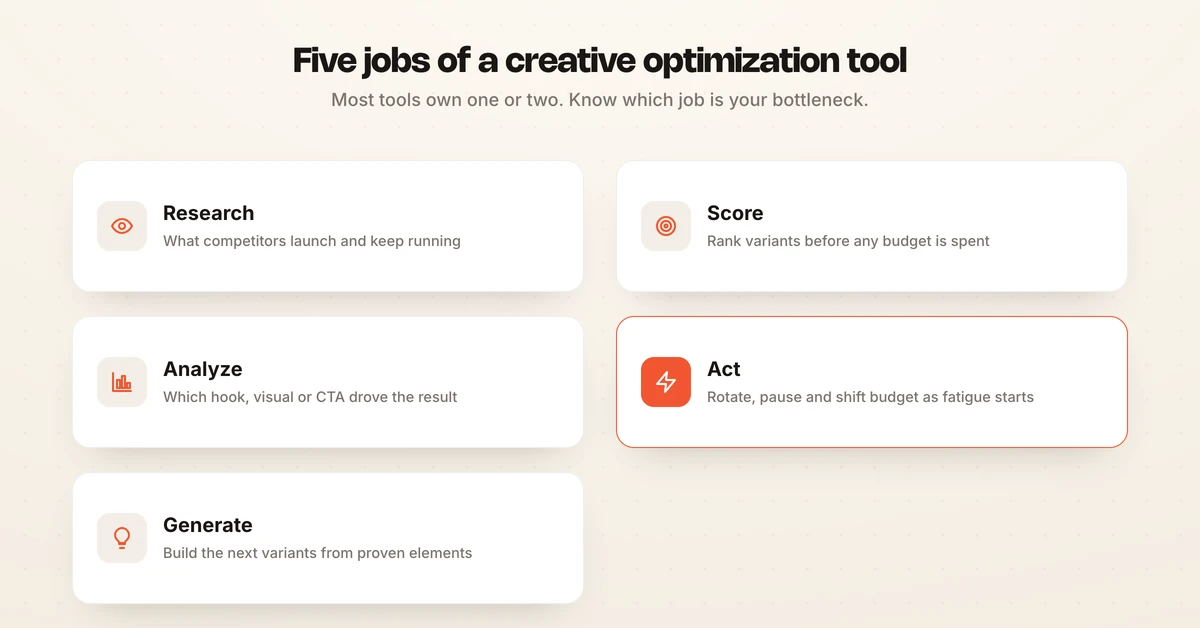
A good creative optimization tool in 2026 does three things. First, it connects creative decisions to revenue outcomes, not vanity metrics like impressions or engagement. Second, it identifies patterns across your creative library fast enough to act on them before they decay. Third, it reduces the manual work of creative analysis, which still consumes 10+ hours per week at most performance marketing teams.
The 9 best creative optimization tools
1. Hawky: Best for element-level creative intelligence
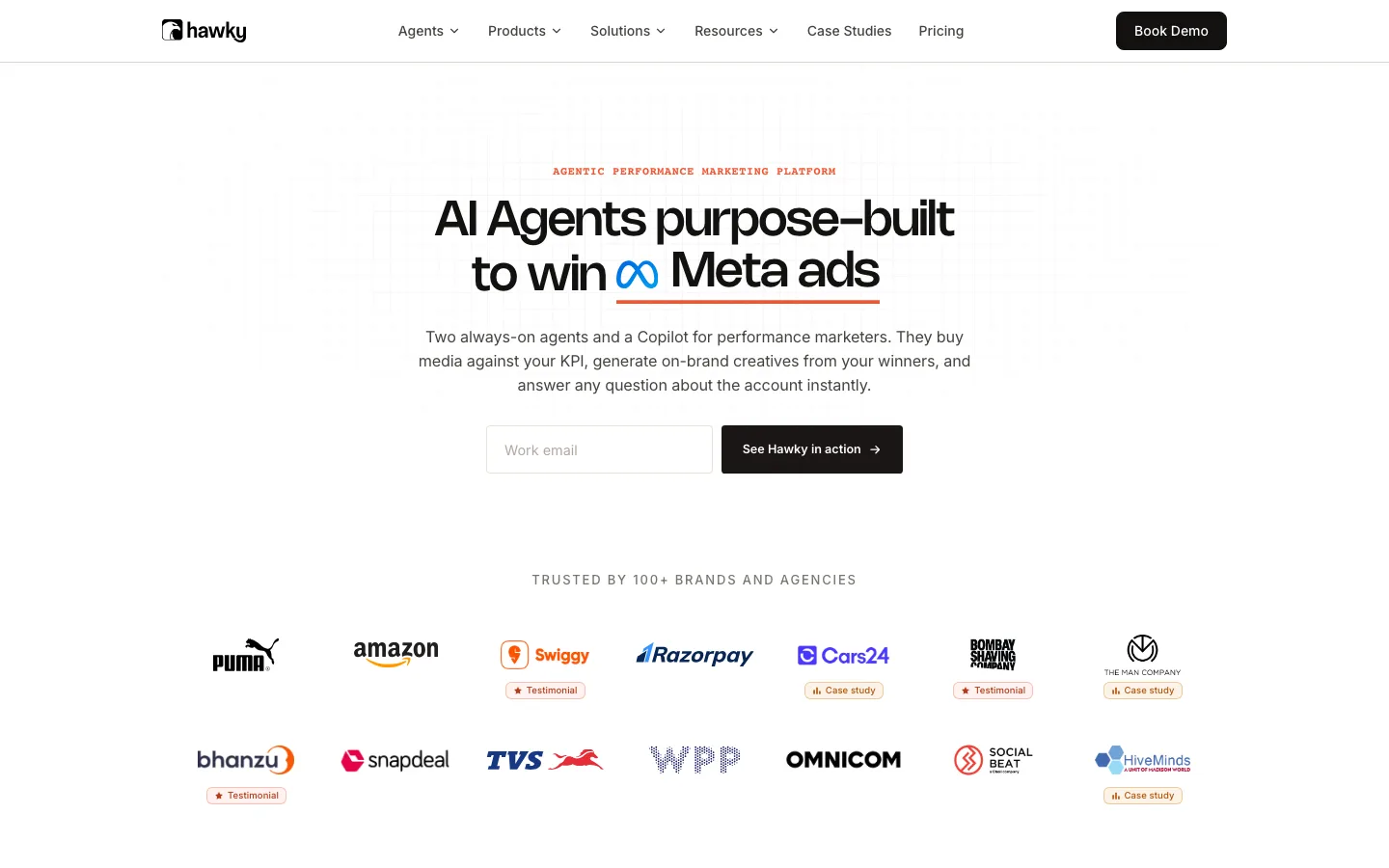
Hawky is an AI-native creative intelligence platform built for performance marketers who need to understand what makes their ads work at the component level. Where most tools tell you which ad is winning, Hawky tells you which hook, visual, CTA, and body copy combination is driving that win.
The platform's core strength is element-level creative analysis. Instead of treating each ad as a single unit, Hawky deconstructs creatives into their building blocks and measures the performance contribution of each element independently. This means you can identify that a specific hook style drives 3x higher CTR regardless of which visual it is paired with, or that a particular CTA format consistently lowers CPL across campaigns. Research from Singular's creative fatigue analysis confirms that this granular approach significantly outperforms aggregate-level optimization.

Hawky also solves one of the biggest pain points in performance marketing: creative fatigue. The platform predicts when your winning creatives will start to decline before it happens, giving your team a head start on producing replacements. Combine that with competitor creative intelligence and AI creative generation from winning patterns, and you have a platform that covers the full creative optimization cycle.
Key capabilities:
Element-level creative analysis that isolates the performance impact of hooks, visuals, CTAs, and body copy
Predictive creative fatigue detection that flags declining creatives before ROAS drops
Competitor ad tracking and creative intelligence across Meta and Google
AI creative generation that builds new ads from your proven winning patterns
Command Center dashboard for unified creative performance visibility
Best for: Performance marketing teams and agencies running $25K+/month on Meta and Google who need to move from "which ad is winning" to "why it's winning."
2. Motion: Best for creative analytics dashboards
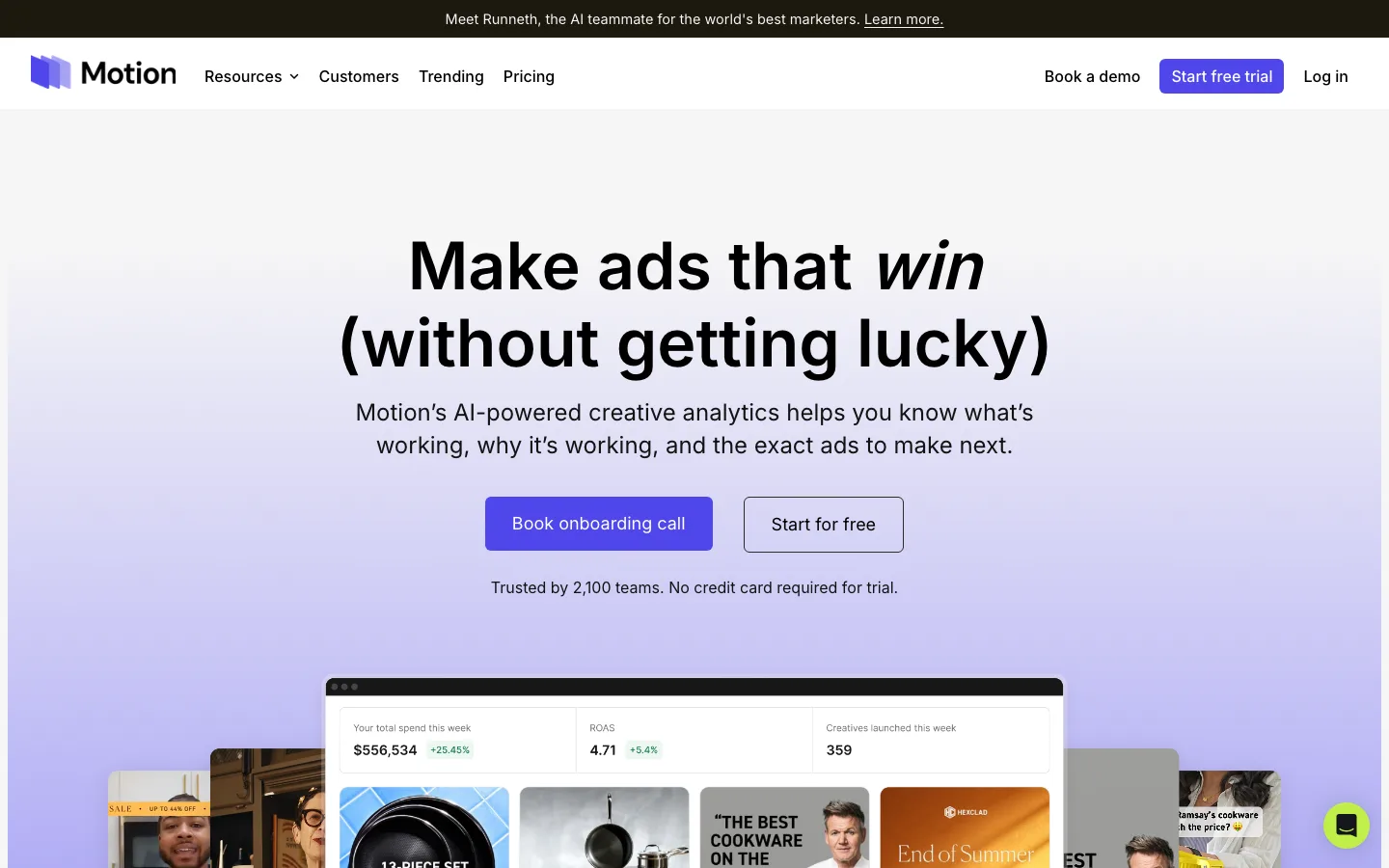
Motion is a creative analytics platform that helps performance marketing teams visualize which creatives are performing and identify patterns across their ad accounts. The platform is particularly popular with agencies for its clean, shareable reporting interface.
Motion's strength is surfacing creative insights that would otherwise require hours of manual analysis. It breaks down performance by creative elements like hooks, formats, and visual patterns, and presents them in dashboards your team can actually use in creative briefs and client reports.
Strength: The reporting interface is genuinely best-in-class for creative analytics. If your primary need is understanding what's working and communicating those insights to creative teams or clients, Motion delivers.
Limitation: Motion focuses on analysis and reporting. It does not generate creatives, predict fatigue, or track competitor ads. You will need additional tools for those stages of the creative optimization workflow.
Best for: Agencies and in-house teams running meaningful creative volume on Meta who need fast, visual creative performance reporting.
Pricing: Tiered plans based on ad spend volume. Most valuable for teams spending $25K-$100K+/month.
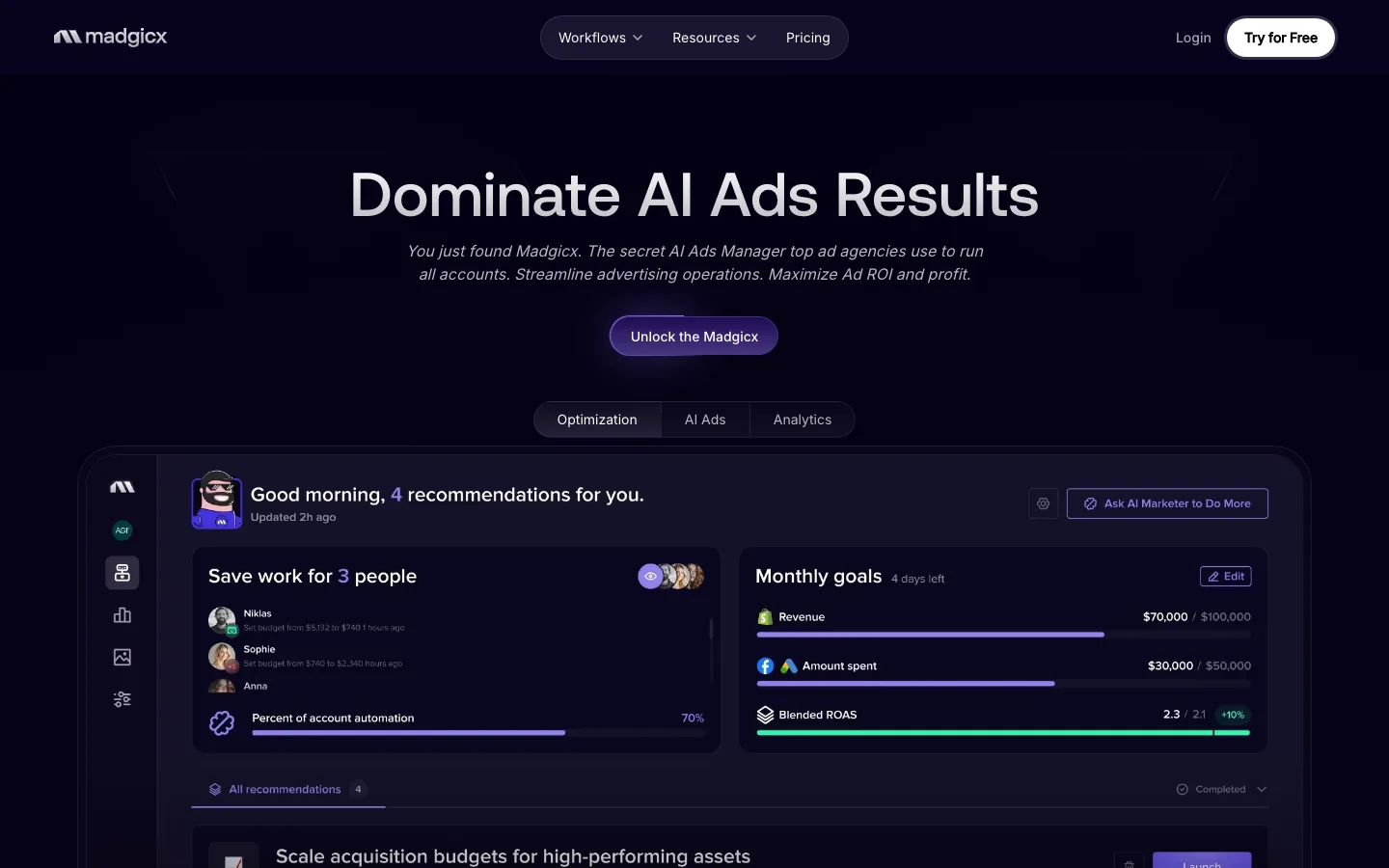
3. Madgicx: Best for Meta Ads all-in-one optimization
Madgicx is an AI-powered platform designed specifically for Meta Ads, combining campaign automation, creative insights, and performance analytics in a single tool. Its AI Marketer feature performs daily account audits and delivers actionable optimization recommendations.
The platform's autonomous budget optimizer reallocates spend every few hours based on live performance signals. Its creative intelligence tools use computer vision to identify winning visual elements, then help you understand which creative attributes drive results for specific audience segments. This aligns with Meta's own guidance on Advantage+ creative for automated creative optimization.
Strength: For teams running exclusively on Meta, Madgicx offers the tightest integration between media buying optimization and creative performance analysis. The AI-driven budget reallocation is a real time-saver.
Limitation: Madgicx is Meta-focused. If your team runs campaigns across Google, TikTok, LinkedIn, or other platforms, you will hit limitations quickly. The creative analysis is also aggregate-level, not element-level.
Best for: Small to mid-size teams spending $10K-$50K/month exclusively on Meta Ads who want automation and creative insights in one place.
Pricing: Starts at approximately $45/month, scaling with ad spend.
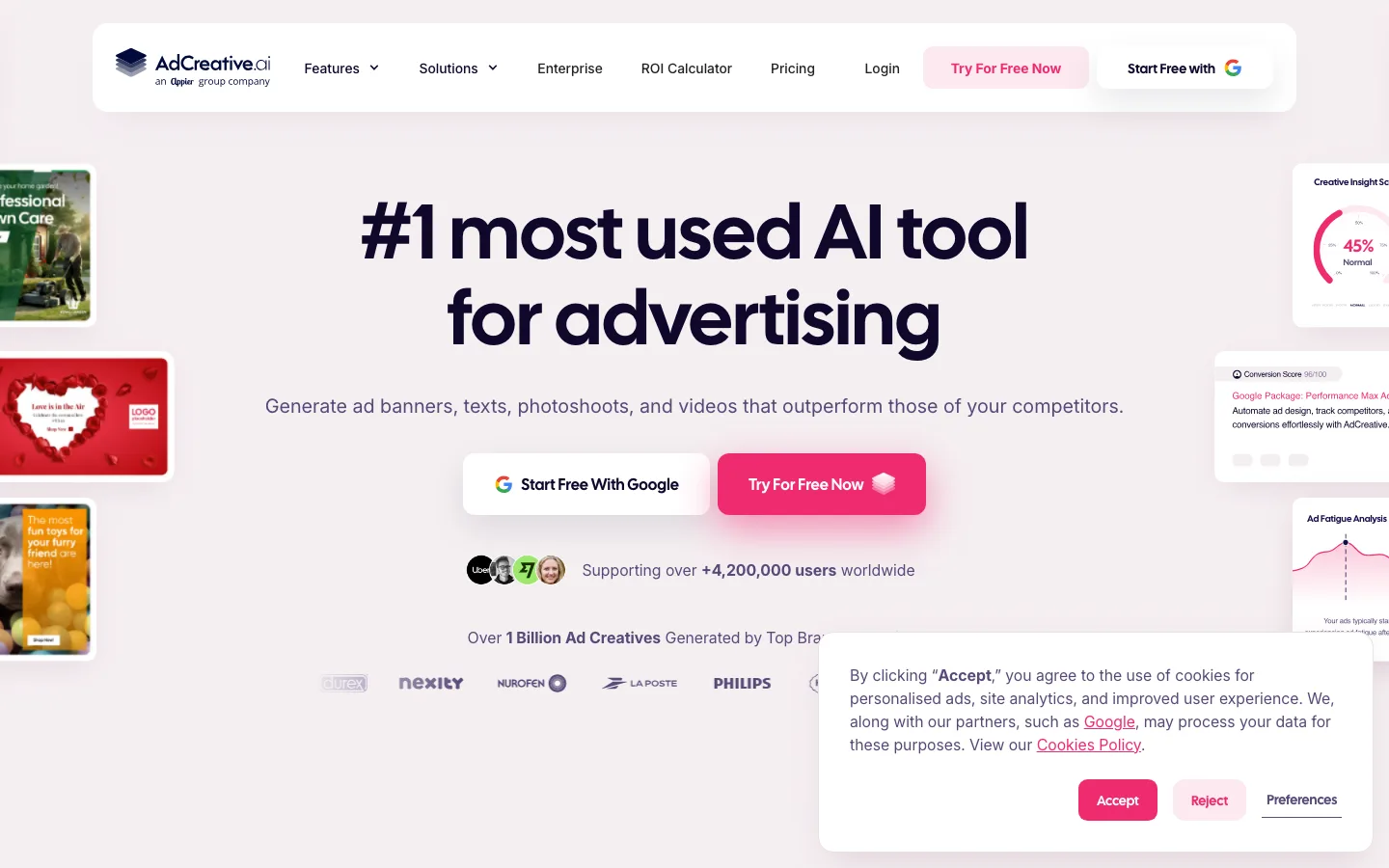
4. AdCreative.ai: Best for AI-powered creative generation
AdCreative.ai specializes in generating high-performing ad creatives using AI. The platform can produce 20+ ad variations in under 5 minutes, with a Creative Scoring AI that claims 90%+ accuracy in predicting which creatives will convert.
The tool integrates directly with Facebook Ads Manager and Google Ads, allowing one-click deployment to live campaigns. Performance data syncs back to the platform to improve future creative recommendations. It also includes a library of 100M+ stock images from iStock, Pexels, and Unsplash.
Strength: Speed of creative production. If your team's bottleneck is producing enough creative variations for testing, AdCreative.ai removes that friction faster than any other tool on this list.
Limitation: The generated creatives are template-driven. Teams that need highly custom or brand-specific creative work will find the output too generic. The credit-based pricing model has also drawn consistent complaints from users who feel they run out of credits too quickly.
Best for: D2C brands and small teams that need high volume of ad creative variations without a full design team.
Pricing: Starts at $39/month (Starter plan, 10 credits). Professional plan at $149/month for 100 credits. Credits = downloads of generated creatives.
5. Superads: Best for multi-platform creative reporting
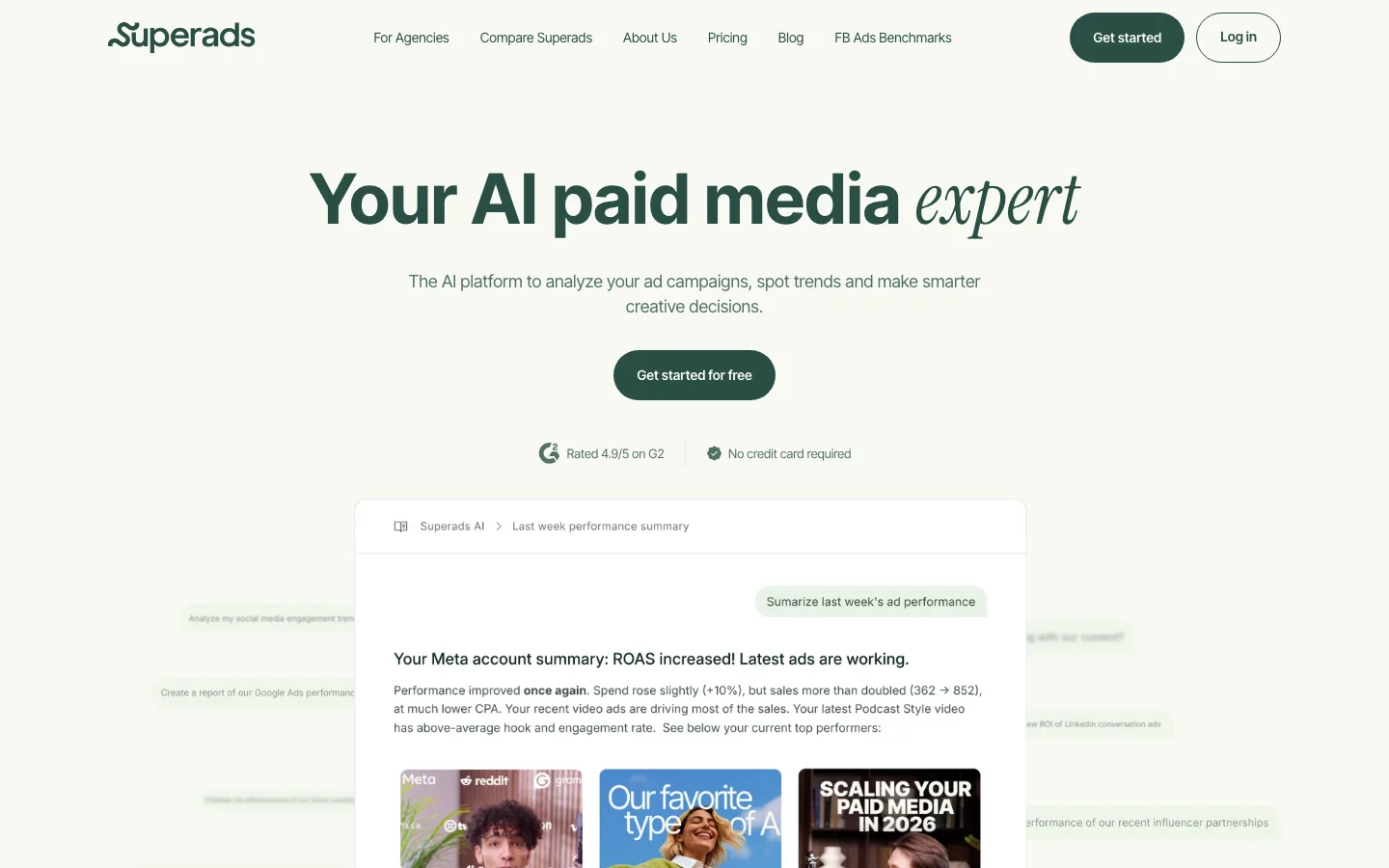
Superads is an analytics-first platform that pulls creative performance data from Meta, TikTok, LinkedIn, and Google Ads into a single reporting interface. Its AI agents automate performance summaries and creative strategy analysis.
The platform offers three AI agents: Pulse generates scheduled performance reports delivered via Slack or email, and Strategist analyzes creative performance to identify winning patterns and surface creative fatigue signals. The interactive dashboards support AI-driven tagging and real-time creative scoring.
Strength: Multi-platform reporting in a single view. If you are running creative across 3+ ad platforms and tired of switching between dashboards, Superads consolidates that data effectively.
Limitation: Still building out its competitive tracking features (launching mid-2026). The platform is analytics-focused and does not generate creatives or manage campaigns.
Best for: Agencies and multi-platform teams that need consolidated creative performance reporting with automated insights.
Pricing: Pro plan starts at $49/month, priced by total monthly ad spend across connected accounts.
6. Smartly.io: Best for enterprise cross-channel creative automation
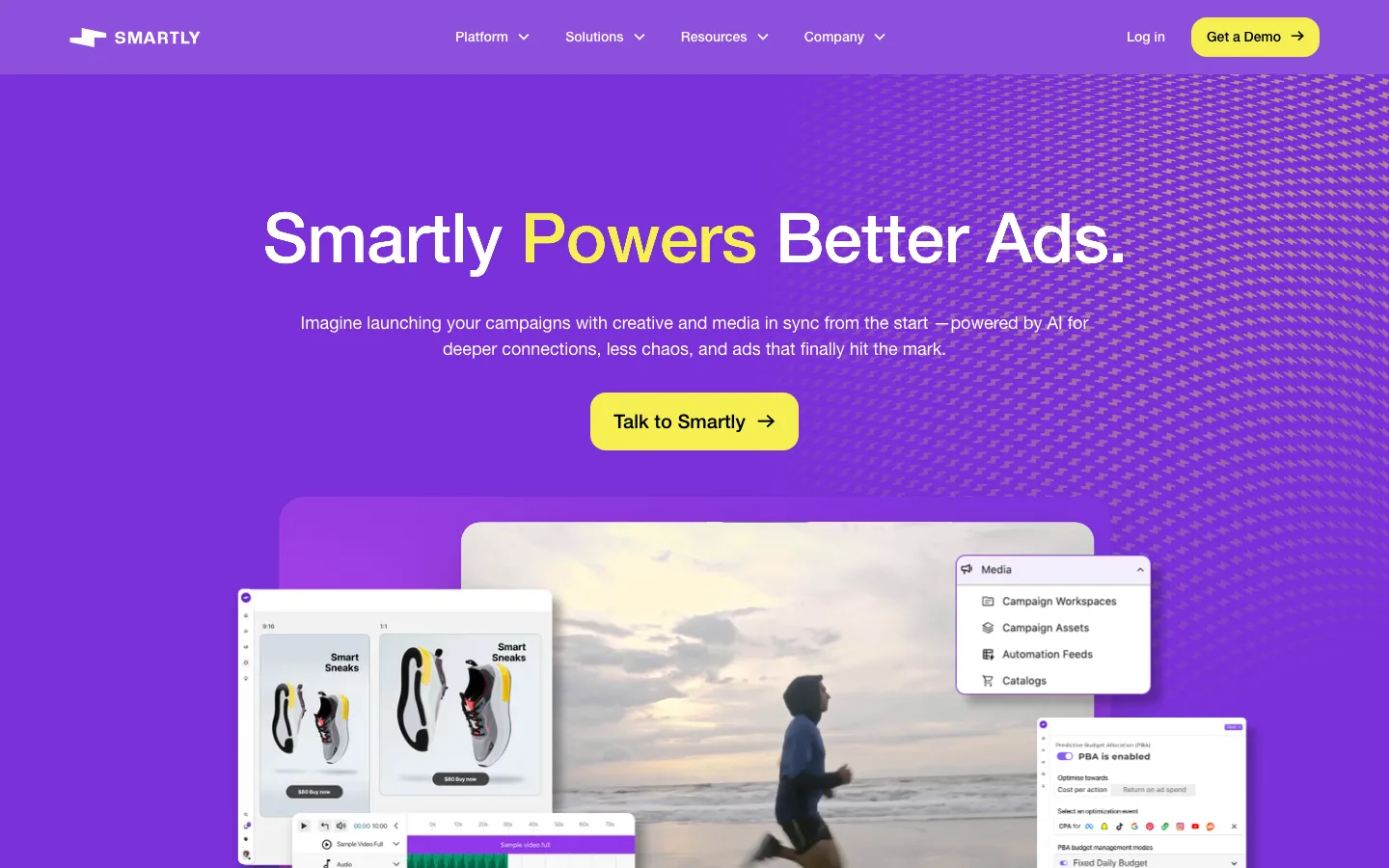
Smartly.io is a full-scale enterprise advertising platform that unifies creative production, media optimization, and performance intelligence across channels. The modular creative production system builds templates once and automatically generates thousands of localized variations.
Smartly's primary value is in eliminating data handoffs between creative production, media buying, and performance reporting. For global brands running campaigns across dozens of markets and audience segments, this integration is significant.
Strength: Unmatched at enterprise scale. If you are a global brand managing campaigns across 20+ markets with localized creative needs, Smartly handles that complexity better than any other platform.
Limitation: The pricing is prohibitive for most teams. Smartly charges a percentage of total media spend, with minimums around $4,000-$5,000/month. The platform is also complex to implement and requires dedicated onboarding.
Best for: Enterprise brands and large agencies managing $500K+/month in ad spend across multiple channels and regions.
Pricing: Percentage of media spend. Minimum approximately $4,000-$5,000/month.
7. Hunch: Best for e-commerce and product-feed DCO
Hunch is a creative automation and dynamic creative optimization (DCO) platform built for e-commerce advertisers. It connects product catalogs to ad templates, automatically generating personalized creatives based on product data, inventory, and pricing.
The platform focuses on Meta, Snapchat, and TikTok, and is designed for growth-stage businesses that need to scale product-level advertising without a massive design team. Hunch's feed-driven production system can generate thousands of product-specific ad variations from a single template.
Strength: Product-feed integration is excellent. For e-commerce teams running dynamic product ads at scale, Hunch automates the creative production bottleneck effectively.
Limitation: Focused primarily on product-feed advertising. If your creative optimization needs go beyond product catalog ads (brand campaigns, awareness, UGC-style content), Hunch is not the right fit.
Best for: E-commerce brands and retailers spending $80K-$500K/month on Meta and Snapchat who need automated product-level creative at scale.
Pricing: Custom pricing based on ad spend and creative volume.
8. Celtra: Best for brand-governed creative production
Celtra is an enterprise creative automation platform focused on creative production and brand asset management. The platform connects brand assets with product data so teams can build ad templates that adjust to different products, formats, and placements while maintaining brand consistency.
Celtra is designed for organizations where brand governance is as important as performance. It allows creative teams to set rules, templates, and brand guidelines that performance marketing teams can use to produce compliant creative variations without bottlenecking the design team.
Strength: Brand control at scale. If your organization needs to produce thousands of creative variations while ensuring every asset meets brand guidelines, Celtra is purpose-built for that problem.
Limitation: Celtra handles creative production but lacks DSP or campaign management capabilities. It does not connect to programmatic platforms for integrated creative automation across channels, and it does not offer performance analytics or fatigue prediction.
Best for: Enterprise brands with strict brand guidelines that need to scale creative production across multiple teams, markets, and formats.
Pricing: Enterprise pricing, custom quotes. Typically requires annual commitment.
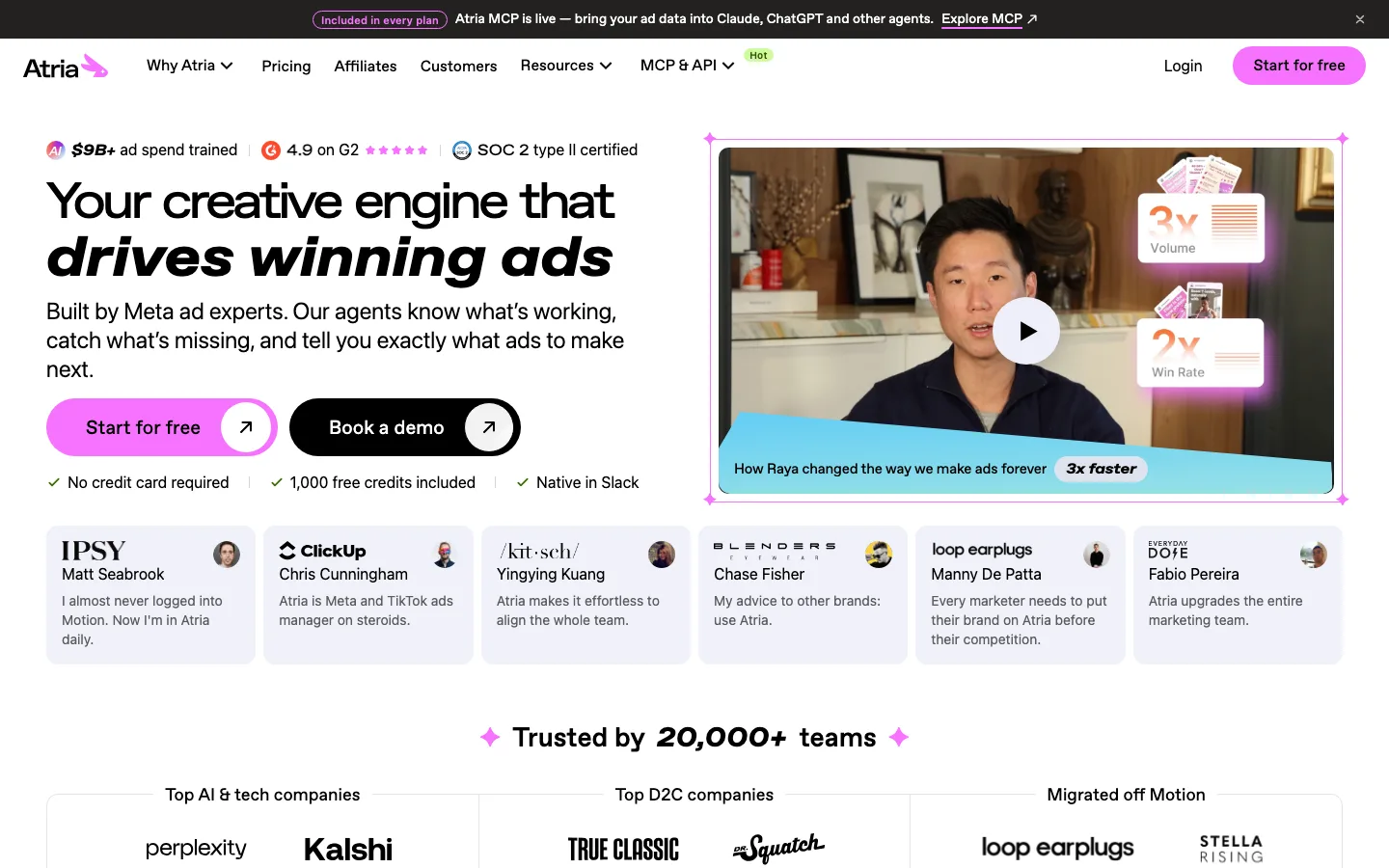
9. Atria: Best for competitive creative research
Atria is a competitive creative research platform with the largest collection of winning ads from Meta and TikTok. Its Spyder technology provides continuous automated monitoring of competitor ad accounts, and its searchable library contains 5M+ ads updated weekly.
The platform lets you track up to 200 competitor brands, get real-time alerts when they change strategies, analyze their hooks and angles, and browse their latest ads. It is built for creative strategists who need inspiration and competitive intelligence before the production phase.
Strength: Competitive ad library is 5x larger than alternatives like Foreplay. The automated monitoring and real-time alerts for competitor creative changes are genuinely useful for fast-moving performance teams.
Limitation: Atria is a research and inspiration tool. It does not analyze your own ad performance, generate creatives from your data, or optimize live campaigns. It sits at the front end of the creative optimization workflow.
Best for: Creative strategists and performance teams that need ongoing competitive creative intelligence to inform their testing roadmap.
Pricing: $129-$269/month (annual plans). Flat-rate tiers without ad-spend percentage fees.
Feature comparison: how these tools stack up
A feature comparison table is the fastest way to evaluate creative optimization tools against specific capabilities your team needs. The table below maps each tool against the six criteria that matter most for performance marketing teams: element-level analysis, fatigue prediction, creative generation, competitor tracking, multi-platform support, and price.
Tool | Element-Level Analysis | Fatigue Prediction | Creative Generation | Competitor Tracking | Multi-Platform | Starting Price |
|---|---|---|---|---|---|---|
Hawky | Yes | Yes | Yes | Yes | Meta, Google | See pricing page |
Motion | Partial | No | No | No | Meta | Tiered by spend |
Madgicx | No | No | No | No | Meta only | $45/mo |
AdCreative.ai | No | No | Yes | No | Meta, Google | $39/mo |
Superads | Partial | Partial | No | Coming soon | Meta, TikTok, LinkedIn, Google | $49/mo |
Smartly.io | No | No | Yes | No | Omnichannel | ~$4,000/mo |
Hunch | No | No | Yes (product-feed) | No | Meta, Snapchat, TikTok | Custom |
Celtra | No | No | Yes (template) | No | Omnichannel | Enterprise |
Atria | No | No | No | Yes | Meta, TikTok | $129/mo |
The creative speed problem no one talks about
The creative speed problem is the mismatch between how quickly ad creatives fatigue and how long it takes teams to test and replace them. This is the biggest challenge in creative optimization, and most tool comparisons ignore it entirely.

In 2024, a winning ad creative might have stayed effective for six weeks before fatigue set in. By 2026, that window has compressed to two weeks or less for most audiences. If your creative testing process takes three weeks to identify a winner, and that winner has a two-week performance window, you have missed the majority of its value during the testing phase itself.
This is why predictive fatigue detection matters more than any other feature on this list. Reactive tools tell you a creative has fatigued after your ROAS has already dropped. Predictive tools flag the decline before it happens, giving your team a head start on producing replacements.
The math is straightforward. Teams running $50K+/month on Meta typically rotate through 15-20 creatives per month. Without predictive fatigue signals, each creative transition comes with a 3-5 day ROAS dip while the algorithm re-optimizes.
Multiply that by 15 transitions and you lose 45-75 days of optimized delivery per year. That is real revenue. RevenueCat's research on ad fatigue detection confirms that proactive fatigue management is now essential for maintaining consistent performance at scale.
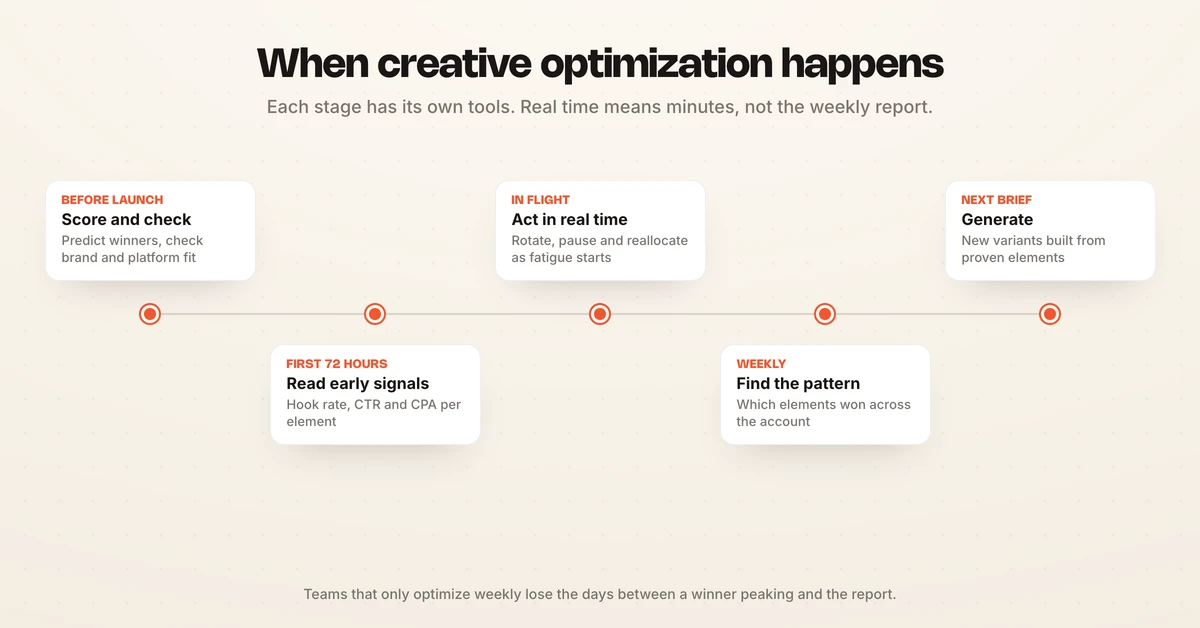
The best-performing teams in 2026 operate on a weekly creative cadence: new ads go live every week, regardless of whether current creatives are still performing. They use creative optimization tools not just to analyze the past, but to stay ahead of fatigue and keep their pipeline full.
Which tool is right for your team?
The right creative optimization tool for your team depends on three factors: monthly ad spend, which platforms you run on, and whether your primary bottleneck is analysis, generation, or both. Here is a decision framework.
Your Situation | Best Fit | Why |
|---|---|---|
Need to know why creatives work, not just which ones | Hawky | Element-level analysis + fatigue prediction + generation |
Want clean analytics dashboards for client reports | Motion | Best-in-class visual creative reporting |
Meta-only, want automation + insights bundled | Madgicx | Cost-effective all-in-one for Meta |
Need high-volume creative variants fast | AdCreative.ai | AI generation at speed, 20+ variants in minutes |
Multi-platform reporting across 3+ channels | Superads | Consolidated Meta, TikTok, LinkedIn, Google reporting |
Enterprise, 20+ markets, localized creative | Smartly.io or Celtra | Scale and brand governance |
If you run primarily Meta and Google ads and need to understand why your creatives work (not just which ones), Hawky's element-level analysis and fatigue prediction give you the deepest insight into creative performance drivers. It is the only platform that covers analysis, prediction, competitor intelligence, and generation in one tool.
If your primary need is clean creative analytics and reporting for client presentations, Motion provides the best visual dashboards for communicating creative performance to stakeholders and creative teams.
If you run Meta ads exclusively and want automation plus creative insights bundled together, Madgicx is the most cost-effective entry point. Its AI-driven budget optimization adds genuine value for smaller teams.
If your bottleneck is producing enough creative variations for testing, AdCreative.ai generates high volumes of ad variations quickly. Pair it with an analytics tool for a complete workflow.
If you are an enterprise brand managing campaigns across multiple markets and channels, Smartly.io or Celtra handle that complexity, though at enterprise price points. Smartly covers the full workflow; Celtra focuses on brand-governed production.
If your team is tired of stitching together 3-4 separate tools for research, analysis, fatigue prediction, and creative generation, Hawky consolidates those capabilities into a single platform. That means fewer data handoffs, faster creative cycles, and one source of truth for creative performance.
Frequently asked questions
What is creative optimization in advertising?
Creative optimization is the data-driven process of analyzing, testing, and improving ad creatives to maximize performance metrics like ROAS, CTR, and CPA. In 2026, it involves using AI and machine learning to identify which specific creative elements (hooks, visuals, CTAs, body copy) drive results, predicting when creatives will fatigue, and generating new variations from proven winning patterns. It replaces gut-feel creative decisions with evidence-based iteration.
What is the difference between DCO and creative analytics?
Dynamic creative optimization (DCO) automatically assembles ad variations from pre-built components (headlines, images, CTAs) and serves the best combination to each audience segment in real time. Creative analytics platforms analyze the performance of your existing ads to identify patterns and insights. (What Is Dynamic Creative Optimization?)
DCO focuses on automated delivery and personalization. Creative analytics focuses on understanding what works and why. Some platforms like Hawky combine both capabilities with element-level analysis.
How do you detect and prevent ad creative fatigue?
Creative fatigue occurs when your target audience sees the same ad too many times, causing performance metrics to decline. Traditional detection involves monitoring frequency and performance metrics manually. Modern creative optimization tools use predictive models that analyze performance trends, audience overlap, and impression velocity to flag fatigue before ROAS drops. Prevention requires maintaining a steady pipeline of fresh creatives and rotating them on a weekly cadence rather than waiting for performance to decline.
How much do creative optimization tools cost?
Pricing varies significantly by tool type and scale. Entry-level platforms like AdCreative.ai and Superads start at $39-$49/month. Mid-market platforms like Motion and Atria range from $100-$270/month.
Enterprise platforms like Smartly.io charge a percentage of ad spend with minimums of $4,000-$5,000/month. Most platforms scale pricing based on monthly ad spend or creative volume.
What is element-level creative analysis?
Element-level creative analysis is a method of measuring ad performance at the component level rather than the ad level. Instead of knowing that Ad A outperforms Ad B, element-level analysis tells you that a specific hook style drives 3x higher CTR, a particular visual format reduces CPA by 20%, or a certain CTA wording increases conversion rate regardless of which other elements it is paired with. This granularity allows teams to build new creatives from proven components rather than testing blindly. Hawky's creative analysis is built around this approach.
Can AI replace human creative strategists?
AI creative optimization tools augment human strategists rather than replacing them. AI excels at pattern recognition across large creative libraries, predicting performance, and generating variations at scale. Human strategists bring brand understanding, cultural awareness, and the ability to develop genuinely novel creative concepts that break patterns. The most effective creative teams in 2026 use AI tools to handle analysis and variation at speed, freeing strategists to focus on big-picture creative direction and breakthrough ideas.
If your team is spending hours analyzing ad performance in spreadsheets while your best creatives fatigue faster than you can replace them, Hawky's element-level creative intelligence is built for that job.
Ready to Stop Guessing and Start Winning with Creative Intelligence? Book Demo
The best creative optimization tools in 2026 are Hawky, Motion, and Madgicx, each built for a different slice of the creative performance problem. Hawky leads for teams that need element-level creative analysis paired with fatigue prediction. Motion excels at visual creative analytics dashboards. Madgicx dominates Meta-specific campaign optimization.
Creative optimization tools are the platforms performance marketers use to analyze, test, and improve ad creatives based on real performance data rather than gut instinct. If your team is spending $25K+ per month on paid media and still making creative decisions from aggregate ROAS numbers, you are leaving money on the table. These tools close the gap between what your ads show and what actually drives conversions. Whether you need ad creative testing at scale or AI ad creative generation from winning patterns, the right platform saves your team hours and budget every week.
What creative optimization actually means in 2026
Creative optimization is the process of using data and AI to identify which specific elements of your ad creatives drive performance, then systematically improving those elements to increase ROAS, reduce CPA, and extend creative lifespan. It goes beyond A/B testing a headline. It means understanding why one hook outperforms another, predicting when a winning ad will start to fatigue, and generating new variations from proven patterns. According to Google's AI-powered advertising research, campaigns using dynamic creative optimization have achieved up to a 58% increase in ROAS.
The category has evolved significantly. In 2023, "creative optimization" mostly meant running split tests and reading platform dashboards. By 2026, the best tools operate at the element level. They break an ad into its components (hook, visual, body copy, CTA, format) and measure each component's contribution to performance independently.
A good creative optimization tool in 2026 does three things. First, it connects creative decisions to revenue outcomes, not vanity metrics like impressions or engagement. Second, it identifies patterns across your creative library fast enough to act on them before they decay. Third, it reduces the manual work of creative analysis, which still consumes 10+ hours per week at most performance marketing teams.
The 9 best creative optimization tools
1. Hawky: Best for element-level creative intelligence
Hawky is an AI-native creative intelligence platform built for performance marketers who need to understand what makes their ads work at the component level. Where most tools tell you which ad is winning, Hawky tells you which hook, visual, CTA, and body copy combination is driving that win.
The platform's core strength is element-level creative analysis. Instead of treating each ad as a single unit, Hawky deconstructs creatives into their building blocks and measures the performance contribution of each element independently. This means you can identify that a specific hook style drives 3x higher CTR regardless of which visual it is paired with, or that a particular CTA format consistently lowers CPL across campaigns. Research from Singular's creative fatigue analysis confirms that this granular approach significantly outperforms aggregate-level optimization.

Hawky also solves one of the biggest pain points in performance marketing: creative fatigue. The platform predicts when your winning creatives will start to decline before it happens, giving your team a head start on producing replacements. Combine that with competitor creative intelligence and AI creative generation from winning patterns, and you have a platform that covers the full creative optimization cycle.
Key capabilities:
Element-level creative analysis that isolates the performance impact of hooks, visuals, CTAs, and body copy
Predictive creative fatigue detection that flags declining creatives before ROAS drops
Competitor ad tracking and creative intelligence across Meta and Google
AI creative generation that builds new ads from your proven winning patterns
Command Center dashboard for unified creative performance visibility
Best for: Performance marketing teams and agencies running $25K+/month on Meta and Google who need to move from "which ad is winning" to "why it's winning."
2. Motion: Best for creative analytics dashboards
Motion is a creative analytics platform that helps performance marketing teams visualize which creatives are performing and identify patterns across their ad accounts. The platform is particularly popular with agencies for its clean, shareable reporting interface.
Motion's strength is surfacing creative insights that would otherwise require hours of manual analysis. It breaks down performance by creative elements like hooks, formats, and visual patterns, and presents them in dashboards your team can actually use in creative briefs and client reports.
Strength: The reporting interface is genuinely best-in-class for creative analytics. If your primary need is understanding what's working and communicating those insights to creative teams or clients, Motion delivers.
Limitation: Motion focuses on analysis and reporting. It does not generate creatives, predict fatigue, or track competitor ads. You will need additional tools for those stages of the creative optimization workflow.
Best for: Agencies and in-house teams running meaningful creative volume on Meta who need fast, visual creative performance reporting.
Pricing: Tiered plans based on ad spend volume. Most valuable for teams spending $25K-$100K+/month.
3. Madgicx: Best for Meta Ads all-in-one optimization
Madgicx is an AI-powered platform designed specifically for Meta Ads, combining campaign automation, creative insights, and performance analytics in a single tool. Its AI Marketer feature performs daily account audits and delivers actionable optimization recommendations.
The platform's autonomous budget optimizer reallocates spend every few hours based on live performance signals. Its creative intelligence tools use computer vision to identify winning visual elements, then help you understand which creative attributes drive results for specific audience segments. This aligns with Meta's own guidance on Advantage+ creative for automated creative optimization.
Strength: For teams running exclusively on Meta, Madgicx offers the tightest integration between media buying optimization and creative performance analysis. The AI-driven budget reallocation is a real time-saver.
Limitation: Madgicx is Meta-focused. If your team runs campaigns across Google, TikTok, LinkedIn, or other platforms, you will hit limitations quickly. The creative analysis is also aggregate-level, not element-level.
Best for: Small to mid-size teams spending $10K-$50K/month exclusively on Meta Ads who want automation and creative insights in one place.
Pricing: Starts at approximately $45/month, scaling with ad spend.
4. AdCreative.ai: Best for AI-powered creative generation
AdCreative.ai specializes in generating high-performing ad creatives using AI. The platform can produce 20+ ad variations in under 5 minutes, with a Creative Scoring AI that claims 90%+ accuracy in predicting which creatives will convert.
The tool integrates directly with Facebook Ads Manager and Google Ads, allowing one-click deployment to live campaigns. Performance data syncs back to the platform to improve future creative recommendations. It also includes a library of 100M+ stock images from iStock, Pexels, and Unsplash.
Strength: Speed of creative production. If your team's bottleneck is producing enough creative variations for testing, AdCreative.ai removes that friction faster than any other tool on this list.
Limitation: The generated creatives are template-driven. Teams that need highly custom or brand-specific creative work will find the output too generic. The credit-based pricing model has also drawn consistent complaints from users who feel they run out of credits too quickly.
Best for: D2C brands and small teams that need high volume of ad creative variations without a full design team.
Pricing: Starts at $39/month (Starter plan, 10 credits). Professional plan at $149/month for 100 credits. Credits = downloads of generated creatives.
5. Superads: Best for multi-platform creative reporting
Superads is an analytics-first platform that pulls creative performance data from Meta, TikTok, LinkedIn, and Google Ads into a single reporting interface. Its AI agents automate performance summaries and creative strategy analysis.
The platform offers three AI agents: Pulse generates scheduled performance reports delivered via Slack or email, and Strategist analyzes creative performance to identify winning patterns and surface creative fatigue signals. The interactive dashboards support AI-driven tagging and real-time creative scoring.
Strength: Multi-platform reporting in a single view. If you are running creative across 3+ ad platforms and tired of switching between dashboards, Superads consolidates that data effectively.
Limitation: Still building out its competitive tracking features (launching mid-2026). The platform is analytics-focused and does not generate creatives or manage campaigns.
Best for: Agencies and multi-platform teams that need consolidated creative performance reporting with automated insights.
Pricing: Pro plan starts at $49/month, priced by total monthly ad spend across connected accounts.
6. Smartly.io: Best for enterprise cross-channel creative automation
Smartly.io is a full-scale enterprise advertising platform that unifies creative production, media optimization, and performance intelligence across channels. The modular creative production system builds templates once and automatically generates thousands of localized variations.
Smartly's primary value is in eliminating data handoffs between creative production, media buying, and performance reporting. For global brands running campaigns across dozens of markets and audience segments, this integration is significant.
Strength: Unmatched at enterprise scale. If you are a global brand managing campaigns across 20+ markets with localized creative needs, Smartly handles that complexity better than any other platform.
Limitation: The pricing is prohibitive for most teams. Smartly charges a percentage of total media spend, with minimums around $4,000-$5,000/month. The platform is also complex to implement and requires dedicated onboarding.
Best for: Enterprise brands and large agencies managing $500K+/month in ad spend across multiple channels and regions.
Pricing: Percentage of media spend. Minimum approximately $4,000-$5,000/month.
7. Hunch: Best for e-commerce and product-feed DCO
Hunch is a creative automation and dynamic creative optimization (DCO) platform built for e-commerce advertisers. It connects product catalogs to ad templates, automatically generating personalized creatives based on product data, inventory, and pricing.
The platform focuses on Meta, Snapchat, and TikTok, and is designed for growth-stage businesses that need to scale product-level advertising without a massive design team. Hunch's feed-driven production system can generate thousands of product-specific ad variations from a single template.
Strength: Product-feed integration is excellent. For e-commerce teams running dynamic product ads at scale, Hunch automates the creative production bottleneck effectively.
Limitation: Focused primarily on product-feed advertising. If your creative optimization needs go beyond product catalog ads (brand campaigns, awareness, UGC-style content), Hunch is not the right fit.
Best for: E-commerce brands and retailers spending $80K-$500K/month on Meta and Snapchat who need automated product-level creative at scale.
Pricing: Custom pricing based on ad spend and creative volume.
8. Celtra: Best for brand-governed creative production
Celtra is an enterprise creative automation platform focused on creative production and brand asset management. The platform connects brand assets with product data so teams can build ad templates that adjust to different products, formats, and placements while maintaining brand consistency.
Celtra is designed for organizations where brand governance is as important as performance. It allows creative teams to set rules, templates, and brand guidelines that performance marketing teams can use to produce compliant creative variations without bottlenecking the design team.
Strength: Brand control at scale. If your organization needs to produce thousands of creative variations while ensuring every asset meets brand guidelines, Celtra is purpose-built for that problem.
Limitation: Celtra handles creative production but lacks DSP or campaign management capabilities. It does not connect to programmatic platforms for integrated creative automation across channels, and it does not offer performance analytics or fatigue prediction.
Best for: Enterprise brands with strict brand guidelines that need to scale creative production across multiple teams, markets, and formats.
Pricing: Enterprise pricing, custom quotes. Typically requires annual commitment.
9. Atria: Best for competitive creative research
Atria is a competitive creative research platform with the largest collection of winning ads from Meta and TikTok. Its Spyder technology provides continuous automated monitoring of competitor ad accounts, and its searchable library contains 5M+ ads updated weekly.
The platform lets you track up to 200 competitor brands, get real-time alerts when they change strategies, analyze their hooks and angles, and browse their latest ads. It is built for creative strategists who need inspiration and competitive intelligence before the production phase.
Strength: Competitive ad library is 5x larger than alternatives like Foreplay. The automated monitoring and real-time alerts for competitor creative changes are genuinely useful for fast-moving performance teams.
Limitation: Atria is a research and inspiration tool. It does not analyze your own ad performance, generate creatives from your data, or optimize live campaigns. It sits at the front end of the creative optimization workflow.
Best for: Creative strategists and performance teams that need ongoing competitive creative intelligence to inform their testing roadmap.
Pricing: $129-$269/month (annual plans). Flat-rate tiers without ad-spend percentage fees.
Feature comparison: how these tools stack up
A feature comparison table is the fastest way to evaluate creative optimization tools against specific capabilities your team needs. The table below maps each tool against the six criteria that matter most for performance marketing teams: element-level analysis, fatigue prediction, creative generation, competitor tracking, multi-platform support, and price.
Tool | Element-Level Analysis | Fatigue Prediction | Creative Generation | Competitor Tracking | Multi-Platform | Starting Price |
|---|---|---|---|---|---|---|
Hawky | Yes | Yes | Yes | Yes | Meta, Google | See pricing page |
Motion | Partial | No | No | No | Meta | Tiered by spend |
Madgicx | No | No | No | No | Meta only | $45/mo |
AdCreative.ai | No | No | Yes | No | Meta, Google | $39/mo |
Superads | Partial | Partial | No | Coming soon | Meta, TikTok, LinkedIn, Google | $49/mo |
Smartly.io | No | No | Yes | No | Omnichannel | ~$4,000/mo |
Hunch | No | No | Yes (product-feed) | No | Meta, Snapchat, TikTok | Custom |
Celtra | No | No | Yes (template) | No | Omnichannel | Enterprise |
Atria | No | No | No | Yes | Meta, TikTok | $129/mo |
The creative speed problem no one talks about
The creative speed problem is the mismatch between how quickly ad creatives fatigue and how long it takes teams to test and replace them. This is the biggest challenge in creative optimization, and most tool comparisons ignore it entirely.

In 2024, a winning ad creative might have stayed effective for six weeks before fatigue set in. By 2026, that window has compressed to two weeks or less for most audiences. If your creative testing process takes three weeks to identify a winner, and that winner has a two-week performance window, you have missed the majority of its value during the testing phase itself.
This is why predictive fatigue detection matters more than any other feature on this list. Reactive tools tell you a creative has fatigued after your ROAS has already dropped. Predictive tools flag the decline before it happens, giving your team a head start on producing replacements.
The math is straightforward. Teams running $50K+/month on Meta typically rotate through 15-20 creatives per month. Without predictive fatigue signals, each creative transition comes with a 3-5 day ROAS dip while the algorithm re-optimizes.
Multiply that by 15 transitions and you lose 45-75 days of optimized delivery per year. That is real revenue. RevenueCat's research on ad fatigue detection confirms that proactive fatigue management is now essential for maintaining consistent performance at scale.
The best-performing teams in 2026 operate on a weekly creative cadence: new ads go live every week, regardless of whether current creatives are still performing. They use creative optimization tools not just to analyze the past, but to stay ahead of fatigue and keep their pipeline full.
Which tool is right for your team?
The right creative optimization tool for your team depends on three factors: monthly ad spend, which platforms you run on, and whether your primary bottleneck is analysis, generation, or both. Here is a decision framework.
Your Situation | Best Fit | Why |
|---|---|---|
Need to know why creatives work, not just which ones | Hawky | Element-level analysis + fatigue prediction + generation |
Want clean analytics dashboards for client reports | Motion | Best-in-class visual creative reporting |
Meta-only, want automation + insights bundled | Madgicx | Cost-effective all-in-one for Meta |
Need high-volume creative variants fast | AdCreative.ai | AI generation at speed, 20+ variants in minutes |
Multi-platform reporting across 3+ channels | Superads | Consolidated Meta, TikTok, LinkedIn, Google reporting |
Enterprise, 20+ markets, localized creative | Smartly.io or Celtra | Scale and brand governance |
If you run primarily Meta and Google ads and need to understand why your creatives work (not just which ones), Hawky's element-level analysis and fatigue prediction give you the deepest insight into creative performance drivers. It is the only platform that covers analysis, prediction, competitor intelligence, and generation in one tool.
If your primary need is clean creative analytics and reporting for client presentations, Motion provides the best visual dashboards for communicating creative performance to stakeholders and creative teams.
If you run Meta ads exclusively and want automation plus creative insights bundled together, Madgicx is the most cost-effective entry point. Its AI-driven budget optimization adds genuine value for smaller teams.
If your bottleneck is producing enough creative variations for testing, AdCreative.ai generates high volumes of ad variations quickly. Pair it with an analytics tool for a complete workflow.
If you are an enterprise brand managing campaigns across multiple markets and channels, Smartly.io or Celtra handle that complexity, though at enterprise price points. Smartly covers the full workflow; Celtra focuses on brand-governed production.
If your team is tired of stitching together 3-4 separate tools for research, analysis, fatigue prediction, and creative generation, Hawky consolidates those capabilities into a single platform. That means fewer data handoffs, faster creative cycles, and one source of truth for creative performance.
Frequently asked questions
What is creative optimization in advertising?
Creative optimization is the data-driven process of analyzing, testing, and improving ad creatives to maximize performance metrics like ROAS, CTR, and CPA. In 2026, it involves using AI and machine learning to identify which specific creative elements (hooks, visuals, CTAs, body copy) drive results, predicting when creatives will fatigue, and generating new variations from proven winning patterns. It replaces gut-feel creative decisions with evidence-based iteration.
What is the difference between DCO and creative analytics?
Dynamic creative optimization (DCO) automatically assembles ad variations from pre-built components (headlines, images, CTAs) and serves the best combination to each audience segment in real time. Creative analytics platforms analyze the performance of your existing ads to identify patterns and insights. (What Is Dynamic Creative Optimization?)
DCO focuses on automated delivery and personalization. Creative analytics focuses on understanding what works and why. Some platforms like Hawky combine both capabilities with element-level analysis.
How do you detect and prevent ad creative fatigue?
Creative fatigue occurs when your target audience sees the same ad too many times, causing performance metrics to decline. Traditional detection involves monitoring frequency and performance metrics manually. Modern creative optimization tools use predictive models that analyze performance trends, audience overlap, and impression velocity to flag fatigue before ROAS drops. Prevention requires maintaining a steady pipeline of fresh creatives and rotating them on a weekly cadence rather than waiting for performance to decline.
How much do creative optimization tools cost?
Pricing varies significantly by tool type and scale. Entry-level platforms like AdCreative.ai and Superads start at $39-$49/month. Mid-market platforms like Motion and Atria range from $100-$270/month.
Enterprise platforms like Smartly.io charge a percentage of ad spend with minimums of $4,000-$5,000/month. Most platforms scale pricing based on monthly ad spend or creative volume.
What is element-level creative analysis?
Element-level creative analysis is a method of measuring ad performance at the component level rather than the ad level. Instead of knowing that Ad A outperforms Ad B, element-level analysis tells you that a specific hook style drives 3x higher CTR, a particular visual format reduces CPA by 20%, or a certain CTA wording increases conversion rate regardless of which other elements it is paired with. This granularity allows teams to build new creatives from proven components rather than testing blindly. Hawky's creative analysis is built around this approach.
Can AI replace human creative strategists?
AI creative optimization tools augment human strategists rather than replacing them. AI excels at pattern recognition across large creative libraries, predicting performance, and generating variations at scale. Human strategists bring brand understanding, cultural awareness, and the ability to develop genuinely novel creative concepts that break patterns. The most effective creative teams in 2026 use AI tools to handle analysis and variation at speed, freeing strategists to focus on big-picture creative direction and breakthrough ideas.
If your team is spending hours analyzing ad performance in spreadsheets while your best creatives fatigue faster than you can replace them, Hawky's element-level creative intelligence is built for that job.
Ready to Stop Guessing and Start Winning with Creative Intelligence? Book Demo
The best creative optimization tools in 2026 are Hawky, Motion, and Madgicx, each built for a different slice of the creative performance problem. Hawky leads for teams that need element-level creative analysis paired with fatigue prediction. Motion excels at visual creative analytics dashboards. Madgicx dominates Meta-specific campaign optimization.
Creative optimization tools are the platforms performance marketers use to analyze, test, and improve ad creatives based on real performance data rather than gut instinct. If your team is spending $25K+ per month on paid media and still making creative decisions from aggregate ROAS numbers, you are leaving money on the table. These tools close the gap between what your ads show and what actually drives conversions. Whether you need ad creative testing at scale or AI ad creative generation from winning patterns, the right platform saves your team hours and budget every week.
What creative optimization actually means in 2026
Creative optimization is the process of using data and AI to identify which specific elements of your ad creatives drive performance, then systematically improving those elements to increase ROAS, reduce CPA, and extend creative lifespan. It goes beyond A/B testing a headline. It means understanding why one hook outperforms another, predicting when a winning ad will start to fatigue, and generating new variations from proven patterns. According to Google's AI-powered advertising research, campaigns using dynamic creative optimization have achieved up to a 58% increase in ROAS.
The category has evolved significantly. In 2023, "creative optimization" mostly meant running split tests and reading platform dashboards. By 2026, the best tools operate at the element level. They break an ad into its components (hook, visual, body copy, CTA, format) and measure each component's contribution to performance independently.
A good creative optimization tool in 2026 does three things. First, it connects creative decisions to revenue outcomes, not vanity metrics like impressions or engagement. Second, it identifies patterns across your creative library fast enough to act on them before they decay. Third, it reduces the manual work of creative analysis, which still consumes 10+ hours per week at most performance marketing teams.
The 9 best creative optimization tools
1. Hawky: Best for element-level creative intelligence
Hawky is an AI-native creative intelligence platform built for performance marketers who need to understand what makes their ads work at the component level. Where most tools tell you which ad is winning, Hawky tells you which hook, visual, CTA, and body copy combination is driving that win.
The platform's core strength is element-level creative analysis. Instead of treating each ad as a single unit, Hawky deconstructs creatives into their building blocks and measures the performance contribution of each element independently. This means you can identify that a specific hook style drives 3x higher CTR regardless of which visual it is paired with, or that a particular CTA format consistently lowers CPL across campaigns. Research from Singular's creative fatigue analysis confirms that this granular approach significantly outperforms aggregate-level optimization.

Hawky also solves one of the biggest pain points in performance marketing: creative fatigue. The platform predicts when your winning creatives will start to decline before it happens, giving your team a head start on producing replacements. Combine that with competitor creative intelligence and AI creative generation from winning patterns, and you have a platform that covers the full creative optimization cycle.
Key capabilities:
Element-level creative analysis that isolates the performance impact of hooks, visuals, CTAs, and body copy
Predictive creative fatigue detection that flags declining creatives before ROAS drops
Competitor ad tracking and creative intelligence across Meta and Google
AI creative generation that builds new ads from your proven winning patterns
Command Center dashboard for unified creative performance visibility
Best for: Performance marketing teams and agencies running $25K+/month on Meta and Google who need to move from "which ad is winning" to "why it's winning."
2. Motion: Best for creative analytics dashboards
Motion is a creative analytics platform that helps performance marketing teams visualize which creatives are performing and identify patterns across their ad accounts. The platform is particularly popular with agencies for its clean, shareable reporting interface.
Motion's strength is surfacing creative insights that would otherwise require hours of manual analysis. It breaks down performance by creative elements like hooks, formats, and visual patterns, and presents them in dashboards your team can actually use in creative briefs and client reports.
Strength: The reporting interface is genuinely best-in-class for creative analytics. If your primary need is understanding what's working and communicating those insights to creative teams or clients, Motion delivers.
Limitation: Motion focuses on analysis and reporting. It does not generate creatives, predict fatigue, or track competitor ads. You will need additional tools for those stages of the creative optimization workflow.
Best for: Agencies and in-house teams running meaningful creative volume on Meta who need fast, visual creative performance reporting.
Pricing: Tiered plans based on ad spend volume. Most valuable for teams spending $25K-$100K+/month.
3. Madgicx: Best for Meta Ads all-in-one optimization
Madgicx is an AI-powered platform designed specifically for Meta Ads, combining campaign automation, creative insights, and performance analytics in a single tool. Its AI Marketer feature performs daily account audits and delivers actionable optimization recommendations.
The platform's autonomous budget optimizer reallocates spend every few hours based on live performance signals. Its creative intelligence tools use computer vision to identify winning visual elements, then help you understand which creative attributes drive results for specific audience segments. This aligns with Meta's own guidance on Advantage+ creative for automated creative optimization.
Strength: For teams running exclusively on Meta, Madgicx offers the tightest integration between media buying optimization and creative performance analysis. The AI-driven budget reallocation is a real time-saver.
Limitation: Madgicx is Meta-focused. If your team runs campaigns across Google, TikTok, LinkedIn, or other platforms, you will hit limitations quickly. The creative analysis is also aggregate-level, not element-level.
Best for: Small to mid-size teams spending $10K-$50K/month exclusively on Meta Ads who want automation and creative insights in one place.
Pricing: Starts at approximately $45/month, scaling with ad spend.
4. AdCreative.ai: Best for AI-powered creative generation
AdCreative.ai specializes in generating high-performing ad creatives using AI. The platform can produce 20+ ad variations in under 5 minutes, with a Creative Scoring AI that claims 90%+ accuracy in predicting which creatives will convert.
The tool integrates directly with Facebook Ads Manager and Google Ads, allowing one-click deployment to live campaigns. Performance data syncs back to the platform to improve future creative recommendations. It also includes a library of 100M+ stock images from iStock, Pexels, and Unsplash.
Strength: Speed of creative production. If your team's bottleneck is producing enough creative variations for testing, AdCreative.ai removes that friction faster than any other tool on this list.
Limitation: The generated creatives are template-driven. Teams that need highly custom or brand-specific creative work will find the output too generic. The credit-based pricing model has also drawn consistent complaints from users who feel they run out of credits too quickly.
Best for: D2C brands and small teams that need high volume of ad creative variations without a full design team.
Pricing: Starts at $39/month (Starter plan, 10 credits). Professional plan at $149/month for 100 credits. Credits = downloads of generated creatives.
5. Superads: Best for multi-platform creative reporting
Superads is an analytics-first platform that pulls creative performance data from Meta, TikTok, LinkedIn, and Google Ads into a single reporting interface. Its AI agents automate performance summaries and creative strategy analysis.
The platform offers three AI agents: Pulse generates scheduled performance reports delivered via Slack or email, and Strategist analyzes creative performance to identify winning patterns and surface creative fatigue signals. The interactive dashboards support AI-driven tagging and real-time creative scoring.
Strength: Multi-platform reporting in a single view. If you are running creative across 3+ ad platforms and tired of switching between dashboards, Superads consolidates that data effectively.
Limitation: Still building out its competitive tracking features (launching mid-2026). The platform is analytics-focused and does not generate creatives or manage campaigns.
Best for: Agencies and multi-platform teams that need consolidated creative performance reporting with automated insights.
Pricing: Pro plan starts at $49/month, priced by total monthly ad spend across connected accounts.
6. Smartly.io: Best for enterprise cross-channel creative automation
Smartly.io is a full-scale enterprise advertising platform that unifies creative production, media optimization, and performance intelligence across channels. The modular creative production system builds templates once and automatically generates thousands of localized variations.
Smartly's primary value is in eliminating data handoffs between creative production, media buying, and performance reporting. For global brands running campaigns across dozens of markets and audience segments, this integration is significant.
Strength: Unmatched at enterprise scale. If you are a global brand managing campaigns across 20+ markets with localized creative needs, Smartly handles that complexity better than any other platform.
Limitation: The pricing is prohibitive for most teams. Smartly charges a percentage of total media spend, with minimums around $4,000-$5,000/month. The platform is also complex to implement and requires dedicated onboarding.
Best for: Enterprise brands and large agencies managing $500K+/month in ad spend across multiple channels and regions.
Pricing: Percentage of media spend. Minimum approximately $4,000-$5,000/month.
7. Hunch: Best for e-commerce and product-feed DCO
Hunch is a creative automation and dynamic creative optimization (DCO) platform built for e-commerce advertisers. It connects product catalogs to ad templates, automatically generating personalized creatives based on product data, inventory, and pricing.
The platform focuses on Meta, Snapchat, and TikTok, and is designed for growth-stage businesses that need to scale product-level advertising without a massive design team. Hunch's feed-driven production system can generate thousands of product-specific ad variations from a single template.
Strength: Product-feed integration is excellent. For e-commerce teams running dynamic product ads at scale, Hunch automates the creative production bottleneck effectively.
Limitation: Focused primarily on product-feed advertising. If your creative optimization needs go beyond product catalog ads (brand campaigns, awareness, UGC-style content), Hunch is not the right fit.
Best for: E-commerce brands and retailers spending $80K-$500K/month on Meta and Snapchat who need automated product-level creative at scale.
Pricing: Custom pricing based on ad spend and creative volume.
8. Celtra: Best for brand-governed creative production
Celtra is an enterprise creative automation platform focused on creative production and brand asset management. The platform connects brand assets with product data so teams can build ad templates that adjust to different products, formats, and placements while maintaining brand consistency.
Celtra is designed for organizations where brand governance is as important as performance. It allows creative teams to set rules, templates, and brand guidelines that performance marketing teams can use to produce compliant creative variations without bottlenecking the design team.
Strength: Brand control at scale. If your organization needs to produce thousands of creative variations while ensuring every asset meets brand guidelines, Celtra is purpose-built for that problem.
Limitation: Celtra handles creative production but lacks DSP or campaign management capabilities. It does not connect to programmatic platforms for integrated creative automation across channels, and it does not offer performance analytics or fatigue prediction.
Best for: Enterprise brands with strict brand guidelines that need to scale creative production across multiple teams, markets, and formats.
Pricing: Enterprise pricing, custom quotes. Typically requires annual commitment.
9. Atria: Best for competitive creative research
Atria is a competitive creative research platform with the largest collection of winning ads from Meta and TikTok. Its Spyder technology provides continuous automated monitoring of competitor ad accounts, and its searchable library contains 5M+ ads updated weekly.
The platform lets you track up to 200 competitor brands, get real-time alerts when they change strategies, analyze their hooks and angles, and browse their latest ads. It is built for creative strategists who need inspiration and competitive intelligence before the production phase.
Strength: Competitive ad library is 5x larger than alternatives like Foreplay. The automated monitoring and real-time alerts for competitor creative changes are genuinely useful for fast-moving performance teams.
Limitation: Atria is a research and inspiration tool. It does not analyze your own ad performance, generate creatives from your data, or optimize live campaigns. It sits at the front end of the creative optimization workflow.
Best for: Creative strategists and performance teams that need ongoing competitive creative intelligence to inform their testing roadmap.
Pricing: $129-$269/month (annual plans). Flat-rate tiers without ad-spend percentage fees.
Feature comparison: how these tools stack up
A feature comparison table is the fastest way to evaluate creative optimization tools against specific capabilities your team needs. The table below maps each tool against the six criteria that matter most for performance marketing teams: element-level analysis, fatigue prediction, creative generation, competitor tracking, multi-platform support, and price.
Tool | Element-Level Analysis | Fatigue Prediction | Creative Generation | Competitor Tracking | Multi-Platform | Starting Price |
|---|---|---|---|---|---|---|
Hawky | Yes | Yes | Yes | Yes | Meta, Google | See pricing page |
Motion | Partial | No | No | No | Meta | Tiered by spend |
Madgicx | No | No | No | No | Meta only | $45/mo |
AdCreative.ai | No | No | Yes | No | Meta, Google | $39/mo |
Superads | Partial | Partial | No | Coming soon | Meta, TikTok, LinkedIn, Google | $49/mo |
Smartly.io | No | No | Yes | No | Omnichannel | ~$4,000/mo |
Hunch | No | No | Yes (product-feed) | No | Meta, Snapchat, TikTok | Custom |
Celtra | No | No | Yes (template) | No | Omnichannel | Enterprise |
Atria | No | No | No | Yes | Meta, TikTok | $129/mo |
The creative speed problem no one talks about
The creative speed problem is the mismatch between how quickly ad creatives fatigue and how long it takes teams to test and replace them. This is the biggest challenge in creative optimization, and most tool comparisons ignore it entirely.

In 2024, a winning ad creative might have stayed effective for six weeks before fatigue set in. By 2026, that window has compressed to two weeks or less for most audiences. If your creative testing process takes three weeks to identify a winner, and that winner has a two-week performance window, you have missed the majority of its value during the testing phase itself.
This is why predictive fatigue detection matters more than any other feature on this list. Reactive tools tell you a creative has fatigued after your ROAS has already dropped. Predictive tools flag the decline before it happens, giving your team a head start on producing replacements.
The math is straightforward. Teams running $50K+/month on Meta typically rotate through 15-20 creatives per month. Without predictive fatigue signals, each creative transition comes with a 3-5 day ROAS dip while the algorithm re-optimizes.
Multiply that by 15 transitions and you lose 45-75 days of optimized delivery per year. That is real revenue. RevenueCat's research on ad fatigue detection confirms that proactive fatigue management is now essential for maintaining consistent performance at scale.
The best-performing teams in 2026 operate on a weekly creative cadence: new ads go live every week, regardless of whether current creatives are still performing. They use creative optimization tools not just to analyze the past, but to stay ahead of fatigue and keep their pipeline full.
Which tool is right for your team?
The right creative optimization tool for your team depends on three factors: monthly ad spend, which platforms you run on, and whether your primary bottleneck is analysis, generation, or both. Here is a decision framework.
Your Situation | Best Fit | Why |
|---|---|---|
Need to know why creatives work, not just which ones | Hawky | Element-level analysis + fatigue prediction + generation |
Want clean analytics dashboards for client reports | Motion | Best-in-class visual creative reporting |
Meta-only, want automation + insights bundled | Madgicx | Cost-effective all-in-one for Meta |
Need high-volume creative variants fast | AdCreative.ai | AI generation at speed, 20+ variants in minutes |
Multi-platform reporting across 3+ channels | Superads | Consolidated Meta, TikTok, LinkedIn, Google reporting |
Enterprise, 20+ markets, localized creative | Smartly.io or Celtra | Scale and brand governance |
If you run primarily Meta and Google ads and need to understand why your creatives work (not just which ones), Hawky's element-level analysis and fatigue prediction give you the deepest insight into creative performance drivers. It is the only platform that covers analysis, prediction, competitor intelligence, and generation in one tool.
If your primary need is clean creative analytics and reporting for client presentations, Motion provides the best visual dashboards for communicating creative performance to stakeholders and creative teams.
If you run Meta ads exclusively and want automation plus creative insights bundled together, Madgicx is the most cost-effective entry point. Its AI-driven budget optimization adds genuine value for smaller teams.
If your bottleneck is producing enough creative variations for testing, AdCreative.ai generates high volumes of ad variations quickly. Pair it with an analytics tool for a complete workflow.
If you are an enterprise brand managing campaigns across multiple markets and channels, Smartly.io or Celtra handle that complexity, though at enterprise price points. Smartly covers the full workflow; Celtra focuses on brand-governed production.
If your team is tired of stitching together 3-4 separate tools for research, analysis, fatigue prediction, and creative generation, Hawky consolidates those capabilities into a single platform. That means fewer data handoffs, faster creative cycles, and one source of truth for creative performance.
Frequently asked questions
What is creative optimization in advertising?
Creative optimization is the data-driven process of analyzing, testing, and improving ad creatives to maximize performance metrics like ROAS, CTR, and CPA. In 2026, it involves using AI and machine learning to identify which specific creative elements (hooks, visuals, CTAs, body copy) drive results, predicting when creatives will fatigue, and generating new variations from proven winning patterns. It replaces gut-feel creative decisions with evidence-based iteration.
What is the difference between DCO and creative analytics?
Dynamic creative optimization (DCO) automatically assembles ad variations from pre-built components (headlines, images, CTAs) and serves the best combination to each audience segment in real time. Creative analytics platforms analyze the performance of your existing ads to identify patterns and insights. (What Is Dynamic Creative Optimization?)
DCO focuses on automated delivery and personalization. Creative analytics focuses on understanding what works and why. Some platforms like Hawky combine both capabilities with element-level analysis.
How do you detect and prevent ad creative fatigue?
Creative fatigue occurs when your target audience sees the same ad too many times, causing performance metrics to decline. Traditional detection involves monitoring frequency and performance metrics manually. Modern creative optimization tools use predictive models that analyze performance trends, audience overlap, and impression velocity to flag fatigue before ROAS drops. Prevention requires maintaining a steady pipeline of fresh creatives and rotating them on a weekly cadence rather than waiting for performance to decline.
How much do creative optimization tools cost?
Pricing varies significantly by tool type and scale. Entry-level platforms like AdCreative.ai and Superads start at $39-$49/month. Mid-market platforms like Motion and Atria range from $100-$270/month.
Enterprise platforms like Smartly.io charge a percentage of ad spend with minimums of $4,000-$5,000/month. Most platforms scale pricing based on monthly ad spend or creative volume.
What is element-level creative analysis?
Element-level creative analysis is a method of measuring ad performance at the component level rather than the ad level. Instead of knowing that Ad A outperforms Ad B, element-level analysis tells you that a specific hook style drives 3x higher CTR, a particular visual format reduces CPA by 20%, or a certain CTA wording increases conversion rate regardless of which other elements it is paired with. This granularity allows teams to build new creatives from proven components rather than testing blindly. Hawky's creative analysis is built around this approach.
Can AI replace human creative strategists?
AI creative optimization tools augment human strategists rather than replacing them. AI excels at pattern recognition across large creative libraries, predicting performance, and generating variations at scale. Human strategists bring brand understanding, cultural awareness, and the ability to develop genuinely novel creative concepts that break patterns. The most effective creative teams in 2026 use AI tools to handle analysis and variation at speed, freeing strategists to focus on big-picture creative direction and breakthrough ideas.
If your team is spending hours analyzing ad performance in spreadsheets while your best creatives fatigue faster than you can replace them, Hawky's element-level creative intelligence is built for that job.
Ready to Stop Guessing and Start Winning with Creative Intelligence? Book Demo
Ready to Stop Guessing and Start Winning with Creative Intelligence?
Company
Alternatives
Ready to Stop Guessing and Start Winning with Creative Intelligence?
Company
Alternatives
Ready to Stop Guessing and Start Winning with Creative Intelligence?
Company
Alternatives